Showing posts with label carlos ezquerra. Show all posts

Tuesday, June 2, 2015

Strontium Dog: The Stix Fix

What I try to do with reviews at this Bookshelf blog is keep it simple and spoiler-free, and let you know whether I'd recommend you pick up a copy of what I just read. Seems to work okay. This time, a brief review of Strontium Dog: The Stix Fix (Rebellion, 2015).


It has been a long time since I really enjoyed a Strontium Dog adventure. Five years ago, creators John Wagner and Carlos Ezquerra began one of the series' biggest-ever epics, a 40-episode beast called "The Life and Death of Johnny Alpha." It was divided into four ten-part chunks and I only liked the first of them. I liked it a whole lot, mind you, especially the really interesting, revisionist death of a supporting character, which was the sort of thing that you never, ever see in mainstream American comics. (You can read my take on that fabulous turn of events over at my defunct blog Thrillpowered Thursday.)

But after that, I felt that the story lacked punch and energy, and meandered its way to a shrug-inducing, rushed conclusion. That's why I'm so happy that the newest Johnny Alpha adventure, a ten-parter called "The Stix Fix," is flatly the very best Stronty Dog story in ages. I loved this completely, and it's been the runaway highlight of the last three months of 2000 AD. Well, the latest Grey Area stories have also been terrific, yeah, but each absurdly thrill-packed chunk of this story had me immediately flipping back to read it again, because just so darn much is happening in every six pages that I was certain I was missing bits.

The story opens with some members of the stone-cold, taciturn Stix clan abducting a high-level government muckity-muck from a thinly-veiled North Korea analogue. So the British government, bastards all, ask Johnny Alpha to get on the trail, because Alpha's had dealings with Stixes a time or three before. From there, it's an absurdly dense rollercoaster of a story, with aliens and clans and bad guys all drawn with broad brushes, a trick which always works with Wagner and Ezquerra. The Jong family, you won't be surprised to learn, are all trigger-happy lunatics with very short tempers, and there's certainly a Stix who will discreetly sell out his kinfolk.

But despite the tropes and generally comfortable beats in the characterization, this story goes everywhere and it moves incredibly quickly. It's one of the fastest-paced of all the many Strontium Dog adventures, and that's saying something. As I began reading the eighth episode, I was completely baffled as to how in the world it was going to wrap up with only another eighteen pages to go, until that episode ended with a wonderfully brilliant twist. It was punch the air perfect, the best kind of twist, the one you didn't know was coming, built from very fair clues that I just didn't think were clues at all.

Recommended? Absolutely; it's flawless, one of the very best, funniest, most entertaining and unpredictable Stronty Dog stories ever. Click the image to buy the issue with episode one from 2000 AD's online shop and continue from there.

Tuesday, June 24, 2014

Judge Dredd: The XXX Files

What I try to do with reviews at this Bookshelf blog is keep it simple and spoiler-free, and let you know whether I'd recommend you pick up a copy of what I just read. Seems to work okay. This time, a brief review of Judge Dredd: The XXX Files (Rebellion / Simon & Schuster, 2014).


I wasn't completely sure I believed that a book like this would work, or read well. As part of their co-publishing strategy with Simon & Schuster, 2000 AD's publisher has assembled a really strange collection of Judge Dredd episodes. They basically identified either every story with a bare butt or breasts in it, along with a few others that deal with sex in the 22nd Century, and gave them this very fun and very neat presentation. It's a very nice and expansive 224 pages, and it doesn't drag in quite the way that I thought it might.

By that I mean, sure, there have been longer collections of Dredd before, but they're either linked by continuity, in which you get a long run of episodes from the same time period, or by artist, where you've still got a strong visual link. This book is just barely linked by anything. It has episodes from here and there across a quarter century stretch, with supporting players who were major points of interest for a few years making a single, somewhat strange appearance outside of their context.

The obvious example here is Judge Jura Edgar, the sinister head of Mega-City One's "Public Surveillance Unit," which turned out to be an ominous prediction of our own NSA. Edgar shows up in the triumphantly cool noir story "Sleaze," which was originally published during a curious time in 2000 AD's sister book Judge Dredd Megazine's life. Fleetway, then the publisher, was set to cancel that title for low sales in the wake of that boom that they expected in '95 and the movie with Sylvester Stallone that tanked. In a desperate move to cut costs and make it profitable, for a couple of years, there was only a single, 17-page Dredd episode in each issue, and reprints of "mature readers" comics, principally Vertigo's Preacher, bulking it up. So on the one hand, the creators - this one's written by John Wagner and painted by John Burns - had more freedom to explore darker and more mature stories, and on the other, there was a much greater public interest in government conspiracies at that time. Most of this book is silly, fun, and occasionally a little bawdy, but "Sleaze" is about the judges holding onto evidence of corruption and vice in order to keep the citizen councils under their thumbs. It really sticks out, and I really love that. It should remind readers that Judge Dredd is not a series that can be pigeonholed as an action strip or a comedy or a parody or a procedural. It evolves and changes all the time.

As for most of the book, it's very silly and fun. Most of it is written by Wagner, who has a ball dropping Dredd into situations where human lust and foolishness leads them to make bad decisions. The first three episodes are the three installments of "Love Story," drawn by Ian Gibson and published over a twenty-year stretch. Bella Bagley is an unfortunate, mentally ill woman who believes that Dredd is her boyfriend. Her desperation leads her into becoming increasingly unhinged and violent. I got the feeling that the brilliantly talented Gibson really loved working on these stories and gave them far more than his usual level of great detail, to the point that when Bella meets her inevitable end, he couldn't bear to draw the details of the bullet wounds.

Lots of other really terrific artists contribute to the book. Apart from Gibson and Burns, who does sterling work, Carlos Ezquerra, Greg Staples, Cliff Robinson, and Vince Locke are all here and they all have great stories. Ezquerra's "The Girlfriend" has always been a favorite, and Gibson gets to draw the blazes out of a hilarious story where Dredd is arresting people behind the scenes of a TV dating game. Lots of the stories here are really funny. Sex tends to be. That's the right attitude. I'd say recommended for everybody, but only if you're understanding that boys will be boys, and some of them are going to want to rush their new acquisition upstairs as soon as they get home. For older readers, then.

A PDF of this book was provided by the publisher for the purpose of review. If you'd like to see your books (typically comics or detective fiction) featured here, send me an email.

Thursday, June 20, 2013

Star Wars Omnibus: Boba Fett

What I try to do with reviews at this Bookshelf blog is keep it simple and spoiler-free, and let you know whether I'd recommend you pick up a copy of what I just read. Seems to work okay. This time, a brief review of Star Wars Omnibus: Boba Fett (Dark Horse, 2010).


I don't envy anybody who's ever tried to collect Dark Horse's sixty-eleven different Star Wars titles. Even accepting that there's a fair stereotype that Star Wars fans are known for being very detail-oriented, the publisher has released such a bewildering array of different limited series, one-shots, special editions, and anthology / umbrella titles with so many creators that even the most ardent of the property's fans must find it daunting. I have only the mildest curiosity for Star Wars, but I really do like the work of four creators who have material in this Omnibus edition. The Dark Horse Omnibus line is a really great one. They're assembled with care, on good paper, slightly shrunk from the original comics, but 500 pages for $25 is a very good deal, especially since, unlike similar repackaging from Marvel and DC, these are in the original color.

It appears that since the editors of these zillion-odd comics never wanted to do a simple continuity, but rather commission writers and artists to tell various stories of the many characters of the Star Wars universe at random points in their lives, the only sensible way to collect them was to break them into Omnibus editions centered on specific characters. I saw this Boba Fett book on sale at Great Escape in Nashville, remembered reading that John Wagner and Cam Kennedy had worked on the character for Dark Horse, and flipped through it. What I found was a heck of a lot of Kennedy work, along with art by Ian Gibson and Carlos Ezquerra. Sold.

Even though these creators, combined, contributed only about half the pages in the book, it was still a steal because these are some tremendously good stories. The others were less important to me, but I enjoyed all of those but one. "The Yavin Vassilika" has a pretty fun "treasure hunt" story written by Mike Kennedy, but the artwork by Carlos Meglia was eyeball-punching. It's set before the first movie, and I'm not sure whether the "Young Kewl Anime Doodz" designs for Han, Lando and the bounty hunters just stank overall, or whether I was distracted by Young Han Solo's hairy chest drawn to look like it has spiky black bugs all over it, or whether the depiction of Young Greedo did me in. Greedo looks like a five year old kid in a Halloween costume.

So yes, a full fifth of the book is unpleasant to look at, but the rest is a joy, and I say that as someone with very little interest in this property. Cam Kennedy just draws the absolute hell out of his stories, with perfectly balanced fight choreography and brilliant design work for all the weird technology. I love his Fett, dominating every scene with his unspeakable badassery even in long shot. Ian Gibson, whom I've been said to admire even more than Kennedy generally, can't hold a candle to Kennedy in the Star Wars universe. Gibson certainly does get things off to a good start with "Enemy of the Empire" before abandoning it before the climax (not the last time he'd pull that stunt), but he's not a patch on Cam here.

Throughout, all the creators, including Ezquerra, who draws a great little Wagner-scripted tale about a salvage job that goes bad, and Andy Mangels, who writes a terrific piece illustrated by John Nadeau, contribute top-of-the-class stories, inventive and original. However, they are all left in the dust by Wagner and Kennedy's "Death, Lies & Treachery." This thing is a masterclass in how to structure an over-the-top spectacle of melodrama and chaos.

There is a whole lot that goes on in "Death, Lies & Treachery," which is the longest story in the book at an expansive 140 pages, and it doesn't sum up very well. In it, Boba Fett allows himself to get caught in the middle of two feuding Hutts, one of whom is blinded by love for the other's hideous daughter, because the money for this mess is consistently good. Fett is the only character in the sprawling insanity who keeps his composure. All around him, it's utter lunacy involving betrayal, bounty hunters, space pirates eating people, loudmouths, pipsqueaks, and an uproarious loss of dignity for entire planets' worth of weirdoes. Like the very best of Maverick, or Wagner's own remarkable Robo-Hunter, it's a situation that starts bad and just keeps getting worse. I laughed like a hyena all through the great and wonderful thing. If the rest of Star Wars was half this good, everybody, everywhere would love it unreservedly.

Honestly, I don't know much about Star Wars. I speak from familiarity, but not love of the property. I doubt that buying this book will prompt many people to attempt to navigate the chaotic mess of Star Wars Omnibi that Dark Horse have released, and will probably allow to quietly go out of print now that the license is returning to Marvel Comics in the next few years. What I can tell you is that the Boba Fett book is four-fifths a completely satisfying gem of a book and darn well worth the money. But it makes sense to buy it now before the license slips away and it goes out of print. Recommended despite the other fifth of the anthology.

Monday, December 10, 2012

The Stainless Steel Rat

What I try to do with reviews at this Bookshelf blog is keep it simple and spoiler-free, and let you know whether I'd recommend you pick up a copy of what I just read. Seems to work okay. This time, a brief review of The Stainless Steel Rat (Rebellion, 2010).


One thing that has marked the last dozen years of 2000 AD is the number of recurring series has skyrocketed, to the point that quite a few series routinely only show up for a single story every couple of years. There are just so darn many strips in the mix that there isn't room for all of them. That wasn't the case in the late nineties, when the comic was home, principally, to one-off serials. I started thinking, then, about how successful the comic's three adaptations of The Stainless Steel Rat had been. I wondered, then, what other classic pulp sci-fi could be adapted into 2000 AD serials. Fred Pohl, perhaps, or E.E. "Doc" Smith? Maybe something really ambitious, like Asimov's Foundation?

But no, there would be no space for such things as 2000 AD refocused on lots of recurring players. Harry Harrison's character of Slippery Jim DiGriz has been the only classic SF hero to make his way to the pages of the comic, in three early '80s storylines - each about 75 pages - that adapted the novels The Stainless Steel Rat, The Stainless Steel Rat Saves the World, and The Stainless Steel Rat for President. DiGriz is a very ethical master criminal, if by "ethical" you include the definition "able to convince himself that what he's doing really isn't all that wrong, since he doesn't wish to actually hurt anybody." He's a con man, a master of disguise and self-defense, and can squirm out of just about any trouble with seconds to spare.

The adaptations, by Kelvin Gosnell, are little miniature masterpieces in the art of adaptation. The novels can hardly be accused of being very challenging or layered with subtext, but to distill them into punchy, all-action comics so well is a real feat. Gosnell, one of 2000 AD's unsung heroes of its early days, really uses the comics' structure and form perfectly, with each episode balancing the advancing plot, some thrilling action and witty narrative, and a perfectly-timed cliffhanger. Anybody with an interest in writing comics should study these things closely to see just how amazingly well Gosnell manages the pace and timing.

That said, The Stainless Steel Rat Saves the World suffers just a hair from being incredibly complex. It's a wild story about a criminal called "He" who begins wiping out his enemies in the galactic Special Corps via time travel. Harrison must have had a ball in the original 1972 novel - I confess I've not read that one - playing with the "timey-wimey" loops and possible futures and causality that Doctor Who only started playing with a few years back. It's a head-scratcher in places, and even Slippery Jim thinks that events get so weird he doesn't want to deal with them any longer, but it sure is clever.

The artwork is by Carlos Ezquerra, and it's reliably fantastic. It's just really great, lazy afternoon pulp fiction that reads like a roller coaster. Rebellion's long overdue collection reprints all three serials in their original black and white - in their only previous reprint, for Eagle Comics in the mid-80s, they had been badly colorized and shrunk to traditional American funnybook dimensions, although they did include some terrific new art by Ezquerra for their covers - and has a short foreword by Harrison, who sadly passed away earlier this year, leaving behind the twelve Rat novels and a whole mess of other books besides. I had no freaking idea that Harrison ghost-wrote Vendetta for the Saint, wherein Simon Templar, implausibly, breaks up the Mafia. Made a good two-part TV episode with Roger Moore, mind.

Although such a thing is very, very, very unlikely, what with rights issues and 2000 AD's own gigantic bank of recurring series that never seem to have room, I sure would love to see more comic adaptations of Slippery Jim. And Bill, the Galactic Hero. Him, too. In fact, I still wouldn't object to somebody, somewhere, drawing up some stories based on Hari Seldon's theorems. Anyway, this book is definitely recommended.

Tuesday, March 6, 2012

Strontium Dog: The Project

What I try to do with reviews at this Bookshelf blog is keep it simple and spoiler-free, and let you know whether I'd recommend you pick up a copy of what I just read. Seems to work okay. This time, a brief review of Strontium Dog: The Project (Rebellion, 2011-2012).


Johnny Alpha's resurrection in the pages of 2000 AD has made for some fascinating comics. The character, who had been the lead in the Strontium Dog feature, had met his end in 1990, ending the series and shifting the focus onto the supporting players. A decade later, creators John Wagner and Carlos Ezquerra began telling "flashback" stories set at various points in Johnny's lifetime, but always left his demise, which had been orchestrated by other creators, intact.

In 2010, Wagner and Ezquerra got everybody in fandom talking with a remarkable story called "The Death and Life of Johnny Alpha." In it, a supporting character from these flashback stories tracks down Johnny's old partner Middenface McNulty. She's following up a story that suggests Johnny had not been killed in his final adventure after all. The trail leads them to a disgraced bounty hunter named Feral and more and more clues, tying into classic Strontium Dog continuity and introducing some wild concepts that build on the originals. Johnny Alpha's universe had always been a very strange one, with the dark magic of villains like Malak Brood and the Sorcerors of Lyra waiting in the shadows of the western-in-space melodrama. This story delves straight into the darkness, and the story, the first of an apparent arc of three, ends with Johnny Alpha restored to life, but with a very weird price.

The second story, "The Project," began in December's Prog 2012 and continued for the next eight issues (1764-1771, for those interested in clicking the image and purchasing them from Clickwheel). It's all kinds of fun, with the Johnny who came back from... wherever he was not quite the same man he was before. He has a strange voice in his head that keeps chastising him, and he's not quick to confide in Middenface about it. Recuperating, they are attacked by strange gunmen who can regenerate their bodies after death, and who have badges from the Search/Destroy Agency that employs the Strontium Dogs.

As an action thriller with a slow-burning detective fiction edge, this is an incredibly fun and rewarding comic, and each installment left me anxious to learn what would happen next. This is why I read comics, basically. Highly recommended.

Saturday, January 22, 2011

The Complete Al's Baby

What I try to do with reviews at this Bookshelf blog is keep it simple and spoiler-free, and let you know whether I'd recommend you pick up a copy of what I just read. Seems to work okay. This time, a brief review of The Complete Al's Baby (Rebellion, 2010).


I can't tell you how pleased I am to have all of this ridiculous, violent and incredibly funny series collected at last. Al's Baby, originally developed for an anthology comic called Toxic and later to appear in three runs in the 1990s in the pages of Judge Dredd Megazine and 2000 AD, is just hilarious, a great, big goofball saga about a situation that keeps getting, hilariously, worse on every other page. It's like the bonebreaking, criminal counterpart to John Wagner's wonderfully over-the-top work on my beloved Robo-Hunter.

In the near future, Al Bestardi is the number one enforcer for an aging, very cranky mobster who rules Chicago, and who gave Al permission to marry his daughter, Velma. But the old man is getting older, and Al has not given the godfather a grandson to carry on the family line. The remarkably violent Velma flat-out refuses - it would interfere with her career as the nation's worst torch singer - and so Al faces either concrete boots for letting down the godfather or the unappealing prospect of male pregnancy. Soon, he's hitting for two, much to the amusement of his peers and rivals in the business.

The series is just huge fun, and is nutty in the very best way. The second storyline, in which Al attempts to arrange the accidental death of a surprising family rival who just refuses to die, is probably my favorite. I used to think that the third and final story was comparatively a little weak, but it's revealed itself upon rereading to be another real blast, with Al hiding out as a deeply ugly woman who nevertheless attracts a scatterbrained suitor.

The artwork is provided by Carlos Ezquerra, and I think this is absolutely some of his best work. It's not merely the mix of truly ugly men with hilariously huge noses and ears and absurdly gorgeous women, but his pacing and his slow burns, reaching a pinnacle in the third story when Al spends the entire story getting progressively and hilariously furious and ready to snap. The third story also features some of the experimental computer coloring that Ezquerra was playing with in the mid-90s, and it's always really interesting to see this style from him.

Put another way, there's never been a time when the teamup of Wagner and Ezquerra didn't result in really great comics, and this terrific book is packed full of the proof. It's a riot, and it's really well presented. The reproduction, on very nice paper, is excellent, and having the complete series in one volume is really wonderful. This was absolutely one of the best collected editions released last year, and certainly comes highly recommended.

Monday, December 20, 2010

Fiends of the Eastern Front

What I try to do with reviews at this Bookshelf blog is keep it simple and spoiler-free, and let you know whether I'd recommend you pick up a copy of what I just read. Seems to work okay. This time, a brief review of Fiends of the Eastern Front (Rebellion, 2010).


Of all the recent examples of contemporary funnybook writers paying tribute to, and rehabilitating the image of, mostly retired or deceased members of the industry, Pat Mills' talking-up of Gerry Finley-Day hasn't got a lot of press. You've got plenty of blogs and essays discussing Seth's curations of Doug Wright and John Stanley, and Eddie Campbell's defense of Vince Coletta got a lot of attention, but, as is disagreeably common, the British creators just don't get a lot of press in the American-dominated blogosphere.

The thing here is, most people aren't going to know what the heck that Finley-Day did that was allegedly worth discussing. We all like to call Pat Mills the godfather of British comics for his work on Battle Picture Weekly, Action and 2000 AD, but Mills is just as quick to cite Finley-Day as the man we should actually be praising, for his work creating and editing an apparently bleak and miserable girls' comic called Tammy, which ran from 1971-84. Mills later brought Finley-Day into Battle, where he wrote D-Day Dawson, and to 2000 AD, where he created The V.C.s, Harry Twenty on the High Rock and Rogue Trooper. The annual 100-page year-end edition of 2000 AD, available this month, features a new Finley-Day Rogue Trooper story, his first comics' work in more than twenty years.

Of course, a reputation's only worth what we can see. In the case of his heroes Wright and Stanley, Seth has the publisher Drawn & Quarterly on his side, putting out lovely editions of those artists' work. While most of his other, earlier work for IPC remains in limbo, Rebellion has repackaged most of his 2000 AD series and serials for everybody to enjoy. The most recent of these is Fiends of the Eastern Front, which ran for ten weeks in 1980, and is considered one of the downright oddest stories that appeared in 2000 AD in that decade.

Many things make Fiends stand out from its companion stories of the day, like its tone, unusual protagonist and brevity, but the real surprise is that it isn't a science fiction story at all. Of course, after more than thirty years of strips as widely divergent as Slaine and Bec & Kawl, that doesn't seem like a big deal, but an occult World War 2 thriller in which a German infantryman figures out that his Romanian allies are a company of vampires was really unusual at the time. What elevates it from curiosity to such a delightful pleasure is the twisting plot, the terrific framing device of having the tale recounted from a dead man's diary found in a present-day building site, and the great artwork by Carlos Ezquerra, done in between the first two serialized adaptations of The Stainless Steel Rat. Plus, it must be said that Captain Constanza is a truly great villain, all smiles and believably urbane charm when necessary, with a bloodthirsty streak just behind the surface.

After the serial, Fiends was retired as a lead feature for a respectable 26 years. It was reprinted a time or two - one of these coincided with a surprising one-off episode of The Scarlet Apocrypha by Ezquerra and Dan Abnett, in which the Romanians find that Russia has their own super-vampire weapon to oppose them - and found a new life in a series of four novels written by David Bishop. Bishop later collaborated with artist Colin MacNeil on a second comic story, serialized across eight issues of the monthly Judge Dredd Megazine. It's not at all bad, although it reads as a little more choppy and fragmented in places than most of these episodic installments naturally do. Bishop came up with some excellent action set pieces in this story, and a terrific, underplayed enemy for the vampires in a beautifully-designed golem with a look quite unlike any other I've seen before.

So Rebellion's latest reprint is the most complete to date. It's still pretty slim; at just over 100 pages, this is not a concept that gets run into the ground. It includes Finley-Day and Ezquerra's original story, Bishop and MacNeil's 2006 revisitation, and Abnett and Ezquerra's 2002 one-off. That's everything save a silly cameo in a silly Garth Ennis Judge Dredd epic, which wouldn't have been necessary or sensible. The only complaint that I have is that sadly, there wasn't room in the budget to revisit the lettering on the MacNeil pages. Halfway through that run, mercifully, Ellie De Ville stepped in to letter the project; previously, MacNeil had been doing it himself with less-than-stellar results.

Otherwise, this is a terrific little book. It's nicely-priced for British readers at £9.95, and, in what must be a first for any 2000 AD project solicited through Diamond for the American market, it's actually priced at a proper exchange rate of $14.99, without some insane markup. Let's see more of that, please! Recommended? Absolutely! Now let's get somebody to reprint more of Finley-Day's ostensibly excellent 1970s stuff so Pat Mills can call his mission accomplished!

Tuesday, November 23, 2010

Judge Dredd: The Restricted Files 02

What I try to do with reviews at this Bookshelf blog is keep it simple and spoiler-free, and let you know whether I'd recommend you pick up a copy of what I just read. Seems to work okay. This time, a brief review of Judge Dredd: The Restricted Files Volume 02 (Rebellion, 2010).


This is the second in a two-volume set that covers all of the various Judge Dredd episodes of the 1980s that did not originally appear in the weekly 2000 AD comic. The publishers, at the time IPC, used to release various annual hardbacks and special editions where additional adventures of the lawman of the future could be found, and these stories, long desired by fans to be collected alongside the weekly episodes, have finally found a home in these two books.

Honestly, there isn't anything in book two as wild and fantastic as the better moments in the first volume, but there isn't anything as dire as that book's first ninety-odd pages, either. As I mentioned in my review of that book, the first several annuals and specials for 2000 AD were compiled by various editorial staffers working anonymously, few of whom had a grasp on the still-developing character of Dredd and his growing world. Until John Wagner became interested and took control of those projects, they were patchy at best.

With Wagner, joined in 1983 by Alan Grant as co-writer, in charge and defining a clear world, and worldview, for Dredd, the one-shot episodes maintained a consistent tone. True, with only a handful of pages per story, they couldn't really dig into things with the detail afforded a multi-week serial in 2000 AD itself. In some cases, like a Mike Collins-illustrated episode about a heat wave, the plot is given over to fantasy. But with a consistent approach, a dry wit and a taciturn leading man, the stories are uniformly entertaining, with few or no fumbles across close to 400 pages.

As usual, there's a pile of really great art from many Dredd regulars. Cam Kennedy is well-represented with one of my favorites of his many times drawing Dredd, "I, Beast," and he's in good company with Carlos Ezquerra, Ian Gibson, Arthur Ranson and others. I think my favorite story in the book might be one of the longest, "Last of the Bad Guys," which was painted by John Higgins. Honestly, there's not a bad-looking page in this book, but I think that Higgins, one of the title's unsung heroes of the period, might have done the best work in the collection. Bryan Talbot illustrates a really funny story that shows what happens when Justice Department's undercover division can't rustle up enough female judges for a case, and Brendan McCarthy is psychedelic, wild and mind-blowing on a couple of very colorful episodes.

Again, nothing in these pages is as completely breathtaking as some of the Mike McMahon material in volume one, but that's not to say anything here is lacking. It's a really terrific reprint, full of clever, surprising plot twists and it's long overdue. It's presented on nice paper, chronologically, and very well designed. Darned if I can find a flaw in it at all, to be blunt. Highly recommended!

Friday, September 24, 2010

Judge Dredd: The Complete Case Files Volume 15

What I try to do with reviews at this Bookshelf blog is keep it simple and spoiler-free, and let you know whether I'd recommend you pick up a copy of what I just read. Seems to work okay. This time, a brief review of Judge Dredd: The Complete Case Files (Volume Fifteen) (Rebellion, 2010)


We are just about teetering on that little precipice where I won't be able to recommend these books quite so wholeheartedly any longer. Even 2000 AD's biggest supporters must admit that the venerable British comic took a quality stumble in the early '90s. This block of 46 Judge Dredd episodes - 36 from 2000 AD and ten from the first installments of its sister book Judge Dredd Megazine (the current issue of which celebrates the title's 20th anniversary) - was produced when the title itself was floundering somewhat. The Slaine saga "The Horned God" and the Dredd epic "Necropolis" had each just ended, and with them went the period that most people define as 2000 AD's "golden age."

This is the first book in Rebellion's Complete Case Files which might really feel a little off-putting to new readers. The stories are set in the aftermath of "Necropolis" and the death of sixty million citizens - wrap your brain around that number - at the hands of Judge Death and his mind-controlled army. Many of the episodes refer back to it, whether by visiting how some of the supporting players, such as the teenage serial killer PJ Maybe, made out while the city was in turmoil, or by showing the desperation of citizens trapped in refugee camps waiting for new apartments to be built.

That's not to say that it's all relentlessly grim. 1991 saw the debut of Garth Ennis, then a promising young newcomer to comics, as Dredd's lead writer in the weekly comic, while John Wagner and Alan Grant moved over to the Megazine to script his adventures there. In time, Ennis would start repeating himself and running out of ideas, but his first few installments really are interesting. He starts out with "Death Aid," in which an old Dreddworld antagonist, Elmort Devries and his Hunter's Club, decides to liven up things in the Necropolis-hungover city with a sponsored mass kill. For charity.

Then there's "Emerald Isle," a celebrated six-parter which teamed Ennis with artist Steve Dillon for the first time, and let the two of them loose on every Irish stereotype that they could cram into thirty-six pages. From singing fish to potato guns ("Spud gun to smash!" is just a lovely line) to a good-natured, hard drinking Irish judge in a green uniform whose idea of getting news from informants is taking Dredd on a pub crawl, they're all here and all ridiculous.

The artwork throughout the book is terrific. Apart from Dillon and old hand Carlos Ezquerra, there are standout episodes by Anthony Williams, Jim Baikie and a tremendously freaky story about a shapeshifting spider-like alien drawn, with the demento-dial cranked up to eleven, by the late John Hicklenton.

Personally, I'm not able to read it without the heavy knowledge that the good times are about to end; probably the next five books in this series are going to be a little rough going before they come back to the episodes from late '95, which is when Dredd would become consistently great again. But this has a lot to recommend it even without that prescient knowledge. From the dark exploration of what the former Chief Judge Silver had done during "Necropolis" to the goofy performance of what passes for Macbeth in the future, it's a really great set of stories, and fans of Ennis and Dillon's later triumphs on Hellblazer and Preacher will definitely want to see their first collaboration. Highly recommended.

Monday, August 30, 2010

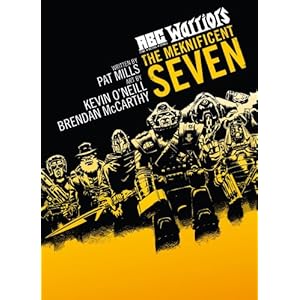
The ABC Warriors: The Meknificent Seven

What I try to do with reviews at this Bookshelf blog is keep it simple and spoiler-free, and let you know whether I'd recommend you pick up a copy of what I just read. Seems to work okay. This time, a brief review of The ABC Warriors: The Meknificent Seven (Rebellion / Simon & Schuster, 2010)


Among all seven gajillion or so of us who like reviewing "graaaaphic novels" and things on the internet, there's a subset who really enjoy the comic juxtaposition of elements that really occur best in the comic medium. Things like J. Jonah Jameson yelling at Godzilla, things like that. It still blows my mind that no publicist has sat these folks down, what with the big audience that they command, and shown them The ABC Warriors, a high-concept science fiction serial written by Pat Mills. It began in 1979 and new episodes have appeared every few years in the pages of 2000 AD. There's a bit in one of their earlier adventures, reprinted in this new American edition, in which war robots with bazookas ride around the deserts of Mars on the backs of tyrannosaurs.

Let me repeat that for the benefit of those not paying attention: ROBOTS WITH BAZOOKAS ON TYRANNOSAURS ON MARS. Drawn by Carlos Ezquerra. This is, in point of fact, the greatest thing to ever appear in fiction.

For those of you who haven't been paying attention, the ABC Warriors are a motley squad of war robots assembled in the waning days of a global conflict against the Volgan Empire. They include a cowboy robot, a sniper who communicates in bursts of letters and numbers, a Volgan general reprogrammed to obey allied commands but who retains his two-timing, traitorous nature and a shrouded, grinning maniac who puts that whole "sufficiently advanced technology indistinguishable from magic" business to the test. They are the coolest team of backstabbing, squabbling characters to appear in comics, and if they don't hypercharge your inner ten year-old, then you were obviously never ten.

The artwork on this initial series of 21 episodes was mainly provided by Mike McMahon, with guest appearances by Ezquerra, Kevin O'Neill, Dave Gibbons, Brett Ewins and Brendan McCarthy. About five years later, Alan Moore contributed the only episode of the long-running series that Mills did not write; it's illustrated by Steve Dillon and it makes its first appearance since its original outing in this new collection by Rebellion, distributed in the US by Simon & Schuster. The new book also includes a six-page framing story by Mills and O'Neill that originally appeared in Titan Books' old collection of this serial.

"The Meknificent Seven" has appeared in print many times before this, but the current edition is the first one aimed at mainstream bookstores, with the Alan Moore episode added as a sweetener for anybody wary about buying it again. It also includes a new foreword by Pat Mills and, as a supplement, five of the old "Fact Files" about the characters. These are really charming, and while the series has "grown up" along with its readers and more recent episodes are aimed more at adults, the "collect 'em all" nature of these pages reminds me that, once upon a time, this was the most awesome idea in kids' comics ever.

As I write this, the book has been out for about six weeks, and I'm a little concerned about the lack of publicity out there. I know that Mills was doing his usual awesome job of promotion in California last month, with signings at an area Barnes & Noble and an appearance at the San Diego Comic-Con, but somebody at Simon & Schuster really needs to start knocking down some doors to tell people that they're carrying these 2000 AD collections, and that they are fantastic. You can't rely on me; my audience is very small, and they almost never listen when I tell them to buy things. Get some review copies out, guys, because everybody in America needs to know that if they have a ten year-old boy in the house, or anybody else who remembers how hotdamned spectacular wild things like this were like when they were that age, then their house needs the ABC Warriors. Highly recommended.

Wednesday, July 14, 2010

Judge Dredd: The Restricted Files 01

What I try to do with reviews at this Bookshelf blog is keep it simple and spoiler-free, and let you know whether I'd recommend you pick up a copy of what I just read. Seems to work okay. This time, a brief review of Judge Dredd: The Restricted Files 01 (Rebellion, 2010)


I guess that every so often, things work out for the best. You probably know that Rebellion has been publishing a series of "Complete Case Files" for the long-running Judge Dredd feature. (The first of these was finally released in a special edition for the US market just last month.) These include the stories from the weekly progs and, from the most recent volume, the monthly magazine, but they have skipped the stories from Fleetway's old hardcover Christmas annuals and summer special issues.

Fans had asked at the time to have the annual and special stories added to the Case Files collections as bonus features, but only a handful trickled in. Finally, however, Rebellion has given the stories a two-book collection of their own. The first volume covers the first seven years of extra features from these specials along with stories from the 2000 AD, Dan Dare and Dredd solo annuals. After a pretty shaky start, there is some amazing material in the first book.

About the first quarter of the 400-page collection is really more interesting to archaeologists than to contemporary fans. While Dredd's stories were settling down into a single continuity orchestrated by John Wagner, the annuals were typically churned out by Fleetway editors with just a glance at the source material. Several of the stories are uncredited, and some of the artwork bears just a faint resemblance to the source material. There's a tale about a city called "Mega-Miami" which looks like the city in the 1970s with a future cop running around, and a deeply unfunny, early attempt at a "House of Tharg"-styled crossover where most of 2000 AD's characters of the first couple of years throw a Christmas party in Dredd's apartment. It looks like the artist, Keith Page, knocked those six pages out before lunch.

But a hundred pages in, we get to the point where Alan Grant takes a job with Fleetway editorial and Wagner takes an interest in what's going on with these books. The greatness starts with a Steve Dillon-illustrated episode from 1980 and doesn't waver after that. It includes dozens of fully-painted pages by Mike McMahon and Carlos Ezquerra, along with Brian Bolland's "The Alien Zoo," possibly the only example of Bolland coloring his own work.

Some of these Wagner and McMahon collaborations had been compiled by Titan in a 1985 collection, but most of the book has never been reprinted. One of this duo's stories is a 16-pager called "The Fear That Made Milwaukee Famous," and it's wonderful, simply one of the wildest, goofiest and most inventive adventure comics I've ever read. In it, Dredd rides out in the desert to apprehend a mutant criminal who really does not want to be called "Chickenhead" and the two of them are besieged by thousands of skeletal ghosts of a dead city. Elements of this amazing story would resurface in the creators' later Last American miniseries.

Packed as it is with so many inventive and clever stories, none of which outstay their welcome, it's difficult to point out the highlights or notable moments. Interestingly, John Byrne has a short story in here as well. At the time, the artist was very popular for his Marvel Comics' work inked by Terry Austin. I don't know that there are many other examples from the period of Byrne inking himself, but his line was altogether too heavy back then, as it remains today. On the other hand, Byrne drew a really impressive Mega-City One, and I think it's a shame he did not contribute again.

Byrne at his best, however, is a wholly different prospect than McMahon or Dredd's co-creator Carlos Ezquerra. His pages are really thrilling and full of life and wild, vivid color. The scenes of Dredd and Cursed Earth cowboys warring against giant tarantulas are really impressive, and nobody draws unbelievably obese men eating themselves sick as well as he does.

It's likely that the strange and ill-formed Judge Dredd of the book's first quarter might put off new readers, and so this might not be a good introduction to the character unless you know the circumstances and jump over those stories. Skipping past them, it's a very solid 300 pages of excellent comics at a reasonable price, around $30 in the US. The production is up to Rebellion's very high standards, and the artwork is reproduced very faithfully on very nice paper. It's a labor of love and exactly what the fans had hoped for, and I recommend it very highly.

Wednesday, June 30, 2010

Strontium Dog: Blood Moon

What I try to do with reviews at this Bookshelf blog is keep it simple and spoiler-free, and let you know whether I'd recommend you pick up a copy of what I just read. Seems to work okay. This time, a brief review of Strontium Dog: Blood Moon (Rebellion, 2010)


Since the great Strontium Dog returned to the pages of 2000 AD, its creators, John Wagner and Carlos Ezquerra, have been telling stories set at various points in Johnny Alpha's history. Their hero has been a bounty hunter since the end of the war for mutant rights, but in these two stories, set very early in his career, he's better known as a war hero than as a licensed agent for the Search/Destroy Agency.

"Blood Moon" and "The Mork Whisperer," originally serialized last year, shows Johnny working with more of the original gang of Doghouse regulars, including several not seen in the comic for about twenty years. They're set before he met his regular partner, the Viking Wulf Sternhammer, and when not only were all three of the nasty Stix brothers alive, but a cousin of theirs was causing trouble, too.

I believe that "Blood Moon" was the first comic art that Ezquerra finished with the the assistance of his son Hector on inks. They've been working as a team for eighteen months now on this series, Judge Dredd and one of the Battlefields miniseries for Dynamite, and the style's naturally a little different, but never jarringly so. Ezquerra remains one of the best artists in the business, regardless of who's inking him, and his designs for the oddball cast of mutants remains consistently entertaining and silly.

The vibrant, fun art effectively counterpoints a couple of downright grim adventures. "Blood Moon" sees a former colonel in the mutant army still able to inspire beyond the grave, and an interplanetary terrorist campaign waged against norms in his name. In "The Mork Whisperer," one of the galaxy's richest men hires Alpha to track down his estranged wife and mutant sons, but doesn't trust Alpha enough to do the job without surveillance. The former is certainly the more dramatic and action-packed of the two, but I quite like the cerebral pace of the second, and the way Alpha uses logic, ratiocenation and a little time travel to solve a complex mystery that involves android duplicates and mind control.

Honestly, singling out any Strontium Dog book is pretty tough. It's been one of my favorite series, consistently entertaining and very clever, for years. Wagner and the Ezquerras are currently working on a new story set after the reported death of Alpha in the 1990 epic "Final Solution." Two episodes in and it's so darn riveting I can't think straight. I'd highly recommend picking up this book, and then settling in with some digital copies of June's 2000 ADs so you can see where the creators are going next.

Saturday, March 20, 2010

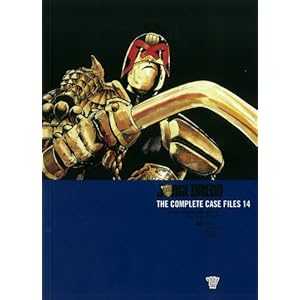
Judge Dredd: The Complete Case Files 14

What I try to do with reviews at this Bookshelf blog is keep it simple and spoiler-free, and let you know whether I'd recommend you pick up a copy of what I just read. Seems to work okay. This time, a brief review of Judge Dredd: The Complete Case Files 14 (Rebellion, 2009)


Judge Dredd isn't always the easiest series to follow, or for new readers to appreciate the complexities of the storylines. Most of the early material - particularly the stuff in black and white, often drawn by Bolland, McMahon, Smith, familiar to Americans through well-worn collections - stands alone very well, but while most of the color episodes - and there are a lot more of them - stand alone just fine, there's so much more pleasure to be found when you get used to all the lingering subplots that build through them. Case in point: "Necropolis," a simply amazing 26-part epic from 1990 by John Wagner and Carlos Ezquerra. This story's been collected a couple of times before, but to get the best effect, it needs to be read with the three months' worth of episodes which preceded it. Happily, this giant story is finally available in one collection. The fourteenth edition of The Complete Case Files compiles 38 episodes in one incredibly satisfying chunk of a book, and it's one everybody who loves comics should track down. It's one of Wagner's finest moments.

I think there's a strong influence from Chris Claremont in Wagner's writing at this time, particularly in the way that his 1980s work on The Uncanny X-Men would let subplots and background details grow over the course of several issues. Wagner, in time, became the master of this style of storytelling, and reworks it today better than anybody else in the medium. It's fascinating the way he finds old details from much older stories and brings them to vibrant life in his contemporary tales. About five years before "Necropolis," during the events of Judge Death's third attack on the city, there was a brief incident where the Dark Judges were teleporting throughout the city blocks, evading capture. Wagner revisits that, briefly, revealing that one woman was left in a partial coma by Death, his malignance influencing her behavior, and setting the stage for his powerful allies to break into this dimension.

"Necropolis" itself is just plain amazing. It starts with some very odd pacing, with the two Sisters of Death tormenting Kraken, a rookie who is entrusted (he sais, hedging his bets against spoilers) with Dredd's role while our hero is otherwise indisposed. The first two episodes are all action with very little plot development. But as events build, and Kraken comes under the Sisters' influence as well, the story becomes a taut, epic, page-turner. It's genuinely horrific - as events spiral into unbelievable carnage, some of the citizens' desperation will make your skin crawl - and it's all visualized in gory detail by Ezquerra, who, I believe, sets a 2000 AD record with 31 straight weeks of color artwork without missing a deadline.

This was the last hurrah for the Dark Judges as fabulous, frightening villains for the strip. Fear, Fire and Mortis were brought out of mothballs for a crossover between Judge Dredd and Batman about eight years later, and Death was periodically seen in ill-advised cameos and black comedy roles that turned him into a joke, before Wagner and Frazer Irving rehabilitated the character and gave him a great sendoff in 2004. When you read this story, however, you really wish they'd all been retired permanently, their impact undiminished.

Perhaps in retrospect, "Necropolis" did more harm than good, first by giving 2000 AD's editors at the time the idea that the characters of the Dark Judges could stand up to repeated (mis)use, and also by giving incoming writer Garth Ennis the idea that Dredd's big epic storylines needed to be bleak, carnage-filled apocalypses, leading to 1992's misbegotten "Judgment Day" saga. But taken on its own, it really was a triumph, and Rebellion's terrific reprinting in their Case Files series is one that every fan of British comics should own. Very highly recommended.

Wednesday, March 10, 2010

The Best of Battle

What I try to do with reviews at this Bookshelf blog is keep it simple and spoiler-free, and let you know whether I'd recommend you pick up a copy of what I just read. Seems to work okay. This time, a brief review of The Best of Battle (Titan, 2009)


Battle Picture Weekly was, of course, one of the best and most important comics ever published. It wasn't just a simply entertaining, well-written and drawn collection of great war stories, it was a critical building block in the development of modern comics. Since without it, you'd never have had a 2000 AD, I've always been interested in it, and any chance to see these terrific stories is one worth taking.

The series and serials in BPW were drawn by some of the best artists working in Britain at the time, including Eric Bradbury, Joe Colquhoun, Carlos Ezquerra, Cam Kennedy and Mike Western. Many of the stories were devised by Pat Mills and John Wagner, and while they only scripted a few themselves, they assigned others to the likes of Gerry Finley-Day and Alan Hebden. They all developed storylines, sometimes sharply different from each other in tone, with vulnerable anti-heroes, radically different from the indestructible leads in American war comics. Reading just one issue of BPW after an identikit Robert Kanigher DC adventure is the greatest breath of fresh air in the medium.

Titan Books, which has been collecting Battle's most lauded strip, Charley's War, for several years now, landed the reprint rights to several old IPC properties what seemed like an eternity ago, and late last year finally released the first of their new Battle collections. The Best of Battle is similar in feel to their two Roy of the Rovers samplers, three hundred pages of reprints in a slightly oversized format with a paperback cover. The book contains the first 3-5 episodes of eighteen different series. Each comes with an introductory page and a short blurb written by either Mills or BPW's one-time editor, Dave Hunt.

I think the format is a good one, as far as samplers go, but it looks to me like Titan was a draft or two shy of assembling something really special. The most aggravating example is Hold Hill 109, a six-part serial by Steve MacManus and Jim Watson. Four of the six episodes are included in this book, which is nice, but what are the odds that Hold Hill 109 will ever be reprinted anywhere else? Between Charley's War, Johnny Red and Darkie's Mob, there are 12-13 episodes which are either already available in Titan collections or are due for release within a few months. Couldn't eight of those pages be given up to see all of Hold Hill 109?

I'm also a little surprised that Battle Action Force isn't even mentioned in the book. Admittedly, even with the nice artwork by John Cooper, the toy line tie-in, sort of a parallel antecedent to Hasbro's G.I. Joe line of the 1980s, was the sign that the comic's brightest moments had passed, but it still has a huge number of fans. Evidently there's some rights issues at work, as Palitoy still owns those characters like Baron Buckethead or whoever it was they were fighting prior to Cobra Commander, but considering just how important the Action Force was to Battle's later days - Johnny Red and Charley's War wouldn't have made it to their ends without Action Force sales propping up the comic - I think it should have been mentioned.

If readers would forgive the regular quibbling of a Monday morning quarterback, the book is truly a fine introduction to Battle, and one which will certainly get new readers excited about the other material Titan has planned. Six volumes of Charley's War are already out, the first collection of Johnny Red should be with us by the end of the month, and a complete Darkie's Mob - all 44 episodes - is solicited in the current Previews for later in the spring. The book also promises that collections of two of my favorite Battle series, Major Eazy and Rat Pack, are on the horizon.

The only other quibble that I have is that getting accurate shipping dates and advance plans from Titan is really like pulling teeth. Most of their books seem subject to interminable delays - where the devil is the third volume of Jeff Hawke, guys?! - and so it's impossible to guess exactly when we'll get the follow-up volumes that I've been craving. It's simply bad business to serve up an appetizer as tasty as this and shy away from the main course!

(Excerpted from Reprint This!)

Thursday, August 27, 2009

The ABC Warriors: The Shadow Warriors

What I try to do with reviews at this Bookshelf blog is keep it simple and spoiler-free, and let you know whether I'd recommend you pick up a copy of what I just read. Seems to work okay. This time, a brief review of The ABC Warriors: The Shadow Warriors (vol. 6, Rebellion, 2009)


Earlier this year, Rebellion released the sixth collection of The ABC Warriors. This book, "The Shadow Warriors," contains the longest of all the Warriors' adventures thus far, an epic written by their creator Pat Mills and drawn by Carlos Ezquerra and Henry Flint. It originally appeared in three "books" between 2003-06, and since I'm looking forward to rereading the original episodes as they come up in the rotation (of my other blog, Thrillpowered Thursday), I just skimmed over the book to get a good feel for it.

Honestly, this collection is terrific. The artwork is, of course, wonderful. Ezquerra is one of 2000 AD's best art droids and he really brings a great, dirty sensibility to the dusty sandhole of the terraformed Mars. But when Flint takes over, things somehow get even better. There's a genuine "shock of the new" feel to Flint's episodes, as our heroes' new, imaginatively-designed foes take center stage and the weirdness factor gets ramped up to ten.

Skimming this volume confirmed what I felt about it upon its release: that the Guv'nor was back in town and ready to kick ass and take names. We'll come to this point in Thrillpowered Thursday in a few months, but it's clear that Pat Mills' time away from the comic, during which he created Requiem: Vampire Knight for his French publisher, recharged his batteries to full. The 2003-model Mills was not the same droid as the one from the 1990s. Here, it's one wild idea after another, no preaching, no stagnation, just a constant escalation of mad plot devices and vibrant characters. If the previous few ABC Warriors collections had been frustrating for one political reason or another, then this is the one to get.

It's every bit as wild and excellent as it was when Ezquerra had last drawn the title in 1979, and the robots were riding on the backs of tyrannosaurs, armed with bazookas. This is that Mills - the one with the turbo-charged imagination creating physics-defying freakiness and making downright excellent comics. I strongly recommend you check this book out! (And keep an eye out for more about Requiem: Vampire Knight here in a couple of weeks!)

(Excerpted from Thrillpowered Thursday.)

Monday, May 11, 2009

Battlefields: The Tankies

Here's how this works. I read a book or two and tell you about them and try not to get too long-winded. This time, a review of Battlefields: The Tankies # 1 (Dynamite, 2009).


Since DC finally balked at publishing his over-the-top superhero satire The Boys, Dynamite has become the de facto home of writer Garth Ennis, who's lately been paying tribute to the British war comics of his youth with a number of three-issue mini-series tackled by different artists. Since I'm a huge fan of Ennis's frequent collaborator Carlos Ezquerra, I decided to give this one a try. Sometimes their work together is pretty wonderful, sometimes it's a little unsatisfying, but the art's guaranteed to be nice. Dynamite seems to be offering each of their mini-series in two formats: three $3.50 issues or a skinny $12.99 book that collects the singles. That's a little high of a price point for something so thin, no matter how much I like the Ezquerras' artwork.

Earlier this year, Carlos's son Hector took up his pen as inker for his dad's work, starting on a completely wonderful new Strontium Dog serial in 2000 AD called "Blood Moon." The Ezquerras continue their collaboration in this story of a no-nonsense Geordie tank commander ("You name it, an' ah've baled oot o' the bastad.") who tries to get an armored division back on course to relieve infantry in France, 1944. Meanwhile, after a German POW turns a pair of scissors on a medic, orders are given to execute all surrendering jerries until further notice.

It's over-the-top and gory and foul-mouthed as you might expect, and I think it's unfortunate that Ennis chose to not rein in the shocks while scripting something much more layered and mature than the comics of his childhood. The plot itself is more adult than most of what used to appear in the pages of Battle Picture Weekly and Warlord; the grim violence simply isn't necessary. This isn't at all a bad comic, and I look forward to the next two parts, but it's markedly less interesting than his wonderful take on Battler Britton from a few years ago, which, you'll note, wasn't punctuated with decapitations and legs burned to the bone. Recommended for older readers.

Thursday, April 16, 2009

Judge Dredd: The Pit

Here's how this works. I read a book or two and tell you about them and try not to get too long-winded. This time, a review of Judge Dredd: The Pit (Rebellion, 2009).


In January, Rebellion released the long-awaited collection of the 1995-96 Dredd epic "The Pit." This 30-part epic, written by John Wagner and illustrated by Carlos Ezquerra, Colin MacNeil, Lee Sullivan and Alex Ronald, was the subject of a Thrillpowered Thursday entry back in 2007, where I explained it as a "change in the status quo that sees Dredd assigned to new duties in one of the Meg's remote regions, where rather than doing the job of a senior street judge, he's assigned to the task of sector chief. It turns out that the Dredd formula works incredibly well as an ensemble police procedural, which was a huge surprise to everybody, including the writer."

"The Pit" is remembered, not because of an outrageous, high-concept plot like many of the big epics of the series, but because Judge Dredd lends itself astonishingly well to overlapping subplots and unique, individual judges with their own perspectives on the proceedings. It's an important story which introduced two of the more interesting recurring characters of Dredd's modern cast, Judges DeMarco and Guthrie, as well as providing further details about the criminal Frendz organization which would be an ongoing menace for the next few years. The entire cast is made up of interesting, sympathetic characters, and as events wind their way from a search for a rogue undercover "Wally Squad" judge to an all-out war with a powerful mob kingpin's forces, through a sector house full of flawed cops trying to do their jobs, it's easy to get completely caught up in events. It's a terrific story, with fabulous contributions from some great artists.

Long overdue for this new edition, "The Pit" has been unavailable for quite some time, since Hamlyn's old version went out of print, and Titan, the next company to issue collected editions, never put their own together. This is one that Rebellion should definitely keep around, and promote to new readers as a fine introduction to Judge Dredd. Whether you're new to the character or an old fan, "The Pit" is certainly a story that every bookshelf should have.

(Excerpted from Thrillpowered Thursday.)

Thursday, January 22, 2009

Strontium Dog: The Kreeler Conspiracy


In other news, Rebellion has continued its series of Strontium Dog collections with The Kreeler Conspiracy. This follows up the five-volume "Search/Destroy Agency Files" which reprinted the entirety of the original run of the series. This book, unnumbered on its spine, reprints three of the first four adventures from the revived series. It starts with the titular "Kreeler Conspiracy" (mentioned here in Thrillpowered Thursday a couple of weeks ago) and also includes the very fun serials "Roadhouse" and "The Tax Dodge." Lost in the shuffle, sadly, is the one-off adventure "The Sad Case," which originally appeared in Prog 2001, and was presumably left behind for space reasons, and which we hope to see in a future collection.

Despite that story's absence, the book's a fun, meaty little exercise in plotting, as Johnny Alpha and Wulf Sternhammer face challenges that require them to use their wits more than their firepower. "The Tax Dodge" is especially fun, as the bounty hunting duo are faced with a representative of customs and excise on one side, and a very amusing alien race on the other. These guys, easily-offended, overcompensating loudmouths with quick tempers, are among the funniest alien species to ever appear in 2000 AD. All three stories are by John Wagner and Carlos Ezquerra, and this book is very highly recommended!

(Excerpted from Thrillpowered Thursday, January 22, 2009.)

Friday, October 3, 2008

Needs More Ezquerra

Here's how this works: I finish reading something, and I tell you about it, and I try not to bore you to death. This time, reviews, of sorts, of Preacher: Ancient History (DC/Vertigo, 1998) and Strontium Dog: The Final Solution (Rebellion, 2008).


As I mentioned in Thrillpowered Thursday a few months back, I really don't enjoy Garth Ennis's Preacher and its uncensored, over-the-top brutality and ugliness, despite its wealth of incredible ideas. However, I decided to give a used copy of this a try to get even more Carlos Ezquerra on my shelves. The book compiles a mini-series and two lengthy special editions which tell stories of some of the main title's supporting cast. The mini-series looks at the violent history of the Saint of Killers, the first special gives us the pathetic origin of the tragic Arseface, and the last story recasts the loathsome Jody and T.C. as protagonists in a parody of an action film.

Steve Pugh is not my favorite artist, but he is perfectly suited to the violent western tale of the Saint and the incident that sent him to Hell. Pugh illustrates the first two episodes and they're fantastic, a studied mix of Western tropes and ideas that suggests he and Ennis would be well-matched on Jonah Hex. In episode three, the Saint awakes on the road to Hell. Ezquerra illustrates this episode, and man, does he ever bring his A-game. With the story now shifted from pulp Western to myth and fantasy, Ezquerra turns in some work that's so amazing that when Pugh returns for the final part and the return to the mortal world, it's an unfortunate and unfair disappointment. Still, it is a great story.

Arseface's tale, illustrated by Richard Case, is an oddly affecting parody of mid-90s suburbia, with outcast teens, uncaring parents and rock and roll. I'm not certain whether the story needed to be told, but I really enjoyed reading it, and any chance to see Richard Case at work is worthwhile. Ezquerra returns for Jody and T.C.'s story, and it's played for laughs. You can't call these two monsters "heroes," but the clever recasting of roles lets the superhumanly powerful jerks take control of a spiralling, ridiculous situation while Ennis mocks the tropes of modern action thrillers. If you enjoyed Ennis and Ezquerra's work on Adventures in the Rifle Brigade, you'll probably like this one.

Overall, I ended up preferring these escapades to the one in the main Preacher storyline. The collection is very reasonably priced, and the Saint of Killers story is so darn good that everybody should see it, regardless of your opinion of Preacher. Recommended for mature readers.


The story goes that in the late 80s, as the fight for creators' rights hit British comics, some of 2000 AD's talent and editorial and publishers all began crossing swords over royalties and loyalties, and it was decided that one of the comic's most popular features, Strontium Dog, would be cancelled and its lead character, the bounty hunter Johnny Alpha, killed. It was a traumatic event for many thousands of readers - see episode 2.6 of Spaced - and one which Alpha's artist and co-creator, Carlos Ezquerra, declined to draw, electing instead to work with Pat Mills on Third World War in the new biweekly Crisis. So Johnny's concluding storylines were taken over by writer Alan Grant and up-and-coming artist Simon Harrison.

There is probably a very good story in the mammoth, 28-part "Final Solution," but Harrison's artwork is so incredibly unappealing that we can't swear to that. To his credit, he's a novel and inventive artist, full of energy and the shock of the new. On the other hand, his anatomy and his faces are so poor, and his storytelling so confusing, that what could have been a great tale of Great Britain finding a terrifying solution to "the mutant problem" becomes a chore to decipher. It's a tragic missed opportunity.

At the time, "The Final Solution" was an even greater chore, as Harrison's workload only allowed him sporadic opportunities to complete the art, and his 23 episodes were printed in four chunks over the course of a year. There followed a thirty-week (!) break before the great Colin MacNeil was drafted to complete the story. So the last part of this epic looks remarkably superior to the first 100-odd pages. Rebellion has assembled the story in a very nice package along with three bonus episodes from old annuals and specials, including the incredibly fun story in which Alpha tries to collect a couple of bounties in Mega-City One under Judge Dredd's nose, but while it is nice to have a complete set of the original series in such nice editions, really, the only thing this book proves is that Strontium Dog without Ezquerra is like a day without sunshine. Recommended for completists.

(Originally posted October 03, 2008 at hipsterdad's LJ.)

Friday, April 11, 2008

Mutant Bounty Hunter edition with Strontium Dog and Durham Red

Here's how this works: I finish reading something, and I tell you about it, and I try not to bore you to death.


Absolutely triumphant. There's a reason this is one of the Eagle Award nominees for best reprint volume of '07: it's absolutely the work of three creators at the top of their game, telling brilliant stories with a mix of lighthearted wit and downright mean energy. Wulf Sternhammer's death really was a shock at the time; what's even more shocking in retrospect is the impact it has on Johnny Alpha, who becomes a taciturn, vengeance-driven monster for many episodes thereafter. The revenge he takes out on Max Bubba is the sort of thing that superhero funnybooks just wish they could get away with. Highly recommended!


This is the last of a three-volume series telling the story of what happened to the sexy vampire bounty hunter Durham Red several centuries after she was last seen as a supporting character in Strontium Dog. It never really sparks, suggesting it would have worked better as two books rather than three, although Mark Harrison's art is never less than interesting.

What really makes this collection shine is the inclusion of the seven episodes of "The Scarlet Apocrypha," in which Dan Abnett reimagines the character in seven very different scenarios, with seven very different artists, throughout history and fiction. Only one doesn't work - Steve Kyte's Japanese animation parody is just stupid - but some of these are downright excellent. John Burns really shines depicting Red in the setting of a 70s Italian horror film, and Enric Romero has fun putting her up against Count Dracula. Steve Yeowell, Frazer Irving and Carlos Ezquerra also contribute great installments before Harrison returns with a fascinating, dense and fun story drawn in a completely different style from his standard - an imitation of Mad's Mort Drucker! - and set at a science fiction convention in a world where Durham Red movies have been sci-fi staples for decades. It's very fun stuff, and, packed as it is with background notes and production artwork, it's a package I have to recommend, even though the lead story left me a bit cold.

(Originally posted April 11, 2008 at hipsterdad's LJ.)