Showing posts with label steve yeowell. Show all posts

Tuesday, April 7, 2015

Zenith Phase Three

What I try to do with reviews at this Bookshelf blog is keep it simple and spoiler-free, and let you know whether I'd recommend you pick up a copy of what I just read. Seems to work okay. This time, a brief review of Zenith Phase Three (Rebellion, 2015).


There's a bit very early on in the third, longest, and very best of the Zenith adventures which lets readers know what they're in for, and which might - with the right cultural background - be one of the all-time best cliffhangers in comics. Grant Morrison has always been really amazing with cliffhangers, but he set the bar really high when Zenith, his spoiled brat of a pop star with super powers, opens the door of his apartment and Robot Archie, the star of a long-running but mostly-forgotten clunky old kids' adventure, is standing in front of him bellowing "ACIEEED," which was the catchphrase of a hit dance song of the day that has also mostly been forgotten.

So in 1989, you had this twenty year-old robot everybody forgot about shouting along to a dance song earworm by D-Mob that everybody reading the comic couldn't get out of their head, and readers of the far-flung future of 2015 are now seeing a forty-five year-old robot mostly known to the world from his appearance in this particular comic, shouting along to a "you had to be there" one-hit wonder, and yet it's strangely still compelling and ridiculous. Even not knowing the pop cultural touchpoints, you can see that there's a contamination of Things That Should Not Be standing at Zenith's door. It could have perhaps been the Robot from Lost in Space singing "I'm Too Sexy" and we'd recognize it a little better, but hate it for its garishness. Robot Archie, instead, points the way toward the secret history of comics that unfolds over the next 140 pages, a glorious epic that swallows the narrative and leaves Zenith a supporting player in his own story.

"Phase Three," also known as "War in Heaven," originally appeared in 26 episodes across nine months of the Galaxy's Greatest Comic, 2000 AD in 1989-90, and has newly been released in a lovely hardback edition for the first time. It's an incredibly fun story which draws its inspiration from DC Comics' ongoing use of parallel universes and superheroes from other timelines all working together to beat some impossible threat. That's what happens here, with long-forgotten characters from older kids' comics all banded together for the first time to save the Multiverse. Some of them have been tweaked a little - "Big Ben" is a moody, Soviet version of the cowboy Desperate Dan - and some, like The Steel Claw, The Leopard of Lime Street, Electroman and Electrogirl, came straight from the 1960s intact. The result was thousands of readers raising their eyebrows in surprise, learning that once upon a time, there were indeed superhero comics in England.

At the same time this was running, Morrison was actually working in American superhero books for the first time, writing Animal Man for DC and exploring many of the same themes, as Animal Man ran across forgotten characters like Sunshine Superman and the Green Team from long-discarded and "unimportant" old comics. It's downright criminal that "War in Heaven" has been out of print for so long, because the similarities between the stories are really amazing. Animal Man has been dissected and praised for such a long time, and for readers to finally get to play compare and contrast with how Morrison approached the concepts for each publisher from nice bookshelf editions is long overdue.

It's a heck of a fun story, with so many superheroes - most of them are not named, and a heck of a lot of 'em get killed off, so there's not a lot of point in slowing down and trying to figure out who's who - at work against impossible odds, and Zenith, smugly thinking this all looks like a convention for pervs and leather fetishists, not taking things seriously until the body count rises. The story is admittedly dated somewhat by the grisly narrative and fates for some of the characters. It's one of many (many) superhero stories to take inspiration from earlier works by Frank Miller and Alan Moore that depict the "realistic" take on what would happen if super-strong people actually punched each other.

The story's illustrated by Steve Yeowell with buckets and buckets of black ink. Many years later, I'd be among many who complained about the sparse inking of Yeowell's The Red Seas. That's probably because we were spoiled by these incredibly dense pages, with so much excitement going on, deep shadows and detailed linework. It's just a huge pleasure to look at the angular, sometimes abstract work in this comic, and not just because you want to play the incredibly silly and fun game of identifying all the characters. The collection's also got a one-off tale featuring one of Zenith's co-stars, Peter St. John, that's illustrated by Jim McCarthy.

Over the last couple of years in 2000 AD, they've been resurrecting some of their old properties like Ulysses Sweet and Orlok for new adventures and making them semi-regulars in the comic. The nicest compliment that I can pay "War in Heaven" is that it's impossible to read this and not ask where in the hell the publisher's put the Blue Wizard and Oakman series that damn well should have appeared by now instead of Yet Another Rogue Trooper spinoff. Happily recommended.

A PDF of this book was provided by the publisher for the purpose of review. If you'd like to see your books (typically comics or detective fiction) featured here, send me an email.

Thursday, September 25, 2014

Zenith Phase One

What I try to do with reviews at this Bookshelf blog is keep it simple and spoiler-free, and let you know whether I'd recommend you pick up a copy of what I just read. Seems to work okay. This time, a brief review of Zenith Phase One (Rebellion, 2014).


I keep telling myself that I should go back and update my old Reprint This! blog. For about three years, I was very interested in seeing some older, out-of-print comics repackaged, and got a kick out of championing these old properties and introducing new readers to them. Eventually, I let it turn into a chore instead of something to touch upon once in a while, and now I have too many other things to do than go back and update all the entries. Miracleman's back in print. So's Shade the Changing Man, and Black Jack, and Stainless Steel Rat, and Tales from Beyond Science, and lots of other things that were on my old wish list. And now, holy anna, Zenith by Grant Morrison and Steve Yeowell. (Here's what I had to say about it at Reprint This!.)

Last year, Rebellion dropped a limited edition brick with the entire series in one huge hardback. Just a thousand copies. In a PR world, this was a terrific idea. It got lots of people talking and paved the way for this four-book series, the first volume of which is out in a couple of weeks.

Zenith is a superbrat celebrity. In the world of this comic, the British government experimented with super-powered soldiers during World War Two, and, after the Allies concluded the unpleasantness by dropping an atom bomb on Berlin, began tests on pregnant volunteers. These children grew up to be short-lived celebrities in the 1960s before some of them lost their powers and some vanished and some died. Zenith is the only second generation human with powers. His mom and dad were killed in what was said to have been an accident in France nineteen years before. And their son? Well, in 1987, he thinks he has some musical talent and he thinks all his parents' boring old friends have got on with their lives, and all he cares about are getting his face in the papers and smooching cute starlets. Saving the world isn't part of his game plan, but when the Nazi supervillain Masterman reappears - he was the reason the Yanks bombed Berlin - not having aged a day since '45, he's got to get his act together quickly...

Zenith was Grant Morrison's first ongoing series and, perhaps despite the writer's protests to the contrary, it does clearly show more than a little influence from Alan Moore's Watchmen. Like that earlier story, it is a "real world" or "realistic" superhero adventure set in a universe where some alternative history has banged everything on the head, and, like that earlier story, the events affecting the present-day characters are influenced by a very large cast from the past, many of whom we only hear about in passing. In other words, Morrison had to design a very detailed backstory to make the present-day adventure work, but it works just beautifully.

The story is absolutely wonderful, and, unlike quite a lot of Morrison's later books unfortunately, it's clear and straightforward and still rewards rereads with lots of foreshadowing and hidden double-meanings, and the artwork by Steve Yeowell is just sublime. There were four long-form Zenith stories, along with four "interlude" one-offs, and a one-shot that appeared nine years after 1992's finale. This new hardcover collection includes the first storyline, or "phase," along with the first two interludes and several pages of character sketches by Yeowell and by Brendan McCarthy, who had done some early design work on the series. It's very nice to see this terrific series given such a nice collection at last. It shouldn't be missed. Highly recommended.

Saturday, February 12, 2011

The Invisibles: The Invisible Kingdom

What I try to do with reviews at this Bookshelf blog is keep it simple and spoiler-free, and let you know whether I'd recommend you pick up a copy of what I just read. Seems to work okay. This time, a brief review of The Invisibles: The Invisible Kingdom (volume six) (DC, 2000).


This book remains a massive disappointment to me. About two-thirds of it are absolutely blinding, some of Grant Morrison's very best work. And then we reach the climax and it is a complete mess. Most of the time, Morrison handles his finales incredibly well. This is one of those rare instances where he fumbles at about the two.

This last book of The Invisibles is the longest, reprinting the series' final twelve issues. It's set a year after the events of volume six, and starts with the three operatives of Division X, last seen in book three, finally making a break in their investigation of Sir Miles and the royal conspiracy. However, what these super-agents don't know is that Mr. Six is in league with the opposing, Invisibles conspiracy. Things spiral crazily out of control as King Mob, Jack Frost and Lord Fanny return to England and one member of Division X - the one who bases his persona on John Thaw's character from The Sweeney - is kidnapped and wakes up in a burning wicker man...

Actually, that this incident is set almost two and a half years after the last Division X episode just drives home what an amazing, parallel, series we missed while the focus was on the main characters. If Grant Morrison and Philip Bond, who illustrated these four episodes, would reteam for a good twenty issue run with Division X, I would buy the hell out of that series. Forget the conspiracy and the metanarrative, I just want to see these guys busting heads and having weird adventures.

So the first third of the book, drawn by Bond, is amazing, and the middle third, drawn by Sean Phillips and centered on 99 year-old Edith Manning, is transcendent. The installment where Edith, having come to India to die, spends her final hours with King Mob, is one of the most brilliant things that Morrison has ever written. Reading it again brought new tears. It's absolutely heart-hammering work, and the tiny flashes from ten years previous, with a younger, twentysomething King Mob looking for some kind of meaning, looking at the river with The Smiths on his walkman, about to have his life upended by an eighty-nine year-old lady who met his future self in the 1920s, suggest just how wild and amazing Doctor Who could be in Morrison's hands. (You think time is wibbly-wobbly when Moffat writes it?)

And then things fall apart.

A big part of the problem is Morrison's decision to let a freaking pile of artists jam on the climactic issues, resulting in a schizophrenic mess, and key, critical moments undermined by huge shifts in style. The absolute worst moment comes when King Mob phones the old girlfriend that we met briefly in book five. She gradually realizes that he's been very badly injured as, going into shock, he starts reliving a childhood memory of the last episode of a kiddie puppet show. Steve Yeowell draws the sequence, and does it brilliantly. I'm a huge fan of Yeowell's, and this might be one of the best things he's ever done. But then it's completely ruined by giving the climactic page of the sequence to Rian Hughes. Normally, I'm a big fan of Hughes, but this splash page is so jarring a shift in style that it doesn't look like it belongs in the same comic at all. It looks like an ad for British Telecom.

This keeps happening, with key moments either interrupted by a change in artist, or assigned to artists who make a complete hash out of things. Characters change their appearance every few pages, even in the middle of scenes. Yeowell and John Ridgway are the only participants in these pages who seem like they have a handle on even how to stage some of the action. There are others who don't look like they should have been let near a mainstream adventure comic at all, let alone one as challenging as this. There's a parallel universe where I'm filthy, stinking rich, and in that reality, I've commissioned Yeowell to redraw everybody else's bungled work and make it look consistent and good. (Parallel-me has also hired Cameron Stewart to redraw all the godawful art of Morrison's JLA, and hired Tony Harris to do the same to Morrison's run on Batman. Don't you wish we could have those comics?)

But while the art jam is a big problem, the script really is a bigger one. On the textual level, the villains' plans have completely stopped making sense - it all seems to be built around coronating a squishy tentacle monster as the new King of England, for some reason - and the Invisibles are going to stop it by doing something, and Sir Miles has been disavowed but suddenly he's back at the reins of things. Divorced from the subtext, it's just a rotten piece of drama, with confused motivations, and once a reader puts the fractured narrative into a linear sequence to understand it, it still doesn't resonate because it's incomprehensible sludge with too many characters.

But the subtext, the suggestion that there's much more to this work of fiction than we can see, completely overwhelms what's going on, and that's why The Invisibles fails right at the end. It's been previously hinted that the events of books one through six were the events that Ragged Robin wrote in a book, and then, rather than traveling back in time to experience as we were told, she actually entered her own fiction and interacted with her characters. By the end, we've added another layer of metatext and pseudoscience, that even Robin's participation was just part of a larger game, that basically people ten or twelve years in the future who read New Scientist every month have built a video game called The Invisibles which features a character who thinks that she wrote The Invisibles, who participates in the events described in her fiction, and, through the use of fiction suits (which people used to just call "writing yourself into your story," and sneered at), other... people... do... too?

The narrative is lost in this. Fiction, even complicated fiction, is most effective when the reader can enjoy the narrative at one level without being sledgehammered by the complex ideas of the other levels. The big climax here is one where both the structure and the meaning are intentionally obscured by the subtext, by the fractured style of storytelling, and by the poor mix of artists, who mishandle the material. It is a massive disappointment as well as a breathtaking experiment, and honestly, while having the whole thing drawn by Yeowell would improve things, as long as we're fantasizing, I think I'd still rather see a Philip Bond-drawn Division X series than bother. Recommended, but only because the first two-thirds are completely amazing, and readers can stop reading when the Sean Phillips artwork wraps up and have a fine experience.

Monday, January 24, 2011

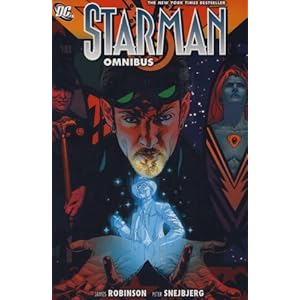
Staman Omnibus Volume Five

What I try to do with reviews at this Bookshelf blog is keep it simple and spoiler-free, and let you know whether I'd recommend you pick up a copy of what I just read. Seems to work okay. This time, a brief review of Staman Omnibus Volume Five (DC, 2010).


Well, I suppose that these had to hit a bump in the road eventually. As much as there is to love about James Robinson's Starman series, which originally ran from 1994 to 2002, there is the unfortunate, and very long, storyline "Stars My Destination," in which Jack Knight goes into outer space on a wild goose chase, hoping to find one of the previous, believed-deceased heroes to use the Starman name. This one, sad to say, gets a little tedious.

I'm not sure why this one never really worked for me, but it just feels endless. It's a series of episodic adventures on various planets, with Jack and his companions running into various other DC superheroes, but the journey never really engaged me as a reader. At the time, it felt like an agonizing wait, with the much more thrilling subplots back on Earth sidelined for far too long.

Once Jack does reach his destination, it really does feel like a mammoth cheat. There's a big battle in the company of some mostly forgotten characters, and Jack rises to the occasion beautifully, and there's a heck of a good twist just when things start looking good for our heroes, but the climax of the quest, which, eye-rollingly, involves four separate heroes who have called themselves Starman, doesn't see the triumphant return that readers will expect. It all ties together in a silly confluence of disparate trademarks, and while they do find the long-missing Will Payton and a happy ending is assured, it's almost like Robinson went out of his way to blow a raspberry at anybody waiting through all this business for the sake of funnybook continuity.

The storyline was the first without longtime artist Tony Harris, who co-created the series. After a few months of fill-ins, mostly by the terrific Steve Yeowell, a new artist, Peter Snejbjerg, takes over. To be fair, Snejbjerg's work is consistently very good and he hits the ground running with a lot of crazy demands from the scripts, but his episodes just aren't as vibrant to me as Yeowell's. Rereading this book, particularly a story where Jack and Mikaal run into Solomon Grundy, of all people, on a blue planet, just makes me wish that Yeowell had become the title's regular artist. Whatever your own preference, this is definitely a gorgeous book. I just can't help but wish Robinson had got to the point a little quicker.

The first four books in the series were all really great, and this one is merely pretty good, drawn well and with a wobbly ending. Still, with that business out of his system, the next thing Robinson would do with Starman would be the amazing "Grand Guignol" epic and the beautiful and tragic "1951" coda, available in the final book, which was released just this past week. Rereading all of "Stars My Destination" may occasionally be tiresome, but I'm reminded that the best Starman story was just a month or two away. Recommended for people who've made it this far, or for Steve Yeowell's fans.

Friday, November 19, 2010

The Invisibles: Entropy in the UK

What I try to do with reviews at this Bookshelf blog is keep it simple and spoiler-free, and let you know whether I'd recommend you pick up a copy of what I just read. Seems to work okay. This time, a brief review of The Invisibles: Entropy in the UK (Volume Three) (Vertigo, 1996)


So I've been rereading Grant Morrison's late-90s series The Invisibles and I had completely forgotten what a bear the third book in the series of seven is. It isn't at all bad, and compiled in one volume it's not too great a chore, but when this was first published, it really was an exercise in testing readers' loyalty.

At the end of the previous volume, two of our heroes had been wounded and captured by the enemy, a grand conspiracy of the British gentry with interdimensional beasties. Remembering that this was a monthly comic, there followed three issues where Sir Miles tries to break down the psychic defenses of his captive, King Mob, and get through an elaborate series of defensive fictions to find his identity and origin. Then there were two one-off chapters looking at the other characters before the protagonists and their allies reassembled to rescue King Mob. This took eight months in all. I really wanted to love this series, but this was a period where it was really trying my patience. It reads much, much better over the course of one week.

That said, the second half of the rescue story is really among the most challenging scribblings from Morrison's pen. Legend has it that the writer was suffering from a massive infection that nearly killed him at the time, and much of the narration reads like a fever dream. This is apparently one of several moments in the series where the fiction he was writing started influencing the reality of his life, and it's interesting to see how the story begins with Sir Miles and his associates injecting King Mob full of toxins to induce cellular breakdown and organ failure, and see how this creeping degeneration impacted Morrison himself.

Some of the visuals in the second half are a little disappointing. No matter how much I typically enjoy Steve Yeowell's artwork, there's no denying that he really was up against one of his biggest artistic challenges with some of the lost-in-a-void magic business of the story. Sad to say the result looks pretty flat and dull, particularly when weighed against the vibrant opening chapters by Phil Jimenez, the breaks by Tommy Lee Edwards and Paul Johnson, and a really terrific epilogue by Mark Buckingham.

This last chapter really renewed my interest after the previous challenging months had sapped it somewhat. It's a one-off which reveals that the schoolteacher from the series' first episode, who was later revealed to be a deep-cover Invisible with the code name Mr. Six, has a triple-identity as a government agent. He's one of three paranormal investigators in a recently-reactivated team called Division X. Continuing the Invisibles' theme of tapping into British media as visual inspirations, Mr. Six dresses like the '70s TV detective Jason King, and his colleagues resemble Regan and Carter from The Sweeney. They have a weird and wild case which visits a casino and uncovers a pornography ring for fetishes involving aliens and royals, and meet a very curious dwarf called Quimper.

I remember loving this episode so much that, when the monthly series took a brief hiatus before relaunching as a second volume, I would have been perfectly happy to see the back of the difficult-to-love Invisibles in favor of an ongoing Division X series. Fortunately, the more straightforward scripting and wild surface action of this episode would point the way to how The Invisibles would be handled in the future, and the Division X characters would be seen again. It's a good set of stories, albeit quite dense in places, and it just left me hungry to start volume four soon. Just, you know, after a short break.

Wednesday, September 15, 2010

The Invisibles: Say You Want a Revolution

What I try to do with reviews at this Bookshelf blog is keep it simple and spoiler-free, and let you know whether I'd recommend you pick up a copy of what I just read. Seems to work okay. This time, a brief review of The Invisibles: Say You Want a Revolution (Volume One) (Vertigo, 1994)


In the cold light of day, this is... a very, very flawed book. It's a story where I found myself apologizing for a full half of its contents for many years, assuring newcomers that it's "difficult" but it improves tremendously. That's not quite true. While Grant Morrison's Invisibles indeed improves hundredfold and presents some completely amazing stories by the time it winds its way to a remarkable conclusion in its seventh volume, this first book is more than difficult, it's a downright painful slog. Half of it is pretty good, a quarter of it is okay, and the last quarter is the pits, just dire. If I ever told anybody - oh, hell, I told many - to start reading The Invisibles with this book, I don't need to apologize for the story, I need to apologize to them.

That said, The Invisibles was a comic series written by Grant Morrison for DC's Vertigo imprint from 1994-2000. It ran for 59 issues which are collected in seven trade paperbacks with wildly divergent designs and no sense of uniformity, which I can't stand in book series. I suppose that puts me on the side of the villains in this tale. The Invisibles are a secret society of anarchists and chaos magicians who have been waging an underground war against... well, here it falls down a bit. Would it help if I explained that the villain in this comic is the same villain as in the TV series The Prisoner?

Mentioning The Prisoner is important, because much of The Invisibles' iconography is informed by British culture, particularly television culture. There are bits later on where we meet characters who are, effectively, Jason King and Detective Inspector Jack Regan, and a key moment in episodes two and three of the first story, involving baddies dressed like fox hunters, is pulled from the Avengers episode "Escape in Time." (The Invisibles is hardly the first comic series to pilfer Peter Wyngarde and Diana Rigg; just ask the Hellfire Club.) The first issue of the series, in which Dane McGowan rebels against his boring Liverpool life and vandalizes his school, features a teacher who echoes "Mr. Liberal" from a celebrated Grange Hill parody.

So there are lots of references which will appeal to fans of British TV, but readers unfamiliar with these programs will have a tougher time finding an entry point. Morrison structures this story in a very unusual way; the result is pretty tough to wade through. Having identified Dane McGowan, for some reason to be explored later, as their latest recruit, a British-based cell of magic-using terrorists and freedom fighters has to break him out of a sinister prison - slash - reindoctrination center and leave him on the streets of London for a few days in the company of a homeless magician. He gives Dane a crash course in a new philosophy before the cell is ready to take him on for his first assignment: traveling back in time to the Reign of Terror to rescue the Marquis de Sade from evil Cyphermen and bring him to the present.

To say that Morrison throws readers in the deep end is an understatement. The readers' identification figure, Dane, is a completely unlikeable jerk and most of the rest of the core cast don't even get introduced properly until halfway through this book and then this first mission is... well, it's a narrative mess and a huge miscalculation. That's a shame, because the series starts out pretty strongly, albeit uncompromisingly densely, before derailing.

The first four of the eight issues here are illustrated, gloriously, by Steve Yeowell. They contain some really amazing moments which are worth revisiting, and the fantastic way that Morrison uses foreshadowing and flashbacks means that readers who stick with the series do get to revisit them in surprising ways. There's a beautiful scene where Dane and his homeless mentor, Tom, are on a swingset and Tom sees a couple dressed in 1920s period clothing arguing. There's another great moment when a riot squad finds a grenade without a pin, and the whole series at its best is like this, a memorable story punctuated by unforgettable moments.

Yet "Arcadia," the four episodes illustrated, not as gloriously, by Jill Thompson, presents a mess that's far more dense than the story which preceded it, without the punctuations. The Cyphermen are groovy villains - like the Sheeda mentioned in this blog earlier this week, Morrison seems to specialize in creating Doctor Who villains for other projects - but the Invisibles' objectives in this story are muddled and unclear. Thompson's artwork - I won't criticize it overmuch as she's since developed into a quite remarkable painter - lacks the dynamics necessary to keep the events punchy, although she does create a really memorably grotesque image in the head of John the Baptist being used to power some phantasmagorial machine.

The problems here are mainly down to Morrison, who fails to sell what the purpose of the excursion is, and, among other things, what the darn head is doing as part of the narrative. While Morrison remains one of the most wildly imaginative voices working in comics, and often the most entertaining, he's inconsistent, and once in a while drops the ball badly when pacing a story's structure. During the climax of episode eight, bringing most of this book's events to some kind of resolution, Dane and his ally Lord Fanny are desperately fighting off an assassin in a fast-paced scene, while "simultaneously" in two other time zones, the other characters are involved in much slower-paced, almost languorous, dialogue-heavy sequences.

I certainly recommend The Invisibles as a whole; there are amazing sequences in the stories that follow this one. Honestly, though, I think newcomers might do better to start with book two, which I'll be rereading next, and plan to come back to this one after book four.

Thursday, November 12, 2009

Judge Dredd: The Complete Case Files 13

What I try to do with reviews at this Bookshelf blog is keep it simple and spoiler-free, and let you know whether I'd recommend you pick up a copy of what I just read. Seems to work okay. This time, a brief review of Judge Dredd: The Complete Case Files 13 (Rebellion, 2009)


Back in the summer, Rebellion issued the thirteenth in their series of Judge Dredd Complete Case Files. This reprints all the Dredd episodes that originally appeared in 2000 AD from March 1989 to January 1990 in one very nice package. Most of them are in full color, although these originally saw print back when 2000 AD only had a single color episode each week out of five stories. For ten weeks in the period, the Slaine storyline "The Horned God" got the color slot, kicking Dredd to the front of the comic in black and white. So now you know, it's been twenty years since Dredd was a black and white comic. Lotta pages under the bridge in all that time!

The first of those episodes is the classic "In the Bath," in which Dredd reflects on his battered and bruised body while trying to enjoy one of his rare moments of scheduled downtime, only to find he still can't escape the crazy, ultraviolent city for even a few moments of peace and quiet. The episode, by John Wagner and Jim Baikie, was instantly praised as a classic, expertly mixing quiet pathos with absurdist comedy.

Most of the book is written by Wagner. By this point, he and Alan Grant were working individually, and Grant doesn't contribute quite as many episodes as before, but he does bring some real gems, best among them "A Family Affair." This is a really mean-spirited, hilarious look at things spiraling way out of control when Dredd goes to inform some citizens that a family member was killed in a police shooting. Steve Yeowell paints the episode, and there's a two-panel moment when someone realizes exactly which policeman did the shooting which is the funniest thing ever. Yeowell's third series of Zenith was running about the same time, and it's very interesting to see him apply the same style, but with color.

There are no major storylines or epics in this collection, but Wagner does touch on some earlier threads that carry on from earlier volumes. At this stage, there are still comparatively few recurring characters in the series, but Anderson and Hershey show up again briefly, and we have a return for the disturbed Judge Kurten, now in his new base of operations south of the border, along with Rookie Judge Kraken, who will become a major player in the fourteenth book.

There is a small, unfortunate printing error in this edition. The Colin MacNeil-painted "Dead Juve's Curve" repeats an error from its original printing and has a couple of pages out of order. It's an unfortunate hiccup, but one easily overlooked among so much really good material. Don't let the number 13 on the book deter you if you're new to Dredd: this is a perfectly fine starting point for new readers, and it might do you well to begin here before the apocalyptic events of the volume which comes next...

(Excerpted from Thrillpowered Thursday.)

Monday, October 13, 2008

Slump and Skrulls

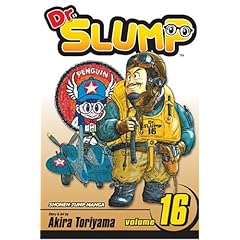
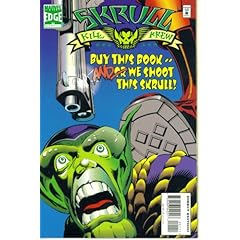
Here's how this works: I finish reading something, and I tell you about it, and I try not to bore you to death. This time, reviews, of sorts, of Dr. Slump vol. 16 (Viz, 2008) and Skrull Kill Krew (Marvel, 2006).


Well, now the last time that I spoke of Akira Toriyama's Dr. Slump in these pages, I was incredulous over the shark-jumping awfulness that was Turbo, the closest thing in Japanese comics to Scrappy-Doo that I'd ever seen. Of course, the problem with Scrappy-Doo was not the introduction of a new supporting character; it was the introduction of a new main character, knocking the existing cast into a gang of second bananas. So it was with Turbo, the magic baby that could do anything, except perhaps save a gag strip that had run its course for another year.

So I was in no particular rush to continue with Slump, but I was pleasantly surprised to find that after Turbo's initial three-month domination of the comic, he was quickly sidelined in favor of more fun Arale strips, particularly a three-parter where she and Senbei are turned into flies, along with some bizarre meta-commentary in which Toriyama, along with his assistant Takashi Matsuyama, interact with their characters, answer reader questions and look at life a decade down the road for the cast. This is definitely material past its prime, but I laughed more than once, and the work suggests that maybe if you've made it this far, you may as well see it to the end. (Volume 18, apparently.) Recommended for existing readers.

(Bonus: Rumic World has a 1986 interview with Toriyama and Rumiko Takahashi available on their site. You should check that out.)


Now here's a book I've been intentionally avoiding for better than ten years. In the mid-90s, Grant Morrison was co-writing a lot of subpar material with Mark Millar, and Marvel Comics had introduced a line called "Marvel Edge" where they could publish all their EXTREME!! stories. The mid-90s were a time for lots of EXTREME!! everything, and intentionally misspelled words, and comics that could be safely avoided. But for a buck and a half at one of the Great Escapes in Nashville, I figured the collected edition was worth it. And maybe it was, just.

So the idea here is that some people have contracted an alien virus that allows them to see the shapeshifting aliens who have infiltrated our society, but the virus is terminal and they are quickly dying. Five of these people resolve to spend their last days motorcycling around killing as many aliens as possible. There are nods towards such concepts as subplots and character development, and Steve Yeowell's art is occasionally very nice, if badly colored.

Skrull Kill Krew was intended as an ongoing set in the Marvel Universe, but was culled to a five-part miniseries before its launch. The second and third issues feature the Krew getting in the middle of a fight between Captain America and Baron Strucker, and perhaps the failure of this comic can be explained best by putting it this way: five days after I read this, I remember Cap and Strucker's verbal sparring and the dynamic work Yeowell put into their fight, but I couldn't pick any one of the Krew from a police lineup, nor tell you any of their names but one. Recommended if you've got a spare buck and a half.

(Originally posted October 13, 2008 at hipsterdad's LJ.)

Friday, April 11, 2008

Mutant Bounty Hunter edition with Strontium Dog and Durham Red

Here's how this works: I finish reading something, and I tell you about it, and I try not to bore you to death.


Absolutely triumphant. There's a reason this is one of the Eagle Award nominees for best reprint volume of '07: it's absolutely the work of three creators at the top of their game, telling brilliant stories with a mix of lighthearted wit and downright mean energy. Wulf Sternhammer's death really was a shock at the time; what's even more shocking in retrospect is the impact it has on Johnny Alpha, who becomes a taciturn, vengeance-driven monster for many episodes thereafter. The revenge he takes out on Max Bubba is the sort of thing that superhero funnybooks just wish they could get away with. Highly recommended!


This is the last of a three-volume series telling the story of what happened to the sexy vampire bounty hunter Durham Red several centuries after she was last seen as a supporting character in Strontium Dog. It never really sparks, suggesting it would have worked better as two books rather than three, although Mark Harrison's art is never less than interesting.

What really makes this collection shine is the inclusion of the seven episodes of "The Scarlet Apocrypha," in which Dan Abnett reimagines the character in seven very different scenarios, with seven very different artists, throughout history and fiction. Only one doesn't work - Steve Kyte's Japanese animation parody is just stupid - but some of these are downright excellent. John Burns really shines depicting Red in the setting of a 70s Italian horror film, and Enric Romero has fun putting her up against Count Dracula. Steve Yeowell, Frazer Irving and Carlos Ezquerra also contribute great installments before Harrison returns with a fascinating, dense and fun story drawn in a completely different style from his standard - an imitation of Mad's Mort Drucker! - and set at a science fiction convention in a world where Durham Red movies have been sci-fi staples for decades. It's very fun stuff, and, packed as it is with background notes and production artwork, it's a package I have to recommend, even though the lead story left me a bit cold.

(Originally posted April 11, 2008 at hipsterdad's LJ.)

Saturday, March 15, 2008

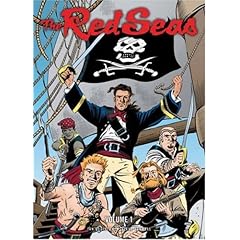
Period piece edition of What I Just Read: Emma vol. 7 and The Red Seas vol. 1

Here's how this works: I finish reading something, and I tell you about it, and I try not to bore you to death.


Well-l-l-l-l... it was okay. There's a bizarre sense of time in this edition, like a trip to and from America is a simple jaunt and not a couple of months in a ship crossing the ocean. Everything ends somewhat satisfactorily, but the viscount doesn't get the comeuppance I was hoping for. And Eleanor, Jesus, what a drip. I started the series captivated by the story and the art, but by the end, I was only thrilled by the art. In the end, not particularly recommended, but I'm willing to give Kaoru Mori's next series Shirley a try since I like her art so much.


It's a rip-roaring tale of pirates on the high seas in the 1760s, led by the dashing Captain Jack Dancer. (The character's name predates that Sparrow fella by about a year, but Sparrow's a little more compelling to this viewer.) The series is full of brilliant period art by Steve Yeowell, who can draw anything and make it look great, excellent villains, and high concepts like a talking two-headed dog and a battle between a giant kraken and the Colossus of Rhodes, but the devices drive the plot more than the characters. We rarely see Capt. Dancer think his way out of an impossible situation, and his crew is disappointingly anonymous. I find myself wishing The Red Seas was more compelling than it actually is, but for what it does, it's not at all bad. Recommended with wishes for more improvement in the ongoing series.

(Originally posted March 15, 2008 at hipsterdad's LJ.)