Showing posts with label cam kennedy. Show all posts

Saturday, May 3, 2014

Banzai Battalion: Just Another Bug Hunt!

What I try to do with reviews at this Bookshelf blog is keep it simple and spoiler-free, and let you know whether I'd recommend you pick up a copy of what I just read. Seems to work okay. This time, a brief review of Banzai Battalion: Just Another Bug Hunt! (Rebellion / Simon & Schuster, 2014).


I haven't checked in with the world of 2000 AD in far too long a time. I'm glad to see that the venerable comic's association with American publisher Simon & Schuster is still going strong, and that they're releasing good collections aimed at this market. One of the most recent is the 160-page complete collection of John Wagner's Banzai Battalion. This reprints every one of the characters' appearances, along with a few somewhat similar Judge Dredd episodes - similar in that they also feature robots - by many of the same creators.

The cover of this collection, originally used for their second story in March of 2000, features a wonderfully old-fashioned composition by Cliff Robinson which evokes any number of 1980s IPC comics. The little gunmen are the action figure-sized heroes of Banzai Battalion, who had two run-ins with Judge Dredd. They are actually semi-sentient pest control droids who keep finding themselves thrown into situations where human criminals become the pests they need to stamp out

A strip like Dredd requires an astonishing number of new concepts and new scenarios thrown at it every week, and every so often the new supporting players take on a life of their own. Wagner and Henry Flint crafted the Battalion's first appearance in 1999, giving the little robots the over-the-top personalities of older war comic heroes. Captain Bug Stomper - "He's a legend in pest control!," people keep telling us - tries to do things by the book, until his men persuade him to charge into glory for the greater good.

A year later, they returned in another Dredd story, this time drawn by the amazing Cam Kennedy. Since their human owners died during one of the Dredd world's occasional catastrophes, and since they keep making themselves useful, the droids are sent by Dredd to join Justice Department in some capacity, but when they reappeared in their own series in 2001, they had to take the initiative to strike out on their own.

Now drawn, brilliantly, by Ian Gibson, the resulting story is a very silly, over-the-top homage to old war comics, with the blustery, true-blue Captain Bug Stomper leading his troops on an expedition through Mega-City One that leads them to a wonderful new garden in which to fight insects. The garden, introduced more than fifteen years previously in a memorable Dredd adventure, becomes the battleground for rival teams of robots and a cute parody of another old comic character, IPC's General Jumbo. As leads, Stomper and the team were kind of limited, and their appearances run to a total of only 19 episodes, but they're clever and hilarious. The artwork is consistently first-rate, and I love the masterful way that Wagner mixes both knowing parodies and old continuity. Neither is essential for following the adventures, but they are mind-blowing little Easter eggs for old fans.

There are many things to love about the Judge Dredd universe, and one of them is the way that the series can wear different hats and be an action strip one week, a grim drama the next, and detective fiction the next. For readers who enjoy the bonkers, oddball comedy of the future, then this is a terrific book, certain to leave you laughing aloud and very impressed with Wagner's skill at making this weird, wild world work. Highly recommended.

A PDF of this book was provided by the publisher for the purpose of review. If you'd like to see your books (typically comics or detective fiction) featured here, send me an email.

Thursday, June 20, 2013

Star Wars Omnibus: Boba Fett

What I try to do with reviews at this Bookshelf blog is keep it simple and spoiler-free, and let you know whether I'd recommend you pick up a copy of what I just read. Seems to work okay. This time, a brief review of Star Wars Omnibus: Boba Fett (Dark Horse, 2010).


I don't envy anybody who's ever tried to collect Dark Horse's sixty-eleven different Star Wars titles. Even accepting that there's a fair stereotype that Star Wars fans are known for being very detail-oriented, the publisher has released such a bewildering array of different limited series, one-shots, special editions, and anthology / umbrella titles with so many creators that even the most ardent of the property's fans must find it daunting. I have only the mildest curiosity for Star Wars, but I really do like the work of four creators who have material in this Omnibus edition. The Dark Horse Omnibus line is a really great one. They're assembled with care, on good paper, slightly shrunk from the original comics, but 500 pages for $25 is a very good deal, especially since, unlike similar repackaging from Marvel and DC, these are in the original color.

It appears that since the editors of these zillion-odd comics never wanted to do a simple continuity, but rather commission writers and artists to tell various stories of the many characters of the Star Wars universe at random points in their lives, the only sensible way to collect them was to break them into Omnibus editions centered on specific characters. I saw this Boba Fett book on sale at Great Escape in Nashville, remembered reading that John Wagner and Cam Kennedy had worked on the character for Dark Horse, and flipped through it. What I found was a heck of a lot of Kennedy work, along with art by Ian Gibson and Carlos Ezquerra. Sold.

Even though these creators, combined, contributed only about half the pages in the book, it was still a steal because these are some tremendously good stories. The others were less important to me, but I enjoyed all of those but one. "The Yavin Vassilika" has a pretty fun "treasure hunt" story written by Mike Kennedy, but the artwork by Carlos Meglia was eyeball-punching. It's set before the first movie, and I'm not sure whether the "Young Kewl Anime Doodz" designs for Han, Lando and the bounty hunters just stank overall, or whether I was distracted by Young Han Solo's hairy chest drawn to look like it has spiky black bugs all over it, or whether the depiction of Young Greedo did me in. Greedo looks like a five year old kid in a Halloween costume.

So yes, a full fifth of the book is unpleasant to look at, but the rest is a joy, and I say that as someone with very little interest in this property. Cam Kennedy just draws the absolute hell out of his stories, with perfectly balanced fight choreography and brilliant design work for all the weird technology. I love his Fett, dominating every scene with his unspeakable badassery even in long shot. Ian Gibson, whom I've been said to admire even more than Kennedy generally, can't hold a candle to Kennedy in the Star Wars universe. Gibson certainly does get things off to a good start with "Enemy of the Empire" before abandoning it before the climax (not the last time he'd pull that stunt), but he's not a patch on Cam here.

Throughout, all the creators, including Ezquerra, who draws a great little Wagner-scripted tale about a salvage job that goes bad, and Andy Mangels, who writes a terrific piece illustrated by John Nadeau, contribute top-of-the-class stories, inventive and original. However, they are all left in the dust by Wagner and Kennedy's "Death, Lies & Treachery." This thing is a masterclass in how to structure an over-the-top spectacle of melodrama and chaos.

There is a whole lot that goes on in "Death, Lies & Treachery," which is the longest story in the book at an expansive 140 pages, and it doesn't sum up very well. In it, Boba Fett allows himself to get caught in the middle of two feuding Hutts, one of whom is blinded by love for the other's hideous daughter, because the money for this mess is consistently good. Fett is the only character in the sprawling insanity who keeps his composure. All around him, it's utter lunacy involving betrayal, bounty hunters, space pirates eating people, loudmouths, pipsqueaks, and an uproarious loss of dignity for entire planets' worth of weirdoes. Like the very best of Maverick, or Wagner's own remarkable Robo-Hunter, it's a situation that starts bad and just keeps getting worse. I laughed like a hyena all through the great and wonderful thing. If the rest of Star Wars was half this good, everybody, everywhere would love it unreservedly.

Honestly, I don't know much about Star Wars. I speak from familiarity, but not love of the property. I doubt that buying this book will prompt many people to attempt to navigate the chaotic mess of Star Wars Omnibi that Dark Horse have released, and will probably allow to quietly go out of print now that the license is returning to Marvel Comics in the next few years. What I can tell you is that the Boba Fett book is four-fifths a completely satisfying gem of a book and darn well worth the money. But it makes sense to buy it now before the license slips away and it goes out of print. Recommended despite the other fifth of the anthology.

Monday, June 20, 2011

The Taxidermist

What I try to do with reviews at this Bookshelf blog is keep it simple and spoiler-free, and let you know whether I'd recommend you pick up a copy of what I just read. Seems to work okay. This time, a brief review of The Taxidermist (Rebellion, 2011).


Well, I am very happy to see this book finally out. There are so few comics available to star a protagonist as elderly as this one - in the first story of three collected here, taxidermist Jacob Sardini is in his seventies - and I am all for any feature that bucks the trend of dashing macho, he-man lead characters quite the way this one does. Sardini is an aging, overweight widower who figures that his glory days are all behind him, but sometimes events have a way of sweeping even the elderly up in their wake.

This is one of several collections that the publisher Rebellion has recently released that shows just how wonderful the world of Judge Dredd is for launching new characters and ideas. In the weird future of Mega-City One, human taxidermy is not only legal, but accepted enough that it's become an Olympic sport, along with some other downright ridiculous pastimes, as the stories reveal as they unfold. In the opening story, we meet Sardini, who had brought home the bronze for taxidermy twenty years previously, as he is contacted again by a mobster to whom he owns a favor. The mobster's son was killed in the first step of a new gang war, and he wants Sardini to stuff his boy, and the fellows that he brought down, without the law learning about it.

This story originally appeared in 1987, and it was six years before Sardini returned. This much longer tale is one of the finest stories that writer John Wagner and artist Ian Gibson have so far produced, a ridiculous and epic farce that sees Sardini representing his city in the Olympics again, with ugly politics shaping up behind the scenes. Wagner has always enjoyed mocking the world of sports - his and Gibson's brilliant takedown of the World Cup in a 1982 Robo-Hunter story is something that everybody should read - and everything about the Olympics, from the gaudy opening ceremonies to the competitions to the inane commentary by the television crews, is wonderfully and hilariously skewered. I think about this story quite frequently, as every single instance where I am consciously aware that I am blinking, I think of Agnes "Laser Gaze" Boulton, who features in just about the funniest thing I have ever seen on the printed page. Rebellion could probably charge the same price for a reprint of just her short subplot and I'd end up recommending it.

Rebellion's design team has done its by-now-expected excellent work. The book contains all of Sardini's appearances, along with a short cover gallery. Reproduction is just about flawless, on good, heavy paper. Overall, it's a very funny and occasionally touching story that goes off in unexpected directions and it's in a terrific package. What more could anybody want? Very highly recommended.

Tuesday, November 23, 2010

Judge Dredd: The Restricted Files 02

What I try to do with reviews at this Bookshelf blog is keep it simple and spoiler-free, and let you know whether I'd recommend you pick up a copy of what I just read. Seems to work okay. This time, a brief review of Judge Dredd: The Restricted Files Volume 02 (Rebellion, 2010).


This is the second in a two-volume set that covers all of the various Judge Dredd episodes of the 1980s that did not originally appear in the weekly 2000 AD comic. The publishers, at the time IPC, used to release various annual hardbacks and special editions where additional adventures of the lawman of the future could be found, and these stories, long desired by fans to be collected alongside the weekly episodes, have finally found a home in these two books.

Honestly, there isn't anything in book two as wild and fantastic as the better moments in the first volume, but there isn't anything as dire as that book's first ninety-odd pages, either. As I mentioned in my review of that book, the first several annuals and specials for 2000 AD were compiled by various editorial staffers working anonymously, few of whom had a grasp on the still-developing character of Dredd and his growing world. Until John Wagner became interested and took control of those projects, they were patchy at best.

With Wagner, joined in 1983 by Alan Grant as co-writer, in charge and defining a clear world, and worldview, for Dredd, the one-shot episodes maintained a consistent tone. True, with only a handful of pages per story, they couldn't really dig into things with the detail afforded a multi-week serial in 2000 AD itself. In some cases, like a Mike Collins-illustrated episode about a heat wave, the plot is given over to fantasy. But with a consistent approach, a dry wit and a taciturn leading man, the stories are uniformly entertaining, with few or no fumbles across close to 400 pages.

As usual, there's a pile of really great art from many Dredd regulars. Cam Kennedy is well-represented with one of my favorites of his many times drawing Dredd, "I, Beast," and he's in good company with Carlos Ezquerra, Ian Gibson, Arthur Ranson and others. I think my favorite story in the book might be one of the longest, "Last of the Bad Guys," which was painted by John Higgins. Honestly, there's not a bad-looking page in this book, but I think that Higgins, one of the title's unsung heroes of the period, might have done the best work in the collection. Bryan Talbot illustrates a really funny story that shows what happens when Justice Department's undercover division can't rustle up enough female judges for a case, and Brendan McCarthy is psychedelic, wild and mind-blowing on a couple of very colorful episodes.

Again, nothing in these pages is as completely breathtaking as some of the Mike McMahon material in volume one, but that's not to say anything here is lacking. It's a really terrific reprint, full of clever, surprising plot twists and it's long overdue. It's presented on nice paper, chronologically, and very well designed. Darned if I can find a flaw in it at all, to be blunt. Highly recommended!

Wednesday, September 8, 2010

Rogue Trooper: Tales of Nu-Earth Volume 1

What I try to do with reviews at this Bookshelf blog is keep it simple and spoiler-free, and let you know whether I'd recommend you pick up a copy of what I just read. Seems to work okay. This time, a brief review of Rogue Trooper: Tales of Nu-Earth Volume 1 (Rebellion, 2010)


Here's a book which, honest to heaven, I did not need. I don't mind the reputation I get as one of 2000 AD's online cheerleaders, and as I have cut way, way back in buying new comics, it's only the constantly-improving, mindblowing platinum age of the Galaxy's Greatest Comic (well, and Legion of Super-Heroes) that has my ongoing interest in the medium at all these days, and it's sort of expected that I'll buy all these things the publisher releases. But Rogue Trooper is far from my favorite property in the 2000 AD world, and this is a series that has been reprinted a lot. Unfortunately for my wallet, I neglected to send an exception to my regular order at my favorite comic shop, and, well, now I have these stories for at least the fifth time.

Having said that, if you've never read Rogue Trooper before, you could certainly do a lot worse. This collects all of the character's adventures from 1981 to 1983, written by Gerry Finley-Day and illustrated, brilliantly, by the likes of Dave Gibbons, Eric Bradbury, Brett Ewins, Cam Kennedy and Colin Wilson. The artwork really is terrific. I've long lost interest in revisiting these storylines, but the artwork constantly sucks me right back in.

These are future war adventures set on a hellworld with poisonous atmosphere. The only man who can breathe in this toxic nightmare is the last of a company of genetically-engineered super-soldiers. He's accompanied by the squabbling dogtags of three of his dead buddies - "biochips" which retain personalities and memories until they can be returned for newly-grown bodies. But since our hero's company has been betrayed by a traitor general and the ironically-named Rogue has gone AWOL to track that man down, they can't be returned any time soon.

I've always accepted that Rogue Trooper is a great icon for merchandising and adverts - Rebellion made a good video game of him in 2006 - thanks to Gibbons' simple, but memorable design. But honestly, these stories are pretty darn juvenile, without the necessary kick that keeps them interesting for older readers. Preteen boys would eat this up before anybody else, although the artwork is a selling point on its own. Also of interest are two bonus episodes. The meat of the book reprints all of the weekly episodes from about a 19-month stretch, but among the bonus supplements are two rare episodes scripted by Alan Moore that originally appeared in the old annual hardbacks. One of them is pretty by-the-numbers; the second, with art by Jesus Redondo, is probably the best story in the book.

For those of you who've kept an eye on Rebellion's ongoing reprint program of the last six years, Tales of Nu-Earth 01 collects the entire contents of the two books released some years ago in partnership with DC, plus the Alan Moore episodes, plus the first seven episodes from the third book, which Rebellion released without DC's involvement. It's a very nice upgrade, as upgrades go, just not one that I personally needed. If readers would please excuse my lack of enthusiasm, I do recommend this for the art - there's not a page of Gibbons that shouldn't be owned by everybody who likes comic art - but really only for readers who have not bought the previous editions.

Wednesday, March 10, 2010

The Best of Battle

What I try to do with reviews at this Bookshelf blog is keep it simple and spoiler-free, and let you know whether I'd recommend you pick up a copy of what I just read. Seems to work okay. This time, a brief review of The Best of Battle (Titan, 2009)


Battle Picture Weekly was, of course, one of the best and most important comics ever published. It wasn't just a simply entertaining, well-written and drawn collection of great war stories, it was a critical building block in the development of modern comics. Since without it, you'd never have had a 2000 AD, I've always been interested in it, and any chance to see these terrific stories is one worth taking.

The series and serials in BPW were drawn by some of the best artists working in Britain at the time, including Eric Bradbury, Joe Colquhoun, Carlos Ezquerra, Cam Kennedy and Mike Western. Many of the stories were devised by Pat Mills and John Wagner, and while they only scripted a few themselves, they assigned others to the likes of Gerry Finley-Day and Alan Hebden. They all developed storylines, sometimes sharply different from each other in tone, with vulnerable anti-heroes, radically different from the indestructible leads in American war comics. Reading just one issue of BPW after an identikit Robert Kanigher DC adventure is the greatest breath of fresh air in the medium.

Titan Books, which has been collecting Battle's most lauded strip, Charley's War, for several years now, landed the reprint rights to several old IPC properties what seemed like an eternity ago, and late last year finally released the first of their new Battle collections. The Best of Battle is similar in feel to their two Roy of the Rovers samplers, three hundred pages of reprints in a slightly oversized format with a paperback cover. The book contains the first 3-5 episodes of eighteen different series. Each comes with an introductory page and a short blurb written by either Mills or BPW's one-time editor, Dave Hunt.

I think the format is a good one, as far as samplers go, but it looks to me like Titan was a draft or two shy of assembling something really special. The most aggravating example is Hold Hill 109, a six-part serial by Steve MacManus and Jim Watson. Four of the six episodes are included in this book, which is nice, but what are the odds that Hold Hill 109 will ever be reprinted anywhere else? Between Charley's War, Johnny Red and Darkie's Mob, there are 12-13 episodes which are either already available in Titan collections or are due for release within a few months. Couldn't eight of those pages be given up to see all of Hold Hill 109?

I'm also a little surprised that Battle Action Force isn't even mentioned in the book. Admittedly, even with the nice artwork by John Cooper, the toy line tie-in, sort of a parallel antecedent to Hasbro's G.I. Joe line of the 1980s, was the sign that the comic's brightest moments had passed, but it still has a huge number of fans. Evidently there's some rights issues at work, as Palitoy still owns those characters like Baron Buckethead or whoever it was they were fighting prior to Cobra Commander, but considering just how important the Action Force was to Battle's later days - Johnny Red and Charley's War wouldn't have made it to their ends without Action Force sales propping up the comic - I think it should have been mentioned.

If readers would forgive the regular quibbling of a Monday morning quarterback, the book is truly a fine introduction to Battle, and one which will certainly get new readers excited about the other material Titan has planned. Six volumes of Charley's War are already out, the first collection of Johnny Red should be with us by the end of the month, and a complete Darkie's Mob - all 44 episodes - is solicited in the current Previews for later in the spring. The book also promises that collections of two of my favorite Battle series, Major Eazy and Rat Pack, are on the horizon.

The only other quibble that I have is that getting accurate shipping dates and advance plans from Titan is really like pulling teeth. Most of their books seem subject to interminable delays - where the devil is the third volume of Jeff Hawke, guys?! - and so it's impossible to guess exactly when we'll get the follow-up volumes that I've been craving. It's simply bad business to serve up an appetizer as tasty as this and shy away from the main course!

(Excerpted from Reprint This!)

Thursday, August 20, 2009

Kidnapped

Here's how this works. I read a book or two and tell you about them and try not to get too long-winded. This time, a review of Kidnapped (Tundra, 2007).


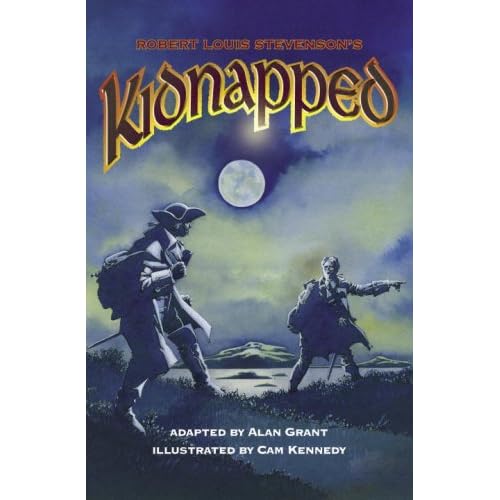
I never read Kidnapped when I was the target age for it. I seem to remember enjoying two or three of Robert Louis Stevenson's novels when I was in middle school, but never found the time for this one. Anyway, a few years ago, the city of Edinburgh tried a neat little initiative to get everybody in town reading the same book, and four editions of this classic were prepared. These were the original novel with annotations, an edition "translated" into Lowland Scots dialect, a version for younger readers, and this comic adaptation by 2000 AD veterans Alan Grant and Cam Kennedy.

I'd been intending to try this one out ever since it was announced, but only found a copy last month at Boston's wonderful Million Year Picnic. The story's certainly good escapist fun - it's about David Balfour, a seventeen year-old who learns, after his parents' deaths, that an estate inheritance awaits him, only to be betrayed by his greedy uncle and sold into slavery and bound for the Carolinas. But world events overtake the ship, and a chance meeting with Alan Breck Stewart sees the two released on the mainland, where the politics of the time, just after the Jacobite Rebellion, have Stewarts and Campbells at loggerheads, and soon both men are on the run after the assassination of the king's agent Colin Roy.

As for the adaptation, I think that Alan Grant did the best he could with the page count assigned, but looking over what was omitted from the original novel for space reasons, you can't help but wish the publishers could have paid out to make this a little longer. Yet the price isn't completely unreasonable for 64 pages of such glorious Cam Kennedy artwork. Kennedy's been overlooked by fandom for far too long; this is fantastic stuff, and certainly worth keeping an eye out for a copy. I hope that my son will enjoy it!

Thursday, April 2, 2009

The VCs: You're Hit, You're Dead!


In other news, while Rebellion tends to focus on releasing collections from more recent properties or big name characters, every so often they do head back to the comic's early days and surprise everybody with a great book full of thrillpower from the past. Such is the case with this new edition of The VCs. This is the original run of 32 episodes from 1979-1980. Most of the installments are written by Gerry Finley-Day, with a couple of fill-ins by Steve MacManus. The art is principally by Cam Kennedy, who contributed the cover, and Garry Leach. Mike McMahon drew the first episode and John Richardson the last five, but everything between them is by Kennedy or Leach. Probably nobody finds that as interesting as I do.

Anyway, The VCs is a pretty standard war story, just dressed up with aliens and spaceships in it. There's the green rookie, disliked by his new crew, and ugly enemies you can neither understand nor sympathize with, and trapped-behind-enemy-lines stories, and callous officers who probably interact with our heroes more than any other company in the military. That's not to say it's at all bad, but I reread this while continuing a once-a-week reread of Battle Picture Weekly produced during the same 1979-80 period and darned if this series couldn't have been flawlessly slotted into that comic. If you enjoy this style of comic storytelling, then The VCs will certainly please you, even if it's only rarely eye-opening.

Actually, I should probably qualify that: if you're coming to this from an American background, there's a lot more to this than simply "another war comic." I grew up reading DC's Sgt. Rock and The Haunted Tank, and later Marvel's G.I. Joe, with their casts of unkillable regular characters. Compared to these, British war comics are a complete revelation, with surprising fatalities among the cast. Any new reader coming to this collection will probably be pretty surprised by this story as it progresses.

There were 32 episodes of The VCs, but this is a pretty slim book, since the episodes were an unusually short 3-4 pages a week. It runs a little light on extras, since there were so few from the period. The strip was spotlighted on 2000 AD's cover only once, and there was a single star scan of the lead cast a few weeks after it finished, and those are included, but there are no other contributions from the period from any of the creators. In lieu of blank pages filling up too much of the back, the first episode of Finley-Day's better-known future war series, Rogue Trooper is included, but honestly, I'm hard pressed to imagine anybody buying this collection who hasn't already read the first Rogue episode plenty of times already. That's not to say that I don't think potential readers are out there, and I hope you'll give it a read, just that I'm not really sure this was the best use of the pages in the back when a new interview would have been very nice.

(Excerpted from Thrillpowered Thursday.)

Wednesday, October 8, 2008

More British stuff

Here's how this works: I finish reading something, and I tell you about it, and I try not to bore you to death. This time, reviews, of sorts, of Charley's War: Blue's Story (Titan, 2007) and Judge Dredd: Complete Case Files Vol. 10 (Rebellion, 2008).


In the fourth of Titan's collections of the amazing Charley's War, the action shifts to the home front. On leave in London, Charley Bourne meets a deserter from the French Foreign Legion. As the military police pursue them, the man who calls himself Blue tells Charley the story of the battles at Verdun and Fort Vaux.

The detour from the principal Charley's War narrative into this look at the rest of the war originally ran for six months in the pages of Battle Picture Weekly and was notable for a number of innovative cover pages. Most memorable of these is a great image of the trapped, starving soldiers, their supplies cut, holding Fort Vaux and looking out helplessly while a German taunts them, pouring a canteen of precious water onto the muddy ground.

If you've been reading Charley's War, as of course you all should, then you already know that Pat Mills and Joe Colquhoun managed something genuinely amazing and moving in every installment. If you're new to the series, this is actually a fine place to start before you go back and pick up the first three books. The reproduction is a little dark and fuzzy in places, and greyscaling the color covers does not always work as well as we would like, but the presentation is great, with introductory material and lengthy afterword commentary by Mills. Highly recommended.

(Note that the fifth book of Charley's War is actually supposed to be in US shops today. Diamond was extraordinarily late shipping this book to my store of choice, hence the belated review.)


The tenth Case Files edition, featuring around 50 episodes originally published in 1986-87, is among the best in this series. Oddly, Judge Dredd is all the better for the lack of a consistent, regular artist, even the good ones like Ron Smith, who, I understand, had taken a sabbatical to do advertising work around this time. With so many great artists all vying for space, there are more opportunities for individual work to shine.

Brendan McCarthy makes a huge splash with the four-part "Atlantis," for instance. Kevin O'Neill gets three episodes in this book, and they really are something to see. "Varks," a story about aliens that reproduce by turning other lifeforms into creatures like them, would have been a creepy and gruesome story in anybody's hands, but O'Neill really turns it into a freakfest. Other artists with standout work include Steve Dillon, Ian Gibson, whose "Paid With Thanks," about a ghost who does not appreciate innovative accounting, is a riot, John Cooper and Cam Kennedy.

John Wagner and Alan Grant were reaching the end of their celebrated regular partnership around this time, but hindsight doesn't show any cracks or tension in these episodes. They are having a ball coming up with more and more goofball citizens and criminals, and letting Dredd reach the end of his patience with their quirks and foibles. Absolutely essential reading, and highly recommended for everybody from longtime fans to newcomers.


(Originally posted October 08, 2008 at hipsterdad's LJ.)

Thursday, February 21, 2008

Peanuts 1965-1966 and Judge Dredd: The Complete Case Files 09

Here's how this works: I finish reading something, and I tell you about it, and I try not to bore you to death.


Among the treats in this eighth collection: the debut of Peppermint Patty, who's even more confident in her cluelessness than you remember, a never-before-reprinted sequence about Snoopy journeying off to be the keynote speaker at a Daisy Hill Puppy Farm convention and not arriving, and the first several sequences with the World War One flying ace. Probably recommended higher than any of these other super volumes, really.


Oh, there's a whole bunch of great stuff in this collection of 50 episodes from 1985-86, featuring really great art from all those names you see below in the tag. It starts with "Midnight Surfer," one of the all-time greats, and ends with the breathtaking "Riders on the Storm," Brendan McCarthy's first Dredd in the way-out style he's known for. Recommended!

(Originally posted February 21, 2008 at hipsterdad's LJ.)