Showing posts with label kevin o'neill. Show all posts

Tuesday, June 3, 2014

Ro-Busters: The Disaster Squad of Distinction

What I try to do with reviews at this Bookshelf blog is keep it simple and spoiler-free, and let you know whether I'd recommend you pick up a copy of what I just read. Seems to work okay. This time, a brief review of Ro-Busters: The Disaster Squad of Distinction (Rebellion / Simon & Schuster, 2014).


Back in the mid-1980s, when all of the various series within 2000 AD were licensed for collected editions by Titan, one of the must-have books was the first of two volumes of Ro-Busters. This was a terrific series written by Pat Mills and featured the exploits of some squabbling working-class robots used as disposable fodder for very dangerous rescue missions. Two of them - an unruly and cantakerous sewage-shoveling droid called Ro-Jaws and a full-of-himself army surplus sergeant called Hammerstein - were the leads. They worked for an unscrupulous cyborg super-capitalist called Howard Quartz who genuinely didn't care whether any of his property lived or died, because Ro-Busters was just one of hundreds of robot-staffed operations that he had going.

That original 80-page Titan collection of Ro-Busters has been out of print for many years, but Rebellion has reissued it in a new, expanded edition in conjunction with its American publishing partner, Simon & Schuster. Now 112 pages, it reprints the same stories as that original book - mostly illustrated by Dave Gibbons, with a few pages by Kevin O'Neill and by Mike Dorey - but bookends them with some interesting additions. Ro-Busters actually began in a different comic, 2000 AD's short-lived sister title Starlord, and this book has the first four episodes from that comic. These are drawn by Carlos Pino and by Gibbons. In the back of the book are a couple of neat curiosities - two of the three one-off Ro-Busters episodes that were written by Alan Moore rather than by Mills, with art by Steve Dillon and Bryan Talbot.

As far as I'm concerned, any book to feature that much artistic talent - seriously, Dillon, Gibbons, O'Neill, and Talbot under one set of covers?! - could be written by anybody and still be worth buying. Gibbons' epic "The Terra-Meks," in particular, features page after page of giant robots pummeling each other. The third part of that story is just a tour de force. I can't think of too many other artists in comics that have ever drawn a scene of giant robot combat as brilliant as that. It's masterful.

As for the stories, they're just remarkably fun. Perhaps through the new eyes of a jaded adult, these might appear clunky and dated, but they're kids' comics which nevertheless resonate. Ro-Jaws is such a fun character, vulgar, to the point, and totally lacking any circuits of discretion or tact. Hammerstein is such a straight man that Mills would, in much later stories, go a little too far in showing him up as a chump and had to scale things back to make him a hero again. These characters have lasted long beyond the very brief original run of Ro-Busters, actually. The series proper ended in 1979, with Alan Moore's bonus episodes appearing in the old harback Christmas 2000 AD Annuals in the mid-80s, but the characters have resurfaced in the very long-running spinoff ABC Warriors, which still shows up with a dozen or so new episodes every couple of years.

Ro-Busters is simply a great, inventive, and very fun series, suitable for all ages. Buy two copies of this book: one for yourself to keep in mint condition on the shelf and one for a nine year-old of your acquaintance to read until it falls apart. Any nine year-old who isn't wowed by this, there's something wrong with that child. Highly recommended.

A PDF of this book was provided by the publisher for the purpose of review. If you'd like to see your books (typically comics or detective fiction) featured here, send me an email.

Tuesday, October 25, 2011

The League of Extraordinary Gentlemen: Century: 1969

What I try to do with reviews at this Bookshelf blog is keep it simple and spoiler-free, and let you know whether I'd recommend you pick up a copy of what I just read. Seems to work okay. This time, a brief review of the latest freaking League of Extraordinary Gentlemen story (Top Shelf, 2011).


Have things really become this awful? Honestly, the best that I can say about the latest, interminable, bloodless exploit of the restless and bored adventurers of the League of Extraordinary Gentlemen is that it's not quite as bad as I thought it was when I first read it. It did improve markedly on a second read, but I still didn't like it at all.

I was not expecting much; Kevin O'Neill, whose work stopped thrilling me at some point between Metalzoic and Marshal Law many years ago, has always had trouble hitting deadlines, but the amount of time he spends drawing these comics only for them to emerge looking so darn ugly just leaves me baffled. It's not as though he's phoning it in; the amount of detail that he packs onto the page really is amazing, but it all looks so flat and it doesn't serve any damn purpose whatsoever other than to give Jess Nevins something to annotate. There's not a point in the world in agonizing over putting caricatures of the actors who played Steptoe and Son into the crowd scenes of your pages when they don't serve the story, slow you down, and, oh, look like they've been run through the ugly machine. Well, not that those guys were winning beauty pageants in the real world, but still.

So, I was predisposed to dislike this comic because I greatly dislike Kevin O'Neill's art, which is certainly heretical in many of the quarters in which I visit, and because I'm amazed that he keeps getting a pass from a fandom for taking such an absurd time to finish the work. I know that sounds like a reverse Woody Allen complaint, but, really, when artists whose work I enjoy more could have illustrated this story in far, far less time, it really feels like a story that I (once) wanted to read is being held up by substandard art. I've given previous editions of the book a break because I was willing to overlook the art that I find unappealing in order to get to the story. Alan Moore often gets that kind of a pass, but often, lately, he's lost me. I'm not about to spend money on, to use a beacon-bright example, Lost Girls, because, while I've no objection to comic book porn, that doesn't sound like the sort of porn that I want to read, and worse, it's just about the most awful art that I have ever seen in any comic, ever, and is, by consequence, the least erotic thing imaginable. Johnny Ryan and Sam Henderson could have made a sexier comic.

But anyway, the flat reality, now that we're into the "Century" cycle of stories, is that I no longer want to read about Mina and the boys, and this art that I can't stand is just making matters worse. Mina's stiff and grouchy exterior played well as a supercilious Victorian, but what the hell is she still doing stomping around with a Victorian-era chip on her shoulder in the nearly-modern day? Socially, the world has become so much brighter and more effervescent since her time, but she's absolutely joyless when not hateful; she's given up, and her malaise infects the story. Orlando and Quatermain seem to want to move on and enjoy life, but they're stuck, loyal and subservient, for some mad reason, to her. When the climax sees Mina separated from her associates, I was left with relief. Soon, Orlando and Quartermain will be able to hang out with Jason King and have some fun for once.

It's always been amusing to watch Moore just get down in the dirt and mess with perceptions and expectations about how the great and the forgotten characters of fiction really would interact with each other. Seeing the not-James Bond-for-trademark-reasons James Bond get such a comeuppance for his vulgar chauvinism in The Black Dossier was a scream, for instance. But Moore has Adam Adamant so utterly backwards in his cameo that it drives home how unpleasant Mina has become, and how there is no longer any reason to read about her. The televsion Adamant was trapped in suspended animation from 1902 until 1966, when he was unfrozen and began solving the sort of cases that John Steed and Emma Peel would normally handle, and, much like Steed, he loved life. Swinging London confounded him for a few moments before he jumped in and took the city and the 1960s by storm. Well, as much storm as a cheap 1960s BBC videotape drama would allow.

So Moore takes a character, who, cut adrift from his stodgy old morality and culture, adapted to the 1960s with wild enthusiasm and abandon, and then lets the unpleasant and bored Mina undermine him and play him for laughs? It's long been suspected that Moore just doesn't like modern life at all, but perhaps more was revealed here in the telling of the joke than was intended. The old crank has lost me. Not recommended.

Thursday, June 2, 2011

2000 AD's Free Comic Book Day Prog

What I try to do with reviews at this Bookshelf blog is keep it simple and spoiler-free, and let you know whether I'd recommend you pick up a copy of what I just read. Seems to work okay. This time, a brief review of 2000 AD's Free Comic Book Day Prog (Rebellion, 2011).


Here's a book that, if I may say so, is long overdue. Every year for about the last decade, the principal comic book distribution company, Diamond, has sponsored this event where retailers order a bunch of comics to be given out freely to customers. The idea is that the comic shops will promote a big event at their store and guests will arrive to reacquaint themselves with how great it was to read funnybooks, and established customers will pick up a couple of new titles. 2000 AD, despite being the most consistently entertaining and rewarding comic book published over the last three decades, has never joined the party until this year. At last, there's a free 2000 AD comic to promote in the US. Free Comic Book Day has come and gone, but it's possible - in fact, it's almost likely, considering the leftover stock that I see in some stores - that there may be a copy or two floating around for new readers to try.

2000 AD is an anthology book, and this issue gives people a reasonably good idea what to expect from any given issue, with a quibble or two. Judge Dredd, as always, is the star of things, and the rest of any given issue is taken up with a mixture of recurring series, serials and short one-off stories. Here, Dredd is ably represented by a short story written by his creator John Wagner and illustrated by Val Semeiks and Cliff Robinson. It's a good introduction, letting people know that Dredd lives in a world where life is violent and technology is downright weird.

The principal backups are Slaine by Pat Mills and Clint Langley, Kingdom by Dan Abnett and Richard Elson, and Shakara by Robbie Morrison and Henry Flint. Kingdom and Shakara are each very recent and popular series - Shakara actually reached its bug-eyed, mad, memorable conclusion earlier this year - and they are each represented by their initial installments. Kingdom is the lyrically paced (if that makes sense) story of a dog soldier called Gene the Hackman, who, with his pack, is defending Antarctica from huge insectoid aliens. Shakara tricks readers into thinking that it's the story of the very last human, an astronaut who was in space when bizarre aliens destroyed Earth, but then it swerves, magically, and shows off that it is not about that at all. Both are completely terrific, and collected editions of each are already available in England. American editions, distributed by Simon & Schuster, will be arriving in a few months' time.

The Slaine story is a pleasant surprise. Slaine has actually been running since 1983 with a dozen different artists illustrating Pat Mills' scripts. The episode here is the first in a series of adventures called "The Books of Invasions" that was painted / photomanipulated by Clint Langley. Langley's tenure on the strip is available in three hardback editions, with a fourth scheduled for later in the year, but I don't believe that these are planned for separate American release (and, presumably, promotion) at this time.

The comic is bookended by a couple of short one-offs, a Tharg story from 1977 illustrated by Kevin O'Neill that introduces readers to the concept of this comic having an alien editor who programs robots to write and draw the features, and a one-page Zombo short by Al Ewing and Henry Flint which is just violent and ridiculous and wonderful. Frankly, 2000 AD should run silly little single pages like this more frequently.

As an introduction, I think this does a pretty good job, although I might quibble that it emphasizes the over-the-top, hyperviolent side of 2000 AD perhaps a little more than I might like. This led at least one store in Atlanta to restrict the freebie to adults only. (I protested that all Earthlet children should be exposed to thrillpower at the earliest possible age.) While 2000 AD, it must be said, isn't for everybody - and a regularly-scheduled, stereotype-avoiding, female-led series is long overdue and would help there - many of its best series are nowhere as dementedly gruesome as the offerings suggested here, and I'm not sure that this really gives readers a feel for how broad the scope of 2000 AD is.

Another eight pages could have introduced readers to the classical pirate adventure of The Red Seas or the weird Victorian crime drama of Stickleback or the Western-in-Hell Ichabod Azrael or the brand new cops vs. demons Absalom, all of which are certainly violent, but not quite as visceral and outlandish as what's on offer here, and I think that might have been a bit more of a balance. Well, now we know for next year! Certainly recommended.

Monday, August 30, 2010

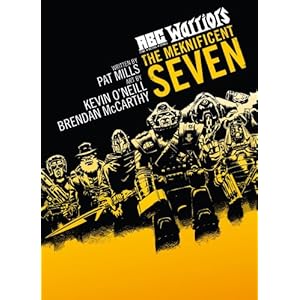
The ABC Warriors: The Meknificent Seven

What I try to do with reviews at this Bookshelf blog is keep it simple and spoiler-free, and let you know whether I'd recommend you pick up a copy of what I just read. Seems to work okay. This time, a brief review of The ABC Warriors: The Meknificent Seven (Rebellion / Simon & Schuster, 2010)


Among all seven gajillion or so of us who like reviewing "graaaaphic novels" and things on the internet, there's a subset who really enjoy the comic juxtaposition of elements that really occur best in the comic medium. Things like J. Jonah Jameson yelling at Godzilla, things like that. It still blows my mind that no publicist has sat these folks down, what with the big audience that they command, and shown them The ABC Warriors, a high-concept science fiction serial written by Pat Mills. It began in 1979 and new episodes have appeared every few years in the pages of 2000 AD. There's a bit in one of their earlier adventures, reprinted in this new American edition, in which war robots with bazookas ride around the deserts of Mars on the backs of tyrannosaurs.

Let me repeat that for the benefit of those not paying attention: ROBOTS WITH BAZOOKAS ON TYRANNOSAURS ON MARS. Drawn by Carlos Ezquerra. This is, in point of fact, the greatest thing to ever appear in fiction.

For those of you who haven't been paying attention, the ABC Warriors are a motley squad of war robots assembled in the waning days of a global conflict against the Volgan Empire. They include a cowboy robot, a sniper who communicates in bursts of letters and numbers, a Volgan general reprogrammed to obey allied commands but who retains his two-timing, traitorous nature and a shrouded, grinning maniac who puts that whole "sufficiently advanced technology indistinguishable from magic" business to the test. They are the coolest team of backstabbing, squabbling characters to appear in comics, and if they don't hypercharge your inner ten year-old, then you were obviously never ten.

The artwork on this initial series of 21 episodes was mainly provided by Mike McMahon, with guest appearances by Ezquerra, Kevin O'Neill, Dave Gibbons, Brett Ewins and Brendan McCarthy. About five years later, Alan Moore contributed the only episode of the long-running series that Mills did not write; it's illustrated by Steve Dillon and it makes its first appearance since its original outing in this new collection by Rebellion, distributed in the US by Simon & Schuster. The new book also includes a six-page framing story by Mills and O'Neill that originally appeared in Titan Books' old collection of this serial.

"The Meknificent Seven" has appeared in print many times before this, but the current edition is the first one aimed at mainstream bookstores, with the Alan Moore episode added as a sweetener for anybody wary about buying it again. It also includes a new foreword by Pat Mills and, as a supplement, five of the old "Fact Files" about the characters. These are really charming, and while the series has "grown up" along with its readers and more recent episodes are aimed more at adults, the "collect 'em all" nature of these pages reminds me that, once upon a time, this was the most awesome idea in kids' comics ever.

As I write this, the book has been out for about six weeks, and I'm a little concerned about the lack of publicity out there. I know that Mills was doing his usual awesome job of promotion in California last month, with signings at an area Barnes & Noble and an appearance at the San Diego Comic-Con, but somebody at Simon & Schuster really needs to start knocking down some doors to tell people that they're carrying these 2000 AD collections, and that they are fantastic. You can't rely on me; my audience is very small, and they almost never listen when I tell them to buy things. Get some review copies out, guys, because everybody in America needs to know that if they have a ten year-old boy in the house, or anybody else who remembers how hotdamned spectacular wild things like this were like when they were that age, then their house needs the ABC Warriors. Highly recommended.

Tuesday, March 30, 2010

Dodgem Logic # 1

What I try to do with reviews at this Bookshelf blog is keep it simple and spoiler-free, and let you know whether I'd recommend you pick up a copy of what I just read. Seems to work okay. This time, a brief review of Dodgem Logic # 1 (2010)


Well, I'm certainly willing to shell out four bucks to see what Alan Moore's up to while he's waiting for artists to finish illustrating his comic scripts. Turns out that he's had a long-standing pipe dream about being the editor and publisher of his own magazine. So he licensed a few tunes for a CD and sold some ad space and got some friends and wrote some articles.

The resulting hodgepodge, Dodgem Logic, resembles an APA more than a professional magazine, although it is nicely printed, on good paper. There isn't any sense of uniform design, which really makes it unfriendly to readers' eyes when they can't tell where articles stop or start. Moore's lead feature, a six page article on the history of underground newspapers, looks like three separate stories, with different fonts and background colors, but it's full of really interesting facts all the same.

The first issue comes with a free CD called Nation of Saints, which is a compilation of Northampton-based music from across the spectrum, with not-quite-getting-it country (if your country song is more than six minutes long, you're not quite getting it) to hip-hop. It's got that terrific Jazz Butcher song "She's on Drugs" which I hadn't heard for many years, and the lead track has that noted duck marcher and warbler Moore returning to the studio for the first time in a while. And it's got something by one of those guys from Bauhaus who isn't Peter Murphy, if you like that sort of thing.

The magazine features health articles, recipes and accessorizing tips, and illustrations by regular Moore cohorts and spouses like Kevin O'Neill and Melinda Gebbie. It's all done with a playful, lighthearted touch, like a bunch of buddies who know their stuff cobbling something together in the hopes that you might get a kick out of them. I can just see Gary Ingraham as an eager sixteen year-old offering to do the local music reviews and a short history of rock bands who've played Northampton. Maybe the magazine lacks focus and defies categorization ("lifestyle," maybe?), and while I don't think this will become essential reading for anybody not already curious about Moore's projects, since it's done with such enthusiasm and lack of pretension, it's impossible to begrudge the gang behind it. Some of the artwork is child-unfriendly, but otherwise it's recommended for older readers.

Thursday, March 5, 2009

The Complete Ro-Busters

In other news, Rebellion continues to impress with their graphic novel collection. Sometimes, they announce a project which doesn't sound like the most exciting book on the shelf, but then the finished product turns out to knock your socks off. That's the case with The Complete Ro-Busters, which does exactly what it claims on the front and compiles absolutely every strip appearance of Hammerstein, Ro-Jaws and the gang from the pages of both Starlord, where the series began, and 2000 AD. The Ro-Busters, as I described 'em over at Touched by the Hand of Tharg, are "a disaster recovery crew along the lines of International Rescue from Thunderbirds, only they are staffed by a crew of robots (chief among them our lead characters Ro-Jaws and Hammerstein) and they are by no means as charitable as the Tracy boys had been. Mr. Ten Percent (so named because only ten percent of him, his brain, was human) charges for the dangerous work his droids perform."

That Ro-Busters should have developed into anything memorable is something of a miracle. The series was created by Pat Mills to fill some editorial request for something about planet-saving superheroes. Since Mills, as anybody who's read Marshal Law could figure, has never had much time for the concept of superheroes, he turned the idea on its head and decided to have the disaster squad staffed, not by noble, selfless people, but by the most expendable of characters: junked-out robots in line for the scrapheap, bought dirt-cheap by a greedy jerk in need of cheap labor to exploit.

Anyway, Ro-Busters is certainly dated, and from the outset feels very much like a comic strip for children, especially in a ridiculous story in which two people disguise themselves as robots in order to start a rebellion on board a casino in space, but it's incredibly fun! The writing did tighten up around the time it moved to 2000 AD, with an engaging mix of class comedy and homages to war comics before the wild lunacy of the final storyline, in which the doomed robots try making a break for a planet where they can be free. But before that frantic conclusion, there's a great story in which Ro-Jaws and Hammerstein are sidetracked for a tale in which one of Mr. Ten Percent's other business ventures show up. A demolition squad called the Terra-Meks, they turn out to be the villains of the piece. Four episodes of utterly gorgeous giant robot violence and mayhem, set against the backdrop of a dying coastal community and its giant robot lighthouse guardian, might be the book's high point.

The book is just tremendous fun, and if Rebellion actually missed an episode anywhere, it'll be news to me. It includes work by other writers besides Mills, including three by Alan Moore, who wrote yearly one-offs for the pages of the 2000 AD Annual in the mid-80s after the series had otherwise concluded. Artists include Steve Dillon, Dave Gibbons, Mike McMahon, Kevin O'Neill and Carlos Pino. Every bookshelf should have one.

(Excerpted from Thrillpowered Thursday, March 5 2009.)

Wednesday, October 8, 2008

More British stuff

Here's how this works: I finish reading something, and I tell you about it, and I try not to bore you to death. This time, reviews, of sorts, of Charley's War: Blue's Story (Titan, 2007) and Judge Dredd: Complete Case Files Vol. 10 (Rebellion, 2008).


In the fourth of Titan's collections of the amazing Charley's War, the action shifts to the home front. On leave in London, Charley Bourne meets a deserter from the French Foreign Legion. As the military police pursue them, the man who calls himself Blue tells Charley the story of the battles at Verdun and Fort Vaux.

The detour from the principal Charley's War narrative into this look at the rest of the war originally ran for six months in the pages of Battle Picture Weekly and was notable for a number of innovative cover pages. Most memorable of these is a great image of the trapped, starving soldiers, their supplies cut, holding Fort Vaux and looking out helplessly while a German taunts them, pouring a canteen of precious water onto the muddy ground.

If you've been reading Charley's War, as of course you all should, then you already know that Pat Mills and Joe Colquhoun managed something genuinely amazing and moving in every installment. If you're new to the series, this is actually a fine place to start before you go back and pick up the first three books. The reproduction is a little dark and fuzzy in places, and greyscaling the color covers does not always work as well as we would like, but the presentation is great, with introductory material and lengthy afterword commentary by Mills. Highly recommended.

(Note that the fifth book of Charley's War is actually supposed to be in US shops today. Diamond was extraordinarily late shipping this book to my store of choice, hence the belated review.)


The tenth Case Files edition, featuring around 50 episodes originally published in 1986-87, is among the best in this series. Oddly, Judge Dredd is all the better for the lack of a consistent, regular artist, even the good ones like Ron Smith, who, I understand, had taken a sabbatical to do advertising work around this time. With so many great artists all vying for space, there are more opportunities for individual work to shine.

Brendan McCarthy makes a huge splash with the four-part "Atlantis," for instance. Kevin O'Neill gets three episodes in this book, and they really are something to see. "Varks," a story about aliens that reproduce by turning other lifeforms into creatures like them, would have been a creepy and gruesome story in anybody's hands, but O'Neill really turns it into a freakfest. Other artists with standout work include Steve Dillon, Ian Gibson, whose "Paid With Thanks," about a ghost who does not appreciate innovative accounting, is a riot, John Cooper and Cam Kennedy.

John Wagner and Alan Grant were reaching the end of their celebrated regular partnership around this time, but hindsight doesn't show any cracks or tension in these episodes. They are having a ball coming up with more and more goofball citizens and criminals, and letting Dredd reach the end of his patience with their quirks and foibles. Absolutely essential reading, and highly recommended for everybody from longtime fans to newcomers.


(Originally posted October 08, 2008 at hipsterdad's LJ.)

Thursday, March 6, 2008

Showcase Presents JLA vol. 3, The Complete Nemesis the Warlock vol. 2

Here's how this works: I finish reading something, and I tell you about it, and I try not to bore you to death.


Read this panel, carefully:


The whole book is like this, except the first half is inked really horribly. None of the art is really inspiring or thrilling, but the Sid Greene-inked stuff in the second half at least looks a little vibrant. Utterly nutty, high-concept lunatic stuff with completely bizarre threats, this is incredibly addictive despite Gardner Fox's often by-the-numbers plot beats. Recommended if you like Grant Morrison, because you see a lot of what inspired him here. Not recommended if you don't.


You can't think too hard about the stories in this book; there's an overarching plot about the evil Torquemada being pulled out of history and placed in a time loop which doesn't make any sense whatsoever. You just have to go with the flow and enjoy the characterization, with Torquemada's incredibly nasty villainy, Nemesis's morally ambiguous decisions, and amusing comedy asides from the disgusting Ro-Jaws. As for the artwork, Bryan Talbot is indeed impressive, though I don't like the way he draws Nemesis as so muscular. Kevin O'Neill's freaky, angular anti-hero is the definitive article, but then John Hicklenton shows up. His panel composition is pretty challenging, but it was an incredibly bold move to let him turn the ostensible hero into this weird, curvy, very organic and very alien thing, his torpedo-like nose transformed into a strange snout. The page where Torquemada spits on his sword before chasing down Thoth is just about the most ominous and ugly sight in comics. This also includes the comic/RPG hybrids from the pages of Diceman and the two bizarre fumetti comics from 1987. Recommended.

(Originally posted March 06, 2008 at hipsterdad's LJ.)

Thursday, November 22, 2007

The League of Extraordinary Gentlemen: Black Dossier

Here's how this works: I finish reading something, and I tell you about it, and I try not to bore you to death.


The second time was the charm, as what began as a very good story reveals itself, by way of so many incredibly intelligent allusions, foreshadowing and narrative puzzles, to be utterly sublime, like a comic version of House of Leaves. The main story is as remarkable as you expect from the Moore and O'Neill's prior work. Remember how, in volume one, M turns out to not be Mycroft Holmes and it's the greatest cliffhanger ever? That happens about six times here. I was totally comfortable with the Dan Dare/Gerry Anderson world that's replacing Big Brother's England, and adding the entirely dissimilar Quatermass Experiment to that world was a masterstroke, just dropped in for a penny-drop gag in one panel.

The use of the supplemental material from the dossier itself is amazing, subtly revealing facts with casual ease, and silently passing notes to the reader on the back of jigsaw puzzle pieces. I did complete The Crazy Wide Forever, although it's likely I won't perform well if quizzed upon its narrative, and liked the unbelievably kinky Fanny Hill sequel best, even better than the thrilling picture story The Life of Orlando. The Wodehouse pastiche had me in stitches, though I think even a dark god like "Cool Lulu" should know better than to mess with Wooster's Aunt Dahlila. Highly recommended for mature readers with ample time to dissect and play with the material.

(originally posted November 22, 2007 at hipsterdad's LJ.)