Showing posts with label dave gibbons. Show all posts

Tuesday, June 3, 2014

Ro-Busters: The Disaster Squad of Distinction

What I try to do with reviews at this Bookshelf blog is keep it simple and spoiler-free, and let you know whether I'd recommend you pick up a copy of what I just read. Seems to work okay. This time, a brief review of Ro-Busters: The Disaster Squad of Distinction (Rebellion / Simon & Schuster, 2014).


Back in the mid-1980s, when all of the various series within 2000 AD were licensed for collected editions by Titan, one of the must-have books was the first of two volumes of Ro-Busters. This was a terrific series written by Pat Mills and featured the exploits of some squabbling working-class robots used as disposable fodder for very dangerous rescue missions. Two of them - an unruly and cantakerous sewage-shoveling droid called Ro-Jaws and a full-of-himself army surplus sergeant called Hammerstein - were the leads. They worked for an unscrupulous cyborg super-capitalist called Howard Quartz who genuinely didn't care whether any of his property lived or died, because Ro-Busters was just one of hundreds of robot-staffed operations that he had going.

That original 80-page Titan collection of Ro-Busters has been out of print for many years, but Rebellion has reissued it in a new, expanded edition in conjunction with its American publishing partner, Simon & Schuster. Now 112 pages, it reprints the same stories as that original book - mostly illustrated by Dave Gibbons, with a few pages by Kevin O'Neill and by Mike Dorey - but bookends them with some interesting additions. Ro-Busters actually began in a different comic, 2000 AD's short-lived sister title Starlord, and this book has the first four episodes from that comic. These are drawn by Carlos Pino and by Gibbons. In the back of the book are a couple of neat curiosities - two of the three one-off Ro-Busters episodes that were written by Alan Moore rather than by Mills, with art by Steve Dillon and Bryan Talbot.

As far as I'm concerned, any book to feature that much artistic talent - seriously, Dillon, Gibbons, O'Neill, and Talbot under one set of covers?! - could be written by anybody and still be worth buying. Gibbons' epic "The Terra-Meks," in particular, features page after page of giant robots pummeling each other. The third part of that story is just a tour de force. I can't think of too many other artists in comics that have ever drawn a scene of giant robot combat as brilliant as that. It's masterful.

As for the stories, they're just remarkably fun. Perhaps through the new eyes of a jaded adult, these might appear clunky and dated, but they're kids' comics which nevertheless resonate. Ro-Jaws is such a fun character, vulgar, to the point, and totally lacking any circuits of discretion or tact. Hammerstein is such a straight man that Mills would, in much later stories, go a little too far in showing him up as a chump and had to scale things back to make him a hero again. These characters have lasted long beyond the very brief original run of Ro-Busters, actually. The series proper ended in 1979, with Alan Moore's bonus episodes appearing in the old harback Christmas 2000 AD Annuals in the mid-80s, but the characters have resurfaced in the very long-running spinoff ABC Warriors, which still shows up with a dozen or so new episodes every couple of years.

Ro-Busters is simply a great, inventive, and very fun series, suitable for all ages. Buy two copies of this book: one for yourself to keep in mint condition on the shelf and one for a nine year-old of your acquaintance to read until it falls apart. Any nine year-old who isn't wowed by this, there's something wrong with that child. Highly recommended.

A PDF of this book was provided by the publisher for the purpose of review. If you'd like to see your books (typically comics or detective fiction) featured here, send me an email.

Monday, January 10, 2011

The Complete Harlem Heroes

What I try to do with reviews at this Bookshelf blog is keep it simple and spoiler-free, and let you know whether I'd recommend you pick up a copy of what I just read. Seems to work okay. This time, a brief review of The Complete Harlem Heroes (Rebellion, 2010).


With The Complete Harlem Heroes, Rebellion continues the gold standard they've been setting with really comprehensive reprints of archival material. This is a series that ran in 2000 AD's first 27 issues in 1977 before taking a short break and resurfacing, two months later, as Inferno, where it continued for a further 40 episodes. Of principal interest to American readers, the first 24 installments were drawn by Dave Gibbons before he stepped down to take over art duties on Dan Dare, whose artist at the time, the late Massimo Bellardinelli, switched over to this series. So this is a big thick doorstop of a book, one-third of which is drawn by Gibbons.

This is a genre of story mostly unseen in American comics: sports adventure. It's set in 2050 and concerns a sport called aeroball, which is played by teams of seven wearing jetpacks. It's sort of an amped-up version of basketball, and the Harlem Heroes are among the best in the league and headed for the postseason when the team's "roadliner" crashes, killing half the team. Throughout the series, the focus shifts from building a new squad, playing new matches, and solving the mystery of who's got it in for them. After the pilot script by Pat Mills, the series was written by Tom Tully, who specialized in these sorts of stories - he would later write a virtual clone of this series, Mean Arena, for 2000 AD from 1980-1982, in between writing one of Britain's best-loved sports comics, the long-running Roy of the Rovers - and who had an amazing ability to keep the action moving and recap all the offstage subterfuge and make threats out of menacing, shadowy conspiracies who want to murder our protagonists.

It's all amazingly ridiculous, of course. If you can imagine a series where Payton and Eli Manning get their old man out of retirement to (a) play football again and (b) solve crimes with him, then you're probably visualizing the greatest Saturday morning cartoon ever, and that's what this feels like, only with the violence ramped up to eleven. The climactic episode of the first Harlem Heroes story even sees half the cast killed off, suddenly and unmourned, to clear the decks for the rethink.

In Inferno, it's revealed that actually, aeroball was a dying sport anyway, only cared about by hopeless obsessives. The real sports action is in Inferno, a game which is something like ice hockey played with jet packs, motorcycles and harpoon guns, and so the Heroes - the ones who made it through the carnage of the last episode - switch sports, with slightly more success than when Michael Jordan decided that he was done with hoops and wanted to go play baseball with the Birmingham Barons. But, wouldn't you know it, somebody else has got it in for the new Harlem Hellcats, and so they've got to investigate mysterious clues and nonsense again! It's just as ridiculous, with its inclusion of brains-in-tanks, androids and cyborgs, and just as bloody. One amazing incident, in which a villain pours gasoline all over one of our helpless heroes, intending to set him on fire, came within a hair's breadth of getting 2000 AD canceled for going too far.

So all in all, no, it's really not very good, but it's incredibly entertaining and over the top. I especially love the constant reuse of the idea that neither the Heroes nor the Hellcats have ever even seen film of the opponents of their next match, who are invariably revealed to take whatever nickname that team came up with far too seriously. There's never an aeroball-standard uniform at play here. The Montezuma Mashers dress like Aztec warriors and there's a team that dresses like oil riggers and a team that dresses like Cossacks and as for the Long Island Sharks... Before I die, I want to see the Vikings and the Panthers play a game like that. It's elevated by the artwork. Gibbons' pages are just beautiful, and I think that Belardinelli was initially rushing to keep up, but the more far-out and downright weird setting of the Inferno storyline is more his speed. At one point towards the end, Belardinelli drew himself as a spectator egging on the mayhem, which is just beautiful.

There's probably good reason they don't make 'em like this anymore, but Harlem Heroes retains a lot of its dated charm in its insensible presentation and wild artwork. Rebellion's collection includes all 67 episodes, along with some good bonus features. These include four pages of unlettered artwork by Carlos Trigo from one of 2000 AD's inhouse ashcan editions, which is the sort of neat extra that all books like this should seek to include. I think that younger and newer readers will find this even more stilted and contrived than the 1960s DC books that get collected in the Showcase series, so I can't really recommend this wholeheartedly, but it's certainly worth a look for the curious or the nostalgic, and absolutely for the art.

Wednesday, September 8, 2010

Rogue Trooper: Tales of Nu-Earth Volume 1

What I try to do with reviews at this Bookshelf blog is keep it simple and spoiler-free, and let you know whether I'd recommend you pick up a copy of what I just read. Seems to work okay. This time, a brief review of Rogue Trooper: Tales of Nu-Earth Volume 1 (Rebellion, 2010)


Here's a book which, honest to heaven, I did not need. I don't mind the reputation I get as one of 2000 AD's online cheerleaders, and as I have cut way, way back in buying new comics, it's only the constantly-improving, mindblowing platinum age of the Galaxy's Greatest Comic (well, and Legion of Super-Heroes) that has my ongoing interest in the medium at all these days, and it's sort of expected that I'll buy all these things the publisher releases. But Rogue Trooper is far from my favorite property in the 2000 AD world, and this is a series that has been reprinted a lot. Unfortunately for my wallet, I neglected to send an exception to my regular order at my favorite comic shop, and, well, now I have these stories for at least the fifth time.

Having said that, if you've never read Rogue Trooper before, you could certainly do a lot worse. This collects all of the character's adventures from 1981 to 1983, written by Gerry Finley-Day and illustrated, brilliantly, by the likes of Dave Gibbons, Eric Bradbury, Brett Ewins, Cam Kennedy and Colin Wilson. The artwork really is terrific. I've long lost interest in revisiting these storylines, but the artwork constantly sucks me right back in.

These are future war adventures set on a hellworld with poisonous atmosphere. The only man who can breathe in this toxic nightmare is the last of a company of genetically-engineered super-soldiers. He's accompanied by the squabbling dogtags of three of his dead buddies - "biochips" which retain personalities and memories until they can be returned for newly-grown bodies. But since our hero's company has been betrayed by a traitor general and the ironically-named Rogue has gone AWOL to track that man down, they can't be returned any time soon.

I've always accepted that Rogue Trooper is a great icon for merchandising and adverts - Rebellion made a good video game of him in 2006 - thanks to Gibbons' simple, but memorable design. But honestly, these stories are pretty darn juvenile, without the necessary kick that keeps them interesting for older readers. Preteen boys would eat this up before anybody else, although the artwork is a selling point on its own. Also of interest are two bonus episodes. The meat of the book reprints all of the weekly episodes from about a 19-month stretch, but among the bonus supplements are two rare episodes scripted by Alan Moore that originally appeared in the old annual hardbacks. One of them is pretty by-the-numbers; the second, with art by Jesus Redondo, is probably the best story in the book.

For those of you who've kept an eye on Rebellion's ongoing reprint program of the last six years, Tales of Nu-Earth 01 collects the entire contents of the two books released some years ago in partnership with DC, plus the Alan Moore episodes, plus the first seven episodes from the third book, which Rebellion released without DC's involvement. It's a very nice upgrade, as upgrades go, just not one that I personally needed. If readers would please excuse my lack of enthusiasm, I do recommend this for the art - there's not a page of Gibbons that shouldn't be owned by everybody who likes comic art - but really only for readers who have not bought the previous editions.

Monday, August 30, 2010

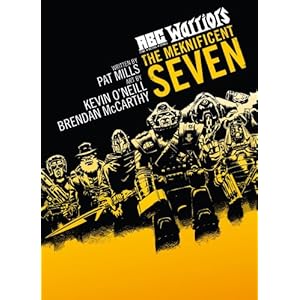
The ABC Warriors: The Meknificent Seven

What I try to do with reviews at this Bookshelf blog is keep it simple and spoiler-free, and let you know whether I'd recommend you pick up a copy of what I just read. Seems to work okay. This time, a brief review of The ABC Warriors: The Meknificent Seven (Rebellion / Simon & Schuster, 2010)


Among all seven gajillion or so of us who like reviewing "graaaaphic novels" and things on the internet, there's a subset who really enjoy the comic juxtaposition of elements that really occur best in the comic medium. Things like J. Jonah Jameson yelling at Godzilla, things like that. It still blows my mind that no publicist has sat these folks down, what with the big audience that they command, and shown them The ABC Warriors, a high-concept science fiction serial written by Pat Mills. It began in 1979 and new episodes have appeared every few years in the pages of 2000 AD. There's a bit in one of their earlier adventures, reprinted in this new American edition, in which war robots with bazookas ride around the deserts of Mars on the backs of tyrannosaurs.

Let me repeat that for the benefit of those not paying attention: ROBOTS WITH BAZOOKAS ON TYRANNOSAURS ON MARS. Drawn by Carlos Ezquerra. This is, in point of fact, the greatest thing to ever appear in fiction.

For those of you who haven't been paying attention, the ABC Warriors are a motley squad of war robots assembled in the waning days of a global conflict against the Volgan Empire. They include a cowboy robot, a sniper who communicates in bursts of letters and numbers, a Volgan general reprogrammed to obey allied commands but who retains his two-timing, traitorous nature and a shrouded, grinning maniac who puts that whole "sufficiently advanced technology indistinguishable from magic" business to the test. They are the coolest team of backstabbing, squabbling characters to appear in comics, and if they don't hypercharge your inner ten year-old, then you were obviously never ten.

The artwork on this initial series of 21 episodes was mainly provided by Mike McMahon, with guest appearances by Ezquerra, Kevin O'Neill, Dave Gibbons, Brett Ewins and Brendan McCarthy. About five years later, Alan Moore contributed the only episode of the long-running series that Mills did not write; it's illustrated by Steve Dillon and it makes its first appearance since its original outing in this new collection by Rebellion, distributed in the US by Simon & Schuster. The new book also includes a six-page framing story by Mills and O'Neill that originally appeared in Titan Books' old collection of this serial.

"The Meknificent Seven" has appeared in print many times before this, but the current edition is the first one aimed at mainstream bookstores, with the Alan Moore episode added as a sweetener for anybody wary about buying it again. It also includes a new foreword by Pat Mills and, as a supplement, five of the old "Fact Files" about the characters. These are really charming, and while the series has "grown up" along with its readers and more recent episodes are aimed more at adults, the "collect 'em all" nature of these pages reminds me that, once upon a time, this was the most awesome idea in kids' comics ever.

As I write this, the book has been out for about six weeks, and I'm a little concerned about the lack of publicity out there. I know that Mills was doing his usual awesome job of promotion in California last month, with signings at an area Barnes & Noble and an appearance at the San Diego Comic-Con, but somebody at Simon & Schuster really needs to start knocking down some doors to tell people that they're carrying these 2000 AD collections, and that they are fantastic. You can't rely on me; my audience is very small, and they almost never listen when I tell them to buy things. Get some review copies out, guys, because everybody in America needs to know that if they have a ten year-old boy in the house, or anybody else who remembers how hotdamned spectacular wild things like this were like when they were that age, then their house needs the ABC Warriors. Highly recommended.

Monday, March 22, 2010

Vworp Vworp! # 1

What I try to do with reviews at this Bookshelf blog is keep it simple and spoiler-free, and let you know whether I'd recommend you pick up a copy of what I just read. Seems to work okay. This time, a brief review of Vworp Vworp! # 1 (2010)


Doctor Who Magazine has been running its tie-in comic for more than thirty years now, and it's usually been a terrific read. There have certainly been patches where it hasn't been as consistently entertaining as the TV show, but frankly, anybody who'd rather watch "Destiny of the Daleks" than read "The Star Beast," or watch "Terminus" over reading "The Stockbridge Horror" just needs their head examined.

It's for people who know that the comic is as vital and engaging a part of Doctor Who's canon as anything else in the fiction that Vworp Vworp!, a fanzine co-edited by Colin Brockhurst and Gareth Kavanagh, is intended. The first in a planned periodic series, the zine is a loving tribute and analysis of the comic. Just like British newsstand comics from the 1970s, it even comes with a free gift - a set of rub-on transfers of the Eleventh Doctor, Amy and some Daleks, drawn by Paul Grist!

Inside, I quickly realized that the writers really know their target audience. The writing, like the best work in Doctor Who Magazine, expertly strides the line between "academic analysis" and "huggingly enthusiastic." The story of "The Iron Legion," the magazine's first serial, is told via interviews with Pat Mills, Dave Gibbons and original editor Dez Skinn, and would not be at all out of place in the professional magazine that they're praising. The writers also turn their attention to the final Eighth Doctor strip, "The Flood," and to Adrian Salmon's thunderously weird "Cybermen" serial. There's a tribute from the magazine's archivist, Andrew Pixley, and David J. Howe resurrects his early '90s "Collectors Corner" feature, designed to look like it came right from an old issue.

There are three new comic strips as well. None of them are necessarily essential, but I enjoyed all of them just the same. "The Master's Life on Mars," by the zine's co-editor Kavanagh and John Daiker, was my favorite of the three. It's a clever little runaround that fiddles with the resume of the last actor to play the Master on television. Daryl Joyce's "Clash of Empires" and Christian Cawley and Justin Abbot's "Time Leech" are also very fun. I think that Joyce has been doing professional work for some time, but there's no reason why the other creators couldn't be doing work for the big leagues pretty soon as well; it's all high-quality stuff.

Overall, it's a really good-looking package, very slick and professional. (It's easy to forget just how terrific fanzines can look these days!) Brockhurst's design work is really impressive, and they're able to cram buckets of entertaining and insightful material into the eighty pages. I enjoyed it all very much and will certainly return to it frequently. Very highly recommended to all Doctor Who fans.

Sunday, July 12, 2009

Wednesday Comics # 1

Here's how this works. I read a book or two and tell you about them and try not to get too long-winded. This time, a review of Wednesday Comics # 1 (DC, 2009).


Well, this is almost terrific. With Wednesday Comics, DC is trying a very interesting experiment, showing off fifteen new stories in an oversized format, like the Sunday funnies used to be. It folds out twice to newspaper size, and each feature gets its own page, for fifteen serialized stories.

It's not completely perfect, and I think fans will be spending the next twelve weeks Monday morning-quarterbacking things they might have done differently. I think they missed a trick by insisting all fifteen be serialized adventure stories; surely they could have given the space to the incoherent Wonder Woman feature over to a classic kid's comedy like Stanley and His Monster. The first issue also suffers from each being a set-up page. It might have been nice to join one adventure already in progress. The Flash story almost accomplishes this, and it's pretty fun. Best of all, the stories are continuity-free. That the publisher has spent the last forty years hammering the characters into one timeline is irrelevant here; it's presented as fifteen separate storyline.

Highlights include Kyle Baker's completely awesome Hawkman story - and no, I don't think I've ever used the phrase "completely awesome Hawkman story" in my life before - along with Paul Pope's gorgeously designed Adam Strange tale, which does suffer from some truly ugly lettering. I like Brian Steelfreeze's art on Catwoman a lot, and Jimmy Palmiotti and Amanda Conner's Supergirl looks like it's going to become a very fun tale. Dave Gibbons scripts a Kamandi story that will probably be great reading, but while Ryan Sook's artwork is really lovely, I can't help but wish Gibbons drew it as well.

Neil Gaiman and Mike Allred are off to a good beginning on Metamorpho, and while Joe Kubert's Sgt. Rock starts a little slower than most of the other features here, you know that Kubert on Sgt. Rock is always worth looking at. I only disliked two of the pages - Wonder Woman and Teen Titans, so that's a pretty good batting average. At $4, the price point feels a bit high, but then again, I think everybody in the house is going to enjoy this comic, so it's probably worth it.

Monday, May 4, 2009

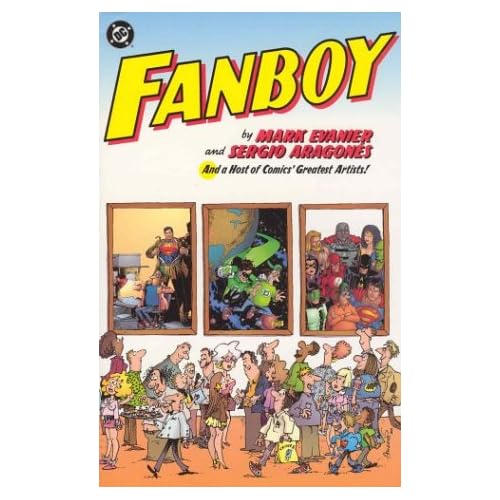
Fanboy

Here's how this works. I read a book or two and tell you about them and try not to get too long-winded. This time, a review of Fanboy (DC, 2001).


When Fanboy, a very silly miniseries by Mark Evanier and the great artist Sergio Aragonés, set in the sidelines of the DC Universe and featuring a hero-obsessed comic shop employee fighting censorship and being oblivious to the girl who loves him, was originally released in 1999, I was not interested in trying it. That's despite all the fun guest art by the likes of Russ Heath, Gil Kane, Dave Gibbons, Brian Bolland and Bruce Timm illustrating various fantasies and daydreams of our hero, the geeky Finster. I plead being a boring person and not really noticing it, and not having been led back to the usual Mad Magazine gang of idiots by my son yet.

Well, three months back, we went to see the artist give a lecture and receive the Jack Davis Distinguished Artist award at UGA and popped by Bizarro Wuxtry beforehand so that my son could get something new signed beyond the older books he owns. (You did read about that, didn't you?) Bizarro had the collected edition of Fanboy along with several of Sergio's other books, so I bought a copy for my son, and he finally let me read it a couple of weeks ago.

I think the most honest way to describe this book is that it's incredibly sweet, with a relaxed pace and a desire to make readers smile. I don't believe I laughed out loud while reading it, but I spent a lunch hour with it and grinned from start to finish. There are points where the motions are not at all original - hey, Finster, guess what, the girl you're crazy about will never feel the same for you - but it's all done with such style and such a light touch that it seems fresh and different. In some ways, it feels like the inverse of Kyle Baker's fabulous Plastic Man comic from a few years back. There, Baker was bludgeoning the sacred cows of the DC Universe in a wild, over-the-top manner. Aragonés and Evanier's decision to gently tease conventions results in something nowhere as raucous, but nonetheless very satisfying. Recommended for all ages.

Thursday, March 5, 2009

The Complete Ro-Busters

In other news, Rebellion continues to impress with their graphic novel collection. Sometimes, they announce a project which doesn't sound like the most exciting book on the shelf, but then the finished product turns out to knock your socks off. That's the case with The Complete Ro-Busters, which does exactly what it claims on the front and compiles absolutely every strip appearance of Hammerstein, Ro-Jaws and the gang from the pages of both Starlord, where the series began, and 2000 AD. The Ro-Busters, as I described 'em over at Touched by the Hand of Tharg, are "a disaster recovery crew along the lines of International Rescue from Thunderbirds, only they are staffed by a crew of robots (chief among them our lead characters Ro-Jaws and Hammerstein) and they are by no means as charitable as the Tracy boys had been. Mr. Ten Percent (so named because only ten percent of him, his brain, was human) charges for the dangerous work his droids perform."

That Ro-Busters should have developed into anything memorable is something of a miracle. The series was created by Pat Mills to fill some editorial request for something about planet-saving superheroes. Since Mills, as anybody who's read Marshal Law could figure, has never had much time for the concept of superheroes, he turned the idea on its head and decided to have the disaster squad staffed, not by noble, selfless people, but by the most expendable of characters: junked-out robots in line for the scrapheap, bought dirt-cheap by a greedy jerk in need of cheap labor to exploit.

Anyway, Ro-Busters is certainly dated, and from the outset feels very much like a comic strip for children, especially in a ridiculous story in which two people disguise themselves as robots in order to start a rebellion on board a casino in space, but it's incredibly fun! The writing did tighten up around the time it moved to 2000 AD, with an engaging mix of class comedy and homages to war comics before the wild lunacy of the final storyline, in which the doomed robots try making a break for a planet where they can be free. But before that frantic conclusion, there's a great story in which Ro-Jaws and Hammerstein are sidetracked for a tale in which one of Mr. Ten Percent's other business ventures show up. A demolition squad called the Terra-Meks, they turn out to be the villains of the piece. Four episodes of utterly gorgeous giant robot violence and mayhem, set against the backdrop of a dying coastal community and its giant robot lighthouse guardian, might be the book's high point.

The book is just tremendous fun, and if Rebellion actually missed an episode anywhere, it'll be news to me. It includes work by other writers besides Mills, including three by Alan Moore, who wrote yearly one-offs for the pages of the 2000 AD Annual in the mid-80s after the series had otherwise concluded. Artists include Steve Dillon, Dave Gibbons, Mike McMahon, Kevin O'Neill and Carlos Pino. Every bookshelf should have one.

(Excerpted from Thrillpowered Thursday, March 5 2009.)

Friday, May 23, 2008

World of Weird and World of Indigo

Here's how this works: I finish reading something, and I tell you about it, and I try not to bore you to death. Today: reviews of Duke Étrange's World of Weird (Nova-X, 2008) and Greyshirt: Indigo Sunset (America's Best, 2003).


"Hey, Pops - Just 'cause the man hits the stick don't mean that the great green cheese ain't gonna rain down 'pon your knowledge box, you dig?" A comic so cool it comes with its own CD-R soundtrack of cah-razee garage rock, Duke Étrange's World of Weird is a 48-page anthology which pays tribute to 1950s EC horror books, but played through the sensibilities of hyperbolic sixties Marvel Comics. Contributors include Leah Moore, John Reppion and rising 2000 AD stars Al Ewing and Nick Dyer, along with small press vets Ed Berridge, who spearheaded this madness, Omnivistascope's Paul Scott and Richmond Clements.

The book leads with one of its strongest strips, Ewing and Brian Coyle's "Frightening Force," a three-page merry Marvel pastiche which reworks Universal monsters into a misfit, angst-ridden Lee & Kirby superhero team. There's a strong sense of affection for America's B-culture throughout the book, from the bombastic 1950s sci-fi world of "National Socialists from Beyond the Moon" to "One Man and His Dog," which evokes a certain horrible movie with Rosey Grier and Motherfuckin' Ray Milland that I've been known to mention a time or two. There are utterly goofball advertisements and over-the-top editorializing, and great fun from start to finish.

The comic will set you back only £3 and will be available at better cons and shops in the UK. The publishers don't seem to have a web page for ordering yet, but I can put you in touch with one of the groovy hepcats behind the shenanigans if you want to get with the scene, daddio.

A complementary copy of this comic was provided to The Journal of Zarjaz Things for the purpose of review.


You know, I just do not read enough Rick Veitch. This is a completely wonderful book starring one of the supporting characters from Alan Moore's America's Best Comics line. Greyshirt is an homage to Will Eisner's The Spirit, a well-dressed vigilante fighting organized crime in the violent streets of Indigo City.

Veitch, who illustrated Greyshirt's appearances in the pages of Tomorrow Stories, took up both script and art chores for this six-part series. Masterfully, the book suggests to the reader that it's an anthology book with contributions from Dave Gibbons, Frank Cho and others, but gradually all of the disparate elements begin to come together, and the audience realizes that characters and story elements introduced in sections set in other times and places are part of an ongoing "present" narrative, and that the "newspaper" section at the end of each issue provides much more than just local color...

Honestly, I've never been a fan of Veitch's style and his disagreeably ugly people, but his layouts, pacing and storytelling are eye-popping. Indigo Sunset is a deceptively simple book, one which uses the format in an incredibly innovative way and which I recommend highly. Veitch is currently working on a Vertigo series called Army@Love which I intend to look at soon.

(Originally posted May 23, 2008 at hipsterdad's LJ.)

Sunday, February 3, 2008

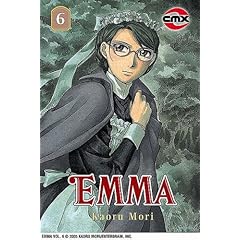
Emma vol. 6 and Watchmen

Here's how this works: I finish reading something, and I tell you about it, and I try not to bore you to death.


The "dark" installment, where everything hits the fan. William finally stands up to his old man in an intensely cool sequence with the two of them shouting at each other for pages. On the other hand, Emma's quiet passivity is really grating this time around. The art's sumptuous and beautiful, but I don't understand what William ever saw in her in the first place. Backbone, people! Spine! Moxie! Recommended with reservations.


What was this, the fourteenth or fifteenth time I read this? It remains a masterpiece of construction and foreshadowing full of genuinely great characters, but it satisfies a little less each time I read it. I don't read all the pirate stuff every time, but I realized this time the main reason I want to skip them is because those damn captions are the most turgid, overwrought things in the book. It might make a good movie, but I don't know that a contemporary audience is going to buy the almost immediate armistice the way we did twenty years ago. Recommended, but not for younger readers.

Incidentally, whatever happened to that comic book with the Art Adams promotional art with Batman punching Rorschach? Did that come out yet?

(Originally posted February 03, 2008 at hipsterdad's LJ.)