Showing posts with label mike mcmahon. Show all posts

Sunday, September 16, 2012

Judge Dredd: The Day the Law Died

What I try to do with reviews at this Bookshelf blog is keep it simple and spoiler-free, and let you know whether I'd recommend you pick up a copy of what I just read. Seems to work okay. This time, a brief review of Judge Dredd: The Day the Law Died (new edition, Rebellion, 2012).


I must admit that I am of two minds about this new collection of this lengthy Judge Dredd story, first published in 1978-79. "The Day the Law Died" is a pretty over-the-top epic in which a powerful senior judge who has completely and absolutely lost his marbles takes control of the city. Thousands of judges, brainwashed and bent to his will, go right along with him. Dredd, who had been out of the city for several weeks on a major mission across the country, had been missing out on the early stages of the brainwashing treatment and needs to be taken out. Soon, the city's top lawman is a wanted criminal, waging a guerilla war against a wild lunatic who gets advice from a goldfish.

Two years previously, the actor John Hurt had portrayed the insane Caligula in the BBC-TV adaptation of I, Claudius, and this, naturally, was the inspiration for this story. Chief Judge Cal - never "Judge Caligula," although that was the name of the original Titan Books repackaging of this story - instantly became one of the all-time great Dredd villains, with his every macabre and ridiculous whim passing into legend. At one point, Cal decides that he wants to make sure one of his lackeys is always there to please him, so he has him pickled. Somebody at the original publishers, IPC, was infuriated by this, fearing that children might attempt to copy it, somewhat missing the point that children have limited access to eight-foot tall jars or quite that much vinegar.

Rebellion's newest packaging of this story is in a new line of "manga-size" reprints, proving that there's no trend that can't be jumped upon six years after the iron is hottest. While I applaud the publisher for branching out and looking for attention outside the traditional comic audience, with our expectations for how reprints should be packaged, and genuinely hope that Barnes & Noble's buyers can be persuaded that this line can easily, and should be, shelved alongside everything else in the "manga" section of their stores, it is not a format that flatters the artwork. Digest reprints have always been tricky things since the artwork is shrunk down so much. With much more detail, and more panels per page, than American comic books of the period, these really lose some luster shrunk down so very small. It's certainly true that art by Brian Bolland, Brett Ewins or Ron Smith looks at least pretty good at any size, but you may need to have a lens ready to read the lettering. Or perhaps I'm just getting old.

This edition is recommended for newcomers or for completists. As the story is available in a larger format in the second volume of The Complete Case Files, however, I'll stick with that when I wish to return to it.

Monday, August 30, 2010

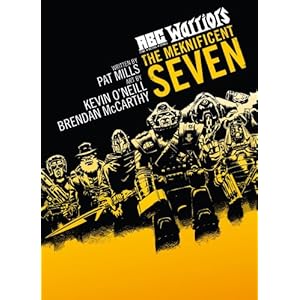
The ABC Warriors: The Meknificent Seven

What I try to do with reviews at this Bookshelf blog is keep it simple and spoiler-free, and let you know whether I'd recommend you pick up a copy of what I just read. Seems to work okay. This time, a brief review of The ABC Warriors: The Meknificent Seven (Rebellion / Simon & Schuster, 2010)


Among all seven gajillion or so of us who like reviewing "graaaaphic novels" and things on the internet, there's a subset who really enjoy the comic juxtaposition of elements that really occur best in the comic medium. Things like J. Jonah Jameson yelling at Godzilla, things like that. It still blows my mind that no publicist has sat these folks down, what with the big audience that they command, and shown them The ABC Warriors, a high-concept science fiction serial written by Pat Mills. It began in 1979 and new episodes have appeared every few years in the pages of 2000 AD. There's a bit in one of their earlier adventures, reprinted in this new American edition, in which war robots with bazookas ride around the deserts of Mars on the backs of tyrannosaurs.

Let me repeat that for the benefit of those not paying attention: ROBOTS WITH BAZOOKAS ON TYRANNOSAURS ON MARS. Drawn by Carlos Ezquerra. This is, in point of fact, the greatest thing to ever appear in fiction.

For those of you who haven't been paying attention, the ABC Warriors are a motley squad of war robots assembled in the waning days of a global conflict against the Volgan Empire. They include a cowboy robot, a sniper who communicates in bursts of letters and numbers, a Volgan general reprogrammed to obey allied commands but who retains his two-timing, traitorous nature and a shrouded, grinning maniac who puts that whole "sufficiently advanced technology indistinguishable from magic" business to the test. They are the coolest team of backstabbing, squabbling characters to appear in comics, and if they don't hypercharge your inner ten year-old, then you were obviously never ten.

The artwork on this initial series of 21 episodes was mainly provided by Mike McMahon, with guest appearances by Ezquerra, Kevin O'Neill, Dave Gibbons, Brett Ewins and Brendan McCarthy. About five years later, Alan Moore contributed the only episode of the long-running series that Mills did not write; it's illustrated by Steve Dillon and it makes its first appearance since its original outing in this new collection by Rebellion, distributed in the US by Simon & Schuster. The new book also includes a six-page framing story by Mills and O'Neill that originally appeared in Titan Books' old collection of this serial.

"The Meknificent Seven" has appeared in print many times before this, but the current edition is the first one aimed at mainstream bookstores, with the Alan Moore episode added as a sweetener for anybody wary about buying it again. It also includes a new foreword by Pat Mills and, as a supplement, five of the old "Fact Files" about the characters. These are really charming, and while the series has "grown up" along with its readers and more recent episodes are aimed more at adults, the "collect 'em all" nature of these pages reminds me that, once upon a time, this was the most awesome idea in kids' comics ever.

As I write this, the book has been out for about six weeks, and I'm a little concerned about the lack of publicity out there. I know that Mills was doing his usual awesome job of promotion in California last month, with signings at an area Barnes & Noble and an appearance at the San Diego Comic-Con, but somebody at Simon & Schuster really needs to start knocking down some doors to tell people that they're carrying these 2000 AD collections, and that they are fantastic. You can't rely on me; my audience is very small, and they almost never listen when I tell them to buy things. Get some review copies out, guys, because everybody in America needs to know that if they have a ten year-old boy in the house, or anybody else who remembers how hotdamned spectacular wild things like this were like when they were that age, then their house needs the ABC Warriors. Highly recommended.

Wednesday, July 14, 2010

Judge Dredd: The Restricted Files 01

What I try to do with reviews at this Bookshelf blog is keep it simple and spoiler-free, and let you know whether I'd recommend you pick up a copy of what I just read. Seems to work okay. This time, a brief review of Judge Dredd: The Restricted Files 01 (Rebellion, 2010)


I guess that every so often, things work out for the best. You probably know that Rebellion has been publishing a series of "Complete Case Files" for the long-running Judge Dredd feature. (The first of these was finally released in a special edition for the US market just last month.) These include the stories from the weekly progs and, from the most recent volume, the monthly magazine, but they have skipped the stories from Fleetway's old hardcover Christmas annuals and summer special issues.

Fans had asked at the time to have the annual and special stories added to the Case Files collections as bonus features, but only a handful trickled in. Finally, however, Rebellion has given the stories a two-book collection of their own. The first volume covers the first seven years of extra features from these specials along with stories from the 2000 AD, Dan Dare and Dredd solo annuals. After a pretty shaky start, there is some amazing material in the first book.

About the first quarter of the 400-page collection is really more interesting to archaeologists than to contemporary fans. While Dredd's stories were settling down into a single continuity orchestrated by John Wagner, the annuals were typically churned out by Fleetway editors with just a glance at the source material. Several of the stories are uncredited, and some of the artwork bears just a faint resemblance to the source material. There's a tale about a city called "Mega-Miami" which looks like the city in the 1970s with a future cop running around, and a deeply unfunny, early attempt at a "House of Tharg"-styled crossover where most of 2000 AD's characters of the first couple of years throw a Christmas party in Dredd's apartment. It looks like the artist, Keith Page, knocked those six pages out before lunch.

But a hundred pages in, we get to the point where Alan Grant takes a job with Fleetway editorial and Wagner takes an interest in what's going on with these books. The greatness starts with a Steve Dillon-illustrated episode from 1980 and doesn't waver after that. It includes dozens of fully-painted pages by Mike McMahon and Carlos Ezquerra, along with Brian Bolland's "The Alien Zoo," possibly the only example of Bolland coloring his own work.

Some of these Wagner and McMahon collaborations had been compiled by Titan in a 1985 collection, but most of the book has never been reprinted. One of this duo's stories is a 16-pager called "The Fear That Made Milwaukee Famous," and it's wonderful, simply one of the wildest, goofiest and most inventive adventure comics I've ever read. In it, Dredd rides out in the desert to apprehend a mutant criminal who really does not want to be called "Chickenhead" and the two of them are besieged by thousands of skeletal ghosts of a dead city. Elements of this amazing story would resurface in the creators' later Last American miniseries.

Packed as it is with so many inventive and clever stories, none of which outstay their welcome, it's difficult to point out the highlights or notable moments. Interestingly, John Byrne has a short story in here as well. At the time, the artist was very popular for his Marvel Comics' work inked by Terry Austin. I don't know that there are many other examples from the period of Byrne inking himself, but his line was altogether too heavy back then, as it remains today. On the other hand, Byrne drew a really impressive Mega-City One, and I think it's a shame he did not contribute again.

Byrne at his best, however, is a wholly different prospect than McMahon or Dredd's co-creator Carlos Ezquerra. His pages are really thrilling and full of life and wild, vivid color. The scenes of Dredd and Cursed Earth cowboys warring against giant tarantulas are really impressive, and nobody draws unbelievably obese men eating themselves sick as well as he does.

It's likely that the strange and ill-formed Judge Dredd of the book's first quarter might put off new readers, and so this might not be a good introduction to the character unless you know the circumstances and jump over those stories. Skipping past them, it's a very solid 300 pages of excellent comics at a reasonable price, around $30 in the US. The production is up to Rebellion's very high standards, and the artwork is reproduced very faithfully on very nice paper. It's a labor of love and exactly what the fans had hoped for, and I recommend it very highly.

Thursday, April 2, 2009

The VCs: You're Hit, You're Dead!


In other news, while Rebellion tends to focus on releasing collections from more recent properties or big name characters, every so often they do head back to the comic's early days and surprise everybody with a great book full of thrillpower from the past. Such is the case with this new edition of The VCs. This is the original run of 32 episodes from 1979-1980. Most of the installments are written by Gerry Finley-Day, with a couple of fill-ins by Steve MacManus. The art is principally by Cam Kennedy, who contributed the cover, and Garry Leach. Mike McMahon drew the first episode and John Richardson the last five, but everything between them is by Kennedy or Leach. Probably nobody finds that as interesting as I do.

Anyway, The VCs is a pretty standard war story, just dressed up with aliens and spaceships in it. There's the green rookie, disliked by his new crew, and ugly enemies you can neither understand nor sympathize with, and trapped-behind-enemy-lines stories, and callous officers who probably interact with our heroes more than any other company in the military. That's not to say it's at all bad, but I reread this while continuing a once-a-week reread of Battle Picture Weekly produced during the same 1979-80 period and darned if this series couldn't have been flawlessly slotted into that comic. If you enjoy this style of comic storytelling, then The VCs will certainly please you, even if it's only rarely eye-opening.

Actually, I should probably qualify that: if you're coming to this from an American background, there's a lot more to this than simply "another war comic." I grew up reading DC's Sgt. Rock and The Haunted Tank, and later Marvel's G.I. Joe, with their casts of unkillable regular characters. Compared to these, British war comics are a complete revelation, with surprising fatalities among the cast. Any new reader coming to this collection will probably be pretty surprised by this story as it progresses.

There were 32 episodes of The VCs, but this is a pretty slim book, since the episodes were an unusually short 3-4 pages a week. It runs a little light on extras, since there were so few from the period. The strip was spotlighted on 2000 AD's cover only once, and there was a single star scan of the lead cast a few weeks after it finished, and those are included, but there are no other contributions from the period from any of the creators. In lieu of blank pages filling up too much of the back, the first episode of Finley-Day's better-known future war series, Rogue Trooper is included, but honestly, I'm hard pressed to imagine anybody buying this collection who hasn't already read the first Rogue episode plenty of times already. That's not to say that I don't think potential readers are out there, and I hope you'll give it a read, just that I'm not really sure this was the best use of the pages in the back when a new interview would have been very nice.

(Excerpted from Thrillpowered Thursday.)

Thursday, March 5, 2009

The Complete Ro-Busters

In other news, Rebellion continues to impress with their graphic novel collection. Sometimes, they announce a project which doesn't sound like the most exciting book on the shelf, but then the finished product turns out to knock your socks off. That's the case with The Complete Ro-Busters, which does exactly what it claims on the front and compiles absolutely every strip appearance of Hammerstein, Ro-Jaws and the gang from the pages of both Starlord, where the series began, and 2000 AD. The Ro-Busters, as I described 'em over at Touched by the Hand of Tharg, are "a disaster recovery crew along the lines of International Rescue from Thunderbirds, only they are staffed by a crew of robots (chief among them our lead characters Ro-Jaws and Hammerstein) and they are by no means as charitable as the Tracy boys had been. Mr. Ten Percent (so named because only ten percent of him, his brain, was human) charges for the dangerous work his droids perform."

That Ro-Busters should have developed into anything memorable is something of a miracle. The series was created by Pat Mills to fill some editorial request for something about planet-saving superheroes. Since Mills, as anybody who's read Marshal Law could figure, has never had much time for the concept of superheroes, he turned the idea on its head and decided to have the disaster squad staffed, not by noble, selfless people, but by the most expendable of characters: junked-out robots in line for the scrapheap, bought dirt-cheap by a greedy jerk in need of cheap labor to exploit.

Anyway, Ro-Busters is certainly dated, and from the outset feels very much like a comic strip for children, especially in a ridiculous story in which two people disguise themselves as robots in order to start a rebellion on board a casino in space, but it's incredibly fun! The writing did tighten up around the time it moved to 2000 AD, with an engaging mix of class comedy and homages to war comics before the wild lunacy of the final storyline, in which the doomed robots try making a break for a planet where they can be free. But before that frantic conclusion, there's a great story in which Ro-Jaws and Hammerstein are sidetracked for a tale in which one of Mr. Ten Percent's other business ventures show up. A demolition squad called the Terra-Meks, they turn out to be the villains of the piece. Four episodes of utterly gorgeous giant robot violence and mayhem, set against the backdrop of a dying coastal community and its giant robot lighthouse guardian, might be the book's high point.

The book is just tremendous fun, and if Rebellion actually missed an episode anywhere, it'll be news to me. It includes work by other writers besides Mills, including three by Alan Moore, who wrote yearly one-offs for the pages of the 2000 AD Annual in the mid-80s after the series had otherwise concluded. Artists include Steve Dillon, Dave Gibbons, Mike McMahon, Kevin O'Neill and Carlos Pino. Every bookshelf should have one.

(Excerpted from Thrillpowered Thursday, March 5 2009.)

Thursday, December 11, 2008

The ABC Warriors: The Third Element

In other news, Rebellion recently released the fifth in a series of slim ABC Warriors collections, this one reprinting the 15-part "Return to Mars" serials under the title The Third Element. We haven't made it to this point in the Thrillpowered Thursday reread, and so I'll save the really juicy-but-sad behind-the-scenes drama that fueled this unhappy storyline until then, and just focus on the book itself.

To be honest, the previous two ABC Warriors books were a little underwhelming for one reason or another, and this one really gives off a glow of failed promise and expectations. When it works, it works incredibly well: the return of Mike McMahon to these characters after twenty-odd years and heaven-only-knows how many style changes is an absolutely fascinating curiosity, and Henry Flint, currently illustrating a Haunted Tank miniseries for Vertigo, turns in some terrific artwork. But Boo Cook's first pro job is frankly a mess, miles removed from what he'd later prove capable of creating, and Liam Sharp apparently abandoned all of his professional tools in favor of two Sharpies and a Bic ballpoint.

Pat Mills' script is almost enough to hold it together, because he's once again running with lunatic ideas and throwing lots of them at the wall in furious sequence. But everything that does catch your imagination here is abandoned too quickly, and each three-episode storyline would have greatly benefitted from an extra week to breathe. On the other hand, three episodes for each piece is somewhat appropriate for a story about three-legged tripod critters on Mars, I suppose.

(Excerpted from Thrillpowered Thursday, Dec. 11 2008)