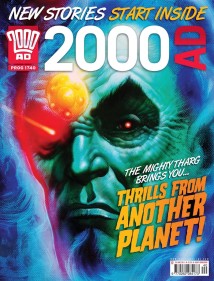
Showing posts with label john wagner. Show all posts

Tuesday, June 2, 2015

Strontium Dog: The Stix Fix

What I try to do with reviews at this Bookshelf blog is keep it simple and spoiler-free, and let you know whether I'd recommend you pick up a copy of what I just read. Seems to work okay. This time, a brief review of Strontium Dog: The Stix Fix (Rebellion, 2015).


It has been a long time since I really enjoyed a Strontium Dog adventure. Five years ago, creators John Wagner and Carlos Ezquerra began one of the series' biggest-ever epics, a 40-episode beast called "The Life and Death of Johnny Alpha." It was divided into four ten-part chunks and I only liked the first of them. I liked it a whole lot, mind you, especially the really interesting, revisionist death of a supporting character, which was the sort of thing that you never, ever see in mainstream American comics. (You can read my take on that fabulous turn of events over at my defunct blog Thrillpowered Thursday.)

But after that, I felt that the story lacked punch and energy, and meandered its way to a shrug-inducing, rushed conclusion. That's why I'm so happy that the newest Johnny Alpha adventure, a ten-parter called "The Stix Fix," is flatly the very best Stronty Dog story in ages. I loved this completely, and it's been the runaway highlight of the last three months of 2000 AD. Well, the latest Grey Area stories have also been terrific, yeah, but each absurdly thrill-packed chunk of this story had me immediately flipping back to read it again, because just so darn much is happening in every six pages that I was certain I was missing bits.

The story opens with some members of the stone-cold, taciturn Stix clan abducting a high-level government muckity-muck from a thinly-veiled North Korea analogue. So the British government, bastards all, ask Johnny Alpha to get on the trail, because Alpha's had dealings with Stixes a time or three before. From there, it's an absurdly dense rollercoaster of a story, with aliens and clans and bad guys all drawn with broad brushes, a trick which always works with Wagner and Ezquerra. The Jong family, you won't be surprised to learn, are all trigger-happy lunatics with very short tempers, and there's certainly a Stix who will discreetly sell out his kinfolk.

But despite the tropes and generally comfortable beats in the characterization, this story goes everywhere and it moves incredibly quickly. It's one of the fastest-paced of all the many Strontium Dog adventures, and that's saying something. As I began reading the eighth episode, I was completely baffled as to how in the world it was going to wrap up with only another eighteen pages to go, until that episode ended with a wonderfully brilliant twist. It was punch the air perfect, the best kind of twist, the one you didn't know was coming, built from very fair clues that I just didn't think were clues at all.

Recommended? Absolutely; it's flawless, one of the very best, funniest, most entertaining and unpredictable Stronty Dog stories ever. Click the image to buy the issue with episode one from 2000 AD's online shop and continue from there.

Wednesday, January 28, 2015

Judge Dredd: Dark Justice

What I try to do with reviews at this Bookshelf blog is keep it simple and spoiler-free, and let you know whether I'd recommend you pick up a copy of what I just read. Seems to work okay. This time, a brief review of Judge Dredd: Dark Justice (Rebellion, 2014-15).


John Wagner did not make this easy on himself. In the 1980s, the supernatural Dark Judges were recurring, albeit overused foes in the Judge Dredd strip, culminating in the epic, gruesome 1990 serial "Necropolis." That really should have been the end for the characters, but they spent the 1990s showing up way too frequently, their horror sidelined for broad black comedy. They've only appeared very sporadically since, played straight and played horrific, but the malady lingered on, you know? I mean, did the world really need another Judge Death story?

Well, Death and his gang have returned in an eleven-part story that began last month and is about at the halfway point now, and it's amazing. The art, very old school fully-painted, is by Greg Staples, and it's just gorgeous. This story was announced in 2013 and some of us - like me - started grousing about the time it took to appear, but this was really worth the wait. It's exceptional work across the board.

The story picks up some dangling plot threads and, halfway through, has just barely addressed them, leaving me hungry for more backstory. Judge Death himself was last seen nuked into another dimension, but a brief flashback showed him back in Mega-City One, looking for his trapped brothers. There's a world of intrigue behind that that I could go into but won't; briefly, he pilfers their spirit forms and takes off on a colony ship bound for a distant world.

Judges Dredd and Anderson are about two weeks behind, unable to stop the carnage when Death and his gang all resurrect themselves with their bizarre superpowers and start mass slaughter. At about the halfway point, our heroes finally catch up to them, but too late to save the colonists, and are trapped on board the spaceship, cut off from resources and help, surrounded by the dead...

It's not all doom and gloom, but in this story, Wagner very sensibly let the humor arise from the colony ship and their foibles, keeping reader attention and sparking some smiles before things go straight to hell, and it's been a mean and ugly action-adventure thriller ever since the third episode. As things get bad, there are still dozens of questions to be addressed, including the whereabouts of another one of Dredd's old enemies, who I'd have guessed would have appeared in this story by now, and what the Dark Judges were thinking, engineering a ssssssituation where everybody's trapped on the stranded colony ship. I have the ugly feeling that this is going to get a lot worse before it gets better.

"Dark Justice" is appearing weekly in 2000 AD, beginning in Prog 2015 and continuing through progs 1912-1921. Click the image above to visit the comic's online shop and order your thrillpower!!

This story is written in memory of my pal, longtime squaxx dek Thargo Mike Horne of Boston, who passed away last weekend after suffering a stroke in November. Mike wasn't able to read any of this story, which is a damn shame. We'll miss you, Mike.

PDFs of these issues were provided by the publisher for the purpose of review. If you'd like to see your books (typically comics or detective fiction) featured here, send me an email.

Tuesday, June 24, 2014

Judge Dredd: The XXX Files

What I try to do with reviews at this Bookshelf blog is keep it simple and spoiler-free, and let you know whether I'd recommend you pick up a copy of what I just read. Seems to work okay. This time, a brief review of Judge Dredd: The XXX Files (Rebellion / Simon & Schuster, 2014).


I wasn't completely sure I believed that a book like this would work, or read well. As part of their co-publishing strategy with Simon & Schuster, 2000 AD's publisher has assembled a really strange collection of Judge Dredd episodes. They basically identified either every story with a bare butt or breasts in it, along with a few others that deal with sex in the 22nd Century, and gave them this very fun and very neat presentation. It's a very nice and expansive 224 pages, and it doesn't drag in quite the way that I thought it might.

By that I mean, sure, there have been longer collections of Dredd before, but they're either linked by continuity, in which you get a long run of episodes from the same time period, or by artist, where you've still got a strong visual link. This book is just barely linked by anything. It has episodes from here and there across a quarter century stretch, with supporting players who were major points of interest for a few years making a single, somewhat strange appearance outside of their context.

The obvious example here is Judge Jura Edgar, the sinister head of Mega-City One's "Public Surveillance Unit," which turned out to be an ominous prediction of our own NSA. Edgar shows up in the triumphantly cool noir story "Sleaze," which was originally published during a curious time in 2000 AD's sister book Judge Dredd Megazine's life. Fleetway, then the publisher, was set to cancel that title for low sales in the wake of that boom that they expected in '95 and the movie with Sylvester Stallone that tanked. In a desperate move to cut costs and make it profitable, for a couple of years, there was only a single, 17-page Dredd episode in each issue, and reprints of "mature readers" comics, principally Vertigo's Preacher, bulking it up. So on the one hand, the creators - this one's written by John Wagner and painted by John Burns - had more freedom to explore darker and more mature stories, and on the other, there was a much greater public interest in government conspiracies at that time. Most of this book is silly, fun, and occasionally a little bawdy, but "Sleaze" is about the judges holding onto evidence of corruption and vice in order to keep the citizen councils under their thumbs. It really sticks out, and I really love that. It should remind readers that Judge Dredd is not a series that can be pigeonholed as an action strip or a comedy or a parody or a procedural. It evolves and changes all the time.

As for most of the book, it's very silly and fun. Most of it is written by Wagner, who has a ball dropping Dredd into situations where human lust and foolishness leads them to make bad decisions. The first three episodes are the three installments of "Love Story," drawn by Ian Gibson and published over a twenty-year stretch. Bella Bagley is an unfortunate, mentally ill woman who believes that Dredd is her boyfriend. Her desperation leads her into becoming increasingly unhinged and violent. I got the feeling that the brilliantly talented Gibson really loved working on these stories and gave them far more than his usual level of great detail, to the point that when Bella meets her inevitable end, he couldn't bear to draw the details of the bullet wounds.

Lots of other really terrific artists contribute to the book. Apart from Gibson and Burns, who does sterling work, Carlos Ezquerra, Greg Staples, Cliff Robinson, and Vince Locke are all here and they all have great stories. Ezquerra's "The Girlfriend" has always been a favorite, and Gibson gets to draw the blazes out of a hilarious story where Dredd is arresting people behind the scenes of a TV dating game. Lots of the stories here are really funny. Sex tends to be. That's the right attitude. I'd say recommended for everybody, but only if you're understanding that boys will be boys, and some of them are going to want to rush their new acquisition upstairs as soon as they get home. For older readers, then.

A PDF of this book was provided by the publisher for the purpose of review. If you'd like to see your books (typically comics or detective fiction) featured here, send me an email.

Saturday, May 3, 2014

Banzai Battalion: Just Another Bug Hunt!

What I try to do with reviews at this Bookshelf blog is keep it simple and spoiler-free, and let you know whether I'd recommend you pick up a copy of what I just read. Seems to work okay. This time, a brief review of Banzai Battalion: Just Another Bug Hunt! (Rebellion / Simon & Schuster, 2014).


I haven't checked in with the world of 2000 AD in far too long a time. I'm glad to see that the venerable comic's association with American publisher Simon & Schuster is still going strong, and that they're releasing good collections aimed at this market. One of the most recent is the 160-page complete collection of John Wagner's Banzai Battalion. This reprints every one of the characters' appearances, along with a few somewhat similar Judge Dredd episodes - similar in that they also feature robots - by many of the same creators.

The cover of this collection, originally used for their second story in March of 2000, features a wonderfully old-fashioned composition by Cliff Robinson which evokes any number of 1980s IPC comics. The little gunmen are the action figure-sized heroes of Banzai Battalion, who had two run-ins with Judge Dredd. They are actually semi-sentient pest control droids who keep finding themselves thrown into situations where human criminals become the pests they need to stamp out

A strip like Dredd requires an astonishing number of new concepts and new scenarios thrown at it every week, and every so often the new supporting players take on a life of their own. Wagner and Henry Flint crafted the Battalion's first appearance in 1999, giving the little robots the over-the-top personalities of older war comic heroes. Captain Bug Stomper - "He's a legend in pest control!," people keep telling us - tries to do things by the book, until his men persuade him to charge into glory for the greater good.

A year later, they returned in another Dredd story, this time drawn by the amazing Cam Kennedy. Since their human owners died during one of the Dredd world's occasional catastrophes, and since they keep making themselves useful, the droids are sent by Dredd to join Justice Department in some capacity, but when they reappeared in their own series in 2001, they had to take the initiative to strike out on their own.

Now drawn, brilliantly, by Ian Gibson, the resulting story is a very silly, over-the-top homage to old war comics, with the blustery, true-blue Captain Bug Stomper leading his troops on an expedition through Mega-City One that leads them to a wonderful new garden in which to fight insects. The garden, introduced more than fifteen years previously in a memorable Dredd adventure, becomes the battleground for rival teams of robots and a cute parody of another old comic character, IPC's General Jumbo. As leads, Stomper and the team were kind of limited, and their appearances run to a total of only 19 episodes, but they're clever and hilarious. The artwork is consistently first-rate, and I love the masterful way that Wagner mixes both knowing parodies and old continuity. Neither is essential for following the adventures, but they are mind-blowing little Easter eggs for old fans.

There are many things to love about the Judge Dredd universe, and one of them is the way that the series can wear different hats and be an action strip one week, a grim drama the next, and detective fiction the next. For readers who enjoy the bonkers, oddball comedy of the future, then this is a terrific book, certain to leave you laughing aloud and very impressed with Wagner's skill at making this weird, wild world work. Highly recommended.

A PDF of this book was provided by the publisher for the purpose of review. If you'd like to see your books (typically comics or detective fiction) featured here, send me an email.

Thursday, June 20, 2013

Star Wars Omnibus: Boba Fett

What I try to do with reviews at this Bookshelf blog is keep it simple and spoiler-free, and let you know whether I'd recommend you pick up a copy of what I just read. Seems to work okay. This time, a brief review of Star Wars Omnibus: Boba Fett (Dark Horse, 2010).


I don't envy anybody who's ever tried to collect Dark Horse's sixty-eleven different Star Wars titles. Even accepting that there's a fair stereotype that Star Wars fans are known for being very detail-oriented, the publisher has released such a bewildering array of different limited series, one-shots, special editions, and anthology / umbrella titles with so many creators that even the most ardent of the property's fans must find it daunting. I have only the mildest curiosity for Star Wars, but I really do like the work of four creators who have material in this Omnibus edition. The Dark Horse Omnibus line is a really great one. They're assembled with care, on good paper, slightly shrunk from the original comics, but 500 pages for $25 is a very good deal, especially since, unlike similar repackaging from Marvel and DC, these are in the original color.

It appears that since the editors of these zillion-odd comics never wanted to do a simple continuity, but rather commission writers and artists to tell various stories of the many characters of the Star Wars universe at random points in their lives, the only sensible way to collect them was to break them into Omnibus editions centered on specific characters. I saw this Boba Fett book on sale at Great Escape in Nashville, remembered reading that John Wagner and Cam Kennedy had worked on the character for Dark Horse, and flipped through it. What I found was a heck of a lot of Kennedy work, along with art by Ian Gibson and Carlos Ezquerra. Sold.

Even though these creators, combined, contributed only about half the pages in the book, it was still a steal because these are some tremendously good stories. The others were less important to me, but I enjoyed all of those but one. "The Yavin Vassilika" has a pretty fun "treasure hunt" story written by Mike Kennedy, but the artwork by Carlos Meglia was eyeball-punching. It's set before the first movie, and I'm not sure whether the "Young Kewl Anime Doodz" designs for Han, Lando and the bounty hunters just stank overall, or whether I was distracted by Young Han Solo's hairy chest drawn to look like it has spiky black bugs all over it, or whether the depiction of Young Greedo did me in. Greedo looks like a five year old kid in a Halloween costume.

So yes, a full fifth of the book is unpleasant to look at, but the rest is a joy, and I say that as someone with very little interest in this property. Cam Kennedy just draws the absolute hell out of his stories, with perfectly balanced fight choreography and brilliant design work for all the weird technology. I love his Fett, dominating every scene with his unspeakable badassery even in long shot. Ian Gibson, whom I've been said to admire even more than Kennedy generally, can't hold a candle to Kennedy in the Star Wars universe. Gibson certainly does get things off to a good start with "Enemy of the Empire" before abandoning it before the climax (not the last time he'd pull that stunt), but he's not a patch on Cam here.

Throughout, all the creators, including Ezquerra, who draws a great little Wagner-scripted tale about a salvage job that goes bad, and Andy Mangels, who writes a terrific piece illustrated by John Nadeau, contribute top-of-the-class stories, inventive and original. However, they are all left in the dust by Wagner and Kennedy's "Death, Lies & Treachery." This thing is a masterclass in how to structure an over-the-top spectacle of melodrama and chaos.

There is a whole lot that goes on in "Death, Lies & Treachery," which is the longest story in the book at an expansive 140 pages, and it doesn't sum up very well. In it, Boba Fett allows himself to get caught in the middle of two feuding Hutts, one of whom is blinded by love for the other's hideous daughter, because the money for this mess is consistently good. Fett is the only character in the sprawling insanity who keeps his composure. All around him, it's utter lunacy involving betrayal, bounty hunters, space pirates eating people, loudmouths, pipsqueaks, and an uproarious loss of dignity for entire planets' worth of weirdoes. Like the very best of Maverick, or Wagner's own remarkable Robo-Hunter, it's a situation that starts bad and just keeps getting worse. I laughed like a hyena all through the great and wonderful thing. If the rest of Star Wars was half this good, everybody, everywhere would love it unreservedly.

Honestly, I don't know much about Star Wars. I speak from familiarity, but not love of the property. I doubt that buying this book will prompt many people to attempt to navigate the chaotic mess of Star Wars Omnibi that Dark Horse have released, and will probably allow to quietly go out of print now that the license is returning to Marvel Comics in the next few years. What I can tell you is that the Boba Fett book is four-fifths a completely satisfying gem of a book and darn well worth the money. But it makes sense to buy it now before the license slips away and it goes out of print. Recommended despite the other fifth of the anthology.

Tuesday, May 28, 2013

Judge Dredd - Day of Chaos: The Fourth Faction

What I try to do with reviews at this Bookshelf blog is keep it simple and spoiler-free, and let you know whether I'd recommend you pick up a copy of what I just read. Seems to work okay. This time, a brief review of Judge Dredd - Day of Chaos: The Fourth Faction (Rebellion, 2013).

I didn't do myself any favors trying to come up with a way to "review" the first of two collected editions that reprint "Day of Chaos," the mammoth 50 (!) episode Judge Dredd epic that ran for a full year from the summer of 2011 into 2012. Taken as a whole, it is one of the biggest game-changers ever seen in Western comics, with a conclusion that just plan screws everything up and leaves the series more shaken and beaten up than almost any similar event in any comic that I can think of. (The destruction of the planet Earth in a late 1992 issue of Legion of Super-Heroes might have counted, but the publishers made everything better and back to normal less than two years later.) But the "you've gotta be kidding" level of rule-changing all happens in the second volume, which will be out in a couple of months. What this book does is set things up by reinforcing reader understanding of how Dredd's world is supposed to work, and then, with an incredibly effective sense of impending doom, starts crumbling the structures that define this world into dust.

When the Judge Dredd comic began in 1977, it was without a firm grasp on its own continuity or world. Over time, new elements would emerge, and odd ideas brought up for consideration. For a few years, the comic, always under the eyes of John Wagner, who has probably written a small majority of the episodes and is acknowledged as the comic's creator and chief architect, placed Dredd in a city-state with a population of 800 million. After five years, this number was halved over the course of the legendary epic "The Apocalypse War," wherein Dredd's home of Mega-City One was invaded by the ruthless Sovs of East-Meg One. Somehow, Wagner considered 400 million a slightly more manageable number than 800 million. Evidently, he's since decided that even that number was too great to control.

From time to time, the events of "The Apocalypse War" have resurfaced to confound our hero. Survivors of East-Meg One were shown to have established a new government on the shores of the Mediterranean Sea, intent on convicting Dredd of war crimes, and various sleeper agents and assassins have surfaced from time to time to make potshots at the city. "Day of Chaos" is, naturally, the culmination of decades of episodes, and as such, no simple summary introduction can do it justice. The volume makes a good effort, though. It opens with a couple of pages of introduction that flesh out the long antagonism, and then begins a very effective scene-setting with a reprint of 2010's "The Skinning Room." This is a five-part story (from issues 1700-1704) that shows the political situation in Mega-City One after the events of an earlier year-long epic, "Tour of Duty," and eases readers into things by way of a typical affair of violent future crime. It's written by John Wagner and drawn by Ben Willsher, who provides much of the artwork in the story that follows, and will remind old readers and inform new ones that, as much as this is an action-adventure melodrama, it is also capable of being the absolute finest police procedural in the comic medium, with a wholly successful, cerebral approach to detective fiction that I think many comic fans don't recognize.

The reprint then skips ahead to June 2011, and a three-part story in which Dredd's most cunning ongoing enemy, the serial killer PJ Maybe, escapes from prison. His recapture becomes a priority when "Day of Chaos" properly begins in issue 1743, but there are even more critical problems. Justice Department's Psi-Division has been a deteriorating failure for years, probably since most of their reliable operatives have died in action, but they have a very good prognosticator who foresees her own death and a disaster that will crush the city like nothing before.

With a Sov camp in Siberia preparing a massive germ warfare attack on the city, and PJ Maybe planning to sabotage the city's mayoral election, and suicide assassins at loose targeting key figures, and Justice Department planning for the unbelievable casualty rate to come in such an unthinkable way that... ah, but I'm getting ahead of myself. This rapidly turns into a spectacle completely outside of any hero's ability to solve. Wagner and his artistic collaborators, including Ben Willsher, Henry Flint and Colin MacNeil, kept this escalating for the next several months.

"The Fourth Faction" is certain to leave anybody reading it desperate for the conclusion. What you'll get until then is twenty-three episodes of things getting worse and worse, a densely-narrated and subplot-heavy story with multiple antagonists, plotlines that weave masterfully in and out of the story, and a tone so grim that readers will agree that nobody and nothing is safe in this tale. I would have preferred that Rebellion release both volumes together - the second is due in July - but there's no chance that anybody spending the hours it will take to absorb this deep and heavy story will miss coming back for the conclusion. Highly recommended.

Sunday, September 16, 2012

Judge Dredd: The Day the Law Died

What I try to do with reviews at this Bookshelf blog is keep it simple and spoiler-free, and let you know whether I'd recommend you pick up a copy of what I just read. Seems to work okay. This time, a brief review of Judge Dredd: The Day the Law Died (new edition, Rebellion, 2012).


I must admit that I am of two minds about this new collection of this lengthy Judge Dredd story, first published in 1978-79. "The Day the Law Died" is a pretty over-the-top epic in which a powerful senior judge who has completely and absolutely lost his marbles takes control of the city. Thousands of judges, brainwashed and bent to his will, go right along with him. Dredd, who had been out of the city for several weeks on a major mission across the country, had been missing out on the early stages of the brainwashing treatment and needs to be taken out. Soon, the city's top lawman is a wanted criminal, waging a guerilla war against a wild lunatic who gets advice from a goldfish.

Two years previously, the actor John Hurt had portrayed the insane Caligula in the BBC-TV adaptation of I, Claudius, and this, naturally, was the inspiration for this story. Chief Judge Cal - never "Judge Caligula," although that was the name of the original Titan Books repackaging of this story - instantly became one of the all-time great Dredd villains, with his every macabre and ridiculous whim passing into legend. At one point, Cal decides that he wants to make sure one of his lackeys is always there to please him, so he has him pickled. Somebody at the original publishers, IPC, was infuriated by this, fearing that children might attempt to copy it, somewhat missing the point that children have limited access to eight-foot tall jars or quite that much vinegar.

Rebellion's newest packaging of this story is in a new line of "manga-size" reprints, proving that there's no trend that can't be jumped upon six years after the iron is hottest. While I applaud the publisher for branching out and looking for attention outside the traditional comic audience, with our expectations for how reprints should be packaged, and genuinely hope that Barnes & Noble's buyers can be persuaded that this line can easily, and should be, shelved alongside everything else in the "manga" section of their stores, it is not a format that flatters the artwork. Digest reprints have always been tricky things since the artwork is shrunk down so much. With much more detail, and more panels per page, than American comic books of the period, these really lose some luster shrunk down so very small. It's certainly true that art by Brian Bolland, Brett Ewins or Ron Smith looks at least pretty good at any size, but you may need to have a lens ready to read the lettering. Or perhaps I'm just getting old.

This edition is recommended for newcomers or for completists. As the story is available in a larger format in the second volume of The Complete Case Files, however, I'll stick with that when I wish to return to it.

Monday, September 10, 2012

Judge Dredd's Day of Chaos

What I try to do with reviews at this Bookshelf blog is keep it simple and spoiler-free, and let you know whether I'd recommend you pick up a copy of what I just read. Seems to work okay. This time, a brief review of the Judge Dredd storyline "Day of Chaos." (Rebellion, 2011-2012).


When the Judge Dredd comic began in 1977, it was without a firm grasp on its own continuity or world. Over time, new elements would emerge, and odd ideas brought up for consideration. For a few years, the comic, always under the eyes of John Wagner, who has probably written a small majority of the episodes and is acknowledged as the comic's creator and chief architect, placed Dredd in a city-state with a population of 800 million. After five years, this number was halved over the course of the legendary epic "The Apocalypse War," wherein Dredd's home of Mega-City One was invaded by the ruthless Sovs of East-Meg One. Somehow, Wagner considered 400 million a slightly more manageable number than 800 million. Evidently, he's since decided that even that number was too great to control.

From time to time, the events of "The Apocalypse War" have resurfaced to confound our hero. Survivors of East-Meg One were shown to have established a new government on the shores of the Mediterranean Sea, intent on convicting Dredd of war crimes, and various sleeper agents and assassins have surfaced from time to time to make potshots at the city. But they've all failed, and frequently been shown up as blunderers, compared to what Yevgeny Borisenko accomplished over the course of the last year.

"Day of Chaos" is, naturally, the culmination of decades of episodes, and as such, no simple summary introduction can do it justice. That said, new readers would do well to begin their approach with prog 1740, from June 2011. This features the beginning of a three-part story in which Dredd's most cunning ongoing enemy, the serial killer PJ Maybe, escapes from prison. His recapture becomes a priority when "Day of Chaos" properly begins in issue 1743, but there are even more critical problems. Justice Department's Psi-Division has been a deteriorating failure for years, probably since most of their reliable operatives have died in action, but they have a very good prognosticator who foresees her own death and a disaster that will crush the city like nothing before.

With a Sov camp in Siberia preparing a massive germ warfare attack on the city, and PJ Maybe planning to sabotage the city's mayoral election, and suicide assassins at loose targeting key figures, and Justice Department planning for the unbelievable casualty rate to come in such an unthinkable way that the citizenry finally has decided they've had enough of their tyranny and rises in full-scale, city-wide open revolt, this rapidly turns into a spectacle completely outside of any hero's ability to solve. Wagner and his artistic collaborators, including Ben Willsher, Henry Flint and Colin MacNeil, kept this escalating for an amazing 49 episodes, wrapping in prog 1789.

A little over halfway through, Wagner calmly played his masterstroke. Just as it really looked like things could not possibly get any worse for Dredd and his city, somebody - I don't know that we ever learned who, or whether they had some particular scheme to control or direct them - arranged for a bent judge to release the three Dark Judges who had been in captivity. Brilliantly, Judges Fear, Fire and Mortis just killed everybody in the narrative who might have explained to the reader what the big idea was, leaving them loose within the much larger narrative as one more titanic problem to overcome.

And the thing that really worked was this: set among this kind of catastrophe, the Dark Judges genuinely don't change things for the worse very much at all. Judge Fear's one-at-a-time killings are visually impressive, but when entire tower blocks of a hundred thousand people are going mad from a lethal plague, there's not a lot that they can do, and their impact on the story turned out not to be a large one. However, they added to the spiraling sense and feeling that this truly was Dredd's darkest hour, their psychological impact almost without equal in the comic's history - I still contend that their original appearance is just about the best cliffhanger in all of the medium - and they left the reader gasping for weeks about how in heaven Dredd's going to win this one.

And he doesn't. The best he can do is survive it. The sun finally rises on a city that has been as ravaged as can be imagined. Of Mega-City One's 400 million citizens, only about 50 million have survived. Almost 90% of the population has been killed.

Where the hell do you go from here?

Unfortunately, most of the episodes that appeared since the conclusion have not really addressed the new psychological state of affairs, and the logistics of managing a world so blighted. There have, of course, been quite a few epics with high bodycounts before, but things routinely get back to normal really quickly, without the eye-popping sweep of death and destruction that this one has brought, and it appears that Wagner's fellow writers misunderstood just how thunderous a change this was going to be, and how readers would want to see "what's next" in a more considered way. "Innocent," a two-parter by Rob Williams and Laurence Campbell, appeared in progs 1798-99 and was the first story to really address just how amazingly bad things are now. There's said to be a comedic-themed one-off by Chris Weston in next week's prog 1800 to celebrate the new feature film, and then, we're optimistic that subsequent episodes will really dig into this new world order.

There's so much more to explore and learn. Mega-City One has effectively been the world's only super-power, and, in many stories scripted by Gordon Rennie, bully, for quite a few years. That's surely not the case any longer. We don't know how other cities have weathered the plague, and whether many of Dredd's gigantic cast of supporting players survived. The smart money's on most anybody who could headline a series of any length returning again, of course, but I contend that a great way to bring the cost home would be to just casually mention in passing somewhere that beloved recurring characters like Chopper, Juliet November, or Galen DeMarco were killed during the outbreak.

For something so wild and unpredictable to come from a regularly-scheduled comic is a real pleasure and a genuine surprise. Watching the status quo deteriorate and disintegrate further as the year progresses is something we are all looking forward to. I highly recommend readers familiar with Dredd start with prog 1740 - linked through the image above - and see what the heck has been going on. Those who don't know the character and world much yet, grab some recent trade collections and hop on board. This is one hell of a ride.

Tuesday, March 6, 2012

Strontium Dog: The Project

What I try to do with reviews at this Bookshelf blog is keep it simple and spoiler-free, and let you know whether I'd recommend you pick up a copy of what I just read. Seems to work okay. This time, a brief review of Strontium Dog: The Project (Rebellion, 2011-2012).


Johnny Alpha's resurrection in the pages of 2000 AD has made for some fascinating comics. The character, who had been the lead in the Strontium Dog feature, had met his end in 1990, ending the series and shifting the focus onto the supporting players. A decade later, creators John Wagner and Carlos Ezquerra began telling "flashback" stories set at various points in Johnny's lifetime, but always left his demise, which had been orchestrated by other creators, intact.

In 2010, Wagner and Ezquerra got everybody in fandom talking with a remarkable story called "The Death and Life of Johnny Alpha." In it, a supporting character from these flashback stories tracks down Johnny's old partner Middenface McNulty. She's following up a story that suggests Johnny had not been killed in his final adventure after all. The trail leads them to a disgraced bounty hunter named Feral and more and more clues, tying into classic Strontium Dog continuity and introducing some wild concepts that build on the originals. Johnny Alpha's universe had always been a very strange one, with the dark magic of villains like Malak Brood and the Sorcerors of Lyra waiting in the shadows of the western-in-space melodrama. This story delves straight into the darkness, and the story, the first of an apparent arc of three, ends with Johnny Alpha restored to life, but with a very weird price.

The second story, "The Project," began in December's Prog 2012 and continued for the next eight issues (1764-1771, for those interested in clicking the image and purchasing them from Clickwheel). It's all kinds of fun, with the Johnny who came back from... wherever he was not quite the same man he was before. He has a strange voice in his head that keeps chastising him, and he's not quick to confide in Middenface about it. Recuperating, they are attacked by strange gunmen who can regenerate their bodies after death, and who have badges from the Search/Destroy Agency that employs the Strontium Dogs.

As an action thriller with a slow-burning detective fiction edge, this is an incredibly fun and rewarding comic, and each installment left me anxious to learn what would happen next. This is why I read comics, basically. Highly recommended.

Saturday, November 5, 2011

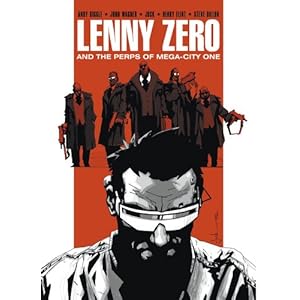
Lenny Zero and the Perps of Mega-City One

What I try to do with reviews at this Bookshelf blog is keep it simple and spoiler-free, and let you know whether I'd recommend you pick up a copy of what I just read. Seems to work okay. This time, a brief review of Lenny Zero and the Perps of Mega-City One (Rebellion / Simon & Schuster, 2011).


I really don't envy anybody's job in trying to introduce Americans to the sprawling world of Judge Dredd. (This collection is among the titles co-published with Simon & Schuster for the American market.) Start anywhere in the present day, and much of the subtleties of such long-running subplots are lost. Start at the beginning and you're looking at something that really takes a lot of effort, primitive stories told in a visual language with which most Americans are unfamiliar. Dredd is always a work in progress, and his stories have leaked out into dozens of other short-run series with other lead characters, set in his universe with rules most familiar to readers who already know Dredd fairly well.

The godawfully titled Lenny Zero and the Perps of Mega-City One collects two of these short series, along with three installments of Dredd that feature a recurring criminal, wrapping up with a fourth memorable character starring in a two-part Dredd tale by Robbie Morrison and Henry Flint. There is some very good stuff in this collection, but as a book, it is really difficult to embrace.

First up are the three stories of Lenny Zero by Andy Diggle and Jock. These are hugely fun little adventures about a clever undercover judge who decides that a life of crime is too darn appealing and sets about taking down the assets of a gangster. They're followed by the first three of four stories for Bato Loco by Gordon Rennie and Simon Coleby. Our "hero" here is a weaselly little con artist and very minor link in various organized crime chains who manages more last-second lucky breaks than anybody deserves.

Unfortunately, while these are both fun little series and, as they are too short to be realistically collected any other way, it's good to see them finding space in an anthology like this, they are also the clear standouts of the material, and the rest of the book just doesn't measure up. Three Dredd episodes featuring the villain Slick Dickens follow these, and it won't take a very trained eye to realize that they all have the same plot, and not a particularly good one. The less said about "Street Fighting Man," with its sentimental underpinning and risible, out-of-character climax, the better, although it's certainly drawn well by Henry Flint.

The problems are just huge, across the board, despite the quality of the ten or so episodes that form the six Lenny Zero and Bato Loco stories. These are good stories, but this presentation doesn't make any sense to me. 160 pages simply isn't enough to really dig into the fun of Mega-City One's criminal culture. Slick Dickens is stunningly out of place among the violence and mayhem, and would have worked better as a single episode coda, suggesting how the criminal class of the city would like things to be. A larger book that incorporated, say, some of the classic Mega-Rackets of the early 1980s, or the completely brilliant "Flood's Thirteen" caper from five or six years ago, would have fit much better thematically.

While 160 pages were not enough to really dig into the material that could have been included, most of the stories here are still entertaining, and they're presented with Rebellion's expected attention to detail and excellent reproduction. Curiously, this book retains the interior design elements of the rest of their extensive line, but neither the front cover nor the spine match anything else from the publisher, an aggravating oversight that will annoy completists, most of whom probably have most of this material in other editions already. Recommended, therefore, for new readers only.

Friday, July 15, 2011

Mean Machine: Real Mean

What I try to do with reviews at this Bookshelf blog is keep it simple and spoiler-free, and let you know whether I'd recommend you pick up a copy of what I just read. Seems to work okay. This time, a brief review of Mean Machine: Real Mean (Rebellion / Simon & Schuster, 2011).


I have previously noted that Rebellion, the British-based publishers of 2000 AD, have teamed up with Simon & Schuster for a line of comic collections aimed at the American market. A small majority of these are revamps of their existing line, but some of the titles are exclusive to the US. Real Mean, an introduction to the immortal, villainous Mean Machine, is one of these. Mean is one of Judge Dredd's recurring antagonists, an incredibly bad-tempered, foul-mouthed and small-minded petty criminal who can take one heck of a lot of abuse before he goes down.

I wrote this about Mean some time back: "One of Dredd's most popular returning foes, Mean Machine Angel was one of the nasty Angel Gang - a crowd of outlaws in the Cursed Earth who made life hell for muties and anyone fool enough t' venture too far afield from Texas City. Pa Angel and his sons Junior, Mean and Link were introduced in a 1980 serial called "The Judge Child," wherein Dredd killed them all. Mean, a giant man with a huge metal claw and a dial on his head which regulates both his temper and the power of his head-butting, was later resurrected by the Judge Child. Despite spending the bulk of the last twenty years in psycho-cubes and undergoing various lobotomies, hypnotherapies and surgical implants to curb his psychotic anti-social ways, Mean Machine remains an ornery, upitty cuss with an intense hatred of Dredd."

Over the years, writer John Wagner has gone back to this well, principally to exploit the character's huge comedic possibilities. More than once, some big-dreaming psychiatrist schemes to build his reputation on curing Mean. Since the character is as volatile as an atomic bomb, extremely wacky hijinks usually ensue.

This collection reprints seven stories of varying length, and is built around the ridiculous and wonderful "Son of Mean," a pretty long story from 1994-95 wherein Mean's previously unmentioned son, a sweet and good-natured boy who loves his dollies, is sent by his criminal mother into the city for some proper learning in the art of being rotten. Mean has no real idea how to go about doing this - he had no real idea how it was that he came up with a son in the first place - but it's a hilarious story which asks the immortal question: Can love triumph over stupidity and extreme violence? The story is painted by Carl Critchlow and the reproduction is a little dark - as seen in the story illustrated by Richard Dolan that opens the book, many of 2000 AD's artists in the early 90s had taken to painting with mud in a misguided effort to hitch a ride on Simon Bisley's coattails - but it's a story that still has me giggling after several rereads.

This is not a complete collection of Mean's adventures - such a beast would be phonebook-sized - but it's a very fun introduction. You get four stories written by Wagner and two, shorter tales by Gordon Rennie. The artists featured are Critchlow and Dolan, along with David Millgate, Steve Dillon, Kev Walker and Paul Marshall. The Rennie and Walker episode, wherein a captive Mean finds himself at the mercy of some even smaller-minded environmentalists, is an absolute treasure. Mean might have actually received some closure and been retired in the pages of Judge Dredd a few years ago. Time will tell, I suppose, but until he's seen again one day, this is a great book to celebrate his over-the-top silliness. Recommended.

Hey, readers! I have reactivated my long-dormant Thrillpowered Thursday blog for a short trial run. This will be the last 2000 AD-related review here while that's going on, and also, content will only appear here once a week during this experiment. I certainly appreciate your reading!

Monday, June 20, 2011

The Taxidermist

What I try to do with reviews at this Bookshelf blog is keep it simple and spoiler-free, and let you know whether I'd recommend you pick up a copy of what I just read. Seems to work okay. This time, a brief review of The Taxidermist (Rebellion, 2011).


Well, I am very happy to see this book finally out. There are so few comics available to star a protagonist as elderly as this one - in the first story of three collected here, taxidermist Jacob Sardini is in his seventies - and I am all for any feature that bucks the trend of dashing macho, he-man lead characters quite the way this one does. Sardini is an aging, overweight widower who figures that his glory days are all behind him, but sometimes events have a way of sweeping even the elderly up in their wake.

This is one of several collections that the publisher Rebellion has recently released that shows just how wonderful the world of Judge Dredd is for launching new characters and ideas. In the weird future of Mega-City One, human taxidermy is not only legal, but accepted enough that it's become an Olympic sport, along with some other downright ridiculous pastimes, as the stories reveal as they unfold. In the opening story, we meet Sardini, who had brought home the bronze for taxidermy twenty years previously, as he is contacted again by a mobster to whom he owns a favor. The mobster's son was killed in the first step of a new gang war, and he wants Sardini to stuff his boy, and the fellows that he brought down, without the law learning about it.

This story originally appeared in 1987, and it was six years before Sardini returned. This much longer tale is one of the finest stories that writer John Wagner and artist Ian Gibson have so far produced, a ridiculous and epic farce that sees Sardini representing his city in the Olympics again, with ugly politics shaping up behind the scenes. Wagner has always enjoyed mocking the world of sports - his and Gibson's brilliant takedown of the World Cup in a 1982 Robo-Hunter story is something that everybody should read - and everything about the Olympics, from the gaudy opening ceremonies to the competitions to the inane commentary by the television crews, is wonderfully and hilariously skewered. I think about this story quite frequently, as every single instance where I am consciously aware that I am blinking, I think of Agnes "Laser Gaze" Boulton, who features in just about the funniest thing I have ever seen on the printed page. Rebellion could probably charge the same price for a reprint of just her short subplot and I'd end up recommending it.

Rebellion's design team has done its by-now-expected excellent work. The book contains all of Sardini's appearances, along with a short cover gallery. Reproduction is just about flawless, on good, heavy paper. Overall, it's a very funny and occasionally touching story that goes off in unexpected directions and it's in a terrific package. What more could anybody want? Very highly recommended.

Thursday, June 2, 2011

2000 AD's Free Comic Book Day Prog

What I try to do with reviews at this Bookshelf blog is keep it simple and spoiler-free, and let you know whether I'd recommend you pick up a copy of what I just read. Seems to work okay. This time, a brief review of 2000 AD's Free Comic Book Day Prog (Rebellion, 2011).


Here's a book that, if I may say so, is long overdue. Every year for about the last decade, the principal comic book distribution company, Diamond, has sponsored this event where retailers order a bunch of comics to be given out freely to customers. The idea is that the comic shops will promote a big event at their store and guests will arrive to reacquaint themselves with how great it was to read funnybooks, and established customers will pick up a couple of new titles. 2000 AD, despite being the most consistently entertaining and rewarding comic book published over the last three decades, has never joined the party until this year. At last, there's a free 2000 AD comic to promote in the US. Free Comic Book Day has come and gone, but it's possible - in fact, it's almost likely, considering the leftover stock that I see in some stores - that there may be a copy or two floating around for new readers to try.

2000 AD is an anthology book, and this issue gives people a reasonably good idea what to expect from any given issue, with a quibble or two. Judge Dredd, as always, is the star of things, and the rest of any given issue is taken up with a mixture of recurring series, serials and short one-off stories. Here, Dredd is ably represented by a short story written by his creator John Wagner and illustrated by Val Semeiks and Cliff Robinson. It's a good introduction, letting people know that Dredd lives in a world where life is violent and technology is downright weird.

The principal backups are Slaine by Pat Mills and Clint Langley, Kingdom by Dan Abnett and Richard Elson, and Shakara by Robbie Morrison and Henry Flint. Kingdom and Shakara are each very recent and popular series - Shakara actually reached its bug-eyed, mad, memorable conclusion earlier this year - and they are each represented by their initial installments. Kingdom is the lyrically paced (if that makes sense) story of a dog soldier called Gene the Hackman, who, with his pack, is defending Antarctica from huge insectoid aliens. Shakara tricks readers into thinking that it's the story of the very last human, an astronaut who was in space when bizarre aliens destroyed Earth, but then it swerves, magically, and shows off that it is not about that at all. Both are completely terrific, and collected editions of each are already available in England. American editions, distributed by Simon & Schuster, will be arriving in a few months' time.

The Slaine story is a pleasant surprise. Slaine has actually been running since 1983 with a dozen different artists illustrating Pat Mills' scripts. The episode here is the first in a series of adventures called "The Books of Invasions" that was painted / photomanipulated by Clint Langley. Langley's tenure on the strip is available in three hardback editions, with a fourth scheduled for later in the year, but I don't believe that these are planned for separate American release (and, presumably, promotion) at this time.

The comic is bookended by a couple of short one-offs, a Tharg story from 1977 illustrated by Kevin O'Neill that introduces readers to the concept of this comic having an alien editor who programs robots to write and draw the features, and a one-page Zombo short by Al Ewing and Henry Flint which is just violent and ridiculous and wonderful. Frankly, 2000 AD should run silly little single pages like this more frequently.

As an introduction, I think this does a pretty good job, although I might quibble that it emphasizes the over-the-top, hyperviolent side of 2000 AD perhaps a little more than I might like. This led at least one store in Atlanta to restrict the freebie to adults only. (I protested that all Earthlet children should be exposed to thrillpower at the earliest possible age.) While 2000 AD, it must be said, isn't for everybody - and a regularly-scheduled, stereotype-avoiding, female-led series is long overdue and would help there - many of its best series are nowhere as dementedly gruesome as the offerings suggested here, and I'm not sure that this really gives readers a feel for how broad the scope of 2000 AD is.

Another eight pages could have introduced readers to the classical pirate adventure of The Red Seas or the weird Victorian crime drama of Stickleback or the Western-in-Hell Ichabod Azrael or the brand new cops vs. demons Absalom, all of which are certainly violent, but not quite as visceral and outlandish as what's on offer here, and I think that might have been a bit more of a balance. Well, now we know for next year! Certainly recommended.

Sunday, March 13, 2011

Chopper: Surf's Up

What I try to do with reviews at this Bookshelf blog is keep it simple and spoiler-free, and let you know whether I'd recommend you pick up a copy of what I just read. Seems to work okay. This time, a brief review of Chopper: Surf's Up (Rebellion, 2010).


The good droids at Rebellion are really doing a great job issuing big, chunky, color reprint volumes lately. Hot on the heels of the Al's Baby doorstop comes this complete collection of Chopper, an antagonist of Judge Dredd who graduated to his own solo series after finally eluding capture, for what we hope is for good. He first appeared as a teenage cut-up in three different Dredd adventures in the 1980s, galvanizing the city's bored youngsters with his exploits as a graffiti artist and, later, as a skysurfer, before escaping all the way to the Australian wilderness. These earlier exploits, reprinted within three volumes of Rebellion's Complete Case Files of Dredd, are summarized in an introduction to this book. This definitely starts this collection off right; I can't tell you how many other books I own that would benefit from pages like this.

Chopper returned in a four-week adventure that first ran in 1988, written by his creator, John Wagner, and illustrated in black and white by Colin MacNeil. This proved to be very successful, and paved the way for a really remarkable follow-up, "Song of the Surfer" in 1989-90. Legendary among 2000 AD's fan base, this serial, again by Wagner and MacNeil (but this time in color) truly is a damned incredible piece of work. In it, Chopper follows his destiny back to another skysurfing competition, this one with the stakes raised to absurd levels by a promoter who has decided to return the sport to the dangerous days of its early, illegal years. He has chosen to make it a blood sport again, and, despite the outrage, still finds enough surfers to make it a reality.

It's a terrific story that touches on the tricky subjects of fate and destiny with an assured hand, wrapping them in a brilliant parody of the absurd world of sports (and, perhaps more accurately, sports commentary, prefiguring Wagner's crowning glory of the form in The Taxidermist, due for a reprint from Rebellion in a couple of months). It's a drama of the highest caliber, with a masterful use of pacing as the stakes are raised and the race begins, but the way that Wagner is able to deftly insert moments of comedy and satire as the story rockets forward is just amazing. This would be a very good story even without the parody; that Wagner was able punctuate it with moments of gleeful, sick absurdity like the smiling sports reporter announcing his own injuries without derailing everything, that's proof that Wagner is one of the very best writers in the medium. Of course, the artwork is completely sublime throughout. Twenty-plus years later, and not one artist in comics has stepped forward to paint exit wounds as frightening as what MacNeil managed here.

"Song of the Surfer" reaches an inevitable and tragic conclusion that definitely knocked thousands of readers on their head and still maintains a visceral power. That, arguably, really should have been the end for the character, but the comic's editors wanted to keep a good thing going. Garth Ennis and John McRea took over the character for a story that appeared later in 1990 in the debut issues of Judge Dredd Megazine.

These and some other stories by noteworthy creators, including the late Martin Emond, Alan McKenzie, John Higgins and Patrick Goddard, have appeared every few years until Chopper's final appearance to date in 2004. None of these stories come close to "Song of the Surfer"s power and energy, but they're all quite good in their own rights, and it is very, very nice to see them all packaged so comprehensively in one book. McKenzie's story is perhaps the weakest by comparison, but even it has a good deal to recommend it, from the vibrant art by Higgins to the curious subplot of the Japanese mega-city rebuilding and repopulating the Californian mega-city, which had been destroyed in a previous Judge Dredd epic story. This was evidently intended as part of the groundwork for a planned storyline in Dredd that, with McKenzie's departure from 2000 AD, was abandoned.

In all, it presents a genuinely fun look at a character aging in real time, from his early twenties and full of fire, to his late thirties and ready to turn down the volume and relax. It was great fun to revisit the character, and Rebellion certainly did him right with this splendid collection. Happily recommended.

Note: I've built up enough of a backlog to resume posting again, but entries will be a little sporadic for a while, probably no more than 2-3 a week. Thank you for reading!

Saturday, January 22, 2011

The Complete Al's Baby

What I try to do with reviews at this Bookshelf blog is keep it simple and spoiler-free, and let you know whether I'd recommend you pick up a copy of what I just read. Seems to work okay. This time, a brief review of The Complete Al's Baby (Rebellion, 2010).


I can't tell you how pleased I am to have all of this ridiculous, violent and incredibly funny series collected at last. Al's Baby, originally developed for an anthology comic called Toxic and later to appear in three runs in the 1990s in the pages of Judge Dredd Megazine and 2000 AD, is just hilarious, a great, big goofball saga about a situation that keeps getting, hilariously, worse on every other page. It's like the bonebreaking, criminal counterpart to John Wagner's wonderfully over-the-top work on my beloved Robo-Hunter.

In the near future, Al Bestardi is the number one enforcer for an aging, very cranky mobster who rules Chicago, and who gave Al permission to marry his daughter, Velma. But the old man is getting older, and Al has not given the godfather a grandson to carry on the family line. The remarkably violent Velma flat-out refuses - it would interfere with her career as the nation's worst torch singer - and so Al faces either concrete boots for letting down the godfather or the unappealing prospect of male pregnancy. Soon, he's hitting for two, much to the amusement of his peers and rivals in the business.

The series is just huge fun, and is nutty in the very best way. The second storyline, in which Al attempts to arrange the accidental death of a surprising family rival who just refuses to die, is probably my favorite. I used to think that the third and final story was comparatively a little weak, but it's revealed itself upon rereading to be another real blast, with Al hiding out as a deeply ugly woman who nevertheless attracts a scatterbrained suitor.

The artwork is provided by Carlos Ezquerra, and I think this is absolutely some of his best work. It's not merely the mix of truly ugly men with hilariously huge noses and ears and absurdly gorgeous women, but his pacing and his slow burns, reaching a pinnacle in the third story when Al spends the entire story getting progressively and hilariously furious and ready to snap. The third story also features some of the experimental computer coloring that Ezquerra was playing with in the mid-90s, and it's always really interesting to see this style from him.

Put another way, there's never been a time when the teamup of Wagner and Ezquerra didn't result in really great comics, and this terrific book is packed full of the proof. It's a riot, and it's really well presented. The reproduction, on very nice paper, is excellent, and having the complete series in one volume is really wonderful. This was absolutely one of the best collected editions released last year, and certainly comes highly recommended.

Tuesday, November 23, 2010

Judge Dredd: The Restricted Files 02

What I try to do with reviews at this Bookshelf blog is keep it simple and spoiler-free, and let you know whether I'd recommend you pick up a copy of what I just read. Seems to work okay. This time, a brief review of Judge Dredd: The Restricted Files Volume 02 (Rebellion, 2010).


This is the second in a two-volume set that covers all of the various Judge Dredd episodes of the 1980s that did not originally appear in the weekly 2000 AD comic. The publishers, at the time IPC, used to release various annual hardbacks and special editions where additional adventures of the lawman of the future could be found, and these stories, long desired by fans to be collected alongside the weekly episodes, have finally found a home in these two books.

Honestly, there isn't anything in book two as wild and fantastic as the better moments in the first volume, but there isn't anything as dire as that book's first ninety-odd pages, either. As I mentioned in my review of that book, the first several annuals and specials for 2000 AD were compiled by various editorial staffers working anonymously, few of whom had a grasp on the still-developing character of Dredd and his growing world. Until John Wagner became interested and took control of those projects, they were patchy at best.

With Wagner, joined in 1983 by Alan Grant as co-writer, in charge and defining a clear world, and worldview, for Dredd, the one-shot episodes maintained a consistent tone. True, with only a handful of pages per story, they couldn't really dig into things with the detail afforded a multi-week serial in 2000 AD itself. In some cases, like a Mike Collins-illustrated episode about a heat wave, the plot is given over to fantasy. But with a consistent approach, a dry wit and a taciturn leading man, the stories are uniformly entertaining, with few or no fumbles across close to 400 pages.

As usual, there's a pile of really great art from many Dredd regulars. Cam Kennedy is well-represented with one of my favorites of his many times drawing Dredd, "I, Beast," and he's in good company with Carlos Ezquerra, Ian Gibson, Arthur Ranson and others. I think my favorite story in the book might be one of the longest, "Last of the Bad Guys," which was painted by John Higgins. Honestly, there's not a bad-looking page in this book, but I think that Higgins, one of the title's unsung heroes of the period, might have done the best work in the collection. Bryan Talbot illustrates a really funny story that shows what happens when Justice Department's undercover division can't rustle up enough female judges for a case, and Brendan McCarthy is psychedelic, wild and mind-blowing on a couple of very colorful episodes.

Again, nothing in these pages is as completely breathtaking as some of the Mike McMahon material in volume one, but that's not to say anything here is lacking. It's a really terrific reprint, full of clever, surprising plot twists and it's long overdue. It's presented on nice paper, chronologically, and very well designed. Darned if I can find a flaw in it at all, to be blunt. Highly recommended!

Friday, November 5, 2010

Robo-Hunter: The Droid Files Volume 02

What I try to do with reviews at this Bookshelf blog is keep it simple and spoiler-free, and let you know whether I'd recommend you pick up a copy of what I just read. Seems to work okay. This time, a brief review of Robo-Hunter: The Droid Files Volume 02 (Rebellion, 2010).


Back in June, I mentioned that I reread a series called Robo-Hunter every couple of years. It ran in 2000 AD periodically from 1978 to 1986. Written by John Wagner and Alan Grant and drawn by Ian Gibson, it's the absolute best example in comics of what I was mentioning in my article about Chew the other day, how the type of plotting in fiction that appeals the most to me is the type that has to run all over the map of wild possibilities to get from points A to B. I like stories where the protagonist doesn't just have to overcome great obstacles, but mundane, ridiculous, unexpected, downright weird and lunatic ones as well. Throw a kitchen sink at our hero, literally, and I'm in heaven. There's a bit in the very first Robo-Hunter serial where our hero is held hostage in a sewer until he completes a rigged game of Monopoly. That's what I'm talking about.

Our hero in Robo-Hunter is a hard-boiled PI named Sam Slade who cannot catch anything like a break. Unfairly unable to thrive in a world where he might do well (as though 1940s Los Angeles would be much of an improvement for him), Slade works in a far-flung future where a lazy, indolent, soaps-and-sports-obsessed humanity has let lunatic robots take over their lives for them. The human population in Pixar's Wall-E, and the nutty personalities of its robot cast, is not that far removed from what Wagner, Grant and Gibson had come up with for this comic. It's a world where any human with a job is pretty odd; jobs are what people built robots for! They built them to be their prime ministers and their soccer stars, and now the population of future Britain is content to collect welfare checks, visit historical castles and watch the World Cup. From this premise, the creators come up with some of the funniest and most ridiculous comics ever made. It's an absolute gem.

The first of Rebellion's two phone book-sized omnibus editions reprinted a little more than half of these creators' original run. In the second, you get more tomfoolery with Jim Kidd, a character from the first series who had been de-aged to a baby and briefly starred as the hero of a TV series before his own poor fortunes see him setting up shop as a competing robo-hunter. Slade and Kidd are hired in one of the series' most infamous installments, "Football Crazy," which sees some wildly stereotyped comedy. Having already established that future Britain was nothing to be proud of, and giving their own culture both barrels, Wagner and Grant took a few unbelievable potshots at the Italians and the Japanese in this story, which is guaranteed to make the more politically correct members of a contemporary audience wince. I've always figured it's fair for a writer to mock other cultures, provided the writer isn't simultaneously claiming that his own culture is superior. That clearly doesn't happen here.

After that, Slade's story continued through a pair of much longer adventures before the creators completely surprised readers by giving Sam a happy ending. After all these episodes of Sam overcoming unbelievable and ridiculous odds and never getting his reward, he got it. In a just world, the epic "The Slaying of Slade" would have been Sam's deserved finale, but of course, Sam Slade's world isn't "just." The very next episode, set a few years later (most cruelly, it originally ran in the following issue), sees Sam's two idiot assistants ruining everything yet again and giving Sam new problems to fight. Ian Gibson's redesign for the character - he had to come up with two! - is just hilarious.

"Sam Slade's Last Case" and "Farewell, My Billions" are often overlooked by fans, but they're every bit as ridiculous and convoluted and beautifully drawn as the earlier, better-known stories. In fact, as much as I admire the brilliant plotting and sparkling dialogue of the epic "Day of the Droids" (reprinted in volume one), Gibson's artwork towards the end of the run is leagues superior. "Farewell, My Billions" was drawn between the second and third series of Halo Jones, Gibson's celebrated collaboration with Alan Moore, and his linework, design and inking were at a career high. The decayed, decrepit look of future Harlem is just completely lovely, and the hospital scenes with the strangely familiar Dr. Goyah have an absolutely perfect balance to them. I would love to own some of the original artwork from this story.

"Farewell, My Billions" proved to be a finale that Wagner and Grant didn't believe that they could top, and the series was retired. About six years later, however, there had been some editorial changes at 2000 AD and the strip was resurrected. It was given to Mark Millar, then a promising newcomer, and a rotating bank of artists. Enough has been written already about why these failed; no more needs to be said. Suffice it to say that Millar's lengthy run is not included in this collection, however, an episode by John Smith and Chris Weston, set in the same continuity and using Millar's take on the character, is, probably on the strength of the artwork.

The third iteration of Robo-Hunter followed right on the heels of Millar's. In fact, there was some actual overlap in 1994, with one Millar story drawn by Simon Jacob appearing in print after the first by the new team of Peter Hogan and Rian Hughes. I have also written at length about how wonderful the all-too-brief Hogan and Hughes run was, and encourage visitors unfamiliar with it to see what I have written previously at my currently dormant blogs Thrillpowered Thursday (June 2007) and Reprint This! (April 2009 and April 2010). If you'd rather not click, suffice it to say that these are extremely clever and witty and wonderful in every way. This volume, happily, reprints all of Peter Hogan's episodes. The reproduction is not quite ideal - most of them originally appeared in color, and the grayscale versions here don't do Rian Hughes' thick, solid primary colors justice - but just having them all in one place is a dream come true. Well, my dream, at least.

There has also been a fourth iteration of the series. From 2004-2007, Grant and Gibson reunited to tell the story of Slade's granddaughter Samantha, who followed her predecessor into the robo-hunting business and picked up his two idiot assistants. Criminally, these six stories were not as popular with the fan base as they were with me, and even I'll admit that the second story really does take a lot of defending. Sadly, the series was one where the writer was enjoying the experience more than the artist, and it seemed to end, behind the scenes, acrimoniously. Three or four of us are still hoping for a return and greater things. These episodes are also not included; they should appear, in color, in their own volume, shortly after Samantha makes her triumphant return to the comic. Any day now.

Summing up, across the two volumes, you get the entirety of the original Wagner-Grant-Gibson run, one episode by Smith and Weston, and the full Hogan-scripted apocrypha. They're completely terrific comics. Knock down traffic cones and drive across people's yards to get them. Highly recommended.

Friday, September 24, 2010

Judge Dredd: The Complete Case Files Volume 15

What I try to do with reviews at this Bookshelf blog is keep it simple and spoiler-free, and let you know whether I'd recommend you pick up a copy of what I just read. Seems to work okay. This time, a brief review of Judge Dredd: The Complete Case Files (Volume Fifteen) (Rebellion, 2010)


We are just about teetering on that little precipice where I won't be able to recommend these books quite so wholeheartedly any longer. Even 2000 AD's biggest supporters must admit that the venerable British comic took a quality stumble in the early '90s. This block of 46 Judge Dredd episodes - 36 from 2000 AD and ten from the first installments of its sister book Judge Dredd Megazine (the current issue of which celebrates the title's 20th anniversary) - was produced when the title itself was floundering somewhat. The Slaine saga "The Horned God" and the Dredd epic "Necropolis" had each just ended, and with them went the period that most people define as 2000 AD's "golden age."

This is the first book in Rebellion's Complete Case Files which might really feel a little off-putting to new readers. The stories are set in the aftermath of "Necropolis" and the death of sixty million citizens - wrap your brain around that number - at the hands of Judge Death and his mind-controlled army. Many of the episodes refer back to it, whether by visiting how some of the supporting players, such as the teenage serial killer PJ Maybe, made out while the city was in turmoil, or by showing the desperation of citizens trapped in refugee camps waiting for new apartments to be built.

That's not to say that it's all relentlessly grim. 1991 saw the debut of Garth Ennis, then a promising young newcomer to comics, as Dredd's lead writer in the weekly comic, while John Wagner and Alan Grant moved over to the Megazine to script his adventures there. In time, Ennis would start repeating himself and running out of ideas, but his first few installments really are interesting. He starts out with "Death Aid," in which an old Dreddworld antagonist, Elmort Devries and his Hunter's Club, decides to liven up things in the Necropolis-hungover city with a sponsored mass kill. For charity.

Then there's "Emerald Isle," a celebrated six-parter which teamed Ennis with artist Steve Dillon for the first time, and let the two of them loose on every Irish stereotype that they could cram into thirty-six pages. From singing fish to potato guns ("Spud gun to smash!" is just a lovely line) to a good-natured, hard drinking Irish judge in a green uniform whose idea of getting news from informants is taking Dredd on a pub crawl, they're all here and all ridiculous.

The artwork throughout the book is terrific. Apart from Dillon and old hand Carlos Ezquerra, there are standout episodes by Anthony Williams, Jim Baikie and a tremendously freaky story about a shapeshifting spider-like alien drawn, with the demento-dial cranked up to eleven, by the late John Hicklenton.

Personally, I'm not able to read it without the heavy knowledge that the good times are about to end; probably the next five books in this series are going to be a little rough going before they come back to the episodes from late '95, which is when Dredd would become consistently great again. But this has a lot to recommend it even without that prescient knowledge. From the dark exploration of what the former Chief Judge Silver had done during "Necropolis" to the goofy performance of what passes for Macbeth in the future, it's a really great set of stories, and fans of Ennis and Dillon's later triumphs on Hellblazer and Preacher will definitely want to see their first collaboration. Highly recommended.

Wednesday, July 14, 2010

Judge Dredd: The Restricted Files 01

What I try to do with reviews at this Bookshelf blog is keep it simple and spoiler-free, and let you know whether I'd recommend you pick up a copy of what I just read. Seems to work okay. This time, a brief review of Judge Dredd: The Restricted Files 01 (Rebellion, 2010)


I guess that every so often, things work out for the best. You probably know that Rebellion has been publishing a series of "Complete Case Files" for the long-running Judge Dredd feature. (The first of these was finally released in a special edition for the US market just last month.) These include the stories from the weekly progs and, from the most recent volume, the monthly magazine, but they have skipped the stories from Fleetway's old hardcover Christmas annuals and summer special issues.

Fans had asked at the time to have the annual and special stories added to the Case Files collections as bonus features, but only a handful trickled in. Finally, however, Rebellion has given the stories a two-book collection of their own. The first volume covers the first seven years of extra features from these specials along with stories from the 2000 AD, Dan Dare and Dredd solo annuals. After a pretty shaky start, there is some amazing material in the first book.

About the first quarter of the 400-page collection is really more interesting to archaeologists than to contemporary fans. While Dredd's stories were settling down into a single continuity orchestrated by John Wagner, the annuals were typically churned out by Fleetway editors with just a glance at the source material. Several of the stories are uncredited, and some of the artwork bears just a faint resemblance to the source material. There's a tale about a city called "Mega-Miami" which looks like the city in the 1970s with a future cop running around, and a deeply unfunny, early attempt at a "House of Tharg"-styled crossover where most of 2000 AD's characters of the first couple of years throw a Christmas party in Dredd's apartment. It looks like the artist, Keith Page, knocked those six pages out before lunch.

But a hundred pages in, we get to the point where Alan Grant takes a job with Fleetway editorial and Wagner takes an interest in what's going on with these books. The greatness starts with a Steve Dillon-illustrated episode from 1980 and doesn't waver after that. It includes dozens of fully-painted pages by Mike McMahon and Carlos Ezquerra, along with Brian Bolland's "The Alien Zoo," possibly the only example of Bolland coloring his own work.

Some of these Wagner and McMahon collaborations had been compiled by Titan in a 1985 collection, but most of the book has never been reprinted. One of this duo's stories is a 16-pager called "The Fear That Made Milwaukee Famous," and it's wonderful, simply one of the wildest, goofiest and most inventive adventure comics I've ever read. In it, Dredd rides out in the desert to apprehend a mutant criminal who really does not want to be called "Chickenhead" and the two of them are besieged by thousands of skeletal ghosts of a dead city. Elements of this amazing story would resurface in the creators' later Last American miniseries.

Packed as it is with so many inventive and clever stories, none of which outstay their welcome, it's difficult to point out the highlights or notable moments. Interestingly, John Byrne has a short story in here as well. At the time, the artist was very popular for his Marvel Comics' work inked by Terry Austin. I don't know that there are many other examples from the period of Byrne inking himself, but his line was altogether too heavy back then, as it remains today. On the other hand, Byrne drew a really impressive Mega-City One, and I think it's a shame he did not contribute again.

Byrne at his best, however, is a wholly different prospect than McMahon or Dredd's co-creator Carlos Ezquerra. His pages are really thrilling and full of life and wild, vivid color. The scenes of Dredd and Cursed Earth cowboys warring against giant tarantulas are really impressive, and nobody draws unbelievably obese men eating themselves sick as well as he does.

It's likely that the strange and ill-formed Judge Dredd of the book's first quarter might put off new readers, and so this might not be a good introduction to the character unless you know the circumstances and jump over those stories. Skipping past them, it's a very solid 300 pages of excellent comics at a reasonable price, around $30 in the US. The production is up to Rebellion's very high standards, and the artwork is reproduced very faithfully on very nice paper. It's a labor of love and exactly what the fans had hoped for, and I recommend it very highly.

Wednesday, June 30, 2010

Strontium Dog: Blood Moon

What I try to do with reviews at this Bookshelf blog is keep it simple and spoiler-free, and let you know whether I'd recommend you pick up a copy of what I just read. Seems to work okay. This time, a brief review of Strontium Dog: Blood Moon (Rebellion, 2010)


Since the great Strontium Dog returned to the pages of 2000 AD, its creators, John Wagner and Carlos Ezquerra, have been telling stories set at various points in Johnny Alpha's history. Their hero has been a bounty hunter since the end of the war for mutant rights, but in these two stories, set very early in his career, he's better known as a war hero than as a licensed agent for the Search/Destroy Agency.

"Blood Moon" and "The Mork Whisperer," originally serialized last year, shows Johnny working with more of the original gang of Doghouse regulars, including several not seen in the comic for about twenty years. They're set before he met his regular partner, the Viking Wulf Sternhammer, and when not only were all three of the nasty Stix brothers alive, but a cousin of theirs was causing trouble, too.

I believe that "Blood Moon" was the first comic art that Ezquerra finished with the the assistance of his son Hector on inks. They've been working as a team for eighteen months now on this series, Judge Dredd and one of the Battlefields miniseries for Dynamite, and the style's naturally a little different, but never jarringly so. Ezquerra remains one of the best artists in the business, regardless of who's inking him, and his designs for the oddball cast of mutants remains consistently entertaining and silly.

The vibrant, fun art effectively counterpoints a couple of downright grim adventures. "Blood Moon" sees a former colonel in the mutant army still able to inspire beyond the grave, and an interplanetary terrorist campaign waged against norms in his name. In "The Mork Whisperer," one of the galaxy's richest men hires Alpha to track down his estranged wife and mutant sons, but doesn't trust Alpha enough to do the job without surveillance. The former is certainly the more dramatic and action-packed of the two, but I quite like the cerebral pace of the second, and the way Alpha uses logic, ratiocenation and a little time travel to solve a complex mystery that involves android duplicates and mind control.

Honestly, singling out any Strontium Dog book is pretty tough. It's been one of my favorite series, consistently entertaining and very clever, for years. Wagner and the Ezquerras are currently working on a new story set after the reported death of Alpha in the 1990 epic "Final Solution." Two episodes in and it's so darn riveting I can't think straight. I'd highly recommend picking up this book, and then settling in with some digital copies of June's 2000 ADs so you can see where the creators are going next.