Showing posts with label colin macneil. Show all posts

Tuesday, May 28, 2013

Judge Dredd - Day of Chaos: The Fourth Faction

What I try to do with reviews at this Bookshelf blog is keep it simple and spoiler-free, and let you know whether I'd recommend you pick up a copy of what I just read. Seems to work okay. This time, a brief review of Judge Dredd - Day of Chaos: The Fourth Faction (Rebellion, 2013).

I didn't do myself any favors trying to come up with a way to "review" the first of two collected editions that reprint "Day of Chaos," the mammoth 50 (!) episode Judge Dredd epic that ran for a full year from the summer of 2011 into 2012. Taken as a whole, it is one of the biggest game-changers ever seen in Western comics, with a conclusion that just plan screws everything up and leaves the series more shaken and beaten up than almost any similar event in any comic that I can think of. (The destruction of the planet Earth in a late 1992 issue of Legion of Super-Heroes might have counted, but the publishers made everything better and back to normal less than two years later.) But the "you've gotta be kidding" level of rule-changing all happens in the second volume, which will be out in a couple of months. What this book does is set things up by reinforcing reader understanding of how Dredd's world is supposed to work, and then, with an incredibly effective sense of impending doom, starts crumbling the structures that define this world into dust.

When the Judge Dredd comic began in 1977, it was without a firm grasp on its own continuity or world. Over time, new elements would emerge, and odd ideas brought up for consideration. For a few years, the comic, always under the eyes of John Wagner, who has probably written a small majority of the episodes and is acknowledged as the comic's creator and chief architect, placed Dredd in a city-state with a population of 800 million. After five years, this number was halved over the course of the legendary epic "The Apocalypse War," wherein Dredd's home of Mega-City One was invaded by the ruthless Sovs of East-Meg One. Somehow, Wagner considered 400 million a slightly more manageable number than 800 million. Evidently, he's since decided that even that number was too great to control.

From time to time, the events of "The Apocalypse War" have resurfaced to confound our hero. Survivors of East-Meg One were shown to have established a new government on the shores of the Mediterranean Sea, intent on convicting Dredd of war crimes, and various sleeper agents and assassins have surfaced from time to time to make potshots at the city. "Day of Chaos" is, naturally, the culmination of decades of episodes, and as such, no simple summary introduction can do it justice. The volume makes a good effort, though. It opens with a couple of pages of introduction that flesh out the long antagonism, and then begins a very effective scene-setting with a reprint of 2010's "The Skinning Room." This is a five-part story (from issues 1700-1704) that shows the political situation in Mega-City One after the events of an earlier year-long epic, "Tour of Duty," and eases readers into things by way of a typical affair of violent future crime. It's written by John Wagner and drawn by Ben Willsher, who provides much of the artwork in the story that follows, and will remind old readers and inform new ones that, as much as this is an action-adventure melodrama, it is also capable of being the absolute finest police procedural in the comic medium, with a wholly successful, cerebral approach to detective fiction that I think many comic fans don't recognize.

The reprint then skips ahead to June 2011, and a three-part story in which Dredd's most cunning ongoing enemy, the serial killer PJ Maybe, escapes from prison. His recapture becomes a priority when "Day of Chaos" properly begins in issue 1743, but there are even more critical problems. Justice Department's Psi-Division has been a deteriorating failure for years, probably since most of their reliable operatives have died in action, but they have a very good prognosticator who foresees her own death and a disaster that will crush the city like nothing before.

With a Sov camp in Siberia preparing a massive germ warfare attack on the city, and PJ Maybe planning to sabotage the city's mayoral election, and suicide assassins at loose targeting key figures, and Justice Department planning for the unbelievable casualty rate to come in such an unthinkable way that... ah, but I'm getting ahead of myself. This rapidly turns into a spectacle completely outside of any hero's ability to solve. Wagner and his artistic collaborators, including Ben Willsher, Henry Flint and Colin MacNeil, kept this escalating for the next several months.

"The Fourth Faction" is certain to leave anybody reading it desperate for the conclusion. What you'll get until then is twenty-three episodes of things getting worse and worse, a densely-narrated and subplot-heavy story with multiple antagonists, plotlines that weave masterfully in and out of the story, and a tone so grim that readers will agree that nobody and nothing is safe in this tale. I would have preferred that Rebellion release both volumes together - the second is due in July - but there's no chance that anybody spending the hours it will take to absorb this deep and heavy story will miss coming back for the conclusion. Highly recommended.

Monday, September 10, 2012

Judge Dredd's Day of Chaos

What I try to do with reviews at this Bookshelf blog is keep it simple and spoiler-free, and let you know whether I'd recommend you pick up a copy of what I just read. Seems to work okay. This time, a brief review of the Judge Dredd storyline "Day of Chaos." (Rebellion, 2011-2012).


When the Judge Dredd comic began in 1977, it was without a firm grasp on its own continuity or world. Over time, new elements would emerge, and odd ideas brought up for consideration. For a few years, the comic, always under the eyes of John Wagner, who has probably written a small majority of the episodes and is acknowledged as the comic's creator and chief architect, placed Dredd in a city-state with a population of 800 million. After five years, this number was halved over the course of the legendary epic "The Apocalypse War," wherein Dredd's home of Mega-City One was invaded by the ruthless Sovs of East-Meg One. Somehow, Wagner considered 400 million a slightly more manageable number than 800 million. Evidently, he's since decided that even that number was too great to control.

From time to time, the events of "The Apocalypse War" have resurfaced to confound our hero. Survivors of East-Meg One were shown to have established a new government on the shores of the Mediterranean Sea, intent on convicting Dredd of war crimes, and various sleeper agents and assassins have surfaced from time to time to make potshots at the city. But they've all failed, and frequently been shown up as blunderers, compared to what Yevgeny Borisenko accomplished over the course of the last year.

"Day of Chaos" is, naturally, the culmination of decades of episodes, and as such, no simple summary introduction can do it justice. That said, new readers would do well to begin their approach with prog 1740, from June 2011. This features the beginning of a three-part story in which Dredd's most cunning ongoing enemy, the serial killer PJ Maybe, escapes from prison. His recapture becomes a priority when "Day of Chaos" properly begins in issue 1743, but there are even more critical problems. Justice Department's Psi-Division has been a deteriorating failure for years, probably since most of their reliable operatives have died in action, but they have a very good prognosticator who foresees her own death and a disaster that will crush the city like nothing before.

With a Sov camp in Siberia preparing a massive germ warfare attack on the city, and PJ Maybe planning to sabotage the city's mayoral election, and suicide assassins at loose targeting key figures, and Justice Department planning for the unbelievable casualty rate to come in such an unthinkable way that the citizenry finally has decided they've had enough of their tyranny and rises in full-scale, city-wide open revolt, this rapidly turns into a spectacle completely outside of any hero's ability to solve. Wagner and his artistic collaborators, including Ben Willsher, Henry Flint and Colin MacNeil, kept this escalating for an amazing 49 episodes, wrapping in prog 1789.

A little over halfway through, Wagner calmly played his masterstroke. Just as it really looked like things could not possibly get any worse for Dredd and his city, somebody - I don't know that we ever learned who, or whether they had some particular scheme to control or direct them - arranged for a bent judge to release the three Dark Judges who had been in captivity. Brilliantly, Judges Fear, Fire and Mortis just killed everybody in the narrative who might have explained to the reader what the big idea was, leaving them loose within the much larger narrative as one more titanic problem to overcome.

And the thing that really worked was this: set among this kind of catastrophe, the Dark Judges genuinely don't change things for the worse very much at all. Judge Fear's one-at-a-time killings are visually impressive, but when entire tower blocks of a hundred thousand people are going mad from a lethal plague, there's not a lot that they can do, and their impact on the story turned out not to be a large one. However, they added to the spiraling sense and feeling that this truly was Dredd's darkest hour, their psychological impact almost without equal in the comic's history - I still contend that their original appearance is just about the best cliffhanger in all of the medium - and they left the reader gasping for weeks about how in heaven Dredd's going to win this one.

And he doesn't. The best he can do is survive it. The sun finally rises on a city that has been as ravaged as can be imagined. Of Mega-City One's 400 million citizens, only about 50 million have survived. Almost 90% of the population has been killed.

Where the hell do you go from here?

Unfortunately, most of the episodes that appeared since the conclusion have not really addressed the new psychological state of affairs, and the logistics of managing a world so blighted. There have, of course, been quite a few epics with high bodycounts before, but things routinely get back to normal really quickly, without the eye-popping sweep of death and destruction that this one has brought, and it appears that Wagner's fellow writers misunderstood just how thunderous a change this was going to be, and how readers would want to see "what's next" in a more considered way. "Innocent," a two-parter by Rob Williams and Laurence Campbell, appeared in progs 1798-99 and was the first story to really address just how amazingly bad things are now. There's said to be a comedic-themed one-off by Chris Weston in next week's prog 1800 to celebrate the new feature film, and then, we're optimistic that subsequent episodes will really dig into this new world order.

There's so much more to explore and learn. Mega-City One has effectively been the world's only super-power, and, in many stories scripted by Gordon Rennie, bully, for quite a few years. That's surely not the case any longer. We don't know how other cities have weathered the plague, and whether many of Dredd's gigantic cast of supporting players survived. The smart money's on most anybody who could headline a series of any length returning again, of course, but I contend that a great way to bring the cost home would be to just casually mention in passing somewhere that beloved recurring characters like Chopper, Juliet November, or Galen DeMarco were killed during the outbreak.

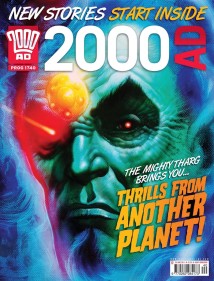
For something so wild and unpredictable to come from a regularly-scheduled comic is a real pleasure and a genuine surprise. Watching the status quo deteriorate and disintegrate further as the year progresses is something we are all looking forward to. I highly recommend readers familiar with Dredd start with prog 1740 - linked through the image above - and see what the heck has been going on. Those who don't know the character and world much yet, grab some recent trade collections and hop on board. This is one hell of a ride.

Sunday, March 13, 2011

Chopper: Surf's Up

What I try to do with reviews at this Bookshelf blog is keep it simple and spoiler-free, and let you know whether I'd recommend you pick up a copy of what I just read. Seems to work okay. This time, a brief review of Chopper: Surf's Up (Rebellion, 2010).


The good droids at Rebellion are really doing a great job issuing big, chunky, color reprint volumes lately. Hot on the heels of the Al's Baby doorstop comes this complete collection of Chopper, an antagonist of Judge Dredd who graduated to his own solo series after finally eluding capture, for what we hope is for good. He first appeared as a teenage cut-up in three different Dredd adventures in the 1980s, galvanizing the city's bored youngsters with his exploits as a graffiti artist and, later, as a skysurfer, before escaping all the way to the Australian wilderness. These earlier exploits, reprinted within three volumes of Rebellion's Complete Case Files of Dredd, are summarized in an introduction to this book. This definitely starts this collection off right; I can't tell you how many other books I own that would benefit from pages like this.

Chopper returned in a four-week adventure that first ran in 1988, written by his creator, John Wagner, and illustrated in black and white by Colin MacNeil. This proved to be very successful, and paved the way for a really remarkable follow-up, "Song of the Surfer" in 1989-90. Legendary among 2000 AD's fan base, this serial, again by Wagner and MacNeil (but this time in color) truly is a damned incredible piece of work. In it, Chopper follows his destiny back to another skysurfing competition, this one with the stakes raised to absurd levels by a promoter who has decided to return the sport to the dangerous days of its early, illegal years. He has chosen to make it a blood sport again, and, despite the outrage, still finds enough surfers to make it a reality.

It's a terrific story that touches on the tricky subjects of fate and destiny with an assured hand, wrapping them in a brilliant parody of the absurd world of sports (and, perhaps more accurately, sports commentary, prefiguring Wagner's crowning glory of the form in The Taxidermist, due for a reprint from Rebellion in a couple of months). It's a drama of the highest caliber, with a masterful use of pacing as the stakes are raised and the race begins, but the way that Wagner is able to deftly insert moments of comedy and satire as the story rockets forward is just amazing. This would be a very good story even without the parody; that Wagner was able punctuate it with moments of gleeful, sick absurdity like the smiling sports reporter announcing his own injuries without derailing everything, that's proof that Wagner is one of the very best writers in the medium. Of course, the artwork is completely sublime throughout. Twenty-plus years later, and not one artist in comics has stepped forward to paint exit wounds as frightening as what MacNeil managed here.

"Song of the Surfer" reaches an inevitable and tragic conclusion that definitely knocked thousands of readers on their head and still maintains a visceral power. That, arguably, really should have been the end for the character, but the comic's editors wanted to keep a good thing going. Garth Ennis and John McRea took over the character for a story that appeared later in 1990 in the debut issues of Judge Dredd Megazine.

These and some other stories by noteworthy creators, including the late Martin Emond, Alan McKenzie, John Higgins and Patrick Goddard, have appeared every few years until Chopper's final appearance to date in 2004. None of these stories come close to "Song of the Surfer"s power and energy, but they're all quite good in their own rights, and it is very, very nice to see them all packaged so comprehensively in one book. McKenzie's story is perhaps the weakest by comparison, but even it has a good deal to recommend it, from the vibrant art by Higgins to the curious subplot of the Japanese mega-city rebuilding and repopulating the Californian mega-city, which had been destroyed in a previous Judge Dredd epic story. This was evidently intended as part of the groundwork for a planned storyline in Dredd that, with McKenzie's departure from 2000 AD, was abandoned.

In all, it presents a genuinely fun look at a character aging in real time, from his early twenties and full of fire, to his late thirties and ready to turn down the volume and relax. It was great fun to revisit the character, and Rebellion certainly did him right with this splendid collection. Happily recommended.

Note: I've built up enough of a backlog to resume posting again, but entries will be a little sporadic for a while, probably no more than 2-3 a week. Thank you for reading!

Monday, December 20, 2010

Fiends of the Eastern Front

What I try to do with reviews at this Bookshelf blog is keep it simple and spoiler-free, and let you know whether I'd recommend you pick up a copy of what I just read. Seems to work okay. This time, a brief review of Fiends of the Eastern Front (Rebellion, 2010).


Of all the recent examples of contemporary funnybook writers paying tribute to, and rehabilitating the image of, mostly retired or deceased members of the industry, Pat Mills' talking-up of Gerry Finley-Day hasn't got a lot of press. You've got plenty of blogs and essays discussing Seth's curations of Doug Wright and John Stanley, and Eddie Campbell's defense of Vince Coletta got a lot of attention, but, as is disagreeably common, the British creators just don't get a lot of press in the American-dominated blogosphere.

The thing here is, most people aren't going to know what the heck that Finley-Day did that was allegedly worth discussing. We all like to call Pat Mills the godfather of British comics for his work on Battle Picture Weekly, Action and 2000 AD, but Mills is just as quick to cite Finley-Day as the man we should actually be praising, for his work creating and editing an apparently bleak and miserable girls' comic called Tammy, which ran from 1971-84. Mills later brought Finley-Day into Battle, where he wrote D-Day Dawson, and to 2000 AD, where he created The V.C.s, Harry Twenty on the High Rock and Rogue Trooper. The annual 100-page year-end edition of 2000 AD, available this month, features a new Finley-Day Rogue Trooper story, his first comics' work in more than twenty years.

Of course, a reputation's only worth what we can see. In the case of his heroes Wright and Stanley, Seth has the publisher Drawn & Quarterly on his side, putting out lovely editions of those artists' work. While most of his other, earlier work for IPC remains in limbo, Rebellion has repackaged most of his 2000 AD series and serials for everybody to enjoy. The most recent of these is Fiends of the Eastern Front, which ran for ten weeks in 1980, and is considered one of the downright oddest stories that appeared in 2000 AD in that decade.

Many things make Fiends stand out from its companion stories of the day, like its tone, unusual protagonist and brevity, but the real surprise is that it isn't a science fiction story at all. Of course, after more than thirty years of strips as widely divergent as Slaine and Bec & Kawl, that doesn't seem like a big deal, but an occult World War 2 thriller in which a German infantryman figures out that his Romanian allies are a company of vampires was really unusual at the time. What elevates it from curiosity to such a delightful pleasure is the twisting plot, the terrific framing device of having the tale recounted from a dead man's diary found in a present-day building site, and the great artwork by Carlos Ezquerra, done in between the first two serialized adaptations of The Stainless Steel Rat. Plus, it must be said that Captain Constanza is a truly great villain, all smiles and believably urbane charm when necessary, with a bloodthirsty streak just behind the surface.

After the serial, Fiends was retired as a lead feature for a respectable 26 years. It was reprinted a time or two - one of these coincided with a surprising one-off episode of The Scarlet Apocrypha by Ezquerra and Dan Abnett, in which the Romanians find that Russia has their own super-vampire weapon to oppose them - and found a new life in a series of four novels written by David Bishop. Bishop later collaborated with artist Colin MacNeil on a second comic story, serialized across eight issues of the monthly Judge Dredd Megazine. It's not at all bad, although it reads as a little more choppy and fragmented in places than most of these episodic installments naturally do. Bishop came up with some excellent action set pieces in this story, and a terrific, underplayed enemy for the vampires in a beautifully-designed golem with a look quite unlike any other I've seen before.

So Rebellion's latest reprint is the most complete to date. It's still pretty slim; at just over 100 pages, this is not a concept that gets run into the ground. It includes Finley-Day and Ezquerra's original story, Bishop and MacNeil's 2006 revisitation, and Abnett and Ezquerra's 2002 one-off. That's everything save a silly cameo in a silly Garth Ennis Judge Dredd epic, which wouldn't have been necessary or sensible. The only complaint that I have is that sadly, there wasn't room in the budget to revisit the lettering on the MacNeil pages. Halfway through that run, mercifully, Ellie De Ville stepped in to letter the project; previously, MacNeil had been doing it himself with less-than-stellar results.

Otherwise, this is a terrific little book. It's nicely-priced for British readers at £9.95, and, in what must be a first for any 2000 AD project solicited through Diamond for the American market, it's actually priced at a proper exchange rate of $14.99, without some insane markup. Let's see more of that, please! Recommended? Absolutely! Now let's get somebody to reprint more of Finley-Day's ostensibly excellent 1970s stuff so Pat Mills can call his mission accomplished!

Tuesday, December 7, 2010

Judge Dredd: The Complete Case Files 16

What I try to do with reviews at this Bookshelf blog is keep it simple and spoiler-free, and let you know whether I'd recommend you pick up a copy of what I just read. Seems to work okay. This time, a brief review of Judge Dredd: The Complete Case Files Volume 16 (Rebellion, 2010).


The last time that I reviewed a Judge Dredd Case File, I said that we were rapidly approaching the point where recommending these comics isn't just a given anymore. These days, Judge Dredd is terrific, even better than it was in its celebrated mid-80s heyday. The recently-completed "Tour of Duty" storyline makes a strong case for being the best Dredd serial ever, and a highlight of any comic serial over the last decade. But in 1991-92, Dredd was a surly teenager of a comic, all mouth and no soul.

Writer Garth Ennis, responsible for the bulk of the stories here, ran out of ideas very quickly during his tenure on the title. The book is incredibly tedious, with overlong chapters of tough-guy nonsense going nowhere fast. Sadly, a lot of the fault is down to artist Simon Coleby, who we must agree has developed amazingly and has, over the last few years, contributed several great-looking pages to the various series that run in the weekly 2000 AD anthology. In 1991-92, however, his work was awkward, blocky, stilted and he was assigned to all of Ennis's worst stories. "The Flabfighters," "A Clockwork Pineapple," "School Bully" and the risible "Koole Killers," a dull one-parter bloated to an agonizing three, would have been awful stories in anybody's hands, but giving them to Coleby was a facepalm of a mistake.

"Justice One" is the longest Ennis story in the book. Painted in various shades of brown mud by Peter Doherty, another talent who has improved tremendously over the years, this murder-in-space mini-epic promises on the opening page that what will happen onboard Justice Department's flagship starliner will be unimaginable. It isn't. After a promising first episode, this story reveals itself as just another "judges in love and trying to flee" mess, the sort of thing John Wagner was doing in his sleep six years previously, albeit with a laughably absurd getaway plan.

It's not all this awful, but enough of it is. Ennis did contribute a couple of amusing one-offs before mediocrity completely overwhelmed him. There's a clever Twin Peaks parody, and a Cliff Robinson-illustrated story about the first guy that Dredd ever arrested making an unwelcome comeback to say hello closes his portion of the book. You can occasionally see Ennis's love of the character shine through, but weekly deadlines on this strip just weren't for him. But at least he liked Dredd. What's coming up when we hit the 1993-95 run really will be tough to get through.

While Ennis was the main writer on the weekly comic, Alan Grant took over writing duties on the strip in the monthly Judge Dredd Megazine. This book collects another clutch of ten installments. Some of these episodes are pretty good, but it really looks like somebody was saving money by just letting anybody draw it. "Raptaur" is a long epic that could have been a good read - there's actually a funny little bit about an eloping couple on gliders - but the artwork by Dean Ormston is just horrible. Same with a one-off drawn by Charlie Adlard - another who'd improve massively over time - and one drawn by American artist Sam Kieth in, apparently, twenty minutes. The policy of putting untried artists on Dredd really was one of the editorial team's worst blunders. Occasionally, some good pages by Robinson, Colin MacNeil or John Burns make it through, but for the most part this is an ugly, ugly book.

Well, that's not completely true. The interiors are mostly garish and undercooked, but the book itself is another example of Rebellion's very classy work with reprints, which puts damn near everybody else in the field to shame. In all, it collects fifty episodes in color on nice paper. The reproduction is very good and if you must have ten months' worth of Dredd from this period, it might as well be in a package that looks as good as this. Recommended for completists, but not with any real enthusiasm.

Thursday, December 24, 2009

Judge Dredd: Mechanismo

What I try to do with reviews at this Bookshelf blog is keep it simple and spoiler-free, and let you know whether I'd recommend you pick up a copy of what I just read. Seems to work okay. This time, a brief review of Judge Dredd: Mechanismo (Rebellion, 2009)


It's been a couple of years now, but I was talking once in my Thrillpowered Thursday blog about how Rebellion really needs to bring the sprawling Mechanismo epic back into print. This was a mammoth story full of subplots and subterfuge, detailing the deterioration of Chief Judge MacGruder as she orders the development of robot judges. It seemed like a good idea at the time; with the judges' numbers seriously depleted after the high bodycounts of the "Necropolis" and "Judgement Day" epics, something needed to be done. Turns out, this wasn't it. The stories wormed their way through the pages of the weekly and the then-biweekly Judge Dredd Megazine from 1992-94, before coming to a storming conclusion in the aftermath of a 16-part story called "Wilderlands."

Back in May of '07, I suggested how Rebellion could repackage the story for bookshelves and they have done something quite similar, and very satisfactory. The new "Mechanismo" book, released in October, contains the first three serials from the storyline and deal with one robot, Number Five. These originally appeared from October 1992 to December 1993 and feature art by Colin MacNeil, Peter Doherty and Manuel Benet, with scripts by John Wagner. Although there is a great deal more of the story to come, this book ends on as satisfactory a point as is possible, and hopefully we will see MacGruder's next series of moves in a second volume in 2010.

Wagner does a terrific job in telling the story from multiple viewpoints. The focus shifts from Dredd to various robots to a hapless security clerk, and he uses his frequent Mega-City One trope of having dingbat teevee news announcers comment on the action, which is both effective and very funny. MacNeil and Doherty certainly bring their usual A-games to the party, and Manuel Benet does a laudable job for what I believe was his only assignment for the House of Tharg. It was certainly odd to see a new name dropped in the deep end for what was a critically important story, but Benet's work is pretty good, if perhaps not completely suited to Mega-City weirdness. Production of the book is mostly up to Rebellion's very high standards, but an unfortunate production error left a few erroneous credits on the spine and front cover for artists whose work does not actually appear in the book. Overall, though, a fine collection of a very good sequence of stories, and highly recommended. More, please!

(Excerpted from Thrillpowered Thursday.)

Thursday, April 16, 2009

Judge Dredd: The Pit

Here's how this works. I read a book or two and tell you about them and try not to get too long-winded. This time, a review of Judge Dredd: The Pit (Rebellion, 2009).


In January, Rebellion released the long-awaited collection of the 1995-96 Dredd epic "The Pit." This 30-part epic, written by John Wagner and illustrated by Carlos Ezquerra, Colin MacNeil, Lee Sullivan and Alex Ronald, was the subject of a Thrillpowered Thursday entry back in 2007, where I explained it as a "change in the status quo that sees Dredd assigned to new duties in one of the Meg's remote regions, where rather than doing the job of a senior street judge, he's assigned to the task of sector chief. It turns out that the Dredd formula works incredibly well as an ensemble police procedural, which was a huge surprise to everybody, including the writer."

"The Pit" is remembered, not because of an outrageous, high-concept plot like many of the big epics of the series, but because Judge Dredd lends itself astonishingly well to overlapping subplots and unique, individual judges with their own perspectives on the proceedings. It's an important story which introduced two of the more interesting recurring characters of Dredd's modern cast, Judges DeMarco and Guthrie, as well as providing further details about the criminal Frendz organization which would be an ongoing menace for the next few years. The entire cast is made up of interesting, sympathetic characters, and as events wind their way from a search for a rogue undercover "Wally Squad" judge to an all-out war with a powerful mob kingpin's forces, through a sector house full of flawed cops trying to do their jobs, it's easy to get completely caught up in events. It's a terrific story, with fabulous contributions from some great artists.

Long overdue for this new edition, "The Pit" has been unavailable for quite some time, since Hamlyn's old version went out of print, and Titan, the next company to issue collected editions, never put their own together. This is one that Rebellion should definitely keep around, and promote to new readers as a fine introduction to Judge Dredd. Whether you're new to the character or an old fan, "The Pit" is certainly a story that every bookshelf should have.

(Excerpted from Thrillpowered Thursday.)

Friday, October 3, 2008

Needs More Ezquerra

Here's how this works: I finish reading something, and I tell you about it, and I try not to bore you to death. This time, reviews, of sorts, of Preacher: Ancient History (DC/Vertigo, 1998) and Strontium Dog: The Final Solution (Rebellion, 2008).


As I mentioned in Thrillpowered Thursday a few months back, I really don't enjoy Garth Ennis's Preacher and its uncensored, over-the-top brutality and ugliness, despite its wealth of incredible ideas. However, I decided to give a used copy of this a try to get even more Carlos Ezquerra on my shelves. The book compiles a mini-series and two lengthy special editions which tell stories of some of the main title's supporting cast. The mini-series looks at the violent history of the Saint of Killers, the first special gives us the pathetic origin of the tragic Arseface, and the last story recasts the loathsome Jody and T.C. as protagonists in a parody of an action film.

Steve Pugh is not my favorite artist, but he is perfectly suited to the violent western tale of the Saint and the incident that sent him to Hell. Pugh illustrates the first two episodes and they're fantastic, a studied mix of Western tropes and ideas that suggests he and Ennis would be well-matched on Jonah Hex. In episode three, the Saint awakes on the road to Hell. Ezquerra illustrates this episode, and man, does he ever bring his A-game. With the story now shifted from pulp Western to myth and fantasy, Ezquerra turns in some work that's so amazing that when Pugh returns for the final part and the return to the mortal world, it's an unfortunate and unfair disappointment. Still, it is a great story.

Arseface's tale, illustrated by Richard Case, is an oddly affecting parody of mid-90s suburbia, with outcast teens, uncaring parents and rock and roll. I'm not certain whether the story needed to be told, but I really enjoyed reading it, and any chance to see Richard Case at work is worthwhile. Ezquerra returns for Jody and T.C.'s story, and it's played for laughs. You can't call these two monsters "heroes," but the clever recasting of roles lets the superhumanly powerful jerks take control of a spiralling, ridiculous situation while Ennis mocks the tropes of modern action thrillers. If you enjoyed Ennis and Ezquerra's work on Adventures in the Rifle Brigade, you'll probably like this one.

Overall, I ended up preferring these escapades to the one in the main Preacher storyline. The collection is very reasonably priced, and the Saint of Killers story is so darn good that everybody should see it, regardless of your opinion of Preacher. Recommended for mature readers.


The story goes that in the late 80s, as the fight for creators' rights hit British comics, some of 2000 AD's talent and editorial and publishers all began crossing swords over royalties and loyalties, and it was decided that one of the comic's most popular features, Strontium Dog, would be cancelled and its lead character, the bounty hunter Johnny Alpha, killed. It was a traumatic event for many thousands of readers - see episode 2.6 of Spaced - and one which Alpha's artist and co-creator, Carlos Ezquerra, declined to draw, electing instead to work with Pat Mills on Third World War in the new biweekly Crisis. So Johnny's concluding storylines were taken over by writer Alan Grant and up-and-coming artist Simon Harrison.

There is probably a very good story in the mammoth, 28-part "Final Solution," but Harrison's artwork is so incredibly unappealing that we can't swear to that. To his credit, he's a novel and inventive artist, full of energy and the shock of the new. On the other hand, his anatomy and his faces are so poor, and his storytelling so confusing, that what could have been a great tale of Great Britain finding a terrifying solution to "the mutant problem" becomes a chore to decipher. It's a tragic missed opportunity.

At the time, "The Final Solution" was an even greater chore, as Harrison's workload only allowed him sporadic opportunities to complete the art, and his 23 episodes were printed in four chunks over the course of a year. There followed a thirty-week (!) break before the great Colin MacNeil was drafted to complete the story. So the last part of this epic looks remarkably superior to the first 100-odd pages. Rebellion has assembled the story in a very nice package along with three bonus episodes from old annuals and specials, including the incredibly fun story in which Alpha tries to collect a couple of bounties in Mega-City One under Judge Dredd's nose, but while it is nice to have a complete set of the original series in such nice editions, really, the only thing this book proves is that Strontium Dog without Ezquerra is like a day without sunshine. Recommended for completists.

(Originally posted October 03, 2008 at hipsterdad's LJ.)

Saturday, April 26, 2008

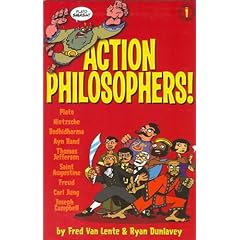
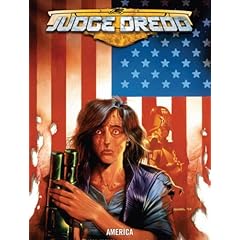
Action Philosophers and America

Here's how this works: I finish reading something, and I tell you about it, and I try not to bore you to death.


I've certainly got spare time for Ryan Dunlavey, who was very encouraging and helpful back when I was doing GMS Legion and he was doing Tommy Atomic, even going so far as to send me a sketch of my two-panel character Head Pop-Off Boy. Action Philosophers is a very silly comic he does with Fred van Lente, telling the tales of various great thinkers and their idiosyncrasies and hypocrasies, in little biographies, sort of like those great Big Book Ofs that DC put out in the nineties. It's nice to see icons deconstructed in such a loving, silly way. The definition of "undergraduate humor," this is recommended for anybody who likes Monty Python.


One of the most acclaimed series in either 2000 AD or the Megazine, America explored the concepts of freedom and liberty in Mega-City One, from the perspective of Bennett Beeny, a songwriter, and America, the daughter of immigrant parents who finds the underground talk of violent revolution too persuasive to ignore. The original 62-page story was expanded over time as the characters were revisited. This is genuinely some of the very best work on Dredd, with Wagner and MacNeil focussing on how normal people are impacted by the totalitarian world of the judges, and it is completely brilliant, from start to finish. Certainly on the short list for reprint book of the year, this is highly recommended.

(Originally posted April 26, 2008 at hipsterdad's LJ.)