Showing posts with label alan moore. Show all posts

Tuesday, June 3, 2014

Ro-Busters: The Disaster Squad of Distinction

What I try to do with reviews at this Bookshelf blog is keep it simple and spoiler-free, and let you know whether I'd recommend you pick up a copy of what I just read. Seems to work okay. This time, a brief review of Ro-Busters: The Disaster Squad of Distinction (Rebellion / Simon & Schuster, 2014).


Back in the mid-1980s, when all of the various series within 2000 AD were licensed for collected editions by Titan, one of the must-have books was the first of two volumes of Ro-Busters. This was a terrific series written by Pat Mills and featured the exploits of some squabbling working-class robots used as disposable fodder for very dangerous rescue missions. Two of them - an unruly and cantakerous sewage-shoveling droid called Ro-Jaws and a full-of-himself army surplus sergeant called Hammerstein - were the leads. They worked for an unscrupulous cyborg super-capitalist called Howard Quartz who genuinely didn't care whether any of his property lived or died, because Ro-Busters was just one of hundreds of robot-staffed operations that he had going.

That original 80-page Titan collection of Ro-Busters has been out of print for many years, but Rebellion has reissued it in a new, expanded edition in conjunction with its American publishing partner, Simon & Schuster. Now 112 pages, it reprints the same stories as that original book - mostly illustrated by Dave Gibbons, with a few pages by Kevin O'Neill and by Mike Dorey - but bookends them with some interesting additions. Ro-Busters actually began in a different comic, 2000 AD's short-lived sister title Starlord, and this book has the first four episodes from that comic. These are drawn by Carlos Pino and by Gibbons. In the back of the book are a couple of neat curiosities - two of the three one-off Ro-Busters episodes that were written by Alan Moore rather than by Mills, with art by Steve Dillon and Bryan Talbot.

As far as I'm concerned, any book to feature that much artistic talent - seriously, Dillon, Gibbons, O'Neill, and Talbot under one set of covers?! - could be written by anybody and still be worth buying. Gibbons' epic "The Terra-Meks," in particular, features page after page of giant robots pummeling each other. The third part of that story is just a tour de force. I can't think of too many other artists in comics that have ever drawn a scene of giant robot combat as brilliant as that. It's masterful.

As for the stories, they're just remarkably fun. Perhaps through the new eyes of a jaded adult, these might appear clunky and dated, but they're kids' comics which nevertheless resonate. Ro-Jaws is such a fun character, vulgar, to the point, and totally lacking any circuits of discretion or tact. Hammerstein is such a straight man that Mills would, in much later stories, go a little too far in showing him up as a chump and had to scale things back to make him a hero again. These characters have lasted long beyond the very brief original run of Ro-Busters, actually. The series proper ended in 1979, with Alan Moore's bonus episodes appearing in the old harback Christmas 2000 AD Annuals in the mid-80s, but the characters have resurfaced in the very long-running spinoff ABC Warriors, which still shows up with a dozen or so new episodes every couple of years.

Ro-Busters is simply a great, inventive, and very fun series, suitable for all ages. Buy two copies of this book: one for yourself to keep in mint condition on the shelf and one for a nine year-old of your acquaintance to read until it falls apart. Any nine year-old who isn't wowed by this, there's something wrong with that child. Highly recommended.

A PDF of this book was provided by the publisher for the purpose of review. If you'd like to see your books (typically comics or detective fiction) featured here, send me an email.

Tuesday, March 4, 2014

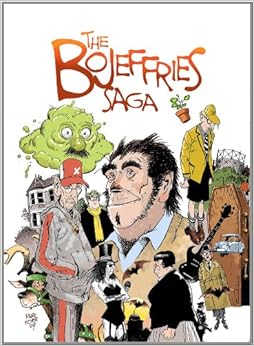
The Bojeffries Saga

What I try to do with reviews at this Bookshelf blog is keep it simple and spoiler-free, and let you know whether I'd recommend you pick up a copy of what I just read. Seems to work okay. This time, a brief review of The Bojeffries Saga (Top Shelf, 2014).


If you'd like some evidence why some of us who love the comic medium have the greatest respect for Alan Moore, then Top Shelf has just the book for you. It's a collection of The Bojeffries Saga, a deeply oddball little comic that he wrote and which was illustrated by the downright brilliant Steve Parkhouse. Scattered here and there in these comedy stories are some of the best, funniest, most downright clever one-two punches in the business.

Take "A Quiet Christmas with the Family," which was originally published in the anthology magazine A1 in 1990. It looks for all the world like Moore just found a great throwaway gag for a single panel while the rest of the story chugged along. The family son gets a Christmas present which nobody would want and finds unexpected joy and pleasure in it. The ridiculous gift, and his reaction, are very funny. I've read this I-don't-know-how-many times and always got a huge smile, it's so silly. And then, two pages later, bam!, the gag gets a second, totally unexpected bonus punch line in an additional throwaway panel. Moore does this frequently - in a masterful short story called "Chronocops" that appeared in 2000 AD, he did it something like thirteen times in five pages - but he camouflages his structure so well that even when I've read a story repeatedly, I still don't see it coming and laugh like a hyena.

The Bojeffries Saga has always surprised readers who see that title and find something different. This "saga" isn't a twelve-book epic, some lost magnum opus by our man from Northampton. It's a collection of nine short stories, coming to under one hundred pages, about the misadventures of a really weird family who have lived for decades in a council estate. There's a quiet mad scientist, his two teenage kids, a werewolf uncle and a vampire uncle, a grandfather who is a violent blob of protoplasm, and a radiation-emitting baby. Their house has time and space warps scattered around the place, and none of the Bojeffries clan really has much understanding of any kind of social sense, or, as the violent and hideous Ginda demonstrates as she looks for a mate one evening, biological sense.

It's howlingly funny, every bit as clever and downright wonderful as some of Moore's other comedy series like D.R. & Quinch and Jack B. Quick, neither of which have particularly deep page counts either. Top Shelf's new edition reprints all of the previous stories along with a sparkling, brand new 24-page tale, the first new Bojeffries escapade in twenty years. The reproduction is flawless and it's priced just right, which is lovely since a previous edition from the early nineties regularly goes for three figures these days. If you enjoy comics, and if you enjoy laughing, then you need this book. Highly recommended.

An advance copy of this book was provided by the publisher for the purpose of review. If you'd like to see your books (typically comics or detective fiction) featured here, send me an email.

Tuesday, October 25, 2011

The League of Extraordinary Gentlemen: Century: 1969

What I try to do with reviews at this Bookshelf blog is keep it simple and spoiler-free, and let you know whether I'd recommend you pick up a copy of what I just read. Seems to work okay. This time, a brief review of the latest freaking League of Extraordinary Gentlemen story (Top Shelf, 2011).


Have things really become this awful? Honestly, the best that I can say about the latest, interminable, bloodless exploit of the restless and bored adventurers of the League of Extraordinary Gentlemen is that it's not quite as bad as I thought it was when I first read it. It did improve markedly on a second read, but I still didn't like it at all.

I was not expecting much; Kevin O'Neill, whose work stopped thrilling me at some point between Metalzoic and Marshal Law many years ago, has always had trouble hitting deadlines, but the amount of time he spends drawing these comics only for them to emerge looking so darn ugly just leaves me baffled. It's not as though he's phoning it in; the amount of detail that he packs onto the page really is amazing, but it all looks so flat and it doesn't serve any damn purpose whatsoever other than to give Jess Nevins something to annotate. There's not a point in the world in agonizing over putting caricatures of the actors who played Steptoe and Son into the crowd scenes of your pages when they don't serve the story, slow you down, and, oh, look like they've been run through the ugly machine. Well, not that those guys were winning beauty pageants in the real world, but still.

So, I was predisposed to dislike this comic because I greatly dislike Kevin O'Neill's art, which is certainly heretical in many of the quarters in which I visit, and because I'm amazed that he keeps getting a pass from a fandom for taking such an absurd time to finish the work. I know that sounds like a reverse Woody Allen complaint, but, really, when artists whose work I enjoy more could have illustrated this story in far, far less time, it really feels like a story that I (once) wanted to read is being held up by substandard art. I've given previous editions of the book a break because I was willing to overlook the art that I find unappealing in order to get to the story. Alan Moore often gets that kind of a pass, but often, lately, he's lost me. I'm not about to spend money on, to use a beacon-bright example, Lost Girls, because, while I've no objection to comic book porn, that doesn't sound like the sort of porn that I want to read, and worse, it's just about the most awful art that I have ever seen in any comic, ever, and is, by consequence, the least erotic thing imaginable. Johnny Ryan and Sam Henderson could have made a sexier comic.

But anyway, the flat reality, now that we're into the "Century" cycle of stories, is that I no longer want to read about Mina and the boys, and this art that I can't stand is just making matters worse. Mina's stiff and grouchy exterior played well as a supercilious Victorian, but what the hell is she still doing stomping around with a Victorian-era chip on her shoulder in the nearly-modern day? Socially, the world has become so much brighter and more effervescent since her time, but she's absolutely joyless when not hateful; she's given up, and her malaise infects the story. Orlando and Quatermain seem to want to move on and enjoy life, but they're stuck, loyal and subservient, for some mad reason, to her. When the climax sees Mina separated from her associates, I was left with relief. Soon, Orlando and Quartermain will be able to hang out with Jason King and have some fun for once.

It's always been amusing to watch Moore just get down in the dirt and mess with perceptions and expectations about how the great and the forgotten characters of fiction really would interact with each other. Seeing the not-James Bond-for-trademark-reasons James Bond get such a comeuppance for his vulgar chauvinism in The Black Dossier was a scream, for instance. But Moore has Adam Adamant so utterly backwards in his cameo that it drives home how unpleasant Mina has become, and how there is no longer any reason to read about her. The televsion Adamant was trapped in suspended animation from 1902 until 1966, when he was unfrozen and began solving the sort of cases that John Steed and Emma Peel would normally handle, and, much like Steed, he loved life. Swinging London confounded him for a few moments before he jumped in and took the city and the 1960s by storm. Well, as much storm as a cheap 1960s BBC videotape drama would allow.

So Moore takes a character, who, cut adrift from his stodgy old morality and culture, adapted to the 1960s with wild enthusiasm and abandon, and then lets the unpleasant and bored Mina undermine him and play him for laughs? It's long been suspected that Moore just doesn't like modern life at all, but perhaps more was revealed here in the telling of the joke than was intended. The old crank has lost me. Not recommended.

Tuesday, March 22, 2011

The Many Worlds of Tesla Strong

What I try to do with reviews at this Bookshelf blog is keep it simple and spoiler-free, and let you know whether I'd recommend you pick up a copy of what I just read. Seems to work okay. This time, a brief review of The Many Worlds of Tesla Strong (DC, 2003).


Going through my boxes of comics that I have not read since I bought them, I've found several that I wanted to give one more thumb-through before sending them off to new homes. One of them is this 64-page spinoff of Alan Moore's wonderfully fun Tom Strong series written by Peter Hogan. In it, Tom's adventurous daughter Tesla tries, unsuccessfully as ever, to save the day before her mom and dad get home from an important mission. This sees her hopping from dimension to dimension in search of her family's loyal and beloved assistant, Solomon, who's gone missing in a parallel universe.

About a dozen artists contribute to the story, each in charge of a few pages that illustrate the different worlds that Tesla visits while looking for Solomon. Some of the artists are given assignments tailored for their talents, most memorably J. Scott Campbell, who drew the cheesecake Danger Girl, gets a few pages in a nudist universe. In keeping with the rules of the genre, each world has parallel versions of the Strong Family, and all of them are missing their world's version of Solomon.

I seem to recall that this was released around the time that Alan Moore started growing bored with Tom Strong. It looks like Moore stepped down from the series after 22 issues, the last two of which were terribly delayed, in 2003, and several guest writers, including this title's Peter Hogan, carried the book to its conclusion. Despite the good art throughout, with contributors including Frank Cho, Chris Sprouse, Art Adams and Michael Golden, this is just an incredibly lightweight and fluffy bit of popcorn, with none of the excitement and unexpected twists that Moore and company brought to those four terrific years of the main title. Cute, but not really recommended.

Wednesday, September 8, 2010

Rogue Trooper: Tales of Nu-Earth Volume 1

What I try to do with reviews at this Bookshelf blog is keep it simple and spoiler-free, and let you know whether I'd recommend you pick up a copy of what I just read. Seems to work okay. This time, a brief review of Rogue Trooper: Tales of Nu-Earth Volume 1 (Rebellion, 2010)


Here's a book which, honest to heaven, I did not need. I don't mind the reputation I get as one of 2000 AD's online cheerleaders, and as I have cut way, way back in buying new comics, it's only the constantly-improving, mindblowing platinum age of the Galaxy's Greatest Comic (well, and Legion of Super-Heroes) that has my ongoing interest in the medium at all these days, and it's sort of expected that I'll buy all these things the publisher releases. But Rogue Trooper is far from my favorite property in the 2000 AD world, and this is a series that has been reprinted a lot. Unfortunately for my wallet, I neglected to send an exception to my regular order at my favorite comic shop, and, well, now I have these stories for at least the fifth time.

Having said that, if you've never read Rogue Trooper before, you could certainly do a lot worse. This collects all of the character's adventures from 1981 to 1983, written by Gerry Finley-Day and illustrated, brilliantly, by the likes of Dave Gibbons, Eric Bradbury, Brett Ewins, Cam Kennedy and Colin Wilson. The artwork really is terrific. I've long lost interest in revisiting these storylines, but the artwork constantly sucks me right back in.

These are future war adventures set on a hellworld with poisonous atmosphere. The only man who can breathe in this toxic nightmare is the last of a company of genetically-engineered super-soldiers. He's accompanied by the squabbling dogtags of three of his dead buddies - "biochips" which retain personalities and memories until they can be returned for newly-grown bodies. But since our hero's company has been betrayed by a traitor general and the ironically-named Rogue has gone AWOL to track that man down, they can't be returned any time soon.

I've always accepted that Rogue Trooper is a great icon for merchandising and adverts - Rebellion made a good video game of him in 2006 - thanks to Gibbons' simple, but memorable design. But honestly, these stories are pretty darn juvenile, without the necessary kick that keeps them interesting for older readers. Preteen boys would eat this up before anybody else, although the artwork is a selling point on its own. Also of interest are two bonus episodes. The meat of the book reprints all of the weekly episodes from about a 19-month stretch, but among the bonus supplements are two rare episodes scripted by Alan Moore that originally appeared in the old annual hardbacks. One of them is pretty by-the-numbers; the second, with art by Jesus Redondo, is probably the best story in the book.

For those of you who've kept an eye on Rebellion's ongoing reprint program of the last six years, Tales of Nu-Earth 01 collects the entire contents of the two books released some years ago in partnership with DC, plus the Alan Moore episodes, plus the first seven episodes from the third book, which Rebellion released without DC's involvement. It's a very nice upgrade, as upgrades go, just not one that I personally needed. If readers would please excuse my lack of enthusiasm, I do recommend this for the art - there's not a page of Gibbons that shouldn't be owned by everybody who likes comic art - but really only for readers who have not bought the previous editions.

Monday, August 30, 2010

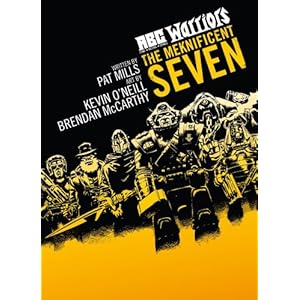
The ABC Warriors: The Meknificent Seven

What I try to do with reviews at this Bookshelf blog is keep it simple and spoiler-free, and let you know whether I'd recommend you pick up a copy of what I just read. Seems to work okay. This time, a brief review of The ABC Warriors: The Meknificent Seven (Rebellion / Simon & Schuster, 2010)


Among all seven gajillion or so of us who like reviewing "graaaaphic novels" and things on the internet, there's a subset who really enjoy the comic juxtaposition of elements that really occur best in the comic medium. Things like J. Jonah Jameson yelling at Godzilla, things like that. It still blows my mind that no publicist has sat these folks down, what with the big audience that they command, and shown them The ABC Warriors, a high-concept science fiction serial written by Pat Mills. It began in 1979 and new episodes have appeared every few years in the pages of 2000 AD. There's a bit in one of their earlier adventures, reprinted in this new American edition, in which war robots with bazookas ride around the deserts of Mars on the backs of tyrannosaurs.

Let me repeat that for the benefit of those not paying attention: ROBOTS WITH BAZOOKAS ON TYRANNOSAURS ON MARS. Drawn by Carlos Ezquerra. This is, in point of fact, the greatest thing to ever appear in fiction.

For those of you who haven't been paying attention, the ABC Warriors are a motley squad of war robots assembled in the waning days of a global conflict against the Volgan Empire. They include a cowboy robot, a sniper who communicates in bursts of letters and numbers, a Volgan general reprogrammed to obey allied commands but who retains his two-timing, traitorous nature and a shrouded, grinning maniac who puts that whole "sufficiently advanced technology indistinguishable from magic" business to the test. They are the coolest team of backstabbing, squabbling characters to appear in comics, and if they don't hypercharge your inner ten year-old, then you were obviously never ten.

The artwork on this initial series of 21 episodes was mainly provided by Mike McMahon, with guest appearances by Ezquerra, Kevin O'Neill, Dave Gibbons, Brett Ewins and Brendan McCarthy. About five years later, Alan Moore contributed the only episode of the long-running series that Mills did not write; it's illustrated by Steve Dillon and it makes its first appearance since its original outing in this new collection by Rebellion, distributed in the US by Simon & Schuster. The new book also includes a six-page framing story by Mills and O'Neill that originally appeared in Titan Books' old collection of this serial.

"The Meknificent Seven" has appeared in print many times before this, but the current edition is the first one aimed at mainstream bookstores, with the Alan Moore episode added as a sweetener for anybody wary about buying it again. It also includes a new foreword by Pat Mills and, as a supplement, five of the old "Fact Files" about the characters. These are really charming, and while the series has "grown up" along with its readers and more recent episodes are aimed more at adults, the "collect 'em all" nature of these pages reminds me that, once upon a time, this was the most awesome idea in kids' comics ever.

As I write this, the book has been out for about six weeks, and I'm a little concerned about the lack of publicity out there. I know that Mills was doing his usual awesome job of promotion in California last month, with signings at an area Barnes & Noble and an appearance at the San Diego Comic-Con, but somebody at Simon & Schuster really needs to start knocking down some doors to tell people that they're carrying these 2000 AD collections, and that they are fantastic. You can't rely on me; my audience is very small, and they almost never listen when I tell them to buy things. Get some review copies out, guys, because everybody in America needs to know that if they have a ten year-old boy in the house, or anybody else who remembers how hotdamned spectacular wild things like this were like when they were that age, then their house needs the ABC Warriors. Highly recommended.

Tuesday, July 27, 2010

The Complete D.R. & Quinch

What I try to do with reviews at this Bookshelf blog is keep it simple and spoiler-free, and let you know whether I'd recommend you pick up a copy of what I just read. Seems to work okay. This time, a brief review of The Complete D.R. & Quinch (Rebellion / Simon & Schuster, 2010)


I don't know whether I have very much left to say about D.R. & Quinch, but I'll give it a try. Originally published in 1983-84, it still sits pretty high on my list of favorite Alan Moore titles. It's a juvenile, loud, anarchic and convention-busting serial about two heavily-armed students who enjoy boozing up more than anybody you ever met, and whose wild adventures set the template for many Alan Moore heroes that would follow. You can find the DNA of Waldo "Diminished Responsibility" Dobbs and Ernest Errol Quinch in almost all of Moore's Tomorrow Stories, and you can find the DNA of The Young Ones, The Hitch-Hiker's Guide to the Galaxy and the National Lampoon feature O.C. and Stiggs in these stories.

Dated they may be, but D.R. and Quinch's brand of mayhem and one-liners remains one of the most entertaining and ridiculous experiences in comics. Moore, abetted by Alan Davis's remarkable designs, clear storytelling and solid character work, came up with some incredibly absurd plots and, once D.R. is given dialogue in the second story - the first is told in narration - it's comedy gold on every page. Sure, the duo's brand of fun involves everything from playing tennis with hand grenades to terraforming planets to write obscene graffiti, but really, who among us hasn't longed to get away with that?

D.R. & Quinch did not run for very long. Moore only wrote six stories, each between one and five 6-page episodes, before retiring the characters. They were resurrected in 1987 for nine "Agony Pages" scripted by Jamie Delano in which the demented duo offered advice for readers. Their advice usually required access to fission material or Adnan Khashoggi's telephone number.

There have been collections of D.R. & Quinch before, many times, but this is by far the most expansive and complete collection published to date. It contains all of the Moore episodes, and all nine Delano-scripted pages, reproduced in color for the first time. Two years ago, Rebellion had released a volume which did have the Agony Pages, but in black and white. This volume also includes a huge collection of pin-ups and sketches of the characters, along with some cameos that they made in the pages of a British comic convention's program book, and a couple of pages of Moore's original script.

I don't know what more to add. It's a great collection of very funny comics, done very well on nice paper. It's the first of two collections aimed at the American market as a co-publishing venture of Rebellion and Simon & Schuster, the other being a new edition of Judge Dredd: The Complete Case Files 01 with a new cover, and everybody's hoping that emphasizing the resumes of Alan Moore and Alan Davis over the comic where they originally appeared might make a difference in how the books perform domestically.

Unlike the previous collections in 2000 AD's large graphic novel line, these are available from big box domestic retailers like Barnes & Noble and Borders, and don't have to be special-ordered through comic specialty shops with fingers crossed. Happily, these have been designed to fit right in with the many previous collections, with matching spines and layout, so people who have been collecting the line and care about this sort of thing (going by the forums, that would apparently be "almost all of us") can breathe easily - Simon & Schuster have totally done right with this collection, and it bodes well for future books in the line. Highly recommended.

Tuesday, March 30, 2010

Dodgem Logic # 1

What I try to do with reviews at this Bookshelf blog is keep it simple and spoiler-free, and let you know whether I'd recommend you pick up a copy of what I just read. Seems to work okay. This time, a brief review of Dodgem Logic # 1 (2010)


Well, I'm certainly willing to shell out four bucks to see what Alan Moore's up to while he's waiting for artists to finish illustrating his comic scripts. Turns out that he's had a long-standing pipe dream about being the editor and publisher of his own magazine. So he licensed a few tunes for a CD and sold some ad space and got some friends and wrote some articles.

The resulting hodgepodge, Dodgem Logic, resembles an APA more than a professional magazine, although it is nicely printed, on good paper. There isn't any sense of uniform design, which really makes it unfriendly to readers' eyes when they can't tell where articles stop or start. Moore's lead feature, a six page article on the history of underground newspapers, looks like three separate stories, with different fonts and background colors, but it's full of really interesting facts all the same.

The first issue comes with a free CD called Nation of Saints, which is a compilation of Northampton-based music from across the spectrum, with not-quite-getting-it country (if your country song is more than six minutes long, you're not quite getting it) to hip-hop. It's got that terrific Jazz Butcher song "She's on Drugs" which I hadn't heard for many years, and the lead track has that noted duck marcher and warbler Moore returning to the studio for the first time in a while. And it's got something by one of those guys from Bauhaus who isn't Peter Murphy, if you like that sort of thing.

The magazine features health articles, recipes and accessorizing tips, and illustrations by regular Moore cohorts and spouses like Kevin O'Neill and Melinda Gebbie. It's all done with a playful, lighthearted touch, like a bunch of buddies who know their stuff cobbling something together in the hopes that you might get a kick out of them. I can just see Gary Ingraham as an eager sixteen year-old offering to do the local music reviews and a short history of rock bands who've played Northampton. Maybe the magazine lacks focus and defies categorization ("lifestyle," maybe?), and while I don't think this will become essential reading for anybody not already curious about Moore's projects, since it's done with such enthusiasm and lack of pretension, it's impossible to begrudge the gang behind it. Some of the artwork is child-unfriendly, but otherwise it's recommended for older readers.

Tuesday, April 7, 2009

Albion

Here's how this works. I read a book or two and tell you about them and try not to get too long-winded. This time, a review of Albion (DC/Wildstorm, 2006).


In a perfect world, Albion would have been a mammoth hit, sparking a fabulous revival of the wonderful characters of British comics' silver age and bringing all their old adventures back into print. But I suppose in that perfect world, Albion itself would have been more memorable and impressive than it actually is. It's the story of missed opportunities and a comic that reads like the rough draft of something that should have been so much better.

A quick recounting of the plot kind of goes like this: Danny, a young fellow who loves the same old British newspaper comics that I do, realizes that a newly-apprehended criminal is the villainous old Leo Baxendale character Grimly Feendish. He joins the mob outside the police station, calls out the rascal by his real name, is grabbed and spirited off by someone who turns out to be Bad Penny, the daughter of Eric Dollman, and pressganged into rebuilding Robot Archie and joining forces with Charlie Peace in order to free Grimly, Mytek the Mighty, Cursitor Doom, the Spider, the Steel Claw, Faceache, Captain Hurricane and a host of others from the remote prison where the former Eagle-Eye Junior Spy and Zip Nolan are keeping them.

This should have been the greatest comic ever. It's nowhere close.

A really big part of its failure is down to Shane Oakley's art. He proves himself, via the flashbacks, to be a talented fellow, able to use multiple styles, but the main narrative is one of the ugliest comics I've tried to follow. There's a disorienting flatness to the characters, and distortion and curvature where we should see solid objects. It's not just that the page is two-dimensional, but rather the world the characters inhabit is equally flat. It's incredibly frustrating, especially when compared to the simiarly busy, Easter egg-filled world of, say, Top 10, when you consider how good this book should have looked.

But Oakley could have turned out a world as rich as Ha and Cannon's and this book would still be a mess, easily one of Alan Moore's weakest stories. Alan only plotted the book, and gave it to the writing team of his daughter Leah and her husband John Reppion to script. They're said to have improved remarkably since this initial stumble, and their forthcoming Sherlock Holmes comic is much anticipated. Somewhere between the writing and the art, so much is fumbled, and tired comic cliches are wheeled out. It even begins looking boring, with a standard early-90s Keith Giffen nine-panel page of the same repeated image of a single character, with minimal lighting changes, while two other unseen characters talk around him.

The list of apalling storytelling just goes on. Scenes abruptly end after two pages, regardless of whether they've actually reached a sensible stopping point. New characters are dumped into the narrative without explanation or introduction. This is an enormous problem throughout the prison sequences, most of which are impossible to follow without Damian Gordon's online annotations. It's simplicity itself to just have characters refer to each other by name the first time we meet them in each issue, or in the case of a dramatic buildup, tell us who we're about to meet. The cliffhanger to issue two is one of the dampest failures in the book, when a character who, after a little chin-scratching, we conclude is probably Captain Hurricane is dumped on us with no drama or sting.

Yet I think even all this could have been overcome had Bad Penny not been the most baffling, illogical character I've ever been forced to follow. Acting like she's come from evening classes at Unfair Warren Ellis Stereotype Academy, all dyed hair, chain-smoking, tough girl attitude and a refusal to explain the situation to Danny, not one word of their "relationship" is at all believable. It doesn't make sense for her to rely on and confide in Danny purely because he recognizes Grimly Feendish, and it doesn't make sense for him to stick around. If this is detailed further in the last episode, when we learn more about Danny, it sailed over my head, and I didn't follow Gordon's annotations that far.

Albion's commercial failure was unfortunate, but it did have a pair of nice legacies. DC/Wildstorm commissioned a pair of miniseries about old IPC characters in its wake. One of these, Battler Britton by Garth Ennis and Colin Wilson, was simply wonderful and it wouldn't have existed without Albion. Additionally, Titan Books released a tie-in collection of some of these old stories, Albion Origins, which I'll be coming back to in a few weeks. And the collected edition of this story does contain a handful of old episodes of some of these comics, even if the Zip Nolan pages are reproduced disagreeably small. It's not a complete failure, even if my personal frustrations are so high as to overwhelm any of the good that might be here, but I would nevertheless only recommend this to Alan Moore devotees who've already tackled almost everything else that's available.

Thursday, March 5, 2009

The Complete Ro-Busters

In other news, Rebellion continues to impress with their graphic novel collection. Sometimes, they announce a project which doesn't sound like the most exciting book on the shelf, but then the finished product turns out to knock your socks off. That's the case with The Complete Ro-Busters, which does exactly what it claims on the front and compiles absolutely every strip appearance of Hammerstein, Ro-Jaws and the gang from the pages of both Starlord, where the series began, and 2000 AD. The Ro-Busters, as I described 'em over at Touched by the Hand of Tharg, are "a disaster recovery crew along the lines of International Rescue from Thunderbirds, only they are staffed by a crew of robots (chief among them our lead characters Ro-Jaws and Hammerstein) and they are by no means as charitable as the Tracy boys had been. Mr. Ten Percent (so named because only ten percent of him, his brain, was human) charges for the dangerous work his droids perform."

That Ro-Busters should have developed into anything memorable is something of a miracle. The series was created by Pat Mills to fill some editorial request for something about planet-saving superheroes. Since Mills, as anybody who's read Marshal Law could figure, has never had much time for the concept of superheroes, he turned the idea on its head and decided to have the disaster squad staffed, not by noble, selfless people, but by the most expendable of characters: junked-out robots in line for the scrapheap, bought dirt-cheap by a greedy jerk in need of cheap labor to exploit.

Anyway, Ro-Busters is certainly dated, and from the outset feels very much like a comic strip for children, especially in a ridiculous story in which two people disguise themselves as robots in order to start a rebellion on board a casino in space, but it's incredibly fun! The writing did tighten up around the time it moved to 2000 AD, with an engaging mix of class comedy and homages to war comics before the wild lunacy of the final storyline, in which the doomed robots try making a break for a planet where they can be free. But before that frantic conclusion, there's a great story in which Ro-Jaws and Hammerstein are sidetracked for a tale in which one of Mr. Ten Percent's other business ventures show up. A demolition squad called the Terra-Meks, they turn out to be the villains of the piece. Four episodes of utterly gorgeous giant robot violence and mayhem, set against the backdrop of a dying coastal community and its giant robot lighthouse guardian, might be the book's high point.

The book is just tremendous fun, and if Rebellion actually missed an episode anywhere, it'll be news to me. It includes work by other writers besides Mills, including three by Alan Moore, who wrote yearly one-offs for the pages of the 2000 AD Annual in the mid-80s after the series had otherwise concluded. Artists include Steve Dillon, Dave Gibbons, Mike McMahon, Kevin O'Neill and Carlos Pino. Every bookshelf should have one.

(Excerpted from Thrillpowered Thursday, March 5 2009.)

Thursday, March 20, 2008

Mighty Marvel Mediocrity Edition, with Power Man, Iron Fist and Captain Britain

Here's how this works: I finish reading something, and I tell you about it, and I try not to bore you to death.


Oh, the things I buy when I find a sale. Honestly, when I was young, my taste in Marvel books ran towards the odder, like The Defenders and Ghost Rider - inasmuch as any title with Don Perlin's workhorse art could be described as even slightly "odd" - and I never actually read a single issue of Power Man and Iron Fist before now, and so I was curious what it might be like. I didn't miss much. Most of the book is written by Mary Jo Duffy, and she keeps things moving at a pretty brisk pace, with a good supporting cast and subplots that keep your interest, but in the end, these stories are toothless and uninspiring, and to label them as "essential" is not in any way accurate. Recommended for under-twelves.


The first thing that struck me when looking at this collection is how godawful the coloring is. There exists a subset of superhero nerd which cannot stand looking at black and white funnybooks, ignoring the simple fact that work designed and balanced for blacks, whites and grays always looks hideous when color is applied to it. It is for these numbskulls that Alan Davis's artwork, which was the best thing about this material, is butchered.

The next thing that struck me was how primitive the early episodes looked and felt. This fault is shared between the lettering by Jenny O'Connor, which put me in mind of a high schooler's efforts, and the actual words the poor soul had to stick in them. Alan Moore hadn't yet learned to edit himself at all yet, and the result is garishly overwordy, a poor imitation of Roy Thomas and Chris Claremont, with characters agonizingly relating not merely complete sentences but giant novels of soul-searching in thought bubbles.

The story is an interlocking series of tales from an epic called "Jaspers' Warp," told across two years (1981-83?) of Marvel UK's various reprint anthologies in episodes of 8-10 pages each. The book does not include the opening six or seven episodes, which were scripted by a guy named Dave Thorpe, nor does it include a "story so far" explanation. To be fair, after about forty pages of barely readable schlock, around the time Steve Potter shows up to make the lettering look better, Moore settles down and what looks to be a good story gets going. But no sooner does the threat get serious and I was looking forward to watching our hero and his gang struggle against Jim Jaspers' government getting out of control does the story suddenly jump forward in time, Jaspers already victorious. What's left is typical convoluted Marvel storytelling, with cosmic entities manipulating the action and reality-warping superpowerful creatures exchanging blows on scales unimaginable to mere mortals, like our quickly-sidelined heroes. It's nothing that hadn't already been done before and better in any number of Marvel books in the sixties and seventies. Okay, "Captain Airbase-One" is funny, and a cute foreshadowing of the third League of Extraordinary Gentlemen volume, but otherwise this is recommended only to Alan Moore completists who've already read everything else they can find by the writer.

(Originally posted March 20, 2008 at hipsterdad's LJ.)

Sunday, February 3, 2008

Emma vol. 6 and Watchmen

Here's how this works: I finish reading something, and I tell you about it, and I try not to bore you to death.


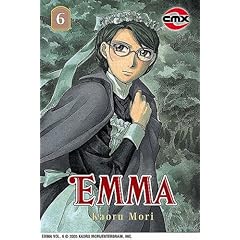
The "dark" installment, where everything hits the fan. William finally stands up to his old man in an intensely cool sequence with the two of them shouting at each other for pages. On the other hand, Emma's quiet passivity is really grating this time around. The art's sumptuous and beautiful, but I don't understand what William ever saw in her in the first place. Backbone, people! Spine! Moxie! Recommended with reservations.


What was this, the fourteenth or fifteenth time I read this? It remains a masterpiece of construction and foreshadowing full of genuinely great characters, but it satisfies a little less each time I read it. I don't read all the pirate stuff every time, but I realized this time the main reason I want to skip them is because those damn captions are the most turgid, overwrought things in the book. It might make a good movie, but I don't know that a contemporary audience is going to buy the almost immediate armistice the way we did twenty years ago. Recommended, but not for younger readers.

Incidentally, whatever happened to that comic book with the Art Adams promotional art with Batman punching Rorschach? Did that come out yet?

(Originally posted February 03, 2008 at hipsterdad's LJ.)

Thursday, November 22, 2007

The League of Extraordinary Gentlemen: Black Dossier

Here's how this works: I finish reading something, and I tell you about it, and I try not to bore you to death.


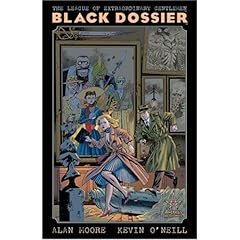
The second time was the charm, as what began as a very good story reveals itself, by way of so many incredibly intelligent allusions, foreshadowing and narrative puzzles, to be utterly sublime, like a comic version of House of Leaves. The main story is as remarkable as you expect from the Moore and O'Neill's prior work. Remember how, in volume one, M turns out to not be Mycroft Holmes and it's the greatest cliffhanger ever? That happens about six times here. I was totally comfortable with the Dan Dare/Gerry Anderson world that's replacing Big Brother's England, and adding the entirely dissimilar Quatermass Experiment to that world was a masterstroke, just dropped in for a penny-drop gag in one panel.

The use of the supplemental material from the dossier itself is amazing, subtly revealing facts with casual ease, and silently passing notes to the reader on the back of jigsaw puzzle pieces. I did complete The Crazy Wide Forever, although it's likely I won't perform well if quizzed upon its narrative, and liked the unbelievably kinky Fanny Hill sequel best, even better than the thrilling picture story The Life of Orlando. The Wodehouse pastiche had me in stitches, though I think even a dark god like "Cool Lulu" should know better than to mess with Wooster's Aunt Dahlila. Highly recommended for mature readers with ample time to dissect and play with the material.

(originally posted November 22, 2007 at hipsterdad's LJ.)

Tuesday, August 14, 2007

Tomorrow Stories Vol. 2

Here's how this works: I finish reading a comic collection, and I tell you about it, and I try not to go on too long.


I didn't like the second collection of this as much as I did the first. There are only two Jack B. Quick stories in it, and while they're both hilarious, there should be a lot more than two, and Moore completely runs out of steam with the First American. On the other hand, there's some very good guest artwork by Joyce Chin on a Cobweb episode, and seven further Greyshirt stories. Greyshirt's been MIA for a few years, and Darwyn Cooke's leaving The Spirit in a few months. Life's not fair. Recommended for Alan Moore fans; I don't see this appealing to people unfamiliar with his quirks.

(Originally posted August 14 2007 at hipsterdad's LJ.)