Showing posts with label neil gaiman. Show all posts

Thursday, December 26, 2013

The Ocean at the End of the Lane

What I try to do with reviews at this Bookshelf blog is keep it simple and spoiler-free, and let you know whether I'd recommend you pick up a copy of what I just read. Seems to work okay. This time, a brief review of The Ocean at the End of the Lane (William Morrow, 2013).


There's a part of me that felt some serious disappointment with Neil Gaiman's most recent novel, because it's just so very Gaimanny. You name the trope, it's in here. Young protagonist, very old magic, trinity of crone / mother / youngster, names having power, tempting from magic circles, mysterious creatures / forces from other realities crossing into ours... this is a story that he's told before, quite honestly.

I'm not sure that he's ever told it so well, however. It's a story remembered by a man in his late forties, who had forgotten most of the events, decades ago, that began with a boarder stealing the family car and killing himself, and ended with a childhood friend moving across the ocean to Australia. But when he revisits the rickety old farm where the girl lived, he remembers a much more vivid story, of some force from another world influencing ours, of a visit to that land in the company of his new friend to try and persuade the force to leave, and of what happened when the creature followed them back to our world.

It is whimsical and interesting, and just long enough to not overstay its welcome, but it mostly follows a very predictable path. Even the fate of his friend - "Australia," indeed - is unsurprising. Gaiman's prose is so darn fine that it mostly didn't matter that this was a story he's told in comics and novels before. The ending, however, does contain a few unexpected revelations and quite heartbreaking gentle little twists. I admire Gaiman's power, but I'm ready for him to blaze a few new trails. Recommended with reservations.

Monday, May 17, 2010

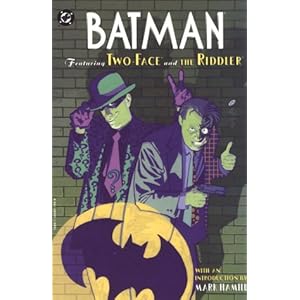
Batman Featuring Two-Face and the Riddler

What I try to do with reviews at this Bookshelf blog is keep it simple and spoiler-free, and let you know whether I'd recommend you pick up a copy of what I just read. Seems to work okay. This time, a brief review of Batman Featuring Two-Face and the Riddler (DC, 1995)


Here's an interesting case where not only is the book I've read just all over the map, my thoughts on it are equally scattered. This might just add up to an even more incoherent than usual entry.

Naturally, DC Comics would like to cash in on the film versions of their comic books, and so when Batman Forever was released in 1995, somebody compiled this incredibly slapdash 192-page book which collects some of the many stories that featured the film's two bad guys. Each villain gets the spotlight in three tales, and they share space with the Penguin in an interesting additional story called "Original Sins."

"Original Sins" is by far the most interesting thing in the book. It was initially published in the 1989 Secret Origins special edition and was co-written by Neil Gaiman, Alan Grant and Mark Verheiden. Gaiman contributed the frame story about a documentary film crew coming to Gotham to investigate the city's problem with oddball criminals, and the middle story, in which the Riddler explains his life of crime to them. Magically, Gaiman chose to include the Riddler of the 1960s TV series, rather than the comics, and presents a sad, aging man who misses his old colleagues like King Tut and Marsha, Queen of Diamonds, and laments the modern version of the Joker, who goes around killing people these days. This story, and Grant's clever look at the Penguin, are easily the best things in the collection, although the two Riddler episodes from his 1960s heyday are each amusing in their audacious, impossible way.

Was Two-Face always such a boring villain that no writer wanted to bother with him unless they were recounting his origin for the umpteenth time? This book includes his two-part first appearance from 1941 and an extra-long tale from 1990, each of which tells his origin. So does Verheiden's segment from "Original Sins." I suppose there is some mild archaeological curiosity in comparing the way that Bill Finger and Bob Kane told the story in '41 and the ways that Verheiden and Andrew Helfer did it more recently, but crowded into this slim volume, it's too repetitive, and makes Two-Face feel One-Note.

The 1960s Riddler episodes are available in the second and third volumes of DC's Showcase Presents line of Batman reprints, where they make a little more sense placed in the high-concept, bizarrely-told pop art world of that time. The Secret Origins Special should be available from many back issue dealers, although demand from Neil Gaiman's fans might make it a little pricy. As for this book itself, I found it at a publishers' overstock clearout store about a year after its release, and felt good paying just two bucks for it. I'd recommend it if you could find it for less than what dealers charge for the Secret Origins Special, but no more.

Monday, January 4, 2010

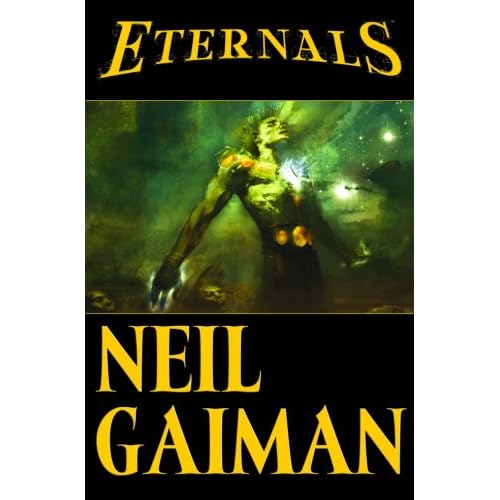
Eternals

Here's how this works. I read a book or two and tell you about them and try not to get too long-winded, and maybe you'd like to think about reading them as well. This time, a review of Eternals (Marvel, 2007).


Well, here's a curiosity. My wife likes Neil Gaiman more than I do, and I like Jack Kirby more than she does, so I suppose it was only a matter of time before one of us picked up this book. Actually, she bought it from Comic Envy in Asheville several months ago, but it took some time to work its way up each of our reading piles for me to tell you about it.

Kirby created The Eternals in the mid-70s after reading those Chariots of the Gods books that were popular back then and figuring those'd make a good comic book. It's a big, weird epic starring super-powered folks with mythological names, scheming among the backdrop of giant space deities called The Celestials influencing human behavior for centuries. Honestly, they were a rung or two down from his very best work, and like a lot of good '70s work by many different creators for Marvel Comics, didn't fit quite so well jerry-rigged into the existing, broader Marvel Universe, but they're still quite good stuff.

After several years of inactivity, Marvel decided to revamp and revisit the characters, and so turned to Neil Gaiman and artist John Romita Jr. for a seven-part series. It's available in a nice hardcover edition, and it's... okay. Just as awkwardly jerry-rigged into the contemporary superhero world, this, bafflingly, features an Iron Man who's nothing like the devil-may-care playboy iconoclast from the movies, but some boring establishment heel who keeps telling these newly-emergent superpeople that they need to get registered with the government for some bound-to-be-forgotten reason that future generations of Neil Gaiman fans will never understand.

If you can get past the unwelcome intrusions by the ongoing Marvel soap opera, this is a pretty good distraction, although rarely compelling. Gaiman does a better job building the events than just about anybody else in comics, and, working outside his comfort zone in the world of super powers, he comes up with some very neat variations on established tropes. One character realizes that he has super speed when the power kicks in during a crisis, and he finds himself among a crowd being fired on by a gang of armed gunmen, having to quickly figure out what to do about hundreds of bullets slowly moving towards the people. On the other hand, Gaiman still has the same problem with climaxes that he did back during The Sandman. I finished this less than a week ago, and I have already forgotten exactly what the protagonists did to save humanity from the sleeping Celestial god.

I found the artwork particularly dull. I didn't like Romita Jr. when I was in high school and he replaced Paul Smith on Uncanny X-Men and I don't like him now. He does nothing at all wrong, but his work looks overly fussy and scratchy to me. For a middle-of-the-road superhero melodrama, I'm sure it's fine, but for something meant to be as epic and mythological as this, I never got that sense of great, cosmic importance the work is asking for.

This sounds like damning with faint praise, and perhaps it is. In much the same way that a Holiday Inn cover band might pull off a performance of "This Old Heart of Mine" that's leagues better than anything on the Q100 pop charts these days, I'm sure this is far superior to the modern comics where Iron Man started acting like such a government stooge. Yet with Kirby's original run of Eternals in print and available from all good shops, there's no more a need to need to read Gaiman's take than to rush down to the Holiday Inn. Recommended for Gaiman completists only.

Sunday, July 12, 2009

Wednesday Comics # 1

Here's how this works. I read a book or two and tell you about them and try not to get too long-winded. This time, a review of Wednesday Comics # 1 (DC, 2009).


Well, this is almost terrific. With Wednesday Comics, DC is trying a very interesting experiment, showing off fifteen new stories in an oversized format, like the Sunday funnies used to be. It folds out twice to newspaper size, and each feature gets its own page, for fifteen serialized stories.

It's not completely perfect, and I think fans will be spending the next twelve weeks Monday morning-quarterbacking things they might have done differently. I think they missed a trick by insisting all fifteen be serialized adventure stories; surely they could have given the space to the incoherent Wonder Woman feature over to a classic kid's comedy like Stanley and His Monster. The first issue also suffers from each being a set-up page. It might have been nice to join one adventure already in progress. The Flash story almost accomplishes this, and it's pretty fun. Best of all, the stories are continuity-free. That the publisher has spent the last forty years hammering the characters into one timeline is irrelevant here; it's presented as fifteen separate storyline.

Highlights include Kyle Baker's completely awesome Hawkman story - and no, I don't think I've ever used the phrase "completely awesome Hawkman story" in my life before - along with Paul Pope's gorgeously designed Adam Strange tale, which does suffer from some truly ugly lettering. I like Brian Steelfreeze's art on Catwoman a lot, and Jimmy Palmiotti and Amanda Conner's Supergirl looks like it's going to become a very fun tale. Dave Gibbons scripts a Kamandi story that will probably be great reading, but while Ryan Sook's artwork is really lovely, I can't help but wish Gibbons drew it as well.

Neil Gaiman and Mike Allred are off to a good beginning on Metamorpho, and while Joe Kubert's Sgt. Rock starts a little slower than most of the other features here, you know that Kubert on Sgt. Rock is always worth looking at. I only disliked two of the pages - Wonder Woman and Teen Titans, so that's a pretty good batting average. At $4, the price point feels a bit high, but then again, I think everybody in the house is going to enjoy this comic, so it's probably worth it.

Sunday, July 5, 2009

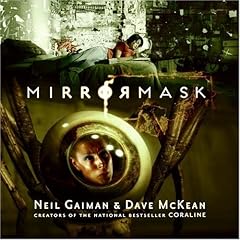
Mirrormask

Here's how this works. I read a book or two and tell you about them and try not to get too long-winded. This time, a review of Mirrormask (HarperCollins, 2005).


I remember thinking, when I saw the film Mirrormask in 2005, that it was an even better film than it was the first time I saw it, back when it was called Labyrinth. In novelised form - this is an illustrated children's book, with words by Neil Gaiman and imagery by Dave McKean - the similarities with the earlier Henson film aren't quite so obvious. For one thing, I can't remember for the life of me anything at all about Jennifer Connelly's character's pre-Muppet/Bowie existence, but Helena in Mirrormask has a very memorable and vivid world as a travelling circus performer.

I've always had problems with the nebulous and vague ways that Gaiman brings his stories to conclusion, but one thing he does amazingly well is create a really vivid, grounded, strikingly real world for his characters. He turns the mundane into something incredibly memorable, before things then get all weird. Having said that, Mirrormask is definitely walking on very familiar ground for Gaiman. If you're familiar with either Coraline or the "Doll's House" storyline in The Sandman, then Helena's descent into a weird world of bad dreams isn't going to seem entirely unfamiliar.

Interestingly, for a film which relies so heavily on its special effects and design, the book stands up pretty well with its emphasis on text. It's a little slim at 80 pages, but then again I was thick enough not to consider this as being a "children's edition" until I looked it up on Amazon. Perhaps it's not an essential part of your Gaiman library, but I'd track down a copy of this before bothering with those Spawn spinoffs he was doing in the early '90s.

Thursday, February 19, 2009

The Best of Tharg's Future Shocks


Speaking of Tharg's Future Shocks, in a nice bit of timing, we hit their return in this reread [over at my Thrillpowered Thursday blog -- grant] just as I finished Rebellion's new collection of several dozen classic ones. The title stretches the truth ever so slightly: rather than somebody's subjective take on the actual best one-offs from the comic, excepting the ones by Alan Moore which have already been compiled, this is a collection of episodes from four of 2000 AD's best-known writers. So it contains a pile of John Smith Shocks, a majority of Peter Milligan episodes, all but one of Grant Morrison's offerings ("Candy and the Catchman" is omitted), and everything that Neil Gaiman ever wrote for the comic.

Certainly the resulting book is uneven and choppy, but there are some real gems to be found in its pages. Grant Morrison's early attempts at channelling Alan Moore are pretty revealing, and not just from an archaeological standpoint. "The Shop That Sold Everything" is really funny, even if the end isn't so much a twist as it is an inevitability. I've also always enjoyed John Smith's "A Change of Scenery," which was the first appearance of some of his Indigo Prime characters, among many other strips in this book.

Seeing characters like Indigo Prime and Ulysses Sweet here actually makes me think that the book's only real flaw is that it didn't collect the five or six one-off adventures of Joe Black by Kelvin Gosnell from the early eighties. That's just quibbling, of course, those are outside the perview of the book, but one of the many things that did make 2000 AD interesting in the early 80s was the existence of characters who only showed up in one-offs or very short series. Dr. Dibworthy and Abelard Snazz were compiled in the big Moore book from a couple of years ago, and it's a real shame Tharg doesn't have any characters like that today.

(Excerpted from Thrillpowered Thursday, Feb. 19 2009.)

Thursday, February 28, 2008

The Sandman: Endless Nights and James Bond: Shark Bait

Here's how this works: I finish reading something, and I tell you about it, and I try not to bore you to death.


I never got around to buying this, but Marie has a copy, which promptly made its way onto the top of my nightstand pile before I shelved it with her other books. Released in 2004, this sees Neil Gaiman and seven artists new to his universe telling seven short tales about his Endless family. They're not all successful - Frank Quitely brings brilliant, beautiful imagery to a story that tells us nothing new about Destiny, Bill Sienkiewicz's messy, challenging layout ends up obscuring a very nice story of Delerium, and I gave up on Barron Storey's "Fifteen Portraits of Despair" entirely - but the four where everything clicks are genuinely wonderful additions to the Sandman story. Perhaps unsurprisingly, I liked the Milo Manara story a lot - I should probably reread all those Manara books outside of young eyes; it's been a while - but best of all is a great tale of Destruction, hanging out at a very strange archaeological dig. I've said before that Gaiman's short stories are more entertaining and fulfilling than his longer tales; don't let Endless Nights' position as "apocrypha" to the ten-book Sandman story encourage you to overlook this!


Speaking of books that should be read away from young eyes, well, the Bond newspaper strips of the 1970s weren't shy about a little T&A, but the first two strips in this collection are just full of Horak-drawn nudity, especially the title piece, in which Bond's KGB nemesis spends pages in just a pair of panties. I wasn't pleased with the previous volume and its implausibly outrageous stories, but things are considerably more believable in these three tales, which are much more grounded in rough seventies espionage. "The Xanadu Connection" and "Shark Bait," from 1978-79, were the last from the original series of strips which dated back to 1964 and never actually appeared in UK newspapers. The series resumed in the pages of the Daily Star in 1981 with "Doomcrack," which was drawn by MAD's Harry North. Overall, a very good volume, and, I must point out, it's got another great essay about James Bond comics, this time highlighting Dark Horse's troubled run and a tale never completed, written by Alan Porter, who knows a whole heck of a lot about 007's long, strange career!

(Originally posted February 28, 2008 at hipsterdad's LJ.)