Showing posts with label fantagraphics. Show all posts

Thursday, December 19, 2013

Walt Disney's Mickey Mouse: Race to Death Valley

What I try to do with reviews at this Bookshelf blog is keep it simple and spoiler-free, and let you know whether I'd recommend you pick up a copy of what I just read. Seems to work okay. This time, a brief review of Walt Disney's Mickey Mouse: Race to Death Valley (Fantagraphics, 2011).


What a nice surprise! I had no idea this comic strip was so good.

Walt Disney and Ub Iwerks launched a Mickey Mouse newspaper comic in January, 1930. Five months later, Floyd Gottfredson came on board to draw and then script the adventures of our hero, ostensibly as a temporary position, and stayed in charge of the feature until he retired from Disney forty-five years later.

Sure, I'd read many accounts of these being really entertaining adventure-comedies, but my antipathy toward both funny animal stories and Walt Disney left me unwilling to sample them. Two years ago, however, Fantagraphics began releasing a really nice line of hardcover archival reprints. The first volume contains all of the strips from January 13, 1930 to January 9, 1932, along with a whole pile of essays and bonus material, including images from other reprint collections around the world.

The stories are rollicking, odd, and completely unpredictable. Gottfredson's first storyline, "Race to Death Valley," is five wild months in which Mickey and Minnie chase after a crooked lawyer and his giant henchman, after the baddies get the drop on them and steal a treasure map. I didn't laugh out loud all that often, the way that I certainly do reading Fantagraphics' collections of the similar-period Popeye strips, but I was completely captivated and charmed, and left wondering what would happen next.

It's dated stuff, to be sure, and sometimes uncomfortably so. There are occasional blackface gags and "booga-booga" natives, as you see in a lot of juvenile entertainment from the 1930s. At one point, Mickey decides life's not worth living and spends an entire week trying to kill himself! Alongside those, however, there are insults and slang phrases that have fallen so completely out of style that they were quite pleasantly new to me. ("You're as much help to me as the seven-year itch!!") The artwork is really vibrant and exciting, in many senses of the word. Comics of the time were still developing their own visual language, and you can see how Gottfredson was developing what we now call speed-lines and other tricks to indicate movement. He joins a very elite crew - Osamu Tezuka is another - who tricked my eyes into seeing actual motion on the page rather than static images. My hat's off to the man. Recommended.

Saturday, August 4, 2012

Esperanza

What I try to do with reviews at this Bookshelf blog is keep it simple and spoiler-free, and let you know whether I'd recommend you pick up a copy of what I just read. Seems to work okay. This time, a brief review of Esperanza (Fantagraphics, 2011).

I made a decision, about the time that I read Jaime Hernandez's most recent Love & Rockets story, "The Love Bunglers," that I was not going to give Fantagraphics any more of my money any more than once for the material that I wished to read. See, they keep publishing these fantastic comics - really, other than 2000 AD, they're the only comics that I am interested in purchasing anymore - and then they keep repackaging them. And I keep buying them. They observe multiple potential audiences who enjoy the material in different configurations - tall and thin hardcovers, big coffee table books, these shorter and fatter paperbacks - and I just sign up for each of them.

I have "reviewed" this material previously. It appears to be all the stories that Jaime drew about Maggie, Hopey, Ray and the Frogmouth in volume two of Love & Rockets, and appears to be all of the material in the second half of the larger, $40 Locas II coffee table collection.

I really love this stuff. I love Maggie, at different times in her life, being haunted by a weird dog who rises on its hind legs. I love how she gains weight and Hopey doesn't. I love how Hopey tries on different glasses to stick around the optician. I love how she and her girlfriend, all the lust gone from their life, agree without any rancor or passion to break up, and how it hurts the reader more than either of them. I love how Maggie never really figures out to never, ever mention Julie Wree around Hopey. I love the artwork. I love that idiot wanna-be gangster shouting about doing a solid at his buddy's funeral and his dimwitted, unpredictable demise. I love the artwork. I love the format. I love the book. I don't love trying to come up with anything new to say about it. I don't love coming up with new excuses to myself to buy the stuff again and again when I don't earn very much money.

I'll almost certainly buy New Stories # 5 when I'm next in Athens. The next time, down the line, that Fantagraphics finds a new format for that story, and "The Love Bunglers," I'll probably put it on my Amazon wish list or something. The center can't hold, and such. Highly, highly recommended for older readers who didn't already buy it someplace else.

Tuesday, April 10, 2012

Nuts

What I try to do with reviews at this Bookshelf blog is keep it simple and spoiler-free, and let you know whether I'd recommend you pick up a copy of what I just read. Seems to work okay. This time, a brief review of Nuts (Fantagraphics, 2011).
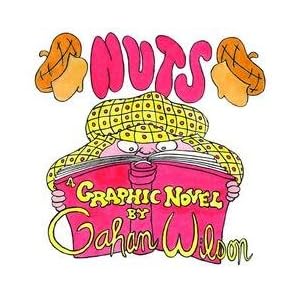


When I was in high school, I really reaped the benefits of whomever had been there before me and encouraged the librarians to stock the humor shelves with some great cartoons and comics. Not only did I discover Jack Ziegler then, but also Gahan Wilson, through the old paperback collection of Nuts. This was a monthly black-and-white strip, usually a single page, that appeared in National Lampoon.

The author's bio on that book led me back to my father's Playboy collection. I won't deny that for three or four years, I'd been reading his girlie magazines, but, unsurprisingly, I was just going from pictorial to centerfold pictorial to the third pictorial and then to the mostly-not-funny Playboy Funnies and then Little Annie Fanny. I'd long ago established that the other single-page comics in Playboy weren't worth my time, but I had never noticed Wilson's monthly page. I suppose that the next evening my folks were out, I probably went down to the basement and found the Wilson page in every one of about seven years' worth of magazines, and went back upstairs knowing that I had another fifteen years' more to find. Whenever it was I got that chance, I remember roaring with laughter over Wilson's iconoclastic, rule-breaking, macabre comedy. It made me a fan for life.

(The process of reading Oh! Wicked Wanda in Penthouse, which I still contend was one of the best comics of the '70s and badly needs to be reprinted was similar, except that Dad had a far smaller run of that magazine, and, unlike Playboy, the skanky pictorials in its pages prompted me to flip past them as quickly as possible. Point being, between Wanda and Wilson and PMOY 1981 Terri Welles, I'm not sure which I enjoyed the most even at age fourteen.)

But Nuts was just this really weird thing. I couldn't tell where it came from, since I only knew the name National Lampoon as appearing as part of the title of R-rated comedies on HBO, and had no idea then that there was a magazine. Logically, I figured that it had to come from somewhere, but even the reference within the author's bio in that book just made me think that Wilson had done some production work for Animal House or something. It was a terrific strip, even though I did not make the connection between it and Peanuts for years and years. As Schulz's strip was an idealized reflection of suburban, small town youth, Wilson's is a really more honest look back at childhood, full of complicated disappointments and the inability to understand grown-ups, illnesses, death, or cities. "The Kid," who mostly keeps his green hat on, is lost inside layers of jackets and coats, and buried under word balloons, insulated from the world as much as a child can try for.

It's certainly a very good strip, although, truly, it doesn't quite captivate me as much today as it did when I discovered it, and it was this completely left-field life event, showing a style of comics I'd never seen before. Other than the sex comics in Dad's magazines, the only other real comics-for-older-readers that I'd seen were probably The Freak Brothers, which had troubled my just-say-no self quite badly, so I didn't know what the heck this was. Nuts can't carry the shock of the new, in other words, now that I recognize it as both a reaction to Peanuts and heavily influenced by Robert Crumb.

And sometimes it is very frustrating. Working in his small grid of panels, Wilson's lettering really does overwhelm his art. Reading Fantagraphics' new hardback collection, which is said to reprint every one of the strips, I began resenting the standard text-only first panel of each comic, as it never really adds much to the story. In time, I caught myself skipping past it.

The dialogue is always important - the profanity-laden episode in which The Kid attempts to become an escape artist absolutely had me roaring with the accuracy of how children really think when they are frantic and very angry - but it becomes irritating when Wilson comes to a panel with just a hint of artwork escaping from underneath a balloon. That's a fair complaint, I think, because his artwork is so incredibly evocative and perfect when he gives it room to shine. There are several unforgettable, perfect panels with The Kid's face bunched up in jealous fury, the lines so small and tight and controlled that, even if it's a close-up on his face, or if there's room beneath the balloon for nothing more than the face, you can still see The Kid's fists somewhere out of the frame and your sight line, clenched in impotent rage, tiny little lines bringing to life every pulsing vein.

I bought a copy of the paperback a few years ago, but only thumbed through it once. I've owned a few thousands of books in my time, and I've never actually seen one where the binding has deteriorated quite like this one has, with the spine's glue disintegrating and transmogrifying into something like sawdust. Afraid of what I might do to it, or what air might do to it, I bagged and filed it, so I'm glad that Fantagraphics has brought this new edition out. Today, I fear that it's my dissatisfaction that might keep Nuts on the shelf, but I'm sure I'll rediscover it in time. The book looks just great, even if I would quibble with the designer's very odd choice to call this a "graphic novel" on the front cover, and while something about it honestly lacks the genuine, timeless brilliance of Wilson's decades of Playboy comics, this is still an important and very readable collection. After all, I'd never have gone looking for the Playboy comics in the first place if it weren't for Nuts! Recommended.

Tuesday, January 24, 2012

Love & Rockets: New Stories #4

What I try to do with reviews at this Bookshelf blog is keep it simple and spoiler-free, and let you know whether I'd recommend you pick up a copy of what I just read. Seems to work okay. This time, a brief review of Love & Rockets: New Stories # 4 (Fantagraphics, 2011).


Admittedly, I am very, very far behind in covering some new releases, but one particular problem kept me from writing a few words about the most recent edition of the Hernandez Brothers' Love & Rockets anthology: everybody else beat me to it. I'd like to bring my readers something a little original or insightful when I have a new Bookshelf entry for you, but as the months wore on and the conclusion of "The Love Bunglers" was annotated and dissected by dozens more reviewers and critics than me, every darn time I tried to come up with something, it was nothing new.

Then the year-end "best of" lists started coming out. This comic sat atop every one of them worth a spit, giving more and more praise for it. I found it tougher and tougher to find something new to say. Then it hit me: yes, "The Love Bunglers" is certainly the best comic of the year, but Love & Rockets # 4, all hundred pages of it, is certainly not, because it also contains, alongside this masterpiece by Jaime Hernandez, about fifty pages by brother Gilbert, and they are horrible.

(Yeah, that's my big, insightful revelation. Go negative.)

No, seriously, Gilbert has been losing me for years, and this is despite the fact that, by and large, his "Palomar" stories were, once upon a time, more engaging to me than any of Jaime's concurrent Hopey and Maggie stories. Gilbert's still doing "adaptations" of sex-filled sci-fi B-movies. If these were real movies, nobody would watch them. They're dumb, grindcore garbage. There's about thirty pages of one of Luba's brain-dead movies, this one about vampires, and about fifteen pages of Killer - I think - talking and talking and talking with some guy. I find it interesting, the way reviewers are sort of glossing over just how bad Gilbert's writing has become, dismissing the work here as being just a mere distraction in as few sentences as possible, probably because reviewers, rightly, want everybody to stop what they're doing and read "The Love Bunglers," and don't want to suggest to any potential new readers that there may be some deeply subpar material in the book with it. For fifteen bucks, you don't want wasted pages.

When a collected edition of "The Love Bunglers" is eventually issued, it, on the other hand, will be worth every penny. It's a masterpiece, even if it doesn't end the way anybody really wanted it to. I'll agree with everybody else that if this is the conclusion of Maggie's story, then it reached a fine one. There's that double-page montage that everybody's talked about. My family is used to me laughing and occasionally exclaiming aloud when I read - awful habit, I know - but I apparently made such an unpleasant choke when I hit this thing that my wife rushed around the corner to see whether I was okay. It's that amazing. And this is after Jaime already smacked me upside the head with a baseball bat by filling in a much older plot and explaining, in an explanation as blunt and tragic and terse as comics can get, what happened to an old supporting player in his large cast.

I really, really like how Jaime chose to defy readers' desires for the characters. The last time that I dipped into their story, rereading the stories in the Penny Century volume, I was reminded of how Hopey, mostly loyal, just patiently waits for her flighty soulmate. I would expect that many, many readers have felt the same way that I have, that when Maggie finally did get her shit together and stopped letting her demons ruin her happiness, the series would naturally conclude with she and Hopey together. Not, I have to say, that anybody wanted this story to conclude. It's in part just how brilliantly Jaime uses the medium to jump from a moment of pointless violence and stupidity into that montage, and in part the sudden, emphatic upending of our expectations and wants. It is an argument-halt as firm as any I've ever seen, it definitively ends any debate, it breaks your heart and leaves you completely fulfilled. We were wrong. Hopey would have been settling. How the hell did that happen?

"The Love Bunglers" is amazing and magical and so incredibly sad. It's been one of the very best stories I've read in the comic medium in years. I wish I could recommend it without any reservation, but, in its present form, I can't. When it gets repackaged in some better format, I certainly will. As for this particular volume, approach with caution, and maybe you'll leave the Gilbert stories thinking that they're not that bad, and that I don't know what I'm talking about.

Saturday, December 17, 2011

Penny Century

What I try to do with reviews at this Bookshelf blog is keep it simple and spoiler-free, and let you know whether I'd recommend you pick up a copy of what I just read. Seems to work okay. This time, a brief review of Penny Century (Love & Rockets Maggie Series vol. 4) (Fantagraphics, 2010).


Love & Rockets is the only series that I don't mind purchasing and repurchasing in multiple editions, although a much, much tighter budget of late has left me far behind with this series. I like the way that Jaime Hernandez's stories read in different configurations. Approaching his little slices of life through flashback or in different sequences lets little details, the sort of which most readers probably miss the first time around, take new shapes and new levels of importance. I really love these paperback editions, about seven and a half by nine, and I even like that the books are unnumbered. This is probably the only book series about which I'll ever say such a thing.

Design nerd that I am, Jacob Covey's packaging on these books is so incredibly appealing, and it honestly doesn't matter in which order people read them. The stories certainly move forward, but at the same time making several looks back. When the two-part "Election Day" climaxes with Hopey learning that there has been a big, important development in Maggie's life that she's missed entirely, it's a punch in the gut that gives Hernandez the chance to turn time back and show what happened. He does this better than darn near anybody else in comics.

Although, while I'm on the subject of design, the only failing of these books is not enumerating where these stories originally appeared. I think that these are all the stories from the graphic novel Whoa Nellie!, the one-off comic Maggie and Hopey Color Fun, and the six or seven issues of Penny Century, in which the characters appeared between the two separate volumes of the ongoing Love & Rockets anthology, along with at least one story from a few issues into volume two.

I think that almost all of it was previously reprinted at least twice before, including in the large hardcover Locas II, a celebrated coffee table book which also contained other, later, material. The design nerd in me cares, and I suspect that budget-minded readers who don't wish to duplicate their purchases might want to know. Small, italicized subscript on the table of contents would answer anybody's questions.

You know, Judge Dredd: "Midnight Surfer," originally appeared in progs 424-429. It's not hard.

Anyway, the "Whoa Nellie!" story lets a couple of the series' minor supporting characters take center stage as Hernandez indulges in his fetish of women's wrestling. It's astonishingly well-drawn, and I love the way he chooses to let pages and pages of combat go on without any dialogue or sound effects, focusing exclusively on the fighting. "Maggie and Hopey Color Fun," presented here in black and white, returns to the main characters, apparently several months after the stories at the end of the previous volume in this series, Perla la Loca. There's a brief allusion to Maggie being missed at home, something revealed in greater detail later in the book, but otherwise, things are back to what passes for normal with our heroines. Hopey waits impatienly, but understandingly, for her flighty soulmate to get her shit together, and tempers her hormones in the meantime by trying to break up her brother and his current squeeze.

They remain on the periphery of Penny Century's life, as they attend a pool party thrown by one of billionaire HR Costigan's other ex-wives, Norma. As ever, the cast grows and swells with new additions. Norma and her daughter with Costigan end up on the lam at one point, trying to avoid an army of attorneys and policemen as Costigan hovers near death. Penny drives Maggie's former lover Ray crazy, does Hopey's hair, sends Maggie down a "horror highway," which is precisely where the flighty Maggie doesn't need to drive, and, either to hide out or to help Izzy with her anxieties, she moves in and mandates that they won't wear clothes anymore. We might accuse Hernandez of giving into another fetish in stories like "Inquiritis!," but, with art this nice, who'd be so churlish?

Actually, though, despite the prurient fun of stories like that, my favorite part of the book is the surreal "The Race," in which Maggie finally meets the little beast inside her "that makes ya fuck up every day of yer shit life," and finds herself woefully unable to cope. As ever, there's just a tiny hint of extra-normal fantasy at work in the stories, just enough for readers to accept that there's something very strange over the horizon or in Izzy's psyche, but never enough to overwhelm the wonderful, human reality of these beloved characters. Highly recommended for older readers.

Tuesday, September 20, 2011

Popeye: Wha's a Jeep?

What I try to do with reviews at this Bookshelf blog is keep it simple and spoiler-free, and let you know whether I'd recommend you pick up a copy of what I just read. Seems to work okay. This time, a brief review of Popeye: Wha's a Jeep? (volume five) (Fantagraphics, 2011).


Fantagraphics is very nearly finished with their complete reprint of E.C. Segar's run on Popeye, with just one more volume to go after this. It's a breathless, surreal and ridiculous collection of fisticuffs and wonderfully funny violence, and every home should own it.

As before, the format is broken down between the daily continuity strip in the first half and the unconnected color Sundays in the back. Some of the Sunday strips have their own storyline - there's a "gold rush" story that runs for a few weeks - but mostly, each stands alone and, as before, shares a page with Segar's other strip, Sappo. Unfortunately, Segar completely lost interest in this little strip, but rather than retire it and give the main strip a few more panels, he oddly decided to have the character do a weekly lesson in silly art, like drawing a letter A and adding enough lines around it to turn it into a person's face. This went on for many, many months. Clearly, Segar was saving all his might for Popeye. There's one where Olive decides to disguise herself as a male suitor to make Popeye jealous. This was a terrible, terrible idea. I don't know whether anything funnier than this page appeared in print, anywhere, for two or three decades.

The daily strips start with Popeye having started an island nation of men who've grown tired of wives bossing them around and this goes on for quite a few entertaining months before the characters, having won a south Pacific war, return home for the introduction of Eugene the Jeep, a prized and coveted weird animal who, living partially in the Fourth Dimension, is able to predict the future and escape any confinement. Confronting a salt-of-the-earth fellow like Popeye with a high concept like that is a work of genius. The Jeep leads Popeye on a quest for his long-lost Poopdeck Pappy, so's he won't be an orphink no more, only to find Pappy a coarse and rough old salt who's not interested in his ugly kid. Pappy, of course, looks exactly like Popeye, just with a couple of extry whiskers.

The disappointment of the once-cute Sappo deteriorating into a waste of space knocks this down just a peg from the previous volumes, but the half-hour I spent guffawing over that strip with Olive dressed as a guy probably makes up for it. Highly recommended.

Tuesday, August 2, 2011

The Complete Peanuts 1979-1980

What I try to do with reviews at this Bookshelf blog is keep it simple and spoiler-free, and let you know whether I'd recommend you pick up a copy of what I just read. Seems to work okay. This time, a brief review of The Complete Peanuts 1979-1980 (Volume 15) (Fantagraphics, 2011).


I have to say, my enthusiasm for this series is not as high as it was two or three years ago, but the arrival of each new volume is still a wonderful thing. Fantagraphics has passed the halfway point, and their choice of celebrities to write the forewords is as weird as ever. Al Roker, of all people, introduces this one, and he doesn't seem to have anything to say about the actual content of Peanuts at the end of the 1970s.

There's still an agreeable edge to the series at this point - Peppermint Patty's resigned acceptance to a life of D-minuses is really kind of savage - but Charles Schulz was relaxed enough to enjoy a few in-jokes and celebrity shout-outs to the likes of Bill Mauldin and various tennis stars. Most of the supporting cast have drifted completely offscreen by this point, and he hasn't found much to do with any of his new characters. There's a girl named Eudora in several strips in this book, and she only seems to function as somebody who silently stands around while Snoopy's World War One Flying Ace speaks French, badly, towards her. Woodstock picks up four fellow birds - Beagle Scouts - who don't accomplish much beyond a recurring punch line about angel food cake.

Still, when Schulz was on, which was most of the time, there's still enough surreal moments and beautiful artwork to make up for the feeling of complacency among the cast. Taking a few moments to study just how Schulz would draw Lucy at her crabbiest always results in me laughing out loud, and there's a sequence where Schroeder, hoping to attend a music camp, allows himself to be "flown" by doghouse, which is revealed to be extremely funny when we learn that Schroeder's the only one who is not in on the joke. Each time that Schulz started one of his longer, weirder stories like this, readers will find themselves wondering how in the world he resolved it. He succeeded every single time. Surely not the best of the Peanuts volumes, but nevertheless happily recommended.

Sunday, October 17, 2010

Love & Rockets: New Stories # 3

What I try to do with reviews at this Bookshelf blog is keep it simple and spoiler-free, and let you know whether I'd recommend you pick up a copy of what I just read. Seems to work okay. This time, a brief review of Love & Rockets: New Stories # 3 (Fantagraphics, 2010).


This is the living definition of "more like it." The previous two editions of the annual Love & Rockets book have been supremely competent but left me very cold and frustrated. That is to say, they were very good comics, but not the comics that I, maybe selfishly, wanted to read.

This time out, Gilbert Hernandez is still telling stories of his almost nothing of a character, the big-boobed "Killer." I still don't think anything of her, but at least the opening chapter of the book, a violent and graphic take on a '50s sci-fi melodrama, is a pretty surprising story. At some point, I'll have to reread the Killer installments of these three editions, because I have the feeling that I'm missing something that I'm supposed to be seeing about this otherwise dull character.

But Jaime Hernandez definitely comes to the rescue for the first new Maggie story in far too long. "Browntown," and the remarkable framing story that surrounds it, is a really harrowing look back at Maggie's childhood, and the abuse that her younger brother silently suffered. Good Jaime Hernandez comics are always just about the most satisfying books that money can buy, and I was so impressed with how the pleasure of seeing contemporary Maggie again for the first time in far too long gave way to the satisfaction of seeing another building block in her curious history, and then everything turned unpleasant in a way that was equally bleak and fascinating. Watching Jaime fit everything together the way he does is breathtaking. Recommended for adult readers.

Monday, July 26, 2010

The Complete Peanuts 1975-1976

What I try to do with reviews at this Bookshelf blog is keep it simple and spoiler-free, and let you know whether I'd recommend you pick up a copy of what I just read. Seems to work okay. This time, a brief review of The Complete Peanuts 1975-1976 (Fantagraphics, 2010)


I don't know that I'll do another entry on a Fantagraphics Peanuts collection on these pages, because they're really quite difficult to write. ("More of the same great comic strips!") The publisher is now halfway through the reprint program, and this is the first book that covers the material that I might have first read in the Sunday funnies of The Atlanta Journal-Constitution when I was a kid.

I think this is the first of the Fantagraphics books to make readers a little wary of the decline in Schulz's work that would come in the nineties; this is the book that introduces some of Snoopy's relations. I don't know about you, but there's only so much Spike that I'm interested in reading, and I think all of it was published by about 1981. In the mid-seventies, however, Schulz was still at the top of his game and putting together some ridiculous and hilarious storylines.

Probably the best of them sees the perpetually clueless Peppermint Patty getting tired of her school and unwittingly ends up enrolled in an obedience school for dogs. In another high point, Marcie spends an entire summer camp beating up some boy. Why on earth Schulz thought Snoopy needed kinfolk at all with those two causing such enjoyable havoc, we'll never know. Recommended.

Wednesday, April 14, 2010

Locas II

What I try to do with reviews at this Bookshelf blog is keep it simple and spoiler-free, and let you know whether I'd recommend you pick up a copy of what I just read. Seems to work okay. This time, a brief review of Locas II (Fantagraphics, 2009)


This was a Christmas present from my wife, a book that I had no intention of buying myself. Well, no immediate intention. You never know. That's because I'd already bought almost all of the contents of Jaime Hernandez's Locas II twice already, when the 418 pages within its covers were originally printed in Love & Rockets and then when the artist carved them out and expanded them into the larger Fantagraphics books Locas in Love, Dicks and Deedees, Ghost of Hoppers, The Education of Hopey Glass and another one that I don't remember the name of. These are wonderful stories, where the aging regulars from the original Locas tales pay lip service to the idea of settling down in the suburban southern California heat. Maggie's past is more painful than her present, Ray and Doyle refuse to grow up, and Hopey... well, I've never really got a handle on Hopey, or what makes her tick.

Frankly, all these different assemblages of the same material is really getting confusing. Maybe it doesn't help that I'm petulantly pouting that I didn't enjoy Hernandez's "Ti-Girls" adventure that appeared in the 2008 and 2009 Love & Rockets "New Stories" books and wish he'd just tell us more about what happens to Maggie and Hopey next, and so since I'm being a dissatisfied Monday morning quarterback, it's coloring how I view the pages in front of me. A week ago, I picked up Penny Century, the newest collection - I think book eight - in that OTHER format, the one that I really like, of about 300 pages in a shorter, squatter book, and it looked a whole lot like a whole bunch of these pages were being reprinted for their FOURTH time there. So I put it back on the rack and didn't buy it.

Honestly, nobody needs to buy these things four times, but I think that Fantagraphics could do a far better job simplifying things to keep things in order. I think the big coffee table books like this one aren't intended for the collectors, and should be perceived as just a one-shot art book. That's part of why I didn't buy Gilbert's The High Soft Lisp (a 120-page tall collection) last week, either. Cash is a little tight around these parts, and I figure all those pages will get into a 300-page short book pretty soon too, right? Is there some comprehensive website somewhere that tells us exactly what stories are in which book, so I can sell some of this stuff? Do I still need Ghost of Hoppers; are all its pages reprinted in Locas II?

As for this book, yes, it's completely lovely, gorgeously designed by Jacob Covey. Its contents are so damn delightful that within one week of finishing reading the book, I was actively entertaining buying what seemed to be all of it again in another format. It's an absolute treasure, a work of art I'm glad to own. I just wish I hadn't spent what looks to be close to a couple hundred bucks chasing assorted L&R comics and books around the last several years getting all this stuff, when I could have just waited and got this for forty, or the Penny Century book for eighteen. Locas II is recommended, strongly, if you haven't read the material, but do some research and make sure you're not duplicating yourself too much if you have.

Wednesday, February 10, 2010

Gahan Wilson: Fifty Years of Playboy Cartoons

What I try to do with reviews at this Bookshelf blog is keep it simple and spoiler-free, and let you know whether I'd recommend you pick up a copy of what I just read. Seems to work okay. This time, a brief review of Gahan Wilson: Fifty Years of Playboy Cartoons (Fantagraphics, 2009)


Be careful what you wish for department: I've loved Gahan Wilson's work for many years. He's an amazing talent, and while you may never find a consensus as to precisely when Playboy was no longer really worth the effort, it's clear that the cartoons have been the best thing about the magazine for many years, and Wilson's the best of those.

Fantagraphics has pleased me greatly by releasing this fantastic collection of all of Wilson's gleefully surreal and macabre work for Playboy. It is one hell of a presentation. It's three hardback collections in a slipcase with a plexiglass backing. The back cover of each volume features a different hilarious photo of the 79 year-old artist's face and hands pressed up against glass; boxed in the slipcase, it looks like he's been crammed into the box and is praying for release. Each book has a die-cut cover and, while arranged chronologically, is divided into sections by inserted pages repeating the die-cut of the cover.

This can't have been a cheap book to produce, and the price tag confirms it: $125 is a lot to pay at retail. It's worth every penny, as, apart from the bells-n-whistles of the presentation, it does contain every single drawing that Wilson did for Playboy, along with short stories, appreciations by Hugh Hefner and Neil Gaiman, and an interview with the artist by Gary Groth. It's nearly 1000 pages long, the cartoons are printed at their original publication size (that is, mostly one to a page), and it's all done on just about the nicest paper available. It's a book that just oozes quality.

And yet... there's a part of me that wishes there was a little less to it. Don't misunderstand me; Fantagraphics has created an amazing tribute, and I'll treasure my copy, but $125 is a really tall order. The presentation and the supplements are wonderful, but I can't help but wish that Fanta made this material available in a series of inexpensive softcover volumes as well. I feel at least a little strongly that great comics should be available to as wide a range of buyers as possible. Then again, I thought that about the thematically similar complete hardcover editions of Calvin & Hobbes, The Far Side and Don Martin's work for Mad and nobody's put out anything resembling mass market editions of those, so I'm not holding my breath. Thanks for realizing one Reprint This! request, Fantagraphics, but could you make sure the next one you fill is just a little more affordable?

(Excerpted from today's Reprint This!)

Saturday, November 28, 2009

Love and Rockets: New Stories # 2

Here's how this works. I read a book or two and tell you about them and try not to get too long-winded, and maybe you'd like to think about reading them as well. This time, a review of Love and Rockets: New Stories # 2 (Fantagraphics, 2009).


Maybe complaining that an anthology series like Love & Rockets isn't bringing you what you want is less a reflection on the material than on the reader's expectations, and maybe it isn't, but I honestly didn't enjoy this latest 100-page collection at all. It's much the same as last year's predecessor, with fifty pages of Jaime Hernandez revisiting the weird SF-n-superhero world that's long existed just on the other side of the hills from his Locas stories, and fifty pages of brother Gilbert being as surreal and demented as he likes.

This time out, however, the Ti-Girls adventure makes even less sense than the first outing. Dense with references to untold stories and parallel timelines, it almost does a good job in showing modern superhero epics up as the wastes of time that they are, but it does so at the cost of its own narrative. In six months, I'll remember the details of this story about as well as the last time I tried to read JLA or Legion of Three Worlds: just some convoluted, well-drawn mess.

As for Gilbert, he's made the mistake of introducing us to his new character Killer, while using the technique, perfected towards the end of the Luba saga, of jumping around in the narrative's timeline. I suggest that only works well once readers know the characters and their situation and understand the relationships that he is straining. Two story chunks in, and I do not know who these people are, because he hasn't lingered on any one place and time long enough for them to impact us.

There are fewer than ten pages of Killer this time out, though. Sadly, the bulk of Gilbert's contribution is a 42-page dialogue-free dreamlike mess called "Hypnotwist," in which a blonde cutie wanders from one surreal shocker of nudity, violence and bizarre landscapes to another. I couldn't follow it.

I have a lot of goodwill towards the creators, but the latest iteration of L&R just hasn't rewarded my patience at all. Not recommended.

Saturday, October 24, 2009

The Louche and Insalubrious Escapades of Art D'Ecco

Here's how this works. I read a book or two and tell you about them and try not to get too long-winded, and maybe you'd like to think about reading them as well. This time, a review of The Louche and Insalubrious Escapades of Art D'Ecco (Fantagraphics, 2006).


While I'm not certain I've ever encountered the words "louche" or "insalubrious" prior to this, I know that Roger Langridge is a huge Bookshelf favorite, and I'm always glad to stumble across his work. I found this a couple of months ago at McDonough's quite excellent Bunjee's Comics and spent a couple of days grimacing over 160-odd pages of the most ghastly, teeth-crackingly awful puns you've ever read. The back cover cogently points out that Langridge is a virus from outer space, and it's all downhill from there.

Originally serialized in the late 1980s across two periodical titles and two special editions, the comics in this book were a collaboration between Roger and his brother Andrew, who wrote the material and who perhaps can be blamed for all the lovely puns on every page. The structure is very loose, and each strip is little more than a skeleton to hang ridiculous comic interplay or neat disruptions of accepted panel layout. In one sequence, the story in the panels travels in a spiral around the page. In another, a character reaches outside the frame structure to retrieve an object from himself in another. When the characters are briefly imprisoned - by guards who resemble the Beagle Boys from Scrooge McDuck (and not far from the revelation that Karl Marx, making a quip about putting something on his bill, is actually Karl Barx in disguise) - Art d'Ecco actually grabs the panel borders, transforming the page into a prison cell.

As for the ostensible structure, we meet Mr. Art d'Ecco, a square-jawed oaf who apparently wants to be a 1920s dandy, but is held back more than a little by his idiot roommate, a triangular mess called the Gump. They get embroiled in one hot situation after another as the Langridges cook up ridiculous stories and adventures. Many of the larger details quickly fade into the background because the wild goings-on are so memorable and so odd, and so I can't really tell you what the plot of the sixty-page "La Trahison des Images" is, just that it's full of eyepopping visual gags and crazy wordplay. At one point, a familiar brick gets thrown, and you'll think, "Yeah, this is about as anarchic as Krazy Kat."

Put another way, this is a book where we meet a clean-up-teevee campaigner named Margie de Sade, who was once an actress who starred with Art as a character called Harlot Mascara. If you're with me in thinking that's about the best name for a character in all of fiction, then you need this book. Highly recommended.

Thursday, September 24, 2009

You Shall Die By Your Own Evil Creation!

Here's how this works. I read a book or two and tell you about them and try not to get too long-winded, and maybe you'd like to think about reading them as well. This time, a review of You Shall Die By Your Own Evil Creation! More Comics of Fletcher Hanks (Fantagraphics, 2009).


Let's keep it simple, shall we? You see this panel here?


The whole book's like this. Every page. It's a nutty thing of beauty. You must buy it.

Oh, you want more? Okay. The follow-up to 2007's I Shall Destroy All the Civilized Planets, this compiles every remaining known Fletcher Hanks comic from the 1939-41 period when he was in the business and there was a perceived market for the thrilling adventures of lumberjacks and space wizards. It's edited, again, by Paul Karasik and while the more completely insane adventures made it into part one, there are still more than enough examples here of gory punishments, fifth columnists, black market timber dealers, bizarre chants, brows furrowed in fury, floating vaults, transmitting belts, Saturnian castles and science so unbelievably whacked that the creators of freaking Buck Rogers were probably reacting against Hanks with their comparatively realistic and down-to-earth take on physics.

More than twelve pages of this and your eyeballs hurt. Every story is downright demented. You must buy it. Understand me?

Tuesday, August 11, 2009

Everybody is Stupid Except for Me and Other Astute Observations

Here's how this works. I read a book or two and tell you about them and try not to get too long-winded. This time, a review of Everybody is Stupid Except for Me and Other Astute Observations (Fantagraphics, 2009)


You know it's bad when crazy pinko leftwingers like me have become so inured by the increasingly rabid, neanderthal bellowing of the disaffected right that when somebody can articulate libertarian viewpoints coherently and persuasively that my response is one of shock. You mean there might be a genuine point of view held by the right that isn't scaremongering distortion? Holy crap, I hope they never let this guy near a microphone.

Anyway, Peter Bagge has been doing a spectacular short comics (none more than four pages) for Reason magazine for ten years now, tackling everything from monorails to Christian "rock" to high-priced sports arenas to Amtrak to Ron Paul's campaign. Admittedly, Bagge's artwork is really tough to love - nobody in any field of illustration looks quite so ugly as an aging, bloviating windbag standing with his trophy wife on the steps of some capitol building, as depicted by Bagge - but if you can finish this book and think of a better political cartoonist in the country, good luck to you. Given the space to detail his arguments and research, and deliver them in a concise, clear, entertaining way, Bagge's work in this field is never less than fascinating.

And here's the real acid test: I like downtown businesses, and going to see basketball games, and at least in theory I like Amtrak, but after Bagge's demolition of the government boondoggery pulling strings behind them, I'm left scratching my head wondering how to respond. Well, heck, maybe high-speed rail isn't such a good idea. I have to agree with Reason's editor-in-chief, who notes in his introduction that regardless of whether you agree with him, Bagge makes you think.

Fantagraphics' collection of this material, which is grouped by theme rather than chronology, is pretty impressive, although I think it suffers a little for the lack of credits beyond the copyright dates in each piece. It's not clear whether this is a complete set of the Reason strips, either. But these are design quibbles; it's a very nice package, and Bagge's work is both hilarious and thoughtful, so this comes highly recommended.

Castle Waiting, vol. 1

Here's how this works. I read a book or two and tell you about them and try not to get too long-winded. This time, a review of Castle Waiting, volume one (Fantagraphics, 2006)


Honestly, I'm no fan of fantasy fiction. If it even looks like somebody's D&D campaign, I lose interest. But I'll give the comics that my wife reads a look-see, and often I'm at least a little pleased by what I find. That's the case with Linda Medley's Castle Waiting, a charming if not essential book that has been sporadically appearing through several publishers for many years. In 2006, Fantagraphics released this gorgeous hardback collection of the first 450-odd pages of story. Seriously, the book is beautifully designed by Adam Grano, and everything from the endpapers to the "from the library of" page to the paper stock perfectly complements Medley's attractive artwork and makes this really stand out as something special.

Unfortunately, I wasn't as taken with the story as I was the artwork or the package. Medley has created a world around a place - a castle that was once lost to time due to a century-long curse and now serves as a refuge - and slowly built a small cast around it. There's a relaxed pace to her storytelling that is sometimes frustrating, either because characters abruptly leave the narrative (did I miss something, or what became of Princess Medora?), or because the narrative sometimes slows to glacial pace to linger on backstory for ages and ages. It seems like a third of the book is devoted to the tales of an order of bearded nuns and how they gained control of a nearby town's mill, but it's all done quite bloodlessly, with no sense of urgency or importance.

For a rainy day read from your library in a bay window, Castle Waiting is perfectly charming and pleasant for what it is, but it's so meatless that you won't lose any sleep waiting for a second volume. Recommended for fans of the genre, I suppose.

Sunday, July 5, 2009

Leather Underwear

Here's how this works. I read a book or two and tell you about them and try not to get too long-winded. This time, a review of Leather Underwear "#1" (Fantagraphics, 1990, this was actually the only issue).


This weekend, we were in Nashville and visited this very nice, new comic shop. And it was lovely, don't get me wrong, except that they didn't stock anything that any other comic shop couldn't get their hands on from the Previews catalog. No, for real treasures, you've got to find a store where you can get your hands grubby in a box full of old magazines. Atlanta's Book Nook on North Druid Hills is a perfect place for this. It's there that I found Roger Langridge's lovely 1990 effort here. It's 32 pages of gloriously mean-spirited, clever and funny comics, featuring the debut appearances of Sister Knuckles the Malevolent Nun.

Even more interesting, for those who met the character via the 2003 collection No More Mrs. Nice Nun, it turns out that her original ten-page appearance was substantially re-lettered and the dialogue rewritten. That was arguably a big improvement, but it's absolutely fascinating, archaeologically speaking, to see how Langridge found Knuckles' voice over time, and to look at the growing confidence in his artwork over the last couple of decades. Worth tracking down a copy!

Monday, April 13, 2009

Dennis the Menace vol. 5 and Searle in the Sixties

Here's how this works. I read a book or two and tell you about them and try not to get too long-winded. This time, reviews of Hank Ketcham's Complete Dennis the Menace 1959-1960 (volume five) (Fantagraphics, 2009) and Searle in the Sixties (Penguin, 1964).


A couple of weeks back, I was mentioning how Monkey Punch's linework on Lupin III in the sixties evoked both Hank Ketcham and Ronald Searle to me. And here are a couple of books from these two. Fantagraphics has been releasing Dennis the Menace in two-year volumes for a while now, and I said when they started, after having my mind blown by how remarkable the earliest stuff with this character was, that I doubted it would be worth following beyond the fifth book. Well, the fifth book is here, and I was mistaken. I should have stopped at four.

True, I laughed three or four times reading this, and there are certainly places where Ketcham kicks his reliably beautiful inking into overdrive and pulls out some eyepoppingly amazing work. I stared at a panel of Dennis and his dad fishing by a gnarled old tree for at least five minutes, marvelling at how gorgeous Ketcham made that scene look. But I also turned past several pages with my eyes rolled, not popped, as Dennis says his bedtime prayers and tells Mrs. Wilson how comfy her lap is. Dennis may have started his career so remarkably menacing that he'd have driven that British kid of the same name running in terror, but five books in and this little scamp is more Walter the Softy, to be blunt. Recommended for cartoonists and artists, and nobody else.


Ever since I read the complete St. Trinian's book (your Hipster Dad's Best Book of 2008), I've been keeping an eye out for old editions of Ronald Searle's work, and found this lovely Penguin paperback at the Book Eddy in Knoxville. This is one of my very favorite bookstores, and I'm already looking forward to stopping back by sometime in July. Searle in the Sixties is a collection of illustrations he'd done over a four-year period for magazines ranging from Punch to Sports Illustrated, ranging from bizarre caricatures to travelogues of everywhere from Las Vegas to Paris to Sanibel Island, of all places.

Searle's love of lines is evident in every picture, and I adore how his focus finds the most comical element of any situation and draws attention to it. A drawing inside a burlesque show is not about the topless cutie on the stage, but the table of old codgers with their noses in the air looking at her. The material from European travelogues and portraits is perhaps even more interesting. Even if I don't know who some of the players are, I really get the impression that Searle has illustrated the Swinging London of Ready, Steady, Go! and That Was The Week That Was better than anybody else.

This book is long out of print, and according to the back cover was never available in the US "for copyright reasons," but you can pick up a copy from used book dealers by clicking the picture above. If you like art or you like the sixties, I recommend you do so!

Thursday, October 30, 2008

Love and Rockets and Ranma

Here's how this works: I finish reading something, and I tell you about it, and I try not to bore you to death. This time, reviews, of sorts, of Love & Rockets: New Stories volume one (Fantagraphics, 2008) and Ranma ½ volume two (Viz, 2003).


Though it pains me to say it, this is a little bit nonessential. Jaime Hernandez's fifty-page tale (broken in half, and with a cliffhanger ending) of bizarre superpowered tomfoolery among his world's supporting cast is pretty fun. Basically, Penny Century finally gets her odd wish to become superhuman, and wacky hijinks involving a pair of all-female superteams follow. It's not at all bad, especially when compared to what passes for this sort of action among contemporary comics. His linework and storytelling are clear and easy to follow, and it probably only fails for not providing what I narrowmindedly was hoping to see. But it's incredibly difficult to connect with characters whom you'll likely never meet again, and who have been drawn in such broad strokes, as these characters tend to be.

Gilbert's stories are even harder to love. No longer working within his extended Palomar narrative, he's apparently turned to illustrating his own nightmares. His fifty pages include some genuinely freaky little tales, including one about some zombifying worms that get into packed lunches out in that nebulous, rural Central American somewhere that he draws so well, and another which reimagines Martin & Lewis as unkillable oddballs punching their way across an alien landscape. They're both great storytellers, and there's nothing here that's not worth reading, but these are creators who have each moved me to tears in the past, and there was no chance of that happening here. Recommended for devotees.


Well, at AWA last month, I picked up the next five volumes of Ranma ½, after confirming that my kids liked the first, each for less than the cost of a current newsstand comic. I'll be spacing these out a little myself, although my daughter is impatiently stamping her foot for a seventh volume, which, sorry for her, I don't intend to buy anytime soon.

Anyway, once upon a long, long ago, I picked up the original first collected Japanese edition of Ranma ½ only to conclude this wasn't for me. Not only have I been proven wrong, but had I picked up the second book, I'd have never made that conclusion, because it's incredibly funny. The high point may come towards the end, when Ranma, wearing his female body, gets a gigantic, drama-stopping smooch from some fancypants ice skating dude and returns wearing his male body roaring with anger like somebody out of Kirby's Asgard. This is great stuff; I'm not certain how many of these damn books are going to warrant individual reviews (Ranma ½ vol. 30 is recommended for anybody who read Ranma ½ 1-29...), but I think the series as a whole deserves looking into. Although, I must point out that the greyscale scanning of the sporadic eight-page color sections is pretty poor, even by Viz's standards, and I'd like to see another edition one day which includes the color as it originally appears.

(Originally posted October 30, 2008 at hipsterdad's LJ.)

Monday, October 27, 2008

I Yam What I Yam and I Didn't Think it Too Many

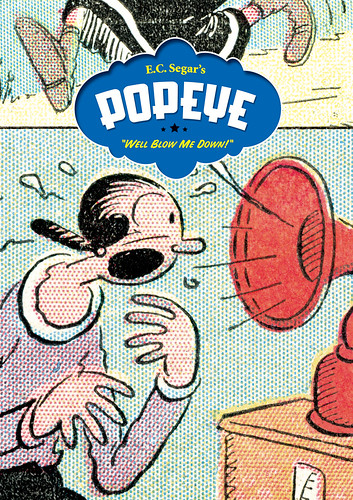
Here's how this works: I finish reading something, and I tell you about it, and I try not to bore you to death. This time, reviews, of sorts, of Slaine: The Horned God (Rebellion, 2008) and Popeye: Well, Blow Me Down (Fantagraphics, 2007).


The Slaine epic "The Horned God" was one of the biggest events in British comic publishing in the late '80s. Originally serialized in three chunks across eighteen months, the series by Pat Mills and Simon Bisley was repackaged into three albums and republished throughout Europe and America, turning Bisley into a star and making fully-painted art all the rage in Britain. So how does the story, in which the wandering warrior-turned-tribal king seeks to unite all the tribes of ancient Ireland to war against invading sea demons and the nightmarish army of the Lord Weird Slough Feg, hold up?

Surprisingly well. Contrary to its popularity, "The Horned God" is certainly not the greatest of Slaine stories, but the novel use of the dwarf Ukko's long-after-the-fact narration allows Mills to retell events from the earlier stories from a new perspective, and what you get in this volume feels less like the fourth book in a longer series than a solid, satisfying read in its own right. Bisley's inventive, perhaps mercurial use of different styles throughout the saga gives it a sense of really huge scale, that what you're reading is an epic greater than something from a twenty year-old comic. I think that there are certainly better Slaine stories, and its impossible to separate "The Horned God" from all the heavily-musculatured painted posing that would bury Bisley's talent in time, never mind impact the look of British comics for at least the next seven years, but it's very solid in its own right, and should be judged very positively on its own merits.

There have been several editions of the story over the years, but Rebellion's new edition knocks them all out of the water. They have been really setting the bar with their 2000 AD books, but this one might be the best one yet. The cover and paper stock are as good as ever, but Pat Mills contributed a remarkable set of annotations to close out this volume, and they had me looking over pages to see things I'd never noticed before. Simply great stuff, and something you really need to order right away.


Hold the phone. You're going to want this as well.

Popeye is another series where I'm well behind the current editions - this is about a year old and the third book is due out soon, but as I'm not gettin' comp copies from anybody, you just have to take 'em as you get 'em. This second edition of Segar's old newspaper strip features Thimble Theatre stories from the early 1930s, and is about equally split with about 90 pages of dailies and 80 pages of Sundays. The dailies tell one amazingly fun continuity where Popeye and Olive go west to manage a ranch deep in criminal badlands, and get drafted to stratergerize a war between two dingbat kingdoms somewhere in the Mediterranean or someplace. The Sundays tell a separate continuity on the homefront where, when he's not being set up for another completely ridiculous prize fight, Popeye's wooing his lady love and eating at the greasiest greasy spoon you've ever seen, and arguing politicks with the owner while the friendless layabout Mr. Wimpy tries to get hamburgers on credit.

It is completely addictive, totally silly, and some of the most emphatically laugh-out-loud material I've sat down to read in ages. I knew this going in; the first volume completely knocked out that considerable stack of skepticism I'd built up over the years, thinking the comic was anything like the mediocre cartoon series. I wish it was not worth wasting space restating in the future, but I fear it'll take a while for the word to get out: don't judge these comics based on all the immunity you'd built up over the years to those godawful King Features cartoons stacked up on your UHF channel afternoons in the late 70s when you were waiting for something good to come on.

The print Popeye was a totally different beast, full of bizarre wordplay, plot twists, spectacular sight gags, and the fantastic lead character, swaggering without compromise as he socks and bludgeons his way through an unbelievable enemies' list. Two-fisted violence never looks quite so hilarious as when Popeye lays somebody out among the swee'peas, and the panels of Wimpy standing on a lunch counter shouting "HEY!" while Popeye and Roughneck scream at each other how Congress never helps either sailors or restauranteurs make me chuckle just thinking about them. Actually, the best thing in the book might be a surprising, yet simple, Sunday strip in which Wimpy pilfers sixty cents from the cash register. Jesus, this is a good book. Does the third volume ship this week?

(Originally posted October 27, 2008 at hipsterdad's LJ.)