Tuesday, August 31, 2010

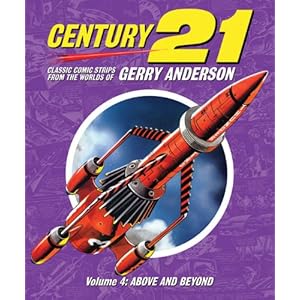
Century 21 Volume 4: Above and Beyond

What I try to do with reviews at this Bookshelf blog is keep it simple and spoiler-free, and let you know whether I'd recommend you pick up a copy of what I just read. Seems to work okay. This time, a brief review of Century 21 Volume 4: Above and Beyond (Reynolds & Hearn, 2010)


Not the final cover.


This is the fourth and, for me, the last of Reynolds & Hearn's collections of old Gerry Anderson strips. Like its predecessors, it's a "greatest hits" compilation of assorted tie-ins to Anderson's fun old TV series of the sixties, with artwork by some of the best in the business. Seriously, you've got the likes of Frank Bellamy, Mike Noble and the great Ron Embleton tackling such fun concepts as Thunderbirds, Captain Scarlet and Stingray, so what's not to love?

The problem is a simple, but overwhelming one. Many of the strips were originally presented as double-page spreads. In a book, with a spine, printed traditionally, this means that artwork and lettering will disappear into what's called the gutter. That, sadly, is the case with many of the pages here.

I'd accept this as an insurmountable problem except the publishers have been ignoring the obvious solution since their series began. On each of these double-page spreads, there is an outer margin on each page of greater than an inch. All it would have taken to make all of the artwork and text legible is adjust the margins and print area, moving material out of the book's gutter. Because this would result in an interior margin where there was originally none, this is considered an inelegant solution.

But the question for readers is, which is preferable? To hold the spine closed a little and eliminate a white gutter bar separating the two pages, or force the spine open to read the text and damage the book? Despite multiple complaints about their production in the wake of the first two volumes, Reynolds & Hearn have chosen to continue forcing customers to have to damage their books in order to read them properly. If you think I'm going to recommend you pay $27 for a book like that, you're nuts. Avoid.

Monday, August 30, 2010

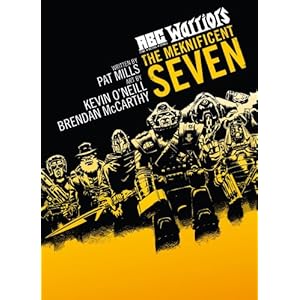
The ABC Warriors: The Meknificent Seven

What I try to do with reviews at this Bookshelf blog is keep it simple and spoiler-free, and let you know whether I'd recommend you pick up a copy of what I just read. Seems to work okay. This time, a brief review of The ABC Warriors: The Meknificent Seven (Rebellion / Simon & Schuster, 2010)


Among all seven gajillion or so of us who like reviewing "graaaaphic novels" and things on the internet, there's a subset who really enjoy the comic juxtaposition of elements that really occur best in the comic medium. Things like J. Jonah Jameson yelling at Godzilla, things like that. It still blows my mind that no publicist has sat these folks down, what with the big audience that they command, and shown them The ABC Warriors, a high-concept science fiction serial written by Pat Mills. It began in 1979 and new episodes have appeared every few years in the pages of 2000 AD. There's a bit in one of their earlier adventures, reprinted in this new American edition, in which war robots with bazookas ride around the deserts of Mars on the backs of tyrannosaurs.

Let me repeat that for the benefit of those not paying attention: ROBOTS WITH BAZOOKAS ON TYRANNOSAURS ON MARS. Drawn by Carlos Ezquerra. This is, in point of fact, the greatest thing to ever appear in fiction.

For those of you who haven't been paying attention, the ABC Warriors are a motley squad of war robots assembled in the waning days of a global conflict against the Volgan Empire. They include a cowboy robot, a sniper who communicates in bursts of letters and numbers, a Volgan general reprogrammed to obey allied commands but who retains his two-timing, traitorous nature and a shrouded, grinning maniac who puts that whole "sufficiently advanced technology indistinguishable from magic" business to the test. They are the coolest team of backstabbing, squabbling characters to appear in comics, and if they don't hypercharge your inner ten year-old, then you were obviously never ten.

The artwork on this initial series of 21 episodes was mainly provided by Mike McMahon, with guest appearances by Ezquerra, Kevin O'Neill, Dave Gibbons, Brett Ewins and Brendan McCarthy. About five years later, Alan Moore contributed the only episode of the long-running series that Mills did not write; it's illustrated by Steve Dillon and it makes its first appearance since its original outing in this new collection by Rebellion, distributed in the US by Simon & Schuster. The new book also includes a six-page framing story by Mills and O'Neill that originally appeared in Titan Books' old collection of this serial.

"The Meknificent Seven" has appeared in print many times before this, but the current edition is the first one aimed at mainstream bookstores, with the Alan Moore episode added as a sweetener for anybody wary about buying it again. It also includes a new foreword by Pat Mills and, as a supplement, five of the old "Fact Files" about the characters. These are really charming, and while the series has "grown up" along with its readers and more recent episodes are aimed more at adults, the "collect 'em all" nature of these pages reminds me that, once upon a time, this was the most awesome idea in kids' comics ever.

As I write this, the book has been out for about six weeks, and I'm a little concerned about the lack of publicity out there. I know that Mills was doing his usual awesome job of promotion in California last month, with signings at an area Barnes & Noble and an appearance at the San Diego Comic-Con, but somebody at Simon & Schuster really needs to start knocking down some doors to tell people that they're carrying these 2000 AD collections, and that they are fantastic. You can't rely on me; my audience is very small, and they almost never listen when I tell them to buy things. Get some review copies out, guys, because everybody in America needs to know that if they have a ten year-old boy in the house, or anybody else who remembers how hotdamned spectacular wild things like this were like when they were that age, then their house needs the ABC Warriors. Highly recommended.

Sunday, August 29, 2010

Beasts of Burden: Animal Rites

What I try to do with reviews at this Bookshelf blog is keep it simple and spoiler-free, and let you know whether I'd recommend you pick up a copy of what I just read. Seems to work okay. This time, a brief review of Beasts of Burden: Animal Rites (Dark Horse, 2010)


I've been enjoying Evan Dorkin's wild comedies for so long that I raised an eyebrow about his latest project, a supernatural horror story. It didn't help that it follows a gang of neighborhood dogs - sorry, but dogs are my least favorite animals - and that it was illustrated by Jill Thompson, whose previous pen-and-ink work I've never embraced. Turns out I was quite spectacularly wrong on every front.

As for the artwork, it turns out that whatever I thought of Thompson's linework, as a painter, she is quite superb. Not only is her comic storytelling very clear and well-designed, but she captures the emotions of her characters very well. These pages really look terrific, and leave me curious to see more from her in this style.

Her style is the perfect complement to a fascinating, really intelligent take on horror which could have been very silly - the premise is ridiculous - but, played straight, ends up being very dramatic and occasionally chilling. A group of neighborhood pets is charged with joining a wide-ranging animal defense of our world from supernatural threats. That Dorkin is able to rein in what could have been goofy and turn it into something frightening really impresses me.

The stories collected in this book originally appeared as one-offs in various anthologies released by Dark Horse Comics before it got its own four-issue miniseries. Each chapter is its own stand-alone short story with various subplot threads developing the background and increasing the tension as the book continues. Probably the most amazing is a chapter in which a new mother dog comes to our heroes for help finding her missing puppies. If the last page of that story doesn't chill you to your soul, you're lacking one.

Dark Horse has done a wonderful job packaging this collection in a reasonably-priced hardcover. It's fleshed out with sketchbook material from Thompson and notes from Dorkin and just oozes quality. I highly recommend this for all readers, and expect to reconsider it in December as a potential book of the year nominee. I was very, very satisfied and am sure you will be, too.

Wednesday, August 25, 2010

Bloom County: The Complete Collection, Vol. 2: 1982-1984

What I try to do with reviews at this Bookshelf blog is keep it simple and spoiler-free, and let you know whether I'd recommend you pick up a copy of what I just read. Seems to work okay. This time, a brief review of Bloom County: The Complete Collection, Vol. 2: 1982-1984 (IDW, 2010)


The first volume in IDW's excellent hardcover series showed Bloom County as a work-in-progress, with creator Berke Breathed throwing dozens of ideas at the wall, desperate for something - anything - to stick. It took a couple of years for the strip to settle down into something that the public would embrace and a small, core cast develop.

The bulk of this book should be familiar to anybody who has the old treasury edition Bloom County Babylon, although this is, of course, a far more comprehensive set. Bill the Cat, still dead at this point, is mostly absent from the shenanigans, but his hairball-hacking spirit lingers on. Binkley stays at war with his anxiety closet, Opus tries catching a freighter to Antarctica to see his mother, and Steve Dallas spends whatever time he's not spending in defense of hopeless clients mourning the end of the 1970s, especially once Time announces that relationships are back "in."

As with the first volume, there's a pile of supplemental material. This time around, there are fewer explanatory footnotes and fewer pages of unpublished art, but there are more annotations from Breathed, all of which should prompt a grin. The introduction is penned by newsman Ted Koppel, and it's worth a grin. I'm looking forward to the third book, and recommend this very highly to newcomers. If you already own Babylon, this might not be quite so tempting because of the amount of duplication, but I vote you buy this and give the paperback to your kids to enjoy.

Monday, August 23, 2010

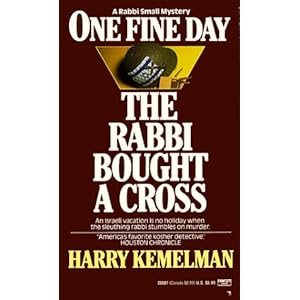
One Fine Day the Rabbi Bought a Cross

What I try to do with reviews at this Bookshelf blog is keep it simple and spoiler-free, and let you know whether I'd recommend you pick up a copy of what I just read. Seems to work okay. This time, a brief review of One Fine Day the Rabbi Bought a Cross (William Morrow & Co, 1986)


How aggravating. I have run out of Harry Kemelman novels to read. And the last one on my pile was the first one that I didn't enjoy very much.

In One Fine Day the Rabbi Bought a Cross, Rabbi Small and his wife take another trip to Israel with their kids safely at summer camp and our hero manages to get involved in another murder. The temple politics and academia avenues are mostly sidelined in favor of very rote, by-the-numbers mystery writing. In the previous novels, Kemelman crafted a huge world of characters around the story and let the actual solution to the crime be plucked from around them. This, by contrast, is like an episode of Murder, She Wrote, where every scene is intricately related to the mystery. It becomes a game, not of spotting these clues, but questioning at what point they will reappear.

Put another way, I figured this one out. I figured it out very early. I never even attempt to figure them out, but this was so remarkably obvious that I couldn't avoid it. The characters, reduced from "character" to "humanoid-shaped item that advances plot," lost all my interest and I found myself, rather than reading the last forty pages, confirming my suspicions.

While I really can't recommend this novel to new readers, I am still looking forward to swinging through some bookstores in the city and finding the other four books in the series that I haven't read.

Sunday, August 22, 2010

Britpop!: Cool Britannia and the Spectacular Demise of English Rock

What I try to do with reviews at this Bookshelf blog is keep it simple and spoiler-free, and let you know whether I'd recommend you pick up a copy of what I just read. Seems to work okay. This time, a brief review of Britpop!: Cool Britannia and the Spectacular Demise of English Rock (US edition: Da Capo, 2004)


Is it possible to write a "review" about a book like this without injecting your own experiences and feelings about the subject into your article? No, probably not, and I'm not going to try. John Harris's Britpop is an incredibly fun book. I bought it when it was first released in the US and I finished my third reading of it last week, this time aided by YouTube clips to give me better understanding of the music that I missed at the time. I had a ball. This is a great story with a tremendously good soundtrack.

I came to a lot of the Britpop-era music (roughly 1992-97) late, because radio here played very little of it. I recall seeing "There's No Other Way" on 120 Minutes before I moved to Athens on a permanent basis, but by the time Suede and Blur went to war, the commercial radio here was stuck playing that hotdamned "Runaway Train" song every hour for something like 28 months, and the college radio in Athens was playing stuff I either never identified or later learned was early Elephant Six. I didn't discover Suede and Pulp until after each band had crested. I enjoy the heck out of each group, and now that I've finally seen the terrific video for "The Universal," as you should right now, I've started to really like Blur, but it would have been so much more fun to experience all this music, and all the bitter rivalries between the bands, when it was new.

Just as the popularity of these hitmakers ebbed and flowed in the early nineties, so does the focus of the book. It begins with Brett Anderson and Justine Frischmann starting their relationship and the formation of Suede. Before long, Justine has left him for Damon Albarn of Blur and started her own band, Elastica. Pulp makes the scene after a decade in obscurity, apparently just to steal Alex James's girlfriends, and then, just as Suede starts missing the top 20 under the weight of their pretentious second album, things go to hell when Oasis shows up to crash the party, all swagger and shouting.

Now, I was familiar with Oasis at the time, because commercial radio here did play some amazing songs from them. This gave people in the US some understanding that there was a rivalry going on between them and several other bands, but we never experienced it. The madness that surrounded the same-day release of Oasis's "Roll With It" and Blur's "Country House" sounds like the most fun media spectacle in the world. It's a shame that we missed it.

Harris's book is so darn good that I'd call it almost perfect. I do think he gives a little short shrift to Suede's roaring resurgence with the Coming Up album and all its hit singles, and Pulp's mammoth Different Class. Compared to the juicy detail in other areas, these seem sidelined in favor of spending a little more time on the party politics of the time and the rise of Tony Blair. That's the only quibble that I have. With a good mix of interviews and research, he really shows us the whole story of the period. Seriously, sit down with this book and let YouTube show you all those videos by Menswear and Sleeper that you missed and you're in for a fine, fine time. Highly recommended.

Thursday, August 19, 2010

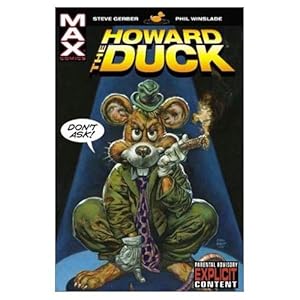
Howard the Duck

What I try to do with reviews at this Bookshelf blog is keep it simple and spoiler-free, and let you know whether I'd recommend you pick up a copy of what I just read. Seems to work okay. This time, a brief review of Howard the Duck (Marvel, 2003)


When the late Steve Gerber returned to Marvel for a final, six-issue run on his most celebrated property, Howard the Duck, I remember being incredibly excited. I've reread the series several times and smiled and laughed but nevertheless closed the book each time wishing things had worked out a little bit differently.

I believe that Howard was the best American comic book of the seventies, and it still holds up extremely well, despite the aggravating aftertaste of the many sad years that followed for Gerber fighting for his rights as a creator. He and Marvel Comics stayed at loggerheads for years. It looked for a few minutes in the mid-nineties like they'd buried the hatchet, but the circumstances behind a one-off issue of Marvel Team-Up produced then proved unsatisfying to Gerber, and the incident ended with Howard and his human steady, Bev, spirited out of the Marvel Universe and into a witness protection program at Image Comics under the names Leonard the Duck and Rhonda.

About seven years later, everybody was friendly again and Gerber returned to Marvel for what would be a final six-issue epilogue for his classic characters. Back in Cleveland and working as security guards at a junkyard, Howard and Bev are desperate and just barely scraping by, but before long, their lives are turned upside down again by the craziness of life in the 21st Century. Bev's ex-husband Dr. Bong is back in town, and his latest gene-splicing scheme not only sees Howard's body changed into a great big mouse, but getting to the bottom of things will send our heroes to find the truth about boy bands, feel-good talk shows, Vertigo Comics, Witchblade and why it is that the Father always leaves the Son and the Holy Ghost to pay for the drinks.

The artwork on five of the six issues was provided by Phil Winslade, who had earlier collaborated with Gerber on the delightful Nevada. That character makes a brief, silly cameo in these pages. On one issue, Glenn Fabry, who painted the covers of the original issues steps in. I greatly enjoy each of their work a lot, and like how they pepper the pages with in-jokes and detail.

And yet... it feels bittersweet and incomplete. I really got the feeling that Gerber had so much say to say through and about Howard, even after the final chapter, which sees Howard grilling the Almighty about the purpose of existence. In a perfect world, Marvel would have greenlit a full series that would have ran for years, until we lost Gerber in 2008. Then again, in a perfect world, we wouldn't have lost Gerber in 2008. Recommended.