Showing posts with label harry kemelman. Show all posts

Tuesday, June 7, 2011

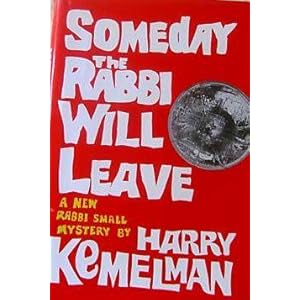
Someday the Rabbi Will Leave

What I try to do with reviews at this Bookshelf blog is keep it simple and spoiler-free, and let you know whether I'd recommend you pick up a copy of what I just read. Seems to work okay. This time, a brief review of Someday the Rabbi Will Leave (William Morrow, 1985).


I think at this point I can safely say that I'm done with Harry Kemelman. I mean, for an average cost of a buck apiece, I've made worse investments, but the guy had maybe five pretty good Rabbi Small stories, at the start of the run, and then they petered out.

This one, at least it's not as awful as 1992's The Day the Rabbi Resigned, but it's still a chore. This time out, the rabbi's nemesis is the new temple president, a shrewd and tough businessman who wants Rabbi Small to perform his daughter's wedding to an up-and-coming politician who isn't Jewish. The rabbi says that they can have a civil ceremony, but not one in the temple, and if the president insists on bringing in some other rabbi to do it, then he will have to resign as president.

So the temple politics get loud and cantankerous, and literally half the book passes by before Kemelman remembers that he's meant to be writing a mystery and kills somebody. Unfortunately, he's chosen to kill somebody with absolutely no connection to the rest of the plot save one conceivable suspect. Look, I understand that detective fiction of the "cozy" school isn't really meant to challenge anybody, but even the lady who writes those The Cat Who books never crafted anything so lazy.

I finally looked up a Kemelman bibliography and compared it to all these books on my shelf. I'm missing the last one. I thought the one where Small resigned was the last, but he did another one, three years later. Maybe if I find it for a dollar, I'll buy it, but I'm in no rush. Not recommended.

Sunday, May 22, 2011

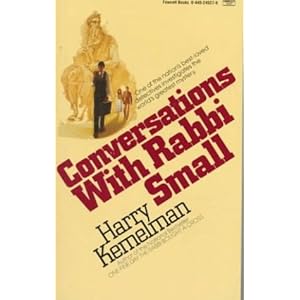
Conversations with Rabbi Small

What I try to do with reviews at this Bookshelf blog is keep it simple and spoiler-free, and let you know whether I'd recommend you pick up a copy of what I just read. Seems to work okay. This time, a brief review of Conversations with Rabbi Small (Fawcett, 1982).


Most used bookstores will file a copy of this in with their mysteries, and why shouldn't they? If the store is worth a shuck, they probably have a few of Harry Kemelman's rabbi novels there already, and any clerk who's doing their job has seen them filed in that section. I thought that this was another detective story, too. I was quite mistaken.

In this novel, a young woman goes to Rabbi Small hoping that he will convert her to Judaism. He apologizes that he does not "do" conversions. She, a Christian, plans to marry a non-practicing Jewish scientist and gain the approval of his parents. Rabbi Small asks to meet the fellow, and over the course of the rest of the book, they spend several evenings just talking about Judaism and what sets it apart from Christianity. The book is a couple of hundred pages of philosophical and theological discussion, which will either try your patience or keep you engrossed in a study of Jewish culture. Eventually, it becomes clear that the crafty Rabbi Small has an ulterior motive: he has no interest in converting the bride-to-be, but he does want the scientist to learn that their faith is as based on logic and reason as his studies.

I didn't enjoy it. I kept waiting for something to happen. I kept flipping ahead twenty or thirty pages and exclaiming "They're still talking?!" If you can handle a book in which three characters do nothing but converse, then you might enjoy the experimentation, but I'm not one of them. I am, similarly, disinterested in reading two hundred and fifty pages of Inspector Morse talking about real ale, Father Brown talking about the priesthood, Sherlock Holmes talking about bees, Nero Wolfe talking about saucisse minuit, or even Lord Peter Wimsey talking about collecting first editions, just in case anybody had any clever ideas.

Wednesday, May 11, 2011

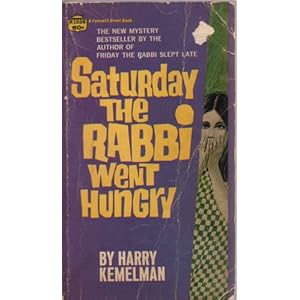
Saturday the Rabbi Went Hungry

What I try to do with reviews at this Bookshelf blog is keep it simple and spoiler-free, and let you know whether I'd recommend you pick up a copy of what I just read. Seems to work okay. This time, a brief review of Saturday the Rabbi Went Hungry (Crown, 1966).


Since I've been reading these books in entirely random order - whenever I happen to find one - I've unwittingly allowed myself the pleasure of popping back and reading some of the earlier, better books in the series. This comes after already seeing how Harry Kemelman, out of touch with any but his Centrum Silver-aged readers, had let his Rabbi David Small series descend into mediocrity and, in the end, awfulness.

However, in 1966, he was still at the height of his powers, and building the rules for his fun little detective adventures. Saturday the Rabbi Went Hungry, like the later books, is certainly not going to be essential reading for more devoted fans of hard-boiled fiction. It's a cozy, cute story about community politics and backstabbing, touchy members of the rabbi's temple, and well over halfway through the book, the characters finally figure out that a death is neither a suicide nor an accident, but murder.

Actually, I really enjoyed the pace, reflecting the confusion about the death. The initial investigation is just for insurance purposes, with a hefty settlement waiting on confirmation that the deceased took his own life. Reading a book like this, from the perspective of the present, the audience is certainly going to know that the fellow was deliberately killed, but the leisurely pace around this point is actually kind of charming, and I really liked how the question suddenly gets the rabbi in trouble with one of the more powerful members of his temple. With the deceased already buried as an accident, and the sudden possibility of him having to be exhumed and moved as a suicide after the rabbi's made a tough ruling elsewhere about whether fasting includes medicine, and the resulting withholding of medicine being suicide, Kemelman might well have tricked his 1960s audience into thinking that this was the principal conflict.

Dated, of course, and not for everybody, but I enjoyed it, and I wonder whether the next couple of Kemelman novels that I've found will prove as amusing.

Thursday, February 17, 2011

The Day the Rabbi Resigned

What I try to do with reviews at this Bookshelf blog is keep it simple and spoiler-free, and let you know whether I'd recommend you pick up a copy of what I just read. Seems to work okay. This time, a brief review of The Day the Rabbi Resigned (Fawcett, 1992).


I really, really hate to say it, but this book was damn difficult to finish. Actually, to be perfectly accurate, it was difficult to continue past around page 80, by which point Harry Kemelman had presented three of the most unrealistic, dated, braindead depictions of new marriages and burgeoning relationships of any book from its period. It felt an awful lot like Kemelman, who was in his early eighties when he wrote this one, hadn't been anywhere near any young couple in decades. The depictions of relationships presented here would have been a little aggravating in the 1950s, but in 1992, I was married and I never heard of anybody remotely like the newlyweds in this book.

As a parallel, consider a book that I keep using as a comparison point, the Rex Stout novel Too Many Cooks, which is dated, uncomfortably so, in its treatment of race in America. But that is a book from the late 1930s; it might make us uncomfortable to read that seventy-odd years ago, attitudes towards race were often repugnant, and that otherwise intelligent (white) detectives would be fooled by shoepolish blackface, but it was honest at the time. Had the same novel been written years later, it would have been utterly out of place and wrongheaded. So here, Kemelman presents a marriage which falls apart almost instantly because the husband actually wants to have sex. It's followed up by a relationship where a woman who enjoys sex is depicted as a malevolent harpy who cannot be trusted, and a relationship which is condemned by parents because it is "serious" without an engagement. This book was written when Bill Clinton, not Eisenhower, was winning primaries.

Readers who can suffer through the antediluvian attitudes of the book might find some pretty good stuff after it. Like the rest of the series, it's a Father Dowling / Murder, She Wrote cozy of a puzzle with no aspirations to anything other than a simple intellectual challenge. This time out, Rabbi David Small is getting ready to retire after 25 years and hopes to find a position on the faculty of an area university. The temple's board of directors, as ever, doesn't understand the rabbi's simple wishes, and one of the area universities that Rabbi Small is considering is having a problem with professors looking to find tenure at whatever cost.

As with most of the Kemelman novels, the actual construction is a treat; watching the author tie several apparently unrelated groups together into one story is fascinating and surprising. The temple and university and police politics are amusing, and the rabbi's humility in the face of people who want to give him unnecessary rewards results in a really funny meeting, so it's not completely awful. There's a murder somewhere in the middle of all this, but it's not very important. The book doesn't even feature the hallmark beats of Small breaking apart the problem and finding the killer by means of Talmudic arguments and reasoning. Even absent the dated look at sex in 1990s America, this would be one of the lesser books in the series. Not recommended.

Monday, August 23, 2010

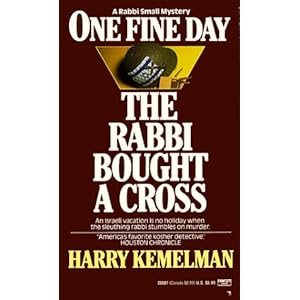
One Fine Day the Rabbi Bought a Cross

What I try to do with reviews at this Bookshelf blog is keep it simple and spoiler-free, and let you know whether I'd recommend you pick up a copy of what I just read. Seems to work okay. This time, a brief review of One Fine Day the Rabbi Bought a Cross (William Morrow & Co, 1986)


How aggravating. I have run out of Harry Kemelman novels to read. And the last one on my pile was the first one that I didn't enjoy very much.

In One Fine Day the Rabbi Bought a Cross, Rabbi Small and his wife take another trip to Israel with their kids safely at summer camp and our hero manages to get involved in another murder. The temple politics and academia avenues are mostly sidelined in favor of very rote, by-the-numbers mystery writing. In the previous novels, Kemelman crafted a huge world of characters around the story and let the actual solution to the crime be plucked from around them. This, by contrast, is like an episode of Murder, She Wrote, where every scene is intricately related to the mystery. It becomes a game, not of spotting these clues, but questioning at what point they will reappear.

Put another way, I figured this one out. I figured it out very early. I never even attempt to figure them out, but this was so remarkably obvious that I couldn't avoid it. The characters, reduced from "character" to "humanoid-shaped item that advances plot," lost all my interest and I found myself, rather than reading the last forty pages, confirming my suspicions.

While I really can't recommend this novel to new readers, I am still looking forward to swinging through some bookstores in the city and finding the other four books in the series that I haven't read.

Sunday, August 8, 2010

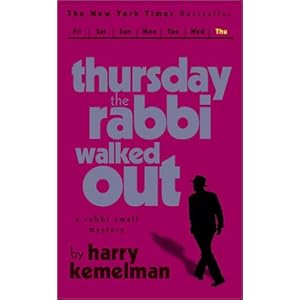
Thursday the Rabbi Walked Out

What I try to do with reviews at this Bookshelf blog is keep it simple and spoiler-free, and let you know whether I'd recommend you pick up a copy of what I just read. Seems to work okay. This time, a brief review of Thursday the Rabbi Walked Out (William Morrow & Co, 1978)


After seven books, I think that Kemelman could well have retired Rabbi David Small, and Thursday the Rabbi Walked Out has the feel of something working towards a conclusion. As it turned out, the author would write another four or five stories after this one, but the always entertaining Temple politics and arguments get pretty crazy this time out, and the question of whether David will still have a job at the end of the book - usually a foregone conclusion - is just as critical as who murdered the town miser, a grouchy anti-Semite who will be mourned by nobody.

I enjoyed this story as much as the first in the series, and despite a pile of hiding-in-plain-sight clues, had no idea who was behind the killing. I honestly don't know that a crime like this would fool an investigator from TV's CSI for a second, however. After I thought about it for a while, I found myself starting to question whether the faked evidence would have fooled the police even in a small, sleepy town in the mid-seventies. Either police methods have improved massively over the years, or the real cops in the seventies were content to let the decade's quirky detectives take all the glory in order to surprise real killers with the knowledge that actually, quirky TV detectives really aren't necessary when they have evidence teams who can see right through these carefully-orchestrated killings. It's the same way that there are at least three episodes of the original run of Columbo in which suspension of belief is similarly damaged by knowing that all the fun cat-and-mouse would have, in the real world, been busted by simple crime scene evidence.

Taken on its own terms, the story remains very fun, and I love the way that Kemelman is able to reflect the business of the Temple into the action, leaving Rabbi Small juggling so many different things. His inflexible position on matters related to Judaism sometimes seems a little baffling to me. I'm really uncertain why he refuses to perform Bar Mitzvah for an elderly man who was unable to have the ceremony at age thirteen. Saying that the ceremony is irrelevant, that the man is Bar Mitzvah regardless, makes sense, but is it that big a deal to him? Well, it's not like I've got any training in Talmudic reasoning. I'll take his word on it. Recommended.

Sunday, August 1, 2010

Friday the Rabbi Slept Late

What I try to do with reviews at this Bookshelf blog is keep it simple and spoiler-free, and let you know whether I'd recommend you pick up a copy of what I just read. Seems to work okay. This time, a brief review of Friday the Rabbi Slept Late (Fawcett, 1964)


I read the first of Harry Kemelman's series of novels about amateur sleuth Rabbi David Small after finishing four others in the series. I've really enjoyed reading them out of sequence, although I've had to force my system to allow me to do it that way. It's just not in my nature to read series out of order!

I really like the way that Kemelman started Friday the Rabbi Slept Late by establishing David as a character who simply isn't going to do what audiences will expect. He agrees to mediate a dispute about car damages between two members of his temple, and I would bet that almost every person reading this book would come to the same conclusion that I did as to who should pay for the repairs, but the character's fascinating use of logic and reasoning turns things completely on their heads. That's not the first time in this book that things don't go the way they're planned.

Interestingly, Barnard's Crossing's police chief Hugh Lanigan comes across as very much an equal character in this book, which is as much focused on him as the rabbi. They get to meet at cross purposes, as the rabbi is a suspect in a girl's death. I used to wonder whether NBC had screwed with the premise when they did their TV adaptation in the '70s and called it Lanigan's Rabbi, but they were really following the template of the original novel. While later books would use Lanigan as a supporting character, the first time out, the story's as much his as it is Small's.

I enjoy this series more with each one I read, and happily recommend them to anybody who likes detective fiction, on the understanding that they're probably more for the Columbo and Murder, She Wrote fans than any other school. Why the heck hasn't the USA Network started a new adaptation of these? There's no character they could welcome more than the rabbi!

Friday, July 16, 2010

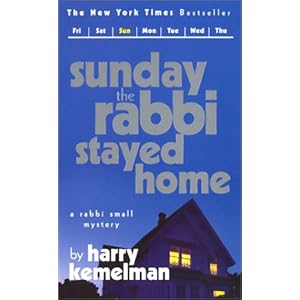
Sunday the Rabbi Stayed Home

Here's how this works. I read a book or two and tell you about them and try not to get too long-winded, and maybe you'd like to think about reading them as well. This time, a review of Sunday the Rabbi Stayed Home (Fawcett, 1970).


A few months ago, I read three of Harry Kemelman's detective stories about Rabbi David Small which I had found in an omnibus at a library sale. A few weeks ago, I found myself in a bookstore with credit to spend and picked up another four novels in the series. I'm not reading them in order, just as they strike my fancy.

In Sunday the Rabbi Stayed Home, Small is in his early thirties and the principal crisis in the community is not the murder of a local boy. He had gone south to play college football but an injury brought him home, where he'd done little but aggravate his family and sell some pot. However, his body is found in a house that's crucial to the main plot, which deals with the political schism going on in the local congregation.

I really enjoy the way that Kemelman varies the structure of the books so that the focus can shift from a traditional murder mystery to something more subtle. This time around, I was more fascinated by the infighting and bickering than who finished off the punk. Kemelman has such a natural flair for dialogue and character that conversations go on for pages and I just get immersed in the debates and the give-and-take.

It's very much a book of it's time, and occasionally just terribly suburban. The period's racial issues are addressed with the subtlety of a jackhammer and the possibility of marijuana making the rounds of area bowling alleys is depicted as just about the worst thing ever. Nevertheless, it's an amusing and occasionally engrossing read, and while I wouldn't claim that you're losing out by skipping it, I think I can recommend it for mystery readers looking for something a little light and off-kilter. Psych and Monk fans, for example might get a kick out of it.

Tuesday, April 20, 2010

Three Days With the Rabbi

Here's how this works. I read a book or two and tell you about them and try not to get too long-winded, and maybe you'd like to think about reading them as well. This time, a review of Three Days With the Rabbi (Fawcett, 1977).


When I was a little kid, I recall wandering into the "grown up fiction" shelves at the Lewis A. Ray public library and being intrigued by the covers of the Harry Kemelman novels featuring Rabbi David Small. I never took a course in design or typography, but whomever came up with that remarkable font used for the titles is probably more responsible than anybody else for sparking any interest in the subject that I have. I was too young to actually read the books, of course. I didn't even know what a rabbi was yet, but I just loved staring at the lettering.

Many years later, my early '90s fascination with Columbo led me to look into that program's fellow series on The NBC Mystery Movie and was surprised to learn that the novels had spawned a short-lived adaptation of four TV movies in 1977 starring Bruce Solomon as Rabbi Small and Art Carney as Chief Paul Lanigan. They seem to have inverted the focus of the books onto Carney's character, the chief of police in a small Massachusetts town, but I never got to see them and so I'm not certain. I recall reading the entry and remembering those neat books with the wonderful lettering on the cover. Despite reading about these movies while sitting down in the largest research library in the southeast and being completely fascinated by everything to do with the NBC Mystery Movie, it still didn't occur to me to actually, you know, read the books.

So, something close to three decades after I first saw the darn things, I finally read three of them. I found an old book club omnibus of the fourth, fifth and sixth novels in the series at the Clarke County Library sale a couple of months ago and they were... cute. As you might expect from a property that attracted Art Carney's attention, they're pretty gentle, read-in-bed cozies where the murder is a puzzle with no broader ramifications and which leaves no major trauma in its wake, rather like Christie's Miss Marple books. Apart from The Late Show, which was filmed around the same time as the Lanigan's Rabbi TV movies, Carney rarely went in for the heavy stuff, and unsurprisingly, the novels are light to the point of being fluffy. Law & Order: Criminal Intent's fanbase, which shipped pounds and pounds of marshmallow cream to Universal and USA to protest Vincent D'Onofrio's ousting from the show, probably wouldn't enjoy a contemporary adaptation of these books.

I did enjoy them to some degree, particularly in contrast to finishing all of Raymond Chandler's novels recently. The focus is more on the rabbi's family life and congregation, and the strange synagogue politics that result from trying to satisfy Orthodox, Conservative, Reform and every other branch of modern Judaism in one community. The books employ an enormous cast of characters to fill the town of Barnard's Crossing with colleges, drug stores and a board of directors, I guess, at the temple. The books focus on all of these families and business partners, and their polite, loving disagreements. The murder is often a background element to resolving the light tensions between squabbling factions.

Rabbi Small fascinates me. He's unfailingly polite and curious, even when confronted with well-intentioned nonsense from sides as disparate as a "some of my best friends are Jews!" anti-Semitic professor or an "I do whatever my rebbe tells me!" Hassidic acolyte, and Kemelman did a really great job breathing life into the character. Interestingly, when reading Chandler, I could never hear a consistent voice for Marlowe. The narration sounded like David Janssen as Harry O sometimes and Humphrey Bogart others. When I read Rabbi Small, however, I invariably heard John Schuck, the character actor who played, among a million other things, Sgt. Enright in McMillan and Wife. See, all things come back to the NBC Mystery Movie.

Having said that, I was baffled by one point. The rabbi's schtick is that he solves the mystery by use of Talmudic reasoning, leading to his climactic party trick where he juggles all the evidence and all sides of the possibilities in a strange little sing-song voice, which Kemelman depicts with elo-o-ongating wo-o-ords in his monologue. I have no idea what on Earth that could sound like.

I really don't think these books are for everybody, but the only sincere letdown I found was the occasional cloying treatment of college-age radicals, whether the demonstrators in the fifth book or the Hassidic fellow in the sixth. They're a shade more sincere and believable than the Hollywood hippies of a period Jack Webb show, and I don't think you can damn with fainter praise than that. Otherwise, if you're looking for a break from hard-boiled detective fiction or don't mind something more interested in amusing you than challenging you, Kemelman's novels have aged reasonably well, and I'll certainly be keeping an eye open for others in the series.