Monday, July 13, 2009

George Sprott, 1894-1975

Here's how this works. I read a book or two and tell you about them and try not to get too long-winded. This time, a review of George Sprott, 1894-1975 (Drawn & Quarterly, 2009)


This book is completely wonderful. It's on the shortlist of the year's best, so far.

I've been a big fan of Seth's work for quite some time, despite owning so little of it. I adored his wonderful Wimbledon Green from a few years ago, and I love his designs for the Peanuts and John Stanley Library series. He puts together gorgeous books, and his cartooning chops are awe-inspiring. One day, I might start drawing again, and just wish I could capture character, time and place half as well as Seth does.

Well, what you get in this gigantic book - it's only 96 pages, but it'll task your ability to find shelf space for it - are fractured memories and discussions about the life of George Sprott, the host for many years of a weekly television program called Northern Hi-Lights. Sprott had made a name for himself in the 1930s with a series of expeditions to the Arctic Circle, and parlayed this into some degree of celebrity in a small city in Ontario. Station CKCK was one of those long-lost television channels which was devoted to regular, regional programming. Both the channel and its home city, with its "Radio Hotel" and lecture hall, have been lost, swept away in the homogenization of modern culture. This is partially a narration (it's not quite a biography) of a man, but more a window into a world that was decaying by the time of Sprott's death in 1975, and doesn't exist at all anymore.

I don't know whether that description's enough to sell anybody on how magical this book is, but I was really moved by it. I'm just amazed by Seth's ability to completely sell this immersive worldview, where you're not sure whether the "then-popular fad for self-improvement" was part of our own history, or Sprott's. I knew I was going to like this book, but I really had no idea just how much.

(Seth was interviewed Friday over at Omnivoracious.)

Sunday, July 12, 2009

Wednesday Comics # 1

Here's how this works. I read a book or two and tell you about them and try not to get too long-winded. This time, a review of Wednesday Comics # 1 (DC, 2009).


Well, this is almost terrific. With Wednesday Comics, DC is trying a very interesting experiment, showing off fifteen new stories in an oversized format, like the Sunday funnies used to be. It folds out twice to newspaper size, and each feature gets its own page, for fifteen serialized stories.

It's not completely perfect, and I think fans will be spending the next twelve weeks Monday morning-quarterbacking things they might have done differently. I think they missed a trick by insisting all fifteen be serialized adventure stories; surely they could have given the space to the incoherent Wonder Woman feature over to a classic kid's comedy like Stanley and His Monster. The first issue also suffers from each being a set-up page. It might have been nice to join one adventure already in progress. The Flash story almost accomplishes this, and it's pretty fun. Best of all, the stories are continuity-free. That the publisher has spent the last forty years hammering the characters into one timeline is irrelevant here; it's presented as fifteen separate storyline.

Highlights include Kyle Baker's completely awesome Hawkman story - and no, I don't think I've ever used the phrase "completely awesome Hawkman story" in my life before - along with Paul Pope's gorgeously designed Adam Strange tale, which does suffer from some truly ugly lettering. I like Brian Steelfreeze's art on Catwoman a lot, and Jimmy Palmiotti and Amanda Conner's Supergirl looks like it's going to become a very fun tale. Dave Gibbons scripts a Kamandi story that will probably be great reading, but while Ryan Sook's artwork is really lovely, I can't help but wish Gibbons drew it as well.

Neil Gaiman and Mike Allred are off to a good beginning on Metamorpho, and while Joe Kubert's Sgt. Rock starts a little slower than most of the other features here, you know that Kubert on Sgt. Rock is always worth looking at. I only disliked two of the pages - Wonder Woman and Teen Titans, so that's a pretty good batting average. At $4, the price point feels a bit high, but then again, I think everybody in the house is going to enjoy this comic, so it's probably worth it.

Friday, July 10, 2009

The Ride Home

Here's how this works. I read a book or two and tell you about them and try not to get too long-winded. This time, a review of The Ride Home (AdHouse, 2007).


The Ride Home is a huggingly cute story about a "directionally-challenged" gnome called Nodo who gets lost and is trying to find his way home. But this isn't your usual fantasy tale; Joey Weiser has set it in a small town in modern America populated by dozens of invisible critters living their own little businesses just on the other side of human perception. Our hero is a nervous little guy who just wants to get back to the human family van that he loves to clean, but between bureaucracy, romance, bigotry and junkyard bullies, he'd have a tough road, even if he could remember the way back...

I enjoyed this book even more than I do Weiser's shorter pieces. He surprised me regularly in this story, with unexpected new obstacles every few pages. It's done with a delightfully balanced sense of scale and wit, with wonderful artwork and character designs. Certainly a great book for kids and for grown-ups looking for something light, this comes recommended for all ages.

Sunday, July 5, 2009

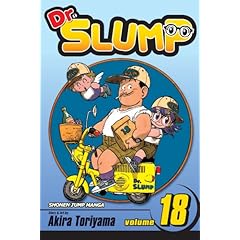
Dr. Slump vol. 18

Here's how this works. I read a book or two and tell you about them and try not to get too long-winded. This time, a review of Dr. Slump vol. 18 (Viz, 2009).


I decided a few months back against reviewing every volume in an ongoing series - the first, the last and every fifth one would do just fine. Well, back in October, I suggested that if you'd made it as far as the 16th volume of Dr. Slump, then you might as well see things through to the end. I don't know that I was right. By the end of the series, Akira Toriyama was clearly bored out of his mind. Weeks went by with his attention split between the excitement of his new series Dragon Ball and his newfound interest in motorcycles, and limping along to his contractually obligated concluding episodes of Dr. Slump affter five years was no longer what he wanted to do. So more than half the episodes in this final, slightly oversized edition sideline everything you were looking for from Dr. Slump in order to introduce new characters on motorcycles. Amusingly, Toriyama even admits this in the narrative, but his honesty doesn't excuse some lazy, tired comics. I mean, they look great, but your interest in them is pretty much going to require that you really, really like motorcycles.

So at last it's over. I'd like to send a small public thanks to Viz for publishing all of the original Japanese editions, and getting them all out there at the original $7.99 price before their line-wide increase begins. Hearty Bookshelf applause to Rich Amtower and Alexander O. Smith for their hard work as well. The series ended up disappointing me in the end, but if you'd told me twenty-three years ago, when I first encountered Dr. Slump, that I'd one day be able to buy English editions of the entire series, I'd have said you were loopy. Sure, it falls apart by the end, but the first twelve books are absolutely essential for houses with kids. For a good while there in the early eighties, Dr. Slump was one of the best gag comics around, and if you've got preteen kids in the house, you'll not be wrong in having the first dozen collections of this series available.

The Big Book of the '70s

Here's how this works. I read a book or two and tell you about them and try not to get too long-winded. This time, a review of The Big Book of the '70s (DC / Paradox, 2000).


I used to love picking up these Big Books that DC used to publish in the late nineties. As with so many of their subsidiary and imprint publishers, however, they really flooded the market with the darn things, releasing close to two dozen over a period of about two years. That was a bit more than even fans like me could handle.

Each of the Big Books gives you close to 200 pages of comics, with several dozen artists tackling a story in around 2-5 pages each. This time out, you've got work from Bookshelf favorites like Sergio Aragonés, Roger Langridge and John Ridgway, among many others, illustrating tales of excess and bizarre behavior from the groovy decade. Everything from The Brady Bunch to the Son of Sam to the Symbionese Liberation Army is profiled within.

Seventies pop culture was often garish and ugly, but it sounded better than it looked, if you take my meaning. Maybe it was my own adolescent curiosity around the time of the 1980 election that made me want to make some kind of sense about the world around me, but I've always found the crazy news and culture of the period fascinating stuff, and enjoyed this Big Book thoroughly. I shouldn't have put off this collection for as long as I did!

Now to find a new copy of The Big Book of Conspiracies. I loaned mine out a couple of years back and don't remember to whom. Bah!

Leather Underwear

Here's how this works. I read a book or two and tell you about them and try not to get too long-winded. This time, a review of Leather Underwear "#1" (Fantagraphics, 1990, this was actually the only issue).


This weekend, we were in Nashville and visited this very nice, new comic shop. And it was lovely, don't get me wrong, except that they didn't stock anything that any other comic shop couldn't get their hands on from the Previews catalog. No, for real treasures, you've got to find a store where you can get your hands grubby in a box full of old magazines. Atlanta's Book Nook on North Druid Hills is a perfect place for this. It's there that I found Roger Langridge's lovely 1990 effort here. It's 32 pages of gloriously mean-spirited, clever and funny comics, featuring the debut appearances of Sister Knuckles the Malevolent Nun.

Even more interesting, for those who met the character via the 2003 collection No More Mrs. Nice Nun, it turns out that her original ten-page appearance was substantially re-lettered and the dialogue rewritten. That was arguably a big improvement, but it's absolutely fascinating, archaeologically speaking, to see how Langridge found Knuckles' voice over time, and to look at the growing confidence in his artwork over the last couple of decades. Worth tracking down a copy!

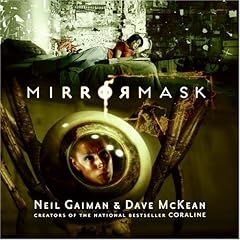
Mirrormask

Here's how this works. I read a book or two and tell you about them and try not to get too long-winded. This time, a review of Mirrormask (HarperCollins, 2005).


I remember thinking, when I saw the film Mirrormask in 2005, that it was an even better film than it was the first time I saw it, back when it was called Labyrinth. In novelised form - this is an illustrated children's book, with words by Neil Gaiman and imagery by Dave McKean - the similarities with the earlier Henson film aren't quite so obvious. For one thing, I can't remember for the life of me anything at all about Jennifer Connelly's character's pre-Muppet/Bowie existence, but Helena in Mirrormask has a very memorable and vivid world as a travelling circus performer.

I've always had problems with the nebulous and vague ways that Gaiman brings his stories to conclusion, but one thing he does amazingly well is create a really vivid, grounded, strikingly real world for his characters. He turns the mundane into something incredibly memorable, before things then get all weird. Having said that, Mirrormask is definitely walking on very familiar ground for Gaiman. If you're familiar with either Coraline or the "Doll's House" storyline in The Sandman, then Helena's descent into a weird world of bad dreams isn't going to seem entirely unfamiliar.

Interestingly, for a film which relies so heavily on its special effects and design, the book stands up pretty well with its emphasis on text. It's a little slim at 80 pages, but then again I was thick enough not to consider this as being a "children's edition" until I looked it up on Amazon. Perhaps it's not an essential part of your Gaiman library, but I'd track down a copy of this before bothering with those Spawn spinoffs he was doing in the early '90s.