Showing posts with label seth. Show all posts

Saturday, June 16, 2012

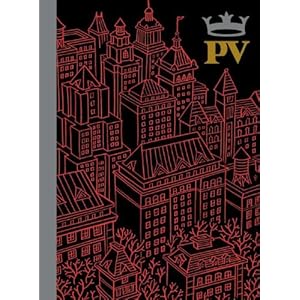
Palookaville # 20

What I try to do with reviews at this Bookshelf blog is keep it simple and spoiler-free, and let you know whether I'd recommend you pick up a copy of what I just read. Seems to work okay. This time, a brief review of Palookaville # 20 (Drawn & Quarterly, 2010).

Longtime readers know that I really enjoy the deceptively simple comics by Seth, which flow with tranquil grace and are often set in a small Ontario city called Dominion. Palookaville used to be his regular periodical, but in 2010 it became an annual hardback with its twentieth installment. He then decided against the annual deadline; the 21st issue is due later this summer.

An issue of Palookaville usually contains some fiction along with some autobiographical comics and sketchbook material. In this book, the fiction is another chunk of thirty-odd pages of "Clyde Fans," a sad exploration of the slow deterioration of a Dominion business. This part of the story is set in 1975, and I like the way that Seth captures the clothes and the hair of the period without being fancy or flashy about it. The last fourteen pages make up a story about Seth's trip to Calgary for a comic festival and him being a completely miserable git about it.

This troubles me, but it also fascinates me. I've often thought that some people who review "alt-comix" give far too much leeway to mediocre work just because it preaches the truth, when the uncomfortable reality is that the overwhelming majority of us lead lives which, transferred to the page, make for comics that I just can't stand to read, and don't know who does. It takes a heck of a lot of talent and a really firm grasp of the medium, both of which Seth has in spades, to turn our humdrum existence into something visually interesting enough that I would like to read about it.

But at the same time, Seth's worldview - if it can be trusted - is so misanthropic and down on himself that even his unbelievable skill can't turn fourteen pages of moaning into something that I'd like to return to. He certainly speaks an uncomfortable truth: he says that he's a big fan of the cartoonist Ben Katchor (as, indeed, every one of us should be), but that he finds himself with nothing really to say to him, and no connection at all. When you get past "I love your stuff," what's next? It's a fair question, and a shame that Seth can't bridge that gap.

Perhaps what it comes down to is that, raising a daughter with some mental health issues of her own, I find myself pulling back from reading depictions of depression. Once in a while, my smile is masking some nonsense I wish wasn't happening, but my own outlook and my perspective is really one of such real positivity that the malaise that infects Seth is downright saddening to read. I'd love to know where Seth buys his suits, and I'd love the funds to dress as well as him (Google AdSense to yer left, readers), and I'm happy as hell to buy his comics and visit Dominion, but man alive, I can't get behind visiting his real world. Cheer up, man!

Wednesday, February 22, 2012

The Great Northern Brotherhood of Canadian Cartoonists

What I try to do with reviews at this Bookshelf blog is keep it simple and spoiler-free, and let you know whether I'd recommend you pick up a copy of what I just read. Seems to work okay. This time, a brief review of The Great Northern Brotherhood of Canadian Cartoonists (Drawn & Quarterly, 2011).


Seth's latest release is another "sketchbook" story with which he tinkered for several years before finalizing it. As his earlier, similar Wimbledon Green suggested a world where the collecting of decades-old comics was a noble and bold pursuit, The Great Northern Brotherhood of Canadian Cartoonists illustrates that world. It's a place where Canada's supposed domination of the art form has led to the many and varied artists being held in the highest possible esteem, and a social club with branches in several cities and a library only accessible via a two-hour school bus ride north of the idiosyncratically-named Green Valley, somewhere up in Nunavut, I suppose.

I love the way that Seth adds layers and layers of fictions to his story, all told via a very unreliable narrator who eventually confesses that some of his tale is not entirely accurate. The story mixes in just enough real-world truth, including both a couple of namechecks for Chester Brown and about nine pages devoted to one of Seth's pet causes, a mostly-forgotten comic strip called Nipper by a guy named Doug Wright. In other words, there's just enough honesty to make the whole fundamentally dishonest narrative seem like it can be trusted. But it's not even set in a real place; Dominion is the small city seen in some of Seth's other works, notably the amazing George Sprott: 1894-1971. Naturally, a fictional city is a good place for a fictional club devoted to the (mostly) fictional art displayed here.

The tour of the club's facility leads into diversions where several key Canadian comics, both newspaper strips and funnybook pamphlets, are explored. My only quibble with The GNBCC is that the many excerpts are still drawn in Seth's simple sketchbook style. I do feel that it would have been a more entertaining and complete immersion had Seth explored some different styles for the many different comics.

That tiny issue aside, this really does work for me. I'd like to visit Dominion in the same way that millions would like to visit Hogwart's. It's that real and that engaging, and I'm always happy to follow one of Seth's little diversions there. Not bad for a town that, if we get right down to it, probably isn't all that much more impressive than Macon. Happily recommended.

Tuesday, January 18, 2011

Clyde Fans Book One

What I try to do with reviews at this Bookshelf blog is keep it simple and spoiler-free, and let you know whether I'd recommend you pick up a copy of what I just read. Seems to work okay. This time, a brief review of Clyde Fans Book One (Drawn & Quarterly, 2004).


Interestingly, this was not a book that I intended to buy just yet. I really like the great cartooning work of Seth, but I wasn't aware of Clyde Fans, the story of a long-closed seller of electrical appliances in yet another timelost Canadian town, until I actually saw a copy in the sadly now-closed Toronto bookseller Pages in the summer of '09. Since it is the first half of a story that Seth hasn't quite got around to finishing yet, I figured that I would wait until both volumes were available, eventually, and buy them both together. Then I found a used hardcover edition at McKay Books in Nashville for four bucks and went ahead.

It's written in a style that I'm not entirely used to from Seth. Rather than the fragmented storytelling that made Wimbledon Green and George Sprott so entertaining, the first half of this book - seventy pages! - are devoted to an old man in 1997 telling readers about the history of his old, long-closed business. It's an extended and, bizarrely, compelling story. I was just sucked right in.

The second half, set in 1957, sees the old man's incompetent brother Simon trying to fashion himself as a salesman, offering Clyde Fans products in the small town of Dominion. It's absolutely lovely cartooning used to illustrate a poignant and fascinating story. Simon's failures kept me completely hooked and Seth created a town so real that it only seems about ninety miles from anywhere. I'd love to see the remainder of this story one day soon. Recommended.

Sunday, September 5, 2010

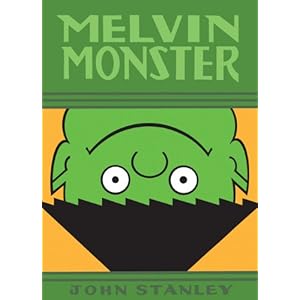
Melvin Monster Volume 2

What I try to do with reviews at this Bookshelf blog is keep it simple and spoiler-free, and let you know whether I'd recommend you pick up a copy of what I just read. Seems to work okay. This time, a brief review of Melvin Monster Volume 2 (Drawn & Quarterly, 2010)


The second volume of Melvin Monster was actually released several months ago, but I waited until my son was in town to pick up a copy, knowing that he enjoys it more than anybody else. The dude is thirteen, clearly a couple of years (at least) outside the original target audience for these comics, but he still chuckles and guffaws all the way through them. Although I've never once heard him exclaim "BAW" or "YOW." Yet.

Melvin Monster was written and drawn by John Stanley and it's a silly and surreal title where a fun-loving and kindhearted green beastie tries to go to school and avoid being eaten by his pet crocodile. His father's incredibly bad-tempered and violent and nobody's seen his uncle's head in years and his witch friend can barely control her temperamental broom.

Like the first volume, this is a wonderfully-designed (it's Seth again, naturally) hardcover that reprints three issues from the 1960s series by John Stanley. The reproduction is nice - it's done on that slightly yellowed faux-aged paper - and it's essential reading for anybody with younguns in the house. I'd actually call this essential for anybody who might have visitors in the seven to ten bracket. Kids might very well really enjoy a trip to "Crazy Uncle So-and-So's house" if they could be assured of a bookshelf full of John Stanley. What the heck's keeping you? Hugely recommended.

Thursday, April 29, 2010

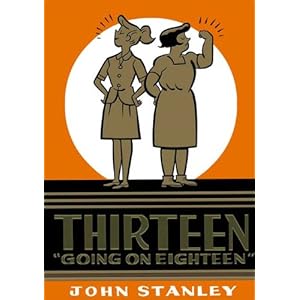
Thirteen "Going on Eighteen"

What I try to do with reviews at this Bookshelf blog is keep it simple and spoiler-free, and let you know whether I'd recommend you pick up a copy of what I just read. Seems to work okay. This time, a brief review of Thirteen "Going on Eighteen" (Drawn & Quarterly, 2010)


Thirteen "Going on Eighteen" was a teen girls' comedy series written, and mostly illustrated, by John Stanley. It was originally published in quarterly issues by Dell between 1962-1967 and the first nine have been repackaged, with truly satisfying design work by Stanley-phile and Bookshelf fave Seth, by Drawn & Quarterly in a really nice, heavy chunk of a hardcover.

Honestly, the ongoing budget crisis - well, I suppose it isn't really a crisis, I just don't have as much disposable income as I once did - meant that I intended to leave this one on the shelves for now, but I showed a copy to my daughter to see whether she'd like it. Just as her brother fell for Stanley's Melvin Monster, my daughter, at age eleven the perfect audience for this comic, insisted that I take it home. If I didn't, she probably would have thrown back her head and hollered "BAW!" at me.

I remain a little frustrated with D&Q's choices about how they're managing their reprints. Melvin Monster's nine terrific issues are being spread across three hardcovers, and here's a nice big book with the first nine issues of Thirteen. On the one hand, I wish D&Q had simply packaged all of Melvin Monster in a book this size, but on the other, I can see that in the case of Thirteen, they would have been shooting themselves in the foot by only reprinting the first three, which really aren't very good. These stories were drawn by Dell regular Tony Tallarico, and they're just plain dull. Stanley's scripts weren't very engaging, either. He took over art duties with the third issue, but it's not until the fourth that I started laughing. I didn't stop until the end, either.

Val and Judy's world of chocolate shoppes and moptops is pretty far removed from ours, but teenage girls still act like drama queens as often as possible, and their shenanigans, usually involving Val's insensitive older sister or her next-door neighbor, are usually quite funny. The very best comics, however, are the little shorts about Judy Jr., suggesting that Stanley was still more supremely confident depicting the world of little kids than teens. Judy Jr. is just hilarious, a clueless bully who strongarms her hapless friend into whatever she wants, punishing him on one occasion by throwing him out of his own house so that she can continue playing with his toys.

Since the first third of the book is really uneven, I can't give this the loudest of recommendations, but if you've got tweenage girls in your household, you'd be well advised to pick up a copy. Should the publisher bring out a second volume, however, that will be essential. When y'all bringing out Kookie, guys?

Thursday, September 17, 2009

It's a Good Life, if You Don't Weaken

Here's how this works. I read a book or two and tell you about them and try not to get too long-winded, and maybe you'd like to think about reading them as well. This time, a review of It's a Good Life, if You Don't Weaken (Drawn & Quarterly, 1996).


Since I've been known to rave about Seth's wonderful comics and book designs around these parts, I figured I should probably look into some of his earlier material. It's a Good Life, if You Don't Weaken was originally published in the 1990s, serialized in his occasionally-appearing comic Palookaville, and it's been whispering "buy me" for years. I finally picked up a copy in Toronto on my honeymoon earlier this summer; it sort of cries out to be bought in Canada.

It's a quasi-autobiography in which Seth lets a promising relationship with a cute student fall apart while he's focussed on an archaeological quest for an obscure gag cartoonist called Kalo. None of this really happened in the real world the way it's portrayed here - there never was a Kalo, neither in the pages of The New Yorker nor anywhere else - but it doesn't really matter. It strikes me as entirely possible that Seth's consuming desire to investigate fictional histories of might-have-beens like Kalo, Wimbledon Green and George Sprott could have cost him a present-day relationship or two over the years.

It's very interesting to see how Seth's style has developed over the years. His lines are thinner, and his anatomy is off, but the gorgeous, muted, single-color approach and his use of lengthy montages of establishing shots are present early on. It's a vibrant, sad and lovely work, and I'm glad I finally bought a copy. Recommended for older readers.

Monday, July 13, 2009

George Sprott, 1894-1975

Here's how this works. I read a book or two and tell you about them and try not to get too long-winded. This time, a review of George Sprott, 1894-1975 (Drawn & Quarterly, 2009)


This book is completely wonderful. It's on the shortlist of the year's best, so far.

I've been a big fan of Seth's work for quite some time, despite owning so little of it. I adored his wonderful Wimbledon Green from a few years ago, and I love his designs for the Peanuts and John Stanley Library series. He puts together gorgeous books, and his cartooning chops are awe-inspiring. One day, I might start drawing again, and just wish I could capture character, time and place half as well as Seth does.

Well, what you get in this gigantic book - it's only 96 pages, but it'll task your ability to find shelf space for it - are fractured memories and discussions about the life of George Sprott, the host for many years of a weekly television program called Northern Hi-Lights. Sprott had made a name for himself in the 1930s with a series of expeditions to the Arctic Circle, and parlayed this into some degree of celebrity in a small city in Ontario. Station CKCK was one of those long-lost television channels which was devoted to regular, regional programming. Both the channel and its home city, with its "Radio Hotel" and lecture hall, have been lost, swept away in the homogenization of modern culture. This is partially a narration (it's not quite a biography) of a man, but more a window into a world that was decaying by the time of Sprott's death in 1975, and doesn't exist at all anymore.

I don't know whether that description's enough to sell anybody on how magical this book is, but I was really moved by it. I'm just amazed by Seth's ability to completely sell this immersive worldview, where you're not sure whether the "then-popular fad for self-improvement" was part of our own history, or Sprott's. I knew I was going to like this book, but I really had no idea just how much.

(Seth was interviewed Friday over at Omnivoracious.)

Thursday, May 21, 2009

Melvin Monster / Nancy # 1

Here's how this works. I read a book or two and tell you about them and try not to get too long-winded. This time, a review of Melvin Monster / Nancy # 1 (Drawn & Quarterly, 2009).


Over at my Reprint This! blog, I've mentioned the forthcoming John Stanley Library from Drawn & Quarterly. To promote the books, the publisher released a neat 32-page flip book on Free Comic Book Day earlier this month. It gives you 16 pages of Melvin Monster and 16 pages of the comic book version of Ernie Bushmiller's strip Nancy and it is all kinds of fun.

I really don't remember ever seeing Melvin before. My son got hold of this comic before me and reported that Melvin was really funny and asked if I was going to be getting any more of it. Melvin apparently was released quarterly for only nine issues in the late sixties by Dell, and was clearly inspired by the Addams Family, the Munsters, the Groovy Ghoulies and their lovable type. Melvin really wants to be a good kid, which doesn't set well with his father ("Baddy"), or monster schoolteachers who don't want to be bothered teaching anybody anything. It's great stuff, with at least two wonderful gags on every page. I can't wait for the full edition, which should be out in a few weeks.

Nancy can't help but pale by comparison. It's still very entertaining stuff, and this sampler introduces the bizarre little girl Oona Goosepimple, who lives in a haunted house, but just not as grin-inducing as Melvin Monster. We'll have to see how the summer finances go before I can commit to the Nancy book, put it that way. The sampler also confirms that a collection of Stanley's Thirteen (Going on Eighteen) is due in the autumn. The books are all designed by Seth, and look wonderful. I'm looking forward to more, and recommend you check into getting a copy of this freebie comic for yourself to see what you think!