Wednesday, January 19, 2011

Eats, Shoots and Leaves

What I try to do with reviews at this Bookshelf blog is keep it simple and spoiler-free, and let you know whether I'd recommend you pick up a copy of what I just read. Seems to work okay. This time, a brief review of Eats, Shoots and Leaves (Gotham, 2006).


Lynne Truss makes an interesting observation in her peculiar little book about punctuation: "The reason it's worth standing up for punctuation is not that it's an arbitrary system of notation known only to an over-sensitive elite who have attacks of the vapours when they see it misapplied." She goes on to explain what that reason is, but she does so, at length, in the language of an over-sensitive elite recovering on a fainting couch from those very attacks of vapours. The existence of an apostrophe-free film entitled Two Weeks Notice has sent her into paroxysms of grief.

This is the silliest, fussiest book that I've nevertheless ever found sympathetic. I have an eye for public misspelling, but it delights me. When Coors started marketing a beer called "Artic Ice," I was in seventh heaven. So I understand where Truss is coming from, but I don't understand where she goes. True, there is some interesting research and background to the stories of apostrophes, commas, and Oxford commas, but it's all done in such a genuinely priggish way that her book feels exactly like the work of fiction's greatest handwringing, worrywart of a fussbudget, Hercule Poirot. I don't like Poirot.

Well, I mock, but there are occasional funny moments scattered throughout. I did love the story of a bedraggled teacher who came to a book signing despairing that she would like to learn punctuation, having studied it at school and forgotten it. I understand being a stickler. I was among the crowd that was once so concerned that, having taken over the production of graphic novels from DC, Rebellion might change the design of the book series' spines in any fashion, never considering that the new designer might improve upon them, that writer Gordon Rennie mocked the group in an episode of Judge Dredd. What I don't understand is letting stickler behavior turn you into an aged schoolmarm instead of a fired-up fun-lover. Sadly, not recommended.

Tuesday, January 18, 2011

Clyde Fans Book One

What I try to do with reviews at this Bookshelf blog is keep it simple and spoiler-free, and let you know whether I'd recommend you pick up a copy of what I just read. Seems to work okay. This time, a brief review of Clyde Fans Book One (Drawn & Quarterly, 2004).


Interestingly, this was not a book that I intended to buy just yet. I really like the great cartooning work of Seth, but I wasn't aware of Clyde Fans, the story of a long-closed seller of electrical appliances in yet another timelost Canadian town, until I actually saw a copy in the sadly now-closed Toronto bookseller Pages in the summer of '09. Since it is the first half of a story that Seth hasn't quite got around to finishing yet, I figured that I would wait until both volumes were available, eventually, and buy them both together. Then I found a used hardcover edition at McKay Books in Nashville for four bucks and went ahead.

It's written in a style that I'm not entirely used to from Seth. Rather than the fragmented storytelling that made Wimbledon Green and George Sprott so entertaining, the first half of this book - seventy pages! - are devoted to an old man in 1997 telling readers about the history of his old, long-closed business. It's an extended and, bizarrely, compelling story. I was just sucked right in.

The second half, set in 1957, sees the old man's incompetent brother Simon trying to fashion himself as a salesman, offering Clyde Fans products in the small town of Dominion. It's absolutely lovely cartooning used to illustrate a poignant and fascinating story. Simon's failures kept me completely hooked and Seth created a town so real that it only seems about ninety miles from anywhere. I'd love to see the remainder of this story one day soon. Recommended.

Sunday, January 16, 2011

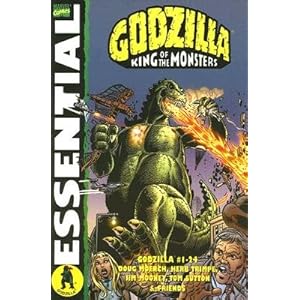
Essential Godzilla

What I try to do with reviews at this Bookshelf blog is keep it simple and spoiler-free, and let you know whether I'd recommend you pick up a copy of what I just read. Seems to work okay. This time, a brief review of Essential Godzilla (Marvel, 2006).


Every couple of years, I find myself returning to this flatly ridiculous comic book and willfully overlooking the giant stack of problems with it. Overwritten narration, utterly terrible art, laughably poor designs, the inclusion of a little Johnny Sokko-wannabe screaming "no, don't hurt Godzilla!" every eighth page, the entire last third of the book, wherein, at one point, a shrunken Godzilla is spirited around Manhattan in a coat and hat... as really dumb comic books go, Marvel's mid-seventies Godzilla title is in a class by itself.

The original seventies Godzilla film series had already concluded when Marvel licensed the property for a two-year run written by Doug Moench. It's mostly drawn, badly, by Herb Trimpe, except when he was not available and some even worse artwork by Tom Sutton was provided. In it, Godzilla attacks America, only it's not so much an "attack" as a curious day outing. Every so often, Godzilla saves Salt Lake City or someplace from space monsters and then wanders off into the sunset, leaving the hapless stooges from SHIELD to hope that the next time he shows up, he doesn't blow up any oil refineries again. Nobody seems to want to actually follow Godzilla anywhere.

I enjoy this collection in part because of the nice nostalgia factor - naturally, I loved this funnybook when I was nine - and in part because of just how amazingly idiotic it all is. You'll really have to work hard to overlook that stupid, whiny kid who seems to have security clearance to everywhere and ends up, inevitably, piloting a giant robot for about seven episodes, but given a remit to entertain nine year-olds, Doug Moench did a serviceable job. It will make you wish that he'd been teamed with a better artist, though. Not recommended, unless you were nine in 1979.

Friday, January 14, 2011

The Dead of Jericho

What I try to do with reviews at this Bookshelf blog is keep it simple and spoiler-free, and let you know whether I'd recommend you pick up a copy of what I just read. Seems to work okay. This time, a brief review of The Dead of Jericho (Macmillan, 1981).


Sometime in the mid-nineties, a few months before I first read this novel, the fifth in Colin Dexter's Inspector Morse series, I saw the adaptation starring John Thaw repeated on A&E. I was already a little familiar with the character from a couple of the TV episodes; PBS's Mystery! broke the movie-length stories into two parts and I started with one of the made-for-TV stories from series four. At any rate, I would have been happy to have kept Morse as just a TV-only affair - who had time to do all that reading? - but the TV version of The Dead of Jericho was so darn good that I wanted to come back to it.

The episode, incidentally, featured the great Patrick Troughton in one of his last roles as a bitter old peeping tom who is implicated in the death of a woman who lives across the road, and who saw Morse enter the woman's flat several hours before her body was found, an apparent suicide. But if this is a suicide, there's a strange matter of a missing key, and a very curious blackmail attempt made on a publisher friend of the deceased. But the most likely suspect of this attempt is illiterate, so who wrote the demand?

This was a really fun read, full of false starts and scenes of Morse being cranky and breaking the law to get around little obstacles. The really nice thing is that it's been so long since I've seen that TV version that I'd forgotten about the really neat trick to create an alibi for a character. The same thing that must have had me once wanting to read a book version to see how Dexter originally did it now has me wanting to track the television adaptation down to see it on screen again. Obviously recommended.

Wednesday, January 12, 2011

Silver Spire

What I try to do with reviews at this Bookshelf blog is keep it simple and spoiler-free, and let you know whether I'd recommend you pick up a copy of what I just read. Seems to work okay. This time, a brief review of Silver Spire (Bantam, 1992).


I think that if I had been following Nero Wolfe in the 1980s and 1990s, I would have, then, been a lot less forgiving of this novel, Goldsborough's sixth, than I am today. In a way, it's almost charming the way that most of his books come across as period pieces, with cultural touchstones that are straight from that debased era. Just as the previous Fade to Black somehow managed to make the '80s cola wars, of all things, into a compelling and fun backdrop for a novel, this one, if you can believe it, manages to make the televangelist scandals of the day into something almost worth reading. Goldsborough even manages to take a Swaggart / Bakker figure and make him sympathetic, albeit a little obnoxious.

Actually, a lot of the characters in this book are pretty darned obnoxious, which is the biggest strike against actually sitting down and reading the novel. Not one of them wants to assist Archie with his investigation, each of them is hyper-defensive, reluctant to give an alibi, and is convinced that the guilty party has already been arrested. There's a usual scene where, once everybody has been gathered, Wolfe reminds the group that this will go quicker without interruption. This time out, Wolfe gives up reminding them. It's an agonizing scene, so full of interruptions as it is. That's a real shame, as Goldsborough turned the structure of this scene completely on its head, and it should have been a winner.

Upon reflection, though, the really contrived nature of the killing really makes this book a much less satisfying read than I hoped. Sadly, it opens very well, only to have my high hopes dashed. Archie cannot convince Wolfe to take a case involving anonymous threats dropped in a Staten Island megachurch's collection plates, and so he recommends the church hire their frequent associate Fred Durkin. Fred is written as somewhat more of a "dese, dem, dose" boor than usually, but it's an interesting angle, ruined by the silly and contrived business that leads him to become a murder suspect. There were some good ideas at work here, but it looks very sadly like my feeling that Goldsborough's tenure on the series was going to end with a bang will be proved mistaken. There's a good notion for a book here, and clever elements to it, but it is executed quite badly. Not recommended.

Monday, January 10, 2011

The Complete Harlem Heroes

What I try to do with reviews at this Bookshelf blog is keep it simple and spoiler-free, and let you know whether I'd recommend you pick up a copy of what I just read. Seems to work okay. This time, a brief review of The Complete Harlem Heroes (Rebellion, 2010).


With The Complete Harlem Heroes, Rebellion continues the gold standard they've been setting with really comprehensive reprints of archival material. This is a series that ran in 2000 AD's first 27 issues in 1977 before taking a short break and resurfacing, two months later, as Inferno, where it continued for a further 40 episodes. Of principal interest to American readers, the first 24 installments were drawn by Dave Gibbons before he stepped down to take over art duties on Dan Dare, whose artist at the time, the late Massimo Bellardinelli, switched over to this series. So this is a big thick doorstop of a book, one-third of which is drawn by Gibbons.

This is a genre of story mostly unseen in American comics: sports adventure. It's set in 2050 and concerns a sport called aeroball, which is played by teams of seven wearing jetpacks. It's sort of an amped-up version of basketball, and the Harlem Heroes are among the best in the league and headed for the postseason when the team's "roadliner" crashes, killing half the team. Throughout the series, the focus shifts from building a new squad, playing new matches, and solving the mystery of who's got it in for them. After the pilot script by Pat Mills, the series was written by Tom Tully, who specialized in these sorts of stories - he would later write a virtual clone of this series, Mean Arena, for 2000 AD from 1980-1982, in between writing one of Britain's best-loved sports comics, the long-running Roy of the Rovers - and who had an amazing ability to keep the action moving and recap all the offstage subterfuge and make threats out of menacing, shadowy conspiracies who want to murder our protagonists.

It's all amazingly ridiculous, of course. If you can imagine a series where Payton and Eli Manning get their old man out of retirement to (a) play football again and (b) solve crimes with him, then you're probably visualizing the greatest Saturday morning cartoon ever, and that's what this feels like, only with the violence ramped up to eleven. The climactic episode of the first Harlem Heroes story even sees half the cast killed off, suddenly and unmourned, to clear the decks for the rethink.

In Inferno, it's revealed that actually, aeroball was a dying sport anyway, only cared about by hopeless obsessives. The real sports action is in Inferno, a game which is something like ice hockey played with jet packs, motorcycles and harpoon guns, and so the Heroes - the ones who made it through the carnage of the last episode - switch sports, with slightly more success than when Michael Jordan decided that he was done with hoops and wanted to go play baseball with the Birmingham Barons. But, wouldn't you know it, somebody else has got it in for the new Harlem Hellcats, and so they've got to investigate mysterious clues and nonsense again! It's just as ridiculous, with its inclusion of brains-in-tanks, androids and cyborgs, and just as bloody. One amazing incident, in which a villain pours gasoline all over one of our helpless heroes, intending to set him on fire, came within a hair's breadth of getting 2000 AD canceled for going too far.

So all in all, no, it's really not very good, but it's incredibly entertaining and over the top. I especially love the constant reuse of the idea that neither the Heroes nor the Hellcats have ever even seen film of the opponents of their next match, who are invariably revealed to take whatever nickname that team came up with far too seriously. There's never an aeroball-standard uniform at play here. The Montezuma Mashers dress like Aztec warriors and there's a team that dresses like oil riggers and a team that dresses like Cossacks and as for the Long Island Sharks... Before I die, I want to see the Vikings and the Panthers play a game like that. It's elevated by the artwork. Gibbons' pages are just beautiful, and I think that Belardinelli was initially rushing to keep up, but the more far-out and downright weird setting of the Inferno storyline is more his speed. At one point towards the end, Belardinelli drew himself as a spectator egging on the mayhem, which is just beautiful.

There's probably good reason they don't make 'em like this anymore, but Harlem Heroes retains a lot of its dated charm in its insensible presentation and wild artwork. Rebellion's collection includes all 67 episodes, along with some good bonus features. These include four pages of unlettered artwork by Carlos Trigo from one of 2000 AD's inhouse ashcan editions, which is the sort of neat extra that all books like this should seek to include. I think that younger and newer readers will find this even more stilted and contrived than the 1960s DC books that get collected in the Showcase series, so I can't really recommend this wholeheartedly, but it's certainly worth a look for the curious or the nostalgic, and absolutely for the art.

Sunday, January 2, 2011

Young Heroes in Love # 1-17

What I try to do with reviews at this Bookshelf blog is keep it simple and spoiler-free, and let you know whether I'd recommend you pick up a copy of what I just read. Seems to work okay. This time, a brief review of Young Heroes in Love # 1-17 (DC, 1997-98).


Clearing out boxes of comics that I have not read in many years, I came across the seventeen-issue run of Young Heroes in Love, a book that I enjoyed during a period where I was a little more patient and willing to try DC books than I am today. At least back in the late nineties, people say, it was possible to read a run of funnybooks without constant references to other funnybooks. Oh, nostalgia. If only that was true.

To be fair, YHIL holds up, not very dated, and those references to other DC books are not very intrusive. There are guest appearances from the likes of Superman and the Scarecrow, and one of the characters is a wealth of DC trivia and can tell you the order of the known Green Lanterns, but this should all basic, entry-level stuff. At least it would be, if DC didn't insist on the Superman who hangs out with the Young Heroes being the one from that frankly ridiculous period where Superman was blue and had electrical powers. It briefly flirts with a line-wide crossover event called Genesis for some insane reason that didn't work. Put another way, rereading YHIL from the otherwise safe distance of twelve years reminds me of everything there is to hate about DC Comics.

And it certainly shouldn't be that way, because if it wasn't for the "shared universe!" idiocy, this is a pretty good comic book and it has aged surprisingly well. It helps that the main cast are all new characters - if I understand the book's indicia, they remain the copyright of the book's creators, Dan Raspler and Dev Madan - a small group of newly-emerged superheroes who have assembled at the behest of the charming, blond, best-and-brightest Hard Drive, sort of the Ken Jennings of the caped crowd. As soon as this group of costumed twentysomethings get together, certain members of their gang start eying each other and considering their bedroom prospects. It's probably a much more honest look at how this sort of thing really would work in the comic book universe, but it's not like DC Comics wants everybody at the Hall of Justice portrayed that way.

Over the course of the book's year and a half run, there are all sorts of fun subplots that develop, because it's made immediately apparent that some of the characters have their own agendas. About the only character who isn't letting bad ideas or bad boyfriends influence his decision is the group's resident tough guy, presented as an innocent who regrets gaining additional mass and super strength, as it means he can no longer play guitar to relax. Everybody else is up to something. Honestly, the day-to-day plot beats and superhero tropes feel less important almost instantly than the interaction, which feels like a backstabbing, albeit still mostly good-natured, take on NBC's Friends than the Justice League.

Cancellation was a sure bet for the title very early on. Despite some notable promotion from the publisher, DC released it during a period where several new titles, all operating on the fringes of the existing DC Universe, were all competing for attention. Books like Aztek and Chase proved equally tough sells in a market where the A-list characters already had several books each demanding readers' money. Launching new, hit properties in such circumstances is practically impossible, but DC gave this book a few more months than many others that they had tried.

I do wish that Raspler had seen the writing on the wall sooner and started wrapping up subplots earlier than he did. Instead, most of them reach very rapid, rushed conclusions in the book's final issue. I was reminded of the way that a later DC title, Jamie Delano's Outlaw Nation for Vertigo, similarly had to swiftly conclude its "long game"-styled subplots in an unsatisfactory rush. So it doesn't end well, and you can see the effect of the last-minute cancellation from a mile away, but it was, genuinely, a pretty fun ride getting to the end. Recommended.