Showing posts with label robert goldsborough. Show all posts

Tuesday, February 18, 2014

Murder in the Ball Park

What I try to do with reviews at this Bookshelf blog is keep it simple and spoiler-free, and let you know whether I'd recommend you pick up a copy of what I just read. Seems to work okay. This time, a brief review of Murder in the Ball Park (The Mysterious Press, 2014).


While enjoying a Giants-Dodgers game at Polo Field in 1950, our hero Archie Goodwin and his longtime friend and fellow detective Saul Panzer witness the murder of a state senator. They leave before they get pulled into a police investigation, but after a few days, the widow hires Archie's boss, the grouchy genius Nero Wolfe, to look into the killing. Business as usual at the old brownstone, in other words.

Robert Goldsborough has been writing Nero Wolfe adventures off and on since the mid-1980s. This is the ninth, and the second since a long hiatus. Like its predecessor, which let me down greatly with its tame adherence to the structure of the books, it's a period piece. This is the first time that any of Goldsborough's books have been set within the long timeline of Rex Stout's original series - all the others were set after or prior to Stout's corpus. You could probably place it not long after Wolfe's final confrontation with his recurring enemy Arnold Zeck.

2012's Archie Meets Nero Wolfe failed for me because I wished to see the characters outside of both the confines of the traditional Wolfe narrative, and of the ironclad rules of Wolfe's precisely-maintained household routine. Setting this story when Goldsborough did deflates those desires. A book set around the time of Prisoner's Base should absolutely feel like a book written around that time, and Goldsborough does his usual expected research and brings the period and the tone to life quite well.

The story is familiar and the beats are predictable, but that's perfectly fine for what this book is. It's revisiting old friends in a comfortable setting. After a stumble in the opening chapter - Saul and Archie, noticing the senator in attendance at the game, discuss without subtlety the man, his relationships, and a controversial road project as if to assure the readers that the man is about to be killed and to stay tuned for other important clues to come - the author captures the voices of the regular characters really flawlessly, adding several amusing new players for Archie to bounce off. The mystery is fun, confusing, and pleasantly satisfying. Not without its flaws, but not without considerable charm, either. Recommended with a smile.

(After some years out of print, The Mysterious Press has obtained the rights to Goldsborough's first seven Wolfe novels and reissued them in dress to match their two new books. Kudos to them for a job well done. They look superb.)


An advance NetGalley copy of this book was provided by the publicist for the purpose of review. If you'd like to see your books (typically comics or detective fiction) featured here, send me an email.

Tuesday, October 23, 2012

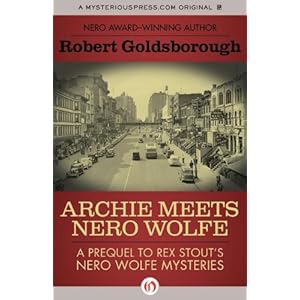
Archie Meets Nero Wolfe

What I try to do with reviews at this Bookshelf blog is keep it simple and spoiler-free, and let you know whether I'd recommend you pick up a copy of what I just read. Seems to work okay. This time, a brief review of Archie Meets Nero Wolfe (Mysterious Press, 2012).


I thought that I was through with Rex Stout's Nero Wolfe for a time after my second pass through the corpus. Then I read that Robert Goldsborough, who had written seven novels continuing the tales of Wolfe and Archie Goodwin into the early nineties, at least five of which I had enjoyed a good deal, was working on a prequel to the series. Goldsborough's last Wolfe adventure, The Missing Chapter, was published nearly twenty years ago, and I was pleased to learn that we'd have another story of these squabbling associates and friends, with the sparkling wordplay and fun character quirks that elevate all of their many adventures.

I was fortunate to receive a prerelease edition of the novel, but I'm sad to say that I'm of two minds about it. Goldsborough is the expert, and I bow to his craft, but this is far from the meeting that I had envisaged. What I can say, gladly, is that Goldsborough tells his story extremely well, and uses Stout's supporting cast effectively. He gives some players, notably Del Bascom and Bill Gore, more page time than Stout ever did, and since Saul Panzer takes the lead in the groundwork investigation, Goldsborough shows us just why Archie has such respect for his talent and ability. It does raise the question, however, about why Panzer is so accommodating and cordial to the newcomer. And, of course, Cramer, Rowcliffe and Stebbins are all present and correct, growling at the private eyes and threatening their licenses.

That's perhaps my problem: it's too by-the-book. Despite Goldsborough's genuine success in crafting a believable Prohibition-era mystery - it concerns the kidnapping of Tommie Williamson, as alluded in the first Wolfe novel, Fer-de-Lance - and grounding it firmly in the period, he plays it too safe. I confess to some bias; some months ago, I really enjoyed an early novel by John Lescroart called Rasputin's Revenge, which unofficially, and pseudonymously, places a younger Nero Wolfe in action in Imperial Russia during the Great War, and it struck me how much more vibrant and fun Wolfe is when stripped of his rules and routines. Some of the most memorable imagery within Stout's novels come from those instances, such as Too Many Cooks or his war against the criminal Arnold Zeck, where Wolfe is uprooted from his comforts. I had hoped in vain to read of Wolfe putting his world into place, but, sadly, his routine is already set in stone. The only difference is that, rather than Archie explaining to a prospective client that his boss is up in the orchid rooms from four to six, it's Panzer explaining it to Archie.

While this is a huge quibble for me, I can imagine that Wolfe's many fans will happily overlook it just for the satisfaction and the genuine pleasure of returning to the brownstone and enjoying more time with one of detective fiction's greatest characters. Both in constructing a good mystery, and in detailing the too-young-to-vote Archie Goodwin, Goldsborough really succeeds, and while he's unfamiliar with New York City and new to the detective game, there's an honest and realistic spark to Goodwin as a person. When Wolfe offers him a permanent position in his household, it's natural and believable.

I also have to credit Goldsborough for playing within the rather ridiculous rules of time within the original corpus. Readers are forced to handwave away the fact that none of the regular or recurring players seem to age within the forty-year span of Stout's novels, because the tradition is that each story is set around the time of its publication. Consequently, a story that takes place six or seven years before Fer-de-Lance has to be a story set around 1928. Goldsborough does a fine job evoking the time, with attendant quirks of language ("autos," "beanery"), technology, and customs, but while I can imagine that many readers will finish this book hoping for Wolfe and Archie's next adventure, it leaves me hoping that, if Goldsborough does have another story in mind, it is set in 1924 or thereabout, and is a tale of a Wolfe who has not yet become sedentary and hidebound. That's what I'd like to read. Recommended for Wolfe's fans.

A copy of this book was provided by the publisher for the purpose of review. If you'd like to see your comics or detective fiction featured here, send me an email.

Friday, February 4, 2011

The Missing Chapter

What I try to do with reviews at this Bookshelf blog is keep it simple and spoiler-free, and let you know whether I'd recommend you pick up a copy of what I just read. Seems to work okay. This time, a brief review of The Missing Chapter (Bantam, 1994).


I briefly had a Wikipedia username and was interested in contributing edits to that worthwhile project. I soon learned that the overwhelming majority of Wikipedia editors are self-obsessed lunatics, not worth association, and consequently almost never edit or update Wikipedia pages any longer. I made an exception with Robert Goldsborough's The Missing Chapter, which some wag had previously claimed on the Nero Wolfe page had been the last "and least" of the author's seven novels. I spent the whole book waiting for some evidence that would back that claim, but, happily, I enjoyed it thoroughly. Then I went and edited the Wikipedia page. If you're going to make an NPOV claim, you'd better be able to back it.

This book is about the definition of "meta." In it, Wolfe is hired to find out who killed a grouchy novelist with an impossibly high opinion of himself and his hackwork. He'd been hired to write continuation novels in the successful series of "Orville Barnstable" mysteries. These have been much loved by millions of readers, including a fan group called PROBE, the Passionate Roster of Orville Barnstable Enthusiasts. Perhaps the wag on Wikipedia who didn't like this book was a member of "The Wolfe Pack" and thought the comparison was unflattering. Anyway, after the original author passed away, Charles Childress took the reins, and made a few enemies, but enough people think that there is more to his apparent suicide for Nero Wolfe to be hired.

It did feel a little different from the rest of Goldsborough's novels. There's an obvious, twinkling affirmation of the author's own tropes and interests, but it never really feels like he is saying goodbye to the characters, not in the same, torch-it-all-down way that Rex Stout bid them farewell in A Family Affair almost twenty years previously. It felt more like he was saying goodbye to the readers, and Nero Wolfe's many fans, leaving the brownstone intact for the next continuator hired to work on the series. Actually, Goldsborough left the brownstone somewhat improved. In a series that was punctuated most amusingly by heaping aggravations upon Nero Wolfe, the installation of a new elevator, and the attendant demands on Wolfe's patience while the crew disrupts his schedule, is one of the funniest.

It's a shame that there has been nothing since. Strangely, despite the evident success of Bantam's series, no new novels have emerged since 1994. As for that Wikipedia editor's thoughtless commentary, The Missing Chapter is certainly not the least of Goldsborough's books - that would be either The Bloodied Ivy, or, possibly, Silver Spire - and while it was not his best, it was a good enough capper for the author's time in charge. I was glad to have had the extra few weeks with Archie and Wolfe, and look forward to rereading the corpus in a couple of years' time. Recommended.

Wednesday, January 12, 2011

Silver Spire

What I try to do with reviews at this Bookshelf blog is keep it simple and spoiler-free, and let you know whether I'd recommend you pick up a copy of what I just read. Seems to work okay. This time, a brief review of Silver Spire (Bantam, 1992).


I think that if I had been following Nero Wolfe in the 1980s and 1990s, I would have, then, been a lot less forgiving of this novel, Goldsborough's sixth, than I am today. In a way, it's almost charming the way that most of his books come across as period pieces, with cultural touchstones that are straight from that debased era. Just as the previous Fade to Black somehow managed to make the '80s cola wars, of all things, into a compelling and fun backdrop for a novel, this one, if you can believe it, manages to make the televangelist scandals of the day into something almost worth reading. Goldsborough even manages to take a Swaggart / Bakker figure and make him sympathetic, albeit a little obnoxious.

Actually, a lot of the characters in this book are pretty darned obnoxious, which is the biggest strike against actually sitting down and reading the novel. Not one of them wants to assist Archie with his investigation, each of them is hyper-defensive, reluctant to give an alibi, and is convinced that the guilty party has already been arrested. There's a usual scene where, once everybody has been gathered, Wolfe reminds the group that this will go quicker without interruption. This time out, Wolfe gives up reminding them. It's an agonizing scene, so full of interruptions as it is. That's a real shame, as Goldsborough turned the structure of this scene completely on its head, and it should have been a winner.

Upon reflection, though, the really contrived nature of the killing really makes this book a much less satisfying read than I hoped. Sadly, it opens very well, only to have my high hopes dashed. Archie cannot convince Wolfe to take a case involving anonymous threats dropped in a Staten Island megachurch's collection plates, and so he recommends the church hire their frequent associate Fred Durkin. Fred is written as somewhat more of a "dese, dem, dose" boor than usually, but it's an interesting angle, ruined by the silly and contrived business that leads him to become a murder suspect. There were some good ideas at work here, but it looks very sadly like my feeling that Goldsborough's tenure on the series was going to end with a bang will be proved mistaken. There's a good notion for a book here, and clever elements to it, but it is executed quite badly. Not recommended.

Wednesday, December 22, 2010

Fade to Black

What I try to do with reviews at this Bookshelf blog is keep it simple and spoiler-free, and let you know whether I'd recommend you pick up a copy of what I just read. Seems to work okay. This time, a brief review of Fade to Black (Bantam, 1990).


If you'd told me that one of the more entertaining of all the Nero Wolfe stories was one set against the backdrop of the 1980s cola wars between Pepsi and Coke, I'd have called you batty, but darn if Robert Goldsborough's fifth adventure of Wolfe and Archie isn't one of the most charming and clever in the whole series. It's easily the best of his first five, and a notch or two more entertaining than some of Stout's less inspired offerings.

So what's going on here is that a small advertising agency is at war with a big Madison Avenue firm. They each have contracts with cherry-flavored sodas with really contrived names and backstories (and, speaking as somebody who knows his ginger ales from Buffalo Rock to Ale-8-1 and back, I know contrived), but the smaller firm figures that there must be a mole somewhere, as the larger firm keeps trumping them with new copycat campaigns rushed out before they can get their original "creatives" into the public eye. Wolfe has little time for industrial espionage, and even less for soda pop, but agrees to let Archie ask some questions. Almost instantly, a potential informant from the big firm comes forward, and, in a none-too surprising development, Archie finds his dead body.

It's not perfect - there's a run of about thirty pages where every example of sparkling wit and clever dialogue gets interrupted by somebody very reluctantly agreeing to provide Archie with yet another alibi - but it's incredibly fun, with Goldsborough's best-developed and most amusing supporting cast. I also started detecting here a few circumstantial clues that suggest that he's actually aging the characters. It's never overt, but it makes the off-key use of the word "chap" in his previous novel seem a little more sensible. Something about the tone here and there makes me perceive Archie as, not merely clued-in to an earlier time than the supporting players, but actually a little bit older than the perennial late thirties of Stout's novels. Maybe I'm wrong, and maybe such things are sacrosanct, but the discordian iconoclast in me can't help but be amused by the notion of a silver fox-styled Archie. Recommended.

Tuesday, December 14, 2010

The Last Coincidence

What I try to do with reviews at this Bookshelf blog is keep it simple and spoiler-free, and let you know whether I'd recommend you pick up a copy of what I just read. Seems to work okay. This time, a brief review of The Last Coincidence (Bantam, 1989).


I enjoyed this novel considerably more than Goldsborough's previous Nero Wolfe adventure. While last time out, we were treated to a pacey, slow, made-for-Centrum Silver account of a boring nothing of a case, this time there's a much punchier story that hits much closer to the brownstone. Thirty-five pages in and somebody's dead and Cramer is bellowing at Archie, who had the misfortune of starting an argument in the street with the dead somebody in front of witnesses shortly before he was killed by an ugly blow to the head, his body next to his Porsche.

Keeping things personal by involving the family of regular supporting player Lily Rowan gives the story a real sense of urgency. Archie's with the characters as events play out, and a false confession is extracted from Lily's nephew. As with the later Rex Stout novels, distrust of the police is important to the story's tone, but there's more than one weird coincidence at work here, especially the way that nobody seems to have an alibi.

There are some eyebrow-raising moments where the tone doesn't feel quite right, such as having Archie twice refer to somebody as a "chap," which seemed hugely out of character. Otherwise, this is a very loving pastiche, and a clever and engaging story that really kept me guessing and surprised. It has renewed my hopes that the next three Goldsborough novels will be as fun as the first two had been.

Thursday, December 9, 2010

The Bloodied Ivy

What I try to do with reviews at this Bookshelf blog is keep it simple and spoiler-free, and let you know whether I'd recommend you pick up a copy of what I just read. Seems to work okay. This time, a brief review of The Bloodied Ivy (Bantam, 1988).


It's true that Rex Stout always made his Nero Wolfe novels a product of the time that they were written. Wolfe and Archie Goodwin and most of the rest of their cast - there was one returning character from the fourth novel, Too Many Cooks, who showed up three decades later having aged three decades while our heroes somehow didn't - were always modern. Well, Archie was modern. Wolfe, grouchily demanding his schedule and disapproving of the world outside his brownstone, would have been just as happy to have remained in prewar New York City as to have moved along with a world that, in Robert Goldsborough's third continuation novel, includes personal computers for Archie to enter his germination records, and a celebrity culture that includes references to David Letterman, Madonna, and Vanna White. If you had told me when I finished Fer-de-Lance last year that at some point in these books, we'd run into a Vanna White reference, I'd have called you a liar.

This time out, a nebbish professor at a small private college eighty miles north of town has come to Wolfe and Archie with a long-winded story about how a controversial right-wing colleague and mentor could not possibly have fallen to his death, but was murdered. Cast Woody Allen and John Huston in those roles and suddenly the whole book turns into less of a novel and more like the big, annual TV movie on CBS with a host of celebrity guest stars in the whodunit. There's even a part here for Stephanie Beacham, generously. That's honestly what reading this book felt like. You remember when Raymond Burr returned to all those Perry Mason TV movies on NBC in the late eighties? I'm going to hope this effort was an aberration, because while Goldsborough's first two novels were reasonably good, this one fell down a crevice steeper than the one that killed the professor. Not recommended.

Thursday, December 2, 2010

Death on Deadline

What I try to do with reviews at this Bookshelf blog is keep it simple and spoiler-free, and let you know whether I'd recommend you pick up a copy of what I just read. Seems to work okay. This time, a brief review of Death on Deadline (Bantam, 1987).


Fifty years in his New York City brownstone and apparently not having aged a day, Nero Wolfe confronted the late '80s trends of newspaper bias and international, jet-set media robber barons in Robert Goldsborough's second continuation novel with the character. This time out, Wolfe elects to stick his nose in when Ian MacLaren, a Maxwell / Murdoch type from Scotland, not content with ruining a dozen newspapers already, sets his sights on The New York Gazette, the paper that employs the detective firm's friend, Lon Cohen.

Certain tricks work within a series, and it's not surprising when, after Wolfe makes a big public stink about his loathing of this Scottish tycoon, somebody ends up dead and the police figure Wolfe either knows more about the situation than he's letting on, or he's interfering in hopes of a fat paycheck from somewhere. So without a client and without a retainer, Wolfe, determined that an alleged suicide is no such thing, digs further into the mess, driving Archie to distraction. Poor Archie is the definition of "long-suffering" in this one.

Very much a novel of its time, I was easily able to picture the entitled, spoiled heirs to the Gazette fortune looking just like the younger members of the Carrington clan from Dynasty, all shoulder pads and giant hair. I'd love to see a 1987-set television adaptation of it, actually! Entertaining and amusing, it probably has a tongue in cheek tone a little unlike Stout's work on the series, but it's a good follow-up all the same.

Friday, November 26, 2010

Murder in E Minor

What I try to do with reviews at this Bookshelf blog is keep it simple and spoiler-free, and let you know whether I'd recommend you pick up a copy of what I just read. Seems to work okay. This time, a brief review of Murder in E Minor (Bantam, 1985).


Now, Robert Goldsborough, for a while there, he was living the dream. Not very many people can claim that they've turned a fanfic hobby into the real thing. In 1977, a couple of years after Rex Stout had passed away, Goldsborough, then a Chicago Tribune staff journalist, wrote a Nero Wolfe novel for his mother, who loved the character and missed having any new adventures. In Sherlock Holmes fandom, this sort of writing is referred to as a pastiche; dozens, hundreds have written their own.

In 1985, Bantam Books and Stout's estate started looking around for an author to officially continue the Wolfe canon. (Actually, in Wolfe fandom, it's called the "corpus." Every fandom has its own quirks.) The character was then still quite well regarded and remembered by the general public, even if an early '80s TV adaptation on NBC failed after a half-season and was loathed by purists. I'd actually like to see that, despite its pedigree. William Conrad was possibly a pretty good choice to play Wolfe even if he refused to shave his beard - the fastidious Wolfe should always, always be clean-shaven - but Lee Horsley as Archie Goodwin, now that was a genius move. He must have made a terrific Archie.

So, if I understand rightly, Bantam and Stout's biographer, the estimable John McAleer, cast around for a new chronicler and Goldsborough submitted his seven year-old fanfic. It's really not bad at all. I actually enjoyed it a good deal more than three or four of the original novels. It's set two years after the events of A Family Affair - the date, 1977, is given in the text - and Wolfe has been retired since things went to hell in that book. Cramer hasn't darkened the brownstone's door in all that time, and while Archie has been getting antsy and doing some freelance work to stay busy, it really looks like Wolfe's career is over.

Getting Wolfe to shift his seventh-of-a-ton back to work is going to take something huge and personal. Goldsborough's solution is to reunite Wolfe with one of the freedom fighters that he and the late Marko Vukcic had known in Montenegro years before. He had also made his way to New York after several decades, changed his name, and is now the director of the city's orchestra. There's a certain note of predictability that befalls this plot in fiction; the original Nero Wolfe stories helped cement it. Important, yet never-previously-mentioned faces from the past end up dead. Before long, the threats against Stevens' life which have brought him back in touch with Wolfe via his great-niece have been carried out and the police have arrested his great-niece's fiance, a violinist with the orchestra. Wolfe doesn't believe they have the right killer, and his renewed relationship with Cramer is off to as terrible a start as it ended.

I found it to be a very good addition to the corpus. Certainly it has the feel of postscript or apocrypha to it, but having seven additional Wolfe novels of this quality available, if occasionally tricky to find, pleases me greatly. I'm glad to have the chance to read them and enjoy Wolfe and Archie's company a little longer.