Tuesday, August 11, 2009

Castle Waiting, vol. 1

Here's how this works. I read a book or two and tell you about them and try not to get too long-winded. This time, a review of Castle Waiting, volume one (Fantagraphics, 2006)


Honestly, I'm no fan of fantasy fiction. If it even looks like somebody's D&D campaign, I lose interest. But I'll give the comics that my wife reads a look-see, and often I'm at least a little pleased by what I find. That's the case with Linda Medley's Castle Waiting, a charming if not essential book that has been sporadically appearing through several publishers for many years. In 2006, Fantagraphics released this gorgeous hardback collection of the first 450-odd pages of story. Seriously, the book is beautifully designed by Adam Grano, and everything from the endpapers to the "from the library of" page to the paper stock perfectly complements Medley's attractive artwork and makes this really stand out as something special.

Unfortunately, I wasn't as taken with the story as I was the artwork or the package. Medley has created a world around a place - a castle that was once lost to time due to a century-long curse and now serves as a refuge - and slowly built a small cast around it. There's a relaxed pace to her storytelling that is sometimes frustrating, either because characters abruptly leave the narrative (did I miss something, or what became of Princess Medora?), or because the narrative sometimes slows to glacial pace to linger on backstory for ages and ages. It seems like a third of the book is devoted to the tales of an order of bearded nuns and how they gained control of a nearby town's mill, but it's all done quite bloodlessly, with no sense of urgency or importance.

For a rainy day read from your library in a bay window, Castle Waiting is perfectly charming and pleasant for what it is, but it's so meatless that you won't lose any sleep waiting for a second volume. Recommended for fans of the genre, I suppose.

Sunday, August 9, 2009

Doctor Who: A Cold Day in Hell!

Here's how this works. I read a book or two and tell you about them and try not to get too long-winded. This time, a review of Doctor Who: A Cold Day in Hell! (Panini, 2009)


We've reached the point in these collections of the Doctor Who strip where I originally stopped buying the magazine, so I was pretty interested in checking this book out. I'm kind of hazy as to why I quit reading, but I sort of recall that the price went up and they dropped eight pages back in 1987. I'm also pretty sure that I enjoyed Sylvester McCoy's Doctor more than anybody else that I knew at the time, but my enthusiasm had still ebbed after a couple of years of fandom. I also seem to recall one issue's cover with McCoy and Richard Briers making stupid faces at each other, and lit so they looked like a couple of ugly jack o'lanterns and deciding my money would be better spent on Siouxsie and the Banshees records.

Inside, the comic was going through some radical changes. In the seven pages of commentary in this collection, John Freeman interviews the comic's editor, Richard Starkings, who confirmed that the magazine was going through some belt-tightening at the time, and that artist John Ridgway, who had drawn the strip since the first Colin Baker episode, was passed over in favor of a rotating series of writers and artists.

The intent was apparently to follow the TV series' lead, as of course each serial had its own screenwriter and director. However, this simply doesn't work as well with an ongoing comic. Particularly in collected form, the inconsistent tone provided by having a new team for each story really jars.

As for the individual stories, some fail spectacularly, but some are pretty good. Freeman's two-part "Planet of the Dead" is a really fun romp, and I like the way the Doctor really seems completely lost, yet still in character, but it's undermined by Lee Sullivan's artwork. In time, Sullivan would grow into a favorite on Judge Dredd, but this early work is really rough and his storytelling is confusing, and the story's aliens, a shapeshifting bunch called the Gwanzulum, are just about the dumbest looking monsters in a series known for dumb-looking monsters. It ends up feeling like a rough draft for what should have been a memorable anniversary runaround, just a disappointment.

A lot of the book is like this, with novice artists just starting their comic career undermining a good story or two. Admittedly, neither Kev Hopgood nor Dougie Braithwaite were ever among my favorites when they started on 2000 AD a few years later, but their work here is just terrible. So is "Culture Shock!," a one-parter written by Grant Morrison and utterly ruined by a teenage Bryan Hitch, who would of course go on to far better things in the future, but who barely understands page composition here. It works the other way around in one case, though: veteran Alan Grant turns in a completely awful script called "Invaders from Gantac!" about an alien invasion of Earth totally at odds with anything else Doctor Who has ever presented, but somehow artists Martin Griffiths and Cam Smith make it look readable.

Elsewhere, among the 21 episodes in the collection, are two crossovers with other Marvel UK titles, putting this Doctor in the same continuity as Death's Head and the Sleeze Brothers. Apparently, these really aggravated readers when they originally appeared. Having never read Death's Head or the Sleeze Brothers myself, all I can say is that I am in no rush to go back and read any other Marvel UK series that I might have missed. These are just awful.

The best stories here are the first four episodes by Simon Furman and John Ridgway, before he moved on, a one-off by Furman and the wonderful John Higgins, and a creepy, clever two-parter by Dan Abnett and the returning Ridgway. Everything really meshes with these episodes, and I almost get a sense for what a regular team might have accomplished. While I honestly liked the artwork in this book by Griffiths and Higgins, the collection in some alternate universe where Ridgway got to draw the whole thing would certainly be a superior prospect. Recommended for fans only.

(Oh, one final bugbear about this book: while I realize that exchange rates often make it difficult to price things in advance, if you're out there, Panini, I really didn't appreciate ordering a book solicited in Diamond for $24.99 only to have it arrive costing $31.95. Seriously, are you going to do this with the supposedly $24.99 [see here] edition of "The Widow's Curse" when it shows up in November?)

Wednesday, August 5, 2009

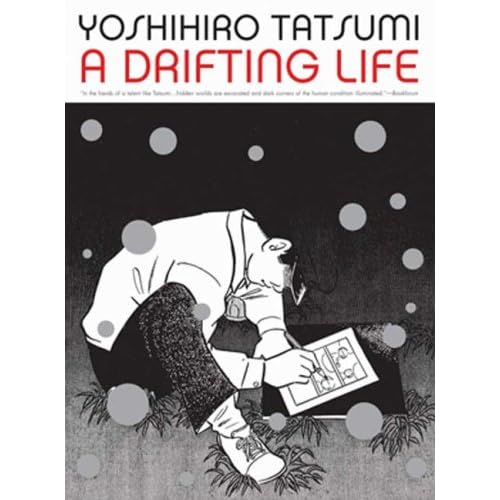
A Drifting Life

Here's how this works. I read a book or two and tell you about them and try not to get too long-winded. This time, a review of A Drifting Life (Drawn & Quarterly, 2009)


Honestly, I'm not completely certain that I was completely satisfied with this book. It's a memoir by Yoshihiro Tatsumi of his early days in Japan's fledgling comics industry in the 1950s, and it's a gargantuan read at 840 pages. If you're looking for anecdotes about life in postwar Japan, or how small publishers started finding new talent to get on board the emerging market for rental books full of short comics, then you will certainly find this a captivating read.

Personally, I found the book very frustrating for what it didn't tell. I take from clues issued by Drawn & Quarterly, and by the cartoonist Adrian Tomine, who has championed his work and acted as Tatsumi's English-language editor, that Tatsumi belongs to a school of alternative cartoonists in Japan, eschewing the fantastic series that result in worldwide fame and merchandising in favor of either crime dramas or slice-of-life stories, without continuing characters. Yet there is very little in A Drifting Life to explain Tatsumi's place in the industry, save some very nebulous attempts at explaining the differences between "manga," "gegika" and "komaga."

By the end of the narrative, we have learned of several stories that Tasumi has had published in a number of anthology books, but we never learn how these are received, whether they're considered important, or even whether they are available in English. My guess is that they aren't; Wikipedia suggests that only a few works, no earlier than 1969, are available here. (Somebody could really stand to update Tatsumi's Wikipedia page, frankly.) For that matter, I was also very curious what became of Tatsumi's fellow artists. Osamu Tezuka and Takao Saito both feature in his story, and I recognized about two other names, but who were these other creators whose work ran alongside Tatsumi's in the pages of Shadow and City and Skyscraper? What did audiences think of them at the time, and did they move on to greater celebrity in the 1960s and 1970s?

For all my frustrations and misgivings, and unhappiness with the way the book ends with many subplots unresolved, I do agree that there's much to love about A Drifting Life. The narrative at least starts out fascinating before it starts feeling obscure, and I do love Tatsumi's style, mating simplistic caricatures of his players with detailed backgrounds. I like the way he includes just enough artistic details to define a strong sense of place, but never too many for the panels to become busy and cramped. You can tell the book is a labor of love, and it is frequently quite charming, and it has certainly encouraged me to look out for D&Q's other Tatsumi releases, but I also think readers with more background in the history are going to take a little more away from it. So, recommended with reservations.

Saturday, August 1, 2009

Iriacynthe

Here's how this works. I read a book or two and tell you about them and try not to get too long-winded. This time, a review of Iriacynthe (Riperman-Drukwerk / Blue Circle, 1982)


Well, this looked interesting. My wife's half-Dutch and I like cute naked girls, and I have a woefully small collection of European comics, so I figured this story by J.C. Servais was worth a go when I found an inexpensive copy of it. Like many of these sorts of books, it's a 48-page hardcover telling a single story. Set around 1900, the Baron Alexander du Boisier has a large estate and the respect of the workers and servants, much to the dislike of his aristo mother and stepfather, who disapprove of consorting with the help. Apparently, the baron's late father, who died two years ago under mysterious circumstances, also had disagreeably 20th-Century notions about being nice to everybody as well.

The baron is out in the thick woods of his property hunting a boar when he hears the siren song of a gorgeous fairy called Iriacynthe. He's immediately driven mad with desire and becomes obsessed with finding her again. The poor baron, he might need to be committed to state care and his estate handed over to his stepfather...

I really like the way that Servais creates a complete world and tells an involved, engaging story with it in so few pages. There's not a lot of room for character development, so the plot is really the only focus. Servais's artwork is really lush. There are very few solid blacks on the page, as he chose instead to use tightly-woven linework to suggest blackness. Copious fairy nudity makes this inappropriate for younger readers, but I would recommend it if you can find a copy for $6 or so, and I am curious to see more of Servais's work in the future.

Thursday, July 30, 2009

Superman: The Dailies 1939-1942

Here's how this works. I read a book or two and tell you about them and try not to get too long-winded. This time, a review of Superman: The Dailies 1939-1942 (Sterling, 2006)


Several years ago, a publisher called Kitchen Sink produced three-volume sets of the Superman and the Batman daily comic strips from the early 1940s. Kitchen Sink sadly went out of business some years ago, but they left a warehouse full of unsold books behind. In 2006, a company called Sterling bought their stock and repackaged the old books in big, compilation hardbacks. So for $20 (and probably less; you can frequently find this book in the clearance section of large chain bookstores), you get a nearly 600-page hardback. It's quite heavy and awkward to read unless you can prop it on a table, unfortunately. (I reviewed the Batman book last year.)

If you do persevere with the possible discomfort of reading the collection, you'll probably enjoy the wild adventures of the original Man of Steel. Before they fleshed out his cast and backstory, and gave him a moral code, Superman was a gleefully violent strongman, who frequently extracted confessions from recalcitrant gangsters by flinging them a mile in the air or dunking them in a lake. It's also really fun to consider how important newspaper reporters were to their day and age, and how Lois Lane doesn't do herself any favors by arrogantly telling men with guns that they had better let her go, because she fully intends to expose their criminal schemes.

The stories themselves have aged very well, even if the artwork - credited to Joe Shuster, but more often handled by a number of ghost artists, some of whom are identified in the supplemental material - is certainly of its time. There's a very fun tale about visiting European royalty and a princess who falls for Clark Kent, and a great anti-war story in which Superman kidnaps two squabbling European dictators and orders them to settle their differences with fisticuffs in front of their troops. Best of all is a quite lengthy storyline in which the criminal underground puts a million dollar bounty on Superman's head, and several mad scientists take turns trying to kill him with a variety of bizarre weapons.

Actually, the thing I enjoyed the most about these stories was the sense of peaceful isolation from the rest of the DC superhero menagerie. In the 1940s, this comparatively low-powered Superman worked quite well as the planet's only superhuman, in stories where he was not known and not trusted by the police. Younger readers probably won't enjoy this as much - my son found them dated and dull - but older buyers might get a kick out of it, particularly with such a nice price point.

Friday, July 17, 2009

Casanova: Luxuria

Here's how this works. I read a book or two and tell you about them and try not to get too long-winded. This time, a review of Casanova: Luxuria (volume 1, Image, 2007)


I picked up this nice hardcover edition of Casanova some time back on a friend's suggestion. It compiles the first seven issues of a completely wild spy series by Matt Fraction and Gabriel Ba and after giving it a second spin recently, I'm even more sold than I was the first time around. This is an excellent, very imaginative story which wears quite a few influences on its sleeve, but is still unlike anything else I can think of.

The story follows Casanova Quinn, a debonair master thief who is also an agent of the international law enforcement organization EMPIRE, but who's also double-crossing EMPIRE on behalf of the evil Newman Zeno, director of the evil WASTE. Oh, yeah, and after an incident in a flying casino, all the pieces get shaken up when Quinn starts afresh in a parallel universe where he had been killed in action a couple of days earlier.

There are robots, bloodthirsty cannibals, double-crosses, triple-crosses, other acronym organizations, sex-droids and serious daddy issues. It is a really immersive experience, told in black and white artwork with spot color, with hardly any pauses for backstory or catchup. Well, occasionally, a caricature of one of Image Comic's editor pops in between panels to remind you where you've seen a character before, but otherwise, this is a series which assumes you're paying attention, but began several pages previously. Just the experience of reading something so dense and told so well is a pleasure.

Casanova has been on hiatus for more than a year. Fourteen issues were published between 2006-2008 before Fraction moved on to to some Marvel superhero comics. Image apparently has held off on releasing a second collection until they can tie it into the title's return. Until then, readers have just this one book available. It reprints the first seven issues, and happily does not end on a cliffhanger, along with some sketchbook material and the original, gorgeous pop art covers from the comics. Some mature themes and visuals suggest that this may not be the best choice for younger readers, but if you enjoy over-the-top espionage stories with crazy technology, then I certainly recommend you check this out. Especially if you were digging Jim Steranko Nick Fury when you were a younger reader yourself!


The Bookshelf will be on a short break but should return before the end of the month.

Wednesday, July 15, 2009

About Time 3

Here's how this works. I read a book or two and tell you about them and try not to get too long-winded. This time, a review of About Time 3 (2nd edition, Mad Norwegian Press, 2009)


Let me start by saying this: if you like Doctor Who at all, then you need to be reading the About Time series. These are incredibly dense books which look in amazing, critical detail about the production and the history of the TV series, with a firm eye on the culture in which it made.

When Lawrence Miles and Tat Wood came up with the idea for the series, I think there might have been some question as to how they'd be received. The first edition covered the Jon Pertwee years and was successful enough for subsequent volumes to be granted a considerably larger page count. With the original series completed in six volumes, Wood, now working alone, was able to return to that first Pertwee book and massively revise it to more than match the page count of the others in the series. Now a stunning three times as thick as the first edition, About Time 3 is a jawdropping doorstop of a book. If you bought the earlier one, you will want to upgrade.

The well-written essays cover everything from Welsh stereotyping in the "Green Death" serial to the controversy about when the UNIT stories were set to Torchwood's apparent inept series of failures through the 1970s. You'll learn more about the development of fictional concepts that fans take for granted, such as regeneration, as well as backstory about how the low-budget series afforded a prop as expensive as the space capsule in "The Ambassadors of Death." (Answer: they split the cost with the contemporary BBC drama Doomwatch.)

Working knowledge of the TV series is probably required before this text can be transformed from arcane academia to fascinating backstory, but if you know who Jo Grant and Sea Devils are, you're going to want to read this book. You probably won't agree with all of Wood's critiques, but it is so refreshing to read informed opinions from a writer who is willing to buck the party line and both praise overlooked moments and offer serious bludgeoning to fandom's sacred cows. It really gives me hope for the forthcoming seventh volume, looking at the current series. Since the shelves that are full of authorized commentary on the present production are all-a-smiling, and Wood routinely gives the impression that he doesn't like the BBC Wales series at all, his contrary viewpoint will make for really fascinating reading. Can we have that book next week, Mr. Wood?