Monday, August 4, 2008

Doctor Who and Hembeck

Here's how this works: I finish reading something, and I tell you about it, and I try not to bore you to death. This time, reviews of Doctor Who: Endgame (Panini, 2005) and The Nearly Complete Essential Hembeck Archives Omnibus (Image, 2008).


That eyepopping cliffhanger from the end of the last Doctor Who season evoked an earlier stunt that the comic had pulled. The time was 1997, and conventional wisdom, much as people (like me!) who enjoyed Paul McGann's Eighth Doctor would prefer it to be otherwise, was that the '96 TV movie was a franchise-killing failure. Nevertheless, when the comic took the massive, unannounced step of regenerating the hero, and giving us a new, Ninth Doctor, one "played" by actor and producer Nick Briggs, it was a big shock. There was an accompanying photo feature of our new, balding, tea-obsessed leading man in his eccentric costume with a toothbrush in his jacket pocket. Since the wheeze wasn't revealed for four months, during which the real Doctor had been busy behind the scenes disrupting the plans of the villainous Threshold, there was plenty of time for an outraged fandom to fill the letters page and the old Usenet group with angry screeds.

Those were great times, and these are great comics. Most of them are scripted by Alan Barnes, and I suppose my only quibble is that the Threshold bunch are pretty obnoxiously snide, but I guess they wouldn't be decent baddies if you weren't sneering when you read them. Martin Geraghty's pencils are inked by former 2000 AD art editor Robin Smith, and while I've never been a fan of Smith's solo work, he really pulls off some great work here as part of a team. But the nicest thing about the Eighth Doctor's comic life - as convoluted and/or expensive as the other options, it's the one that I choose to think that matters most - is that the later volumes, to be reread soon, are even better. Recommended.


This is such a huge, fun book. It's funny, but you sort of know going in that it's a 900-page monster, about as thick as two of Marvel's earlier Essentials combined, and still it's a surprise just to see the thing. And since Hembeck can fill a page with lettering better than anybody else in the industry, you will definitely get your money's worth from this book.

But what is it? Well, if you know American comic fandom, then you'll surely know Fred Hembeck, who's been lampooning and celebrating the medium for about thirty years in the pages of various fan publications and APAs, by way of mini-histories, interviews with fictional characters and recreations of classic moments from comics, all done in his inimitable style. This is an exhaustive collection of damn near everything that can be collected, in one mammoth book.

It's tremendous fun, but certainly not the sort of thing you can breeze through. When Hembeck gets on a joyous rant, with his cartoon alter ego and Dr. Strange, for instance, trading tales of Steve Ditko highlights, the page can become unbelievably dense with dialogue, with more words appearing on a single page in this book than in an entire issue of Brian Bendis's Avengers. And the reproduction is smaller than in the larger magazines where these originally appeared, so you'll want good lighting and possibly a lens to read some of this stuff!

What makes this a winner all the way through is Hembeck's genuine love and respect for the medium and its creators. There are certainly books he's enjoyed less than others, but you really get the impression reading this of a guy who wants to share his enjoyment, and toast the often unsung creators behind comics. It's very Ameri-centric, unsurprisingly, but it's far more than mainstream superheroes; everything from Little Lulu to Preacher gets some page time within these covers. That brings me to my only real complaint: it's absurd that a book this thick should be published without page numbers! It's also a sad reality that a book this thick will soon have livid cracks running up its spine, but a two-volume slipcased hardcover probably wouldn't sell as well... Well, until the day my volume falls apart, it'll have a place of pride on my shelf. You won't be able to miss it; I don't know that I have any other books this thick!

(Originally posted August 04, 2008 at hipsterdad's LJ.)

Saturday, August 2, 2008

Put One of These Books Back on the Shelf

Here's how this works: I finish reading something, and I tell you about it, and I try not to bore you to death. This time, reviews of Put the Book Back on the Shelf (Image, 2006) and Dr. Slump vol. 15 (Viz, 2008).


Well, it's very difficult to come up with a review for this. I read a good chunk of Neal's copy of the similar Tori Amos collection Comic Book Tattoo and was equally stumped as to how to convey it. It's an anthology book inspired by various songs, in this case by the often wonderful Belle & Sebastian. It is nice to get a really broad sweep of material from all across the spectrum, ranging from impossibly cute little sunshiny strips with cartoony animals ("Legal Man" by Joey Weisner) to challenging, oblique pages of expression without narrative ("Fox in the Snow" by Jacob Magraw). On the other hand, I kind of want plot in my comics, and not expression either without narrative, or with it utterly obscured by the layout and presentation.

Most of the strips, mercifully, go for the obvious and feature definable characters in their early twenties, and most of them are pretty good, but some kind of editorial control still would have been nice - a couple of these stories don't actually end, they just seem to stop when they hit their page count. Overall it is a pretty good book and never less than interesting. It's always nice to see work by the very talented Laurenn McCubbin - who also has some pages in Comic Book Tattoo, I noticed - and I'm pleased to say I enjoyed Chris Butcher's script for "Expectations," which is turned into a story of backstabbing in the teen-publishing market, a whole lot. This one was illustrated by Kalman Andrasofsky & Ramon Perez and might be my favorite art in the book. I'd love to see more of Andrzsofsky's work, which is, I think, the most important thing about reading a book like this. It's one thing to go in saying, "oooh, Laurenn McCubbin, I loved her stuff in Rent Girl," but you should also leave finding another creator of whom you want to see more. Recommended for older readers, especially if you like Belle & Sebastian.

On the other hand...


What is this shit?

I considered continuing for many, many more paragraphs than that, but nobody ever read the rest of Greil Marcus's review of Self Portrait; the opening sentence said it all. But to explain briefly why I react in this way, let me continue.

Don't get me wrong; regular readers know that I'm a huge fan of Akira Toriyama's Dr. Slump, and think every home, especially the ones with elementary school-aged kids, should have the first 14 volumes on the shelf. But suddenly there's this cute baby called Turbo who can do anything in the cast. Every panel feels like the work of a creator who just does not care anymore - he was clearly burning out his contracted time getting ready for Dragon Ball at this stage. I did not laugh once.

And this baby? The producers of The Simpsons might have thought that, in "Itchy & Scratchy & Poochie," they were creating the ultimate parody of an obnoxious cute sidekick added to a show and ruining it instantly, but they had no idea that Toriyama had already done it, and a hundred times worse, and he wasn't parodying anything. Volumes 1-14 are recommended. Stop there. There's a sixteenth coming out in a couple of months. You probably won't want that, either.

(Originally posted August 02, 2008 at hipsterdad's LJ.)

Wednesday, July 23, 2008

Hideous Beasts Edition with Judge Death and Hot Stuff

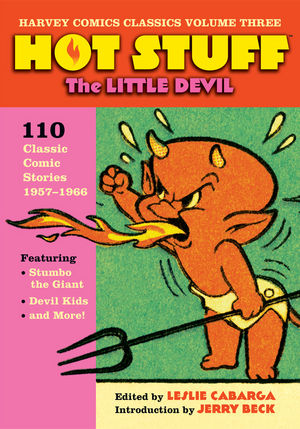
Here's how this works: I finish reading something, and I tell you about it, and I try not to bore you to death. This time, reviews of Judge Death: Boyhood of a Superfiend (Rebellion, 2008) and Harvey Comics Classics: Hot Stuff (Dark Horse, 2008).

Each of these books should be praised for one thing: they look fantastic and are reproduced well. They are each fine additions to any bookshelf. The Judge Death book has the nice matte cover and glossy paper that fans of the Rebellion line have come to expect, while the Hot Stuff book is astonishingly good value for money. Taking a leaf from the Essentials/Showcase playbook, this is about 400 pages of comics, but - and here's an important distinction from the big Marvel/DC books - with a mix of color and monochrome, and reproduced on wonderful paper with introductions and background material.


"Boyhood of a Superfiend" was one of the inaugural series in the Judge Dredd Megazine and it is set after the events of the "Necropolis" epic. In it, Death, licking his wounds, hides out as a lodger with a nearly-blind pensioner and tells his life's story to a journalist. Taken on its own, there isn't anything wrong with the story at all - it's full of grisly, black humor and the artwork by Pete Doherty is very good indeed - but it all seems completely superfluous. Indeed, giving Death all the page time he was getting in the early 90s was detrimental to the character and robbed him of his impact. To be honest, as amusing as this story is, I'm not sure it is a story that ever needed to be told. There's a bonus strip by Si Spencer and John McRea included, but the publisher really missed a trick by not adding "Tea With Mrs. Gunderson," an eight-page story by John Wagner and Dean Ormston that served as an epilogue to this adventure. Recommended for completists.


I normally defer to our friends at Mr. Kitty in all things Harvey, and last year they gave the Hipster Daughter the big bookshelf edition of Richie Rich that Dark Horse compiled. While I haven't read it all yet, I was impressed enough with the package to give Hot Stuff a try. Honestly, I'd never read any Hot Stuff before. I know of the character, but I never, ever saw these comics as a kid.

And you know... I don't think I was missing much. It's always difficult to tell whether you're being too critical in judging material for kids when you're not approaching it from that mindset - clearly your old pal the Hipster Dad is kinder to certain Sid & Marty Krofft shows than they objectively deserve, because he loved them as a child - but this is a downright repetitive, boring book. One main problem is that, unlike Richie Rich or Little Dot and the others, Hot Stuff doesn't have a consistent universe and regular characters to bounce off. He's interacting with medieval villagers in one episode and 1950s stage magicians in the next, then Neptune, then monkeys on some island. And he melts all the snow on top of a mountain forty times and his trident gets snatched thirty times and a volcano erupts twenty times... it's like a lifeless early 60s Hanna-Barbera TV cartoon. The only recurring-ish character in the first chunk is Stumbo the Giant, and he's the most boring character I've ever seen, although there are apparently some "Devil Kids" to be encountered in pages to come.

That said, the Hipster Daughter thinks it's a riot, and I think her opinion trumps mine. About the best I can say is that it's interesting to consider how Hot Stuff is the spiritual ancestor of both Calvin and Bart Simpson, but she'll tell you it's funny and that's all that matters. So if you've got elementary school-age kids, it comes with her seal of approval. Recommended for under-tens; I'll wait for the forthcoming Harvey Girls collection.

(Originally posted July 23, 2008 at hipsterdad's LJ.)
Sunday, July 20, 2008

Green Lantern and Kurosagi Corpse Delivery Service

Here's how this works: I finish reading something, and I tell you about it, and I try not to bore you to death. This time, reviews of Showcase Presents Green Lantern vol. 3 (DC, 2008) and Kurosagi Corpse Delivery Service vol. 6 (Dark Horse, 2008).


Amusingly, this bunch of mid-60s Green Lantern adventures sees the book picking up an influence from the Batman TV series. There's a greater emphasis on real-world fisticuffs and recurring villains and a new job for Hal Jordan driving around the Pacific Northwest as an insurance investigator, not to mention two episodes that reference a popular TV series that everybody watches. One is a Green Lantern action series and one is about a criminal called the Dazzler who escapes each week to fight again another day. However, reflecting the naive innocence of the New Yorkers producing these comics, plot points in each hinge on the incredibly unlikely notion that these programs are transmitted live, which was pretty unlikely in 1966! The biggest selling point is that you get some of the earliest examples of Gil Kane inking himself, and damn, those pages look good. Recommended for readers who enjoy the Showcase Batman books.


Admittedly, it's part of the horror genre's rules that the plot is more important than the hapless people to whom the plot actually happens, but I've been chugging along with this series, enjoying the heck out of how morbid and surprising it can get, but I could not tell you the name of any one of the protagonists. On character kind of dominates the storylines, but there's a sense of anonymity and dullness about the five protagonists that occasionally grates. I can't give it an unqualified thumbs-up on that note alone, but this volume is actually more entertaining than the others, because after four of the usual 30-page episodes (it apparently appears first in a monthly, rather than weekly, anthology), the setting shifts back to the early 1900s for a completely bizarre and grisly adventure starring an amateur detective called Kunio Matsuoka. Hang the tales from the present day, I wanna see more of this guy!

(Originally posted July 20, 2008 at hipsterdad's LJ.)

Wednesday, July 16, 2008

Dare and Doonesbury

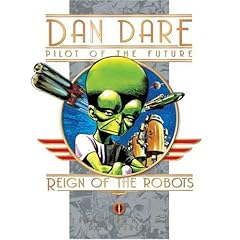
Here's how this works: I finish reading something, and I tell you about it, and I try not to bore you to death. This time, reviews of Dan Dare: Reign of the Robots (Titan, 2008) and Doonesbury: The War Years (Gramercy, 2006).


The previous Dan Dare serial, also available from Titan (and reviewed by me in brief here) had ended with a spectacular twist: Dan and company, having saved the day in a remote galaxy, would be returning to Earth a decade after they left. Then they return to find that the old home was conquered by the Mekon's robot army nine years ago, the entire population enslaved in his immortal enemy's concentration camps, providing fodder for bizarre scientific experiments. Since this is a 1950s kids' serial, little space is devoted to the horrific premise, but the only time this really felt to me like something truly dated and eye-rolling comes in the follow-up serial, also collected here, called "The Ship That Lived." Having liberated Venus and Earth in a rollercoaster thrill ride of unexpected, weird plot developments and derring-do, Dan's first priority is not to oversee the great redevelopment and economic recovery that must come, but to... well, extract his old spaceship from a bog. It takes weeks. It's mostly wonderful, but I can't call this a real priority.


For much of the last decade, Doonesbury has been compiled in 150-page editions which aren't complete. You can always tell, because they lay them out with a week of dailies over two pages, but slowly the storyline starts to creep because a strip gets left out. And there are no dates for you to confirm when they originally appeared either, making it a real chore to go look up the missing ones on the web site. Doonesbury's remarkably poor track record in collected form is one of my biggest bugbears about the comic hobby, which is why I feel quite strongly that it should be reprinted properly, and soon.

But, lacking any progress on that front, we make do with the books we've got. The War Years is an omnibus reprint of the earlier collections Peace Out, Dawg! (which I bought) and Got War? (which I should've), in hardcover for about the original price of either of the originals. So this covers most of the material from 2001-2003, tracking the deterioration of G.W. Bush from beleagured all-hat-no-cattleman into wannabe imperial. Duke gets some great storylines playing fast and loose with double-crossing Enron execs (was Jim Andrews "born" for that role or what?) and their wives, and setting himself up for a reconstruction role in Iraq that leads to him working the black market. Zonker wages war against David Geffen and Boopsie coaches B.D.'s football team, and it's genuinely great stuff. Which I'd swap in a heartbeat for a complete edition with some annotations. Sorry, I know I harp.

(Originally posted July 16, 2008 at hipsterdad's LJ.)

Sunday, July 13, 2008

1940s Batman and 1990s Takahashi

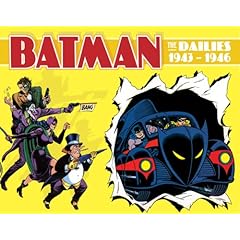
Here's how this works: I finish reading something, and I tell you about it, and I try not to bore you to death. This time, reviews of Batman: The Dailies 1943-1946 (Sterling, 2007) and Rumic Theatre (Viz, 1996).


Boy, a little of this goes a long way. In the early 1990s, the now-defunct publisher Kitchen Sink teamed up with DC to reprint the entirety of the wartime Batman newspaper strip. The three books, poorly designed to my eye, with only two strips per page, sold badly and more than fifteen years later, Sterling cobbled up the innards, not even modifying the page numbers, and put them all in one mammoth, heavy hardback that'd bludgeon a runaway hoodlum, apparently with an eye on the remainders table at larger chain bookstores. If you can stand the discomfort of reading the 600-page thing, there's some good stuff. Batman in the 1940s had a lot more in common with Dick Tracy than the modern super-ninja, and our hero routinely comes out on the wrong side of a fistfight with thugs. He gets knocked cold by a thrown can of tomatoes at one point! Only one of these sixteen serials features a name supervillain - the Joker - the rest are pretty colorless villains with pretty colorful criminal schemes. The strips are supplanted with an amazingly exhaustive series of essays and interviews, meticulously researched and not a little dry, but more like the sort of supplements I'd prefer to see more publishers attempt. I reviewed Sterling's companion volume of Sunday strips in the spring (See here.) and can't help but feel that's the better volume, but I'm perhaps biased against this awkward, heavy book which, redesigned to display three or four strips a page would have been a lot thinner and manageable. Recommended with reservations; look for low-cost options first.


Now Rumiko Takahashi is of course well known for her long-running serial stories, but it looks like every few months she creates a one-off thirty-odd page story which appears in one of those weekly Japanese anthologies in addition to, or in lieu of, an episode of Ranma ½ or InuYasha. These are typically light romances, occasionally with some supernatural or magical element. I'm not certain how these were originally compiled in Japan, but this is a mid-90s Viz effort which packages six of these stories in that awful old neither-fish-nor-fowl $16 format that Viz used to use before giving in and going with low-priced digests like they do today. It's long out of print, but you shouldn't have much trouble tracking down a copy - Amazon has links to sellers letting it go quite cheap - and you certainly should, because each of these are charming and clever and, if we're honest, a whole lot better than InuYasha.

(Originally posted July 13, 2008 at hipsterdad's LJ.)

Friday, July 11, 2008

Ditko, Flint and Kirby

Here's how this works: I finish reading something, and I tell you about it, and I try not to bore you to death. This time, reviews of Essential Doctor Strange Vol. 1 (Marvel, 2004), Judge Dredd: The Henry Flint Collection (Rebellion, 2008) and Kirby: King of Comics (Abrams, 2008).


I picked this up at the Great Escape in Louisville in the spring for nine bucks, and I have to say, if there's a more mistitled book in the whole "essential" library, I haven't seen it yet. Doctor Strange originally appeared as eight-ten page episodes in Marvel's anthology book Strange Tales, and after a hesitant start over the first three or four shaky installments, Stan Lee and Steve Ditko created something genuinely weird and compelling. The visuals are just amazing, and there's a sense of a universe so wild and unrestrained that you're willing to overlook the conventions of 1960s comics, like the talky, cod-Shakespearian dialogue. Nobody says "'tis" as much as Dr. Strange. But there's a great cast, highwire ideas and clever plotting, culminating in a lengthy serial where Strange's two chief villains team up to destroy him. It's genuinely great stuff.

And then, after about 300 pages, Ditko leaves. And while Bill Everett, Roy Thomas and others try their best, what follows is not even remotely essential. I gave up on it, frankly. I'd be much happier with a simple "Complete Ditko" edition of this comic on better paper, because that's the Essential Dr. Strange, not all this extraneous mess. By the hoary hosts of Hoggoth, make it so, Marvel!


This is the third of Rebellion's artist-centered Judge Dredd collections. (The others spotlight Cam Kennedy and Carlos Ezquerra.) This one presents about a dozen episodes of varying length by one of Dredd's best modern artists, and I can't find a nit to pick with it. It includes the hilarious "Turkey Shoot" and the fantastic "Flood's Thirteen," which starts as a parody of those Clooney-Pitt heist films before falling apart in a spectacular disaster of teleporters, stolen identities and lobotomised terrorists. Highly recommended!


The short version: Boy, this is good, but I'm unsatisfied, knowing that there is much more out there.

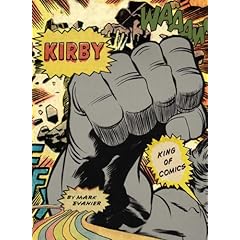
Mark Evanier's Kirby: King of Comics is a gorgeous coffee-table biography of one of the medium's great thinkers and talents. Don't let the appalling cover dissuade you; the interior is as flawlessly designed as you could hope for, and features hundreds of wonderful illustrations of Kirby's work on creations ranging from Captain America to the bulk of 1960s Marvel - pretty much everybody you've heard of other than the handful that Ditko designed. The writing is incisive and paints a real, complete portrait of Kirby, but many of the details that appeal to me as a reader and completist are, due to space limitations, glossed over.

I would love to learn much more than this book provides, and happily, Evanier is in the early stages of a more comprehensive bio. This is a more than adequate placeholder until then, and will surely satisfy most readers, or new fans who'd like to have their eyes pop out at the sight of some of these original sketches, cosmic layouts behind the bizarre visage of Galactus, collages, caricatures and ephemera. Recommended on the understanding that something more essential will one day supplant it.

(Originally published July 10, 2008 at hipsterdad's LJ.)