Saturday, July 5, 2008

Buffy and Popeye

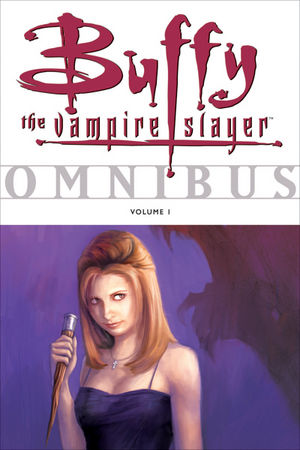
Here's how this works: I finish reading something, and I tell you about it, and I try not to bore you to death. Today: reviews of Buffy the Vampire Slayer Omnibus Volume One (Dark Horse, 2007) and Popeye Volume One (Fantagraphics, 2006).


I felt like giving this a try, since the Hipster Kids and I have been watching the first season of this series. Dark Horse has been publishing Buffy tie-in and spin-off comics from a number of creative teams for around a decade. This compiles more than 300 pages of comics, not in publication order, but in chronological order, setting the stage for the characters before the first episode of the show. It's pretty uneven. The bulk of the book is scripted by Scott Lobdell and Fabian Nicieza, with excellent art by Cliff Richards and Will Conrad, and it's not at all bad, but you have to wade through a mess to get there. A story about Spike and Druscilla set in 1933 doesn't truly evoke either character, but "The Origin," ostensibly a more faithful adaptation of Joss Whedon's original film screenplay than the movie that emerged from it, is a garbled, seventy-page disaster of sloppy, amateurish storytelling, illustrated by someone who was unclear just what Sarah Michelle Gellar looks like. I might pick up additional volumes of this Omnibus series - it's a great package, also done for several other licensed Dark Horse properties like Aliens and Indiana Jones - but the discount will have to be pretty steep. Not really recommended, but Whedon's more devoted fans might overlook the clumsy pacing and narrative more easily than me.


This is about one thousand times better than I thought it was. We're all familiar with the Popeye cartoons of the 1930s, but those seem to have next to nothing to do with the bizarre, engaging, absolutely wonderful newspaper strip that spawned them. Thimble Theatre had been running for about a decade before some of its heroes met this unedermekated, unstoppable brute of a sailor, who rewarded them by taking over their strip. The strip comprises lengthy adventures full of bizarre science and evil spiricks, incredible wit and gorgeous linework by the great E.C. Segar. I laughed myself stupid several times. There's a bit early on where Castor Oyl and Ham Salad get rid of Olive by sending her to purchase "a dime's worth of longitude," and I must say that the silent punch-line panel for that strip is just about the funniest thing I've ever seen drawn. Then Segar runs with that gag for three priceless days. What a great strip.

Best of all though is Popeye himself, a force of nature who just routinely beats the hell out of anybody for any slight. I can't even begin to describe what a revelation this is. They sanitised the heck out of this character when he started appearing in motion picktyers. I wish he could have gone ten rounds with Everett True back in the day; that would have been something.

My only complaint is a small one: in reproducing these so close to print size to get the full effect of the Sunday pages, Fantagraphics created something that's awfully difficult to handle or to shelve. If the strip wasn't so triumphantly fun, I'd question continuing with these ungainly volumes, but my son is reading the second one and we're looking forward to the third later this year, and I'll shelve 'em as long as Fantagraphics prints 'em! Highly recommended!

(Originally posted July 05, 2008 at hipsterdad's LJ.)

Friday, July 4, 2008

Constantine, Blaise and Rao

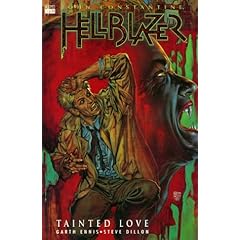
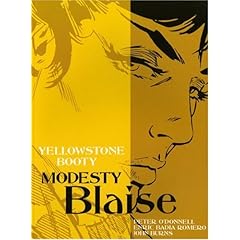
Here's how this works: I finish reading something, and I tell you about it, and I try not to bore you to death. Today: reviews of Hellblazer: Tainted Love (DC/Vertigo, 1998), Modesty Blaise: Yellowstone Booty (Titan, 2008) and Sand Land (Viz, 2004).


In many of DC's contemporary collected editions, a little work on the part of some editors is sorely missed. This one, assembled before their line got so slapdash, is reader-friendly to the point of including an introduction, explaining recent events in the life of John Constantine, the powerful English mystic and con man, who, in these six stories by Garth Ennis and Steve Dillon, has hit rock bottom after his girlfriend Kit has left him. Constantine is easy prey for the vampires and demons who've got a grudge when he's homeless and drunk. I'm not sure that this is in any way a good introduction to the character - for Ennis-written Hellblazer, you want Dangerous Habits or Damnation's Flame, I think - but it feels like some effort and love went into this volume. The story about Kit going home to her sister in Northern Ireland is a truly beautiful piece of writing, glowing with a love of family and community. Recommended for mature readers familiar with the character.


Now I'm certain that all of you reading this have taken my advice and started reading Modesty Blaise, right? Good. Well, since there's very little continuity in the series, you can probably give this one a miss until later on. Oh, it isn't bad, don't get me wrong, but the second story, in which Peter O'Donnell gives a little too much credence to the "mystic powers of the martial arts" malarkey, brings an otherwise thrilling story of an old enemy springing a trap in Cambodia to such a damp climax that you can't help but feel a little cheated. Anyway, this reprints another 14 months of the strip, from 1978-79 and gives you the last two stories illustrated by Enric Romero before he took a hiatus to draw Axa, and the first one handled by John Burns, better known for his work painting Judge Dredd and Nikolai Dante. If you like Burns's painted art, you will really like his linework, which I find even more agreeable. Recommended for readers pretty familiar with the character.


Very, very fun stuff! Akira Toriyama is best known around the Hipster Pad for Dr. Slump, but he's best known everywhere else for Dragon Ball, a strip so phenomenally successful in Japan that it elevated Toriyama to the very rare position of being able to do whatever the heck he wants in comics and not have to sign long-term contracts to keep producing stuff every week in order to also sell the things his heart's really in. So from what I gather, he sold Shonen Jump the concept as a 14-week, fast-paced serial with a definite beginning and end. While I'm certain the magazine would prefer a 14-year Toriyama strip which they could then turn into a huge line of books, they ran the series in the summer of 2000. It's about a retired general in an arid wasteland ruled by a fat, corrupt king who asks a pair of wisecracking demons to help him find a fabled water source. The three of them steal a tank and make their way south while the military and some bizarre criminals try to stop them.

You can tell there's the background here for something that could have run a lot longer, but Toriyama resisted the opportunity for the long-winded "power-up" fights that made Dragon Ball so agonizing, and just kept to the meat of his story. It's lean, fast-paced and very funny, with goofball characters and unexpected comic twists, suggesting what Dragon Ball might have been had the pressure and the money not been so great as to keep him and his studio working on it so long past its sell-by date.

Wikipedia suggests that Sand Land has been the last comic project for Toriyama in some time, and the only one of his short post-Dragon Ball series to be collected in English, though I'm optimistic we'll see the mid-90s Dr. Slump Returns, But Only for a Little While after Viz finishes that series' original run. I understand he's wealthy enough to not have to draw comics anymore, but damn, he's too talented to stay retired, don't you think? Recommended!

(Originally posted July 04, 2008 at hipsterdad's LJ.)
Wednesday, July 2, 2008

A Contract With God and Ranma ½

Here's how this works: I finish reading something, and I tell you about it, and I try not to bore you to death. Today: reviews of A Contract With God (Baronet, 1978) and Ranma ½ vol. 1(Viz, 2003).


It isn't the first graphic novel, nor is it really even a novel - it's a collection of four short stories. I don't know nearly enough about the late, great Will Eisner, but figured I should know more, so I hinted that something from him would make a good Father's Day present. It made a great Father's Day present. Set in and around tenement housing in the Bronx in the 1930s, these are remarkably well-told stories of struggle and unfairness. The first story's certainly the best, concerning an immigrant's plan to become important enough to force the Lord into a new contract after he feels that He broke their initial one. It's a very different and very moving experience, and recommended for older readers.


With teeth clenched, I opened the first of three dozen editions of Ranma ½, a series that Rumiko Takahashi drew for Shonen Sunday weekly from 1987-96. I remember thinking this was kind of cute for about a month in high school, and after that, its astronomical popularity among people younger and louder, so very much louder than me, made it an unwelcome prospect. But as readers of this blog know, I've spent the last couple of years finding there's a hell of a lot more to like about Ms. Takahashi than I ever knew, and so, twenty years later, I gave this another try...

And I really liked it. This was funny as hell, a completely goofy, straight-faced take on pretentious martial arts melodrama, stuck in a high school with a cast of about ten of what will surely grow to about a hundred nutball characters. I don't know that I like it enough to get on board for all three dozen editions, but I can certainly see myself picking up a few more of these when the sales are good. There's some innocuous nudity included for comedy, and if you can handle that without freaking out, then it's recommended for all readers.

(Originally posted July 02, 2008 at hipsterdad's LJ.)

Tuesday, June 17, 2008

Solar Wind and Pogo

Here's how this works: I finish reading something, and I tell you about it, and I try not to bore you to death. Today: reviews of The Bumper Book of Solar Wind vol. 2 (Omnivistascope/Lulu, 2008) and Phi Beta Pogo (Fireside/Simon & Schuster, 1989).


I told you about the first collection of Solar Wind last month, and happily the second bumper book is almost as good as the first one. If you're just breezing through, however, this is a small press tribute to old British newspaper comics, with work from a who's who of the scene's regulars - Paul Scott, Al Ewing, Leigh Shepherd, PJ Holden, Mike Molcher, even old pro Gordon Rennie gets his licks in with a delightful story called El-Alamein Anderson.

So the second book starts with the final three issues of Solar Wind. The first one is another fake merger issue, this time with Sporto: The Comic About Sports, and it's fantastic. Unfortunately, it leads with by far the best strip, the riotous Murderdrome by Ewing and Simon Penter - "the only way to score a goal is with the severed head of an opposing player!" - and the other, wonderful strips just can't keep up with those four pages.

The last two Solar Winds admittedly see a malaise creeping in. Issue 7's celebration of the photo strips that the 1980s Eagle popularized is cute for a time, but it does feel a little long-winded, and the final issue has gags a-plenty, but doesn't seem sure where it should end. Next up is Big War Comic, which skewers Battle Picture Weekly, Warlord, Commando and just nails everything in 32 delicious parody-filled pages, ending with Lord Charley's War by Wyatt and Chris Askham (the team behind the brilliant Zoe Biddle, Wheelchair Ballerina), which, mercifully, Pat Mills was said to have a sense of humor about.

Then there's the two issues of Sunny for Girls, with more ballerinas, and horses, and spunky young public schoolgirls, and the time-travelling Enid Foulbroom, Puritan Hunter by Paul Glasswell and PJ Holden. This is great stuff - when are we seeing those "Best of Misty" volumes, Titan?! At any rate, despite some evident overwork and exasperation on the part of Paul Scott in assembling these contributor-packed tomes, there are still buckets of fantastic gags, and, as I mentioned before, they're very highly recommended, especially at less than eleven bucks! So click the link and get your copy from Lulu!

Read more about the Omnivistascope small press world, from which Solar Wind emerged, at their web site!


Fantagraphics has the rights to Walt Kelly's Pogo and has been promising new editions, but apparent problems in securing complete, best-quality images of the earliest strips has meant they've held off on soliciting the new series, and so people who'd like to read old Pogo have to make do with old, scattershot editions.

Case in point: this is a very odd little collection I found a couple of months ago at the Great Escape in Louisville. It was apparently assembled by the people behind the fanzine Okeefenokee Star, and its principal draw is a complete set of 1953 Pogo dailies. There's some great stuff here, and I laughed out loud several times watching our heroes dealing with interloping ne'er-do-wells like Simple J. Malarkey and Mole MacCarony inflicting the insanity of the outside world on them. Whether involving themselves in schemes to sell dirt - you can't get good results from cleaning powder without dirt, after all - or starting colleges with faculty and sports teams but no students, each storyline is absolutely wonderful, full of puns, wordplay and an enormous cast of engaging, lovable characters. And while Sarcophagus MacAbre isn't exactly lovable, he has the best name ever.

But more than the '53 strips, this includes a massive pile of supplemental material, including an essay by Bill Watterson and interviews about Kelly with his peers Milt Canniff and Ward Kimball. There's a brief look into the three years of Pogo strips produced after Kelly's death, and a festival held down in Waycross. I don't know that the presentation of all this background material is really essential, but it's enlightening, and it will certainly make do until Fantagraphics gets around to the period in their volumes.

This book's long out of print, but I found a copy for cover price at Mile High Comics. Click the link in the cover image and give it a shot!

(Originally posted June 17, 2008 at hipsterdad's LJ.)

Friday, June 13, 2008

Swingin' Sixties Edition, with Tezuka and Kirby

Here's how this works: I finish reading something, and I tell you about it, and I try not to bore you to death. This time, reviews of Dororo (Vertical, 2008) and Essential Thor volume 2 (Marvel, 2005).


Dororo was first published over twelve months in the pages of Shonen Sunday from 1967-68. The strip didn't reach a proper concluding episode by the time its creator, Osamu Tezuka, wrapped up his one-year commitment and went off to do other things, but it inspired a successful cartoon adaptation and was recently made into a live-action film. Vertical released the first English edition of the comic in April.

I can't give this quite the emphatic recommendation that I had hoped to. That's not to say this wonderful story by Tezuka is at all bad; it concerns a swordsman named Hyakkimaru and his associate, a young little thief calling himself Dororo, who travel through a strange, timelost medieval Japan on a quest to slay 48 demons. Because of a deal made by his evil father, Hyakkimaru was born a misshapen, helpless thing without a face, organs or limbs, kept alive by magic and willpower, and given prosthetics by the kindly doctor who raised him. The death of each demon restores one of the body parts he was born without. It's an odd mix of allegory and adventure fiction.

For the most part, I enjoyed the book tremendously, and was pleased to see another mad appearance of the "face tumors" that the great Tezuka would also use in an installment of Black Jack, although played a little differently here.

Unfortunately though, the translator's periodic use of modern slang and phrases which weren't in use when this serial was first published forty years ago really takes the reader out of the story. I think this is fantastic and can't wait for more collections - there are apparently just two more to come, completing the original serial - but I also can't help but believe that this was just one edit away from being truly perfect. It also makes me worry whether Vertical's translation of Black Jack will be accurate.


This, on the other hand, this I can recommend completely.

As a kid, I didn't have much interest in the late 70s Thor. It felt old-fashioned and wordy. Now, adult reasoning tells us that proper Lee and Kirby Thor from the 60s must be good stuff, because, you know, it's Stan Lee and Jack Kirby but their Thor comic is perhaps overshadowed by the period's other, more merchandised material, and it was rarely reprinted. So I'd never actually seen the real stuff before now. I was advised to start with the second collection, as it took a dozen or so issues for the team to find their feet. But if what's in the first book is even half as good as what's in the second, I'll concede that this is even better than the duo's Fantastic Four at its peak.

Holy anna, I can't tell you how fun this book was. It is a complete blast from cover to cover, one great big serial of wildly over-the-top mayhem. There's one sequence where some armed robbers burst in to a restaurant where Hercules is trying to eat, and he beats the hell out of most of them, chases the others outside, and incapacitates their getaway car by hurling a street lamp at the tires and separating the car's undercarriage from the rest of it.

Best of all is Thor himself, who's certainly old-fashioned and wordy, but man, nobody trash-talks like this guy. Even when Odin the All-Father gets annoyed at him for some familial slight and saps half his strength, he still tells his opponents in no uncertain terms just how unbelievable a beatdown they're about to suffer, and then delivers.

The artwork is uniformly amazing from cover to cover. It's certainly true that Kirby's work would have been better served with Joe Sinnott or Dick Ayers on inks than Vince Colletta, but I was never taken out of the reading experience because of sloppy linework or shortcuts. Whether it's the grandeur of Asgard or the deck of some spaceship in the "Black Galaxy," there's always something completely amazing to catch your attention, and surprises galore. I was familiar with Ego, the Living Planet from the 1980s Official Handbook of the Marvel Universe, but its first appearance is still completely eye-popping.

Neatly, each issue of Thor teamed a 16-page lead story set in the contemporary Marvel Universe with an ongoing 5-page serial called Tales of Asgard, in which Thor and his warrior pals have an earlier set of adventures. It's in these that we meet this enormous, overweight braggart called Volstagg. I remember as a kid thinking this guy was the stupidest thing in comics, but in Lee and Kirby's hands, he's actually completely hilarious.

There are currently three Essential collections of Thor - 500-ish pages for $17 - with a fourth on the way next year which should, if I understand it, wrap up the Lee and Kirby days. I've got book three on order at my local comic shop, and so should you. The best superhero book of the sixties? Quite possibly!

(Originally posted June 13, 2008 at hipsterdad's LJ.)

Friday, June 6, 2008

Scarlet Traces and Mandroid

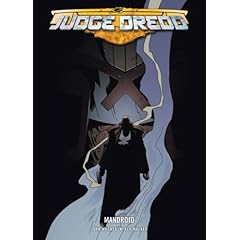
Here's how this works: I finish reading something, and I tell you about it, and I try not to bore you to death. This time, reviews of Scarlet Traces (Dark Horse, 2001) and Judge Dredd: Mandroid (Rebellion, 2008).


A very cool murder mystery, set a decade after the Martian invasion of War of the Worlds, in an England which has reverse-engineered the alien war machines into a technological great leap forward. It's written with panache and style by Ian Edginton, who creates some very memorable characters and an unlikely detective duo to investigate missing women who have come to London in search of employment. The art's by the great D'Israeli, currently illustrating The Vort in 2000 AD. This might have been their first collaboration, and it's been followed by several other memorable ones.

You know how adventure stories usually climax with the hero held captive at the heart of the villain's technological superconstruction and waits until just the right moment to escape and start the self-destruct or something? That's not what happens here. Highly recommended!


Make no mistake, "Mandroid" is one of the Dredd team's great recent achievements, two 12-part serials detailing the sad events around a desperate man, a former soldier, who can't find any peace in Mega-City One, a world that's even tougher and less compromising than himself. It features one of John Wagner's most poetic and evocative scripts to bring this police procedural to life, and it's beautifully illustrated, with Kevin Walker tackling the first serial, and Simon Coleby and Carl Critchlow working on the second.

That said, "Mandroid" is almost unremittingly bleak, and genuinely rough going in places. I certainly think this downbeat change of pace will thrill any readers familiar with the typical Dredd tropes, but it's possibly not a very good recommendation for first-timers.

(Originally posted June 06, 2008 at hipsterdad's LJ.)

Tuesday, June 3, 2008

Stars and S.T.R.I.P.E. and Hopey and Ray and Frogmouth and...

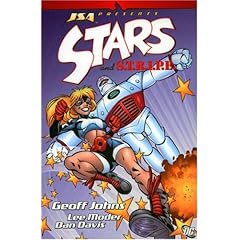
Here's how this works: I finish reading something, and I tell you about it, and I try not to bore you to death. Today: reviews of Stars and S.T.R.I.P.E. Volume One (DC, 2007) and The Education of Hopey Glass (Fantagraphics, 2008).


I could, I suppose, be a lot meaner about this than I will be. I picked up the original run of this series in part because I thought it looked cute, and I figured, correctly, that one day my daughter would like it. I gave her the issues in 2005, and traded up to this collected edition of the first eight episodes earlier this year. She's read them at least twice and enjoys the characters.

The series follows Courtney Whitmore, a teen who relocates with her family from Beverly Hills to the midwest, and learns that her new stepfather is the former sidekick of an old superhero called the Star-Spangled Kid. He's now planning to fight crime again in a big robot suit, and so she claims the Kid's old cosmic-powered belt to take charge of things.

It never rises above "okay," but the only sour notes I came across were the usual superhero comic tropes. It's not enough to simply explain that the original Kid was killed in action by the monster Solomon Grundy; everything has to stop for a two-page flashback. Geoff Johns is really just following convention here, as this is the same way Roy Thomas or Steve Englehart would have done it thirty years ago. What I really found grating was Johns' rush to pile on both superhero and real-teen complications in far too short a time. The eight issues feel like they take place over the course of about one school week, and frankly, I'm more likely to believe in robot suits and cosmic-powered belts than I am the family finding an orthodonist who'll fit Courtney with braces on her second day in a new town.

So the stories themselves are all right, but what actually grates the most is the collected edition's failure to make sense of things to new readers. DC Comics, sadly, are rarely published in a vacuum and there are frequently references to incidents and events in their wider universe that fans reading them when originally published would recognize. This is not true seven or eight years later. One issue here features our heroes rushing off to fight some monsters, a storyline which I think might have been continued in a crossover series called Day of Judgement, but there's nothing here to explain what the heck just went on. Both DC and Marvel desperately need to hire editors for their collected editions to provide footnotes and annotations for readers like my daughter, and me, and the overwhelming majority of potential buyers to explain references like this. At any rate, my daughter's enjoyment suggests that this is a good buy for younger readers. Fans of Buffy the Vampire Slayer might get a kick out of it as well.


The latest collection of Jaime Hernandez's Love & Rockets material shifts the focus away from Maggie and to her longtime friend Hopey, her current roommate Angel, and her ex, the brooding Ray. She shows up in the periphery of several of the stories here, showing how the others relate to her. Ray still isn't over Maggie after all these years, even while he's pursuing the wild, foolish Vivian the Frogmouth.

Most of these stories were originally published alongside the other, Maggie-centered tales which were compiled in the earlier Ghosts of Hoppers collection. I wonder whether they wouldn't have made a better read under one cover, and rearranged slightly. It's very good work, but the wandering focus through supporting characters means that this naturally lacks the emotional punch that some of Hernandez's other work in this world has. Recommended in tandem with Ghosts, but not for new readers.

(Originally posted June 03, 2008 at hipsterdad's LJ.)