Showing posts with label sherlock holmes. Show all posts

Tuesday, March 3, 2015

The Fifth Heart

What I try to do with reviews at this Bookshelf blog is keep it simple and spoiler-free, and let you know whether I'd recommend you pick up a copy of what I just read. Seems to work okay. This time, a brief review of The Fifth Heart (Little, Brown and Company, 2015).


I'm such a dingbat that I don't know the difference between Stephen Dobyns and Dan Simmons. Seriously. I enjoyed the former's Church of Dead Girls, which came with a glowing quote from Stephen King, many years ago, and when I saw the gigantic uncorrected proof of this month's Fifth Heart, also sporting a glowing quote from Stephen King, I thought it was the same guy. I got the initials right, anyway. Just... reversed.

ANYWAY, The Fifth Heart is actually written by Dan Simmons, the fellow who has carved out a niche with great big historical fiction, mixing densely-researched reality with just a little bit of twinkling implausibility. His best-known novels, Drood and The Terror, showcase his talent for creepy and disturbing mysteries, letting just the traces, the shadows, of dark modern fantasy loose on the nineteenth century.

I was interested in this novel because I do love a good Sherlock Holmes pastiche. This one's set in 1893, and features Holmes and at least the third iteration of his-son-by-Irene that I've come across. Sadly, it's not Auguste Lupa / Nero Wolfe, but Super Assassin Son o' Holmes. That's okay, I'm always up for something new. Part of me feels that I might be spoiling a revelation by introducing this, because the information is revealed in two separate chunks, but on the other hand, this novel joins a very full collection of Holmes pastiches to introduce a son to the story. By this time, the real surprise would be introducing a son of Irene Adler whom Holmes did not father. (You know, like Marko Vukčić. *grin* )

But I'm also up for something a little tighter than this. The Fifth Heart swells with bloat, badly needing an editor to crack to the core of things. It's set over the course of several weeks, starting in Paris and moving to DC and finally Chicago more than a month later, as Lucan Adler plots the assassination of President Cleveland, and Holmes, allied with the writer Henry James, investigates the years-old death of James' old friend Clover Adams, whose widower Henry Adams is at the center of the political turmoil.

It's not possible for me to read any writer's take on Holmes without hearing Jeremy Brett exclaim "Patience! All will be revealed!" And, to be sure, lots of writers have had lots of fun leaving Holmes three steps ahead of his associates in the story while they seethe, furiously, waiting for some explanations. If you enjoy this take on the character, then what Holmes puts poor Henry James through in this book is certain to entertain you. Simmons lets us see Holmes orchestrate a beatdown of a local drug gang, arrange an early meeting of what will evolve into the contemporary Secret Service, and take a lengthy side trip to one of Samuel Clemens's homes to have a look at a particular typewriter. It is amusing watching Simmons throw the investigation and drama into all these side streets - one of them involving chimney sweeps! - and wonder how in the world he's going to tie it all together. Then Henry James gets his own investigation going, wondering what's up with Holmes's enemy Moriarty, giving him yet another thing to juggle.

Honestly, there's a good story here, and possibly a very good one, but as with a few other writers' takes on Holmes at his most inscrutable - Laurie King's The Game comes to mind - I really did feel a bit too much for the unfortunate sidekick. No protagonist has ever deserved a bloody nose and a demand for answers quite as much as this Holmes does. In part, that's because the narrative really does get too bloated. The visit with Clemens goes on for pages and pages of cigars on the veranda and nostalgic reflection and thoughts on the subject of whether Holmes is actually a fictional character (and, if so, what that would mean for everybody else), and a good thirty more pages could have been chopped out by making Henry Adams not so damn stubborn and simply agreeing to the demands of the plot.

Going back to Nero Wolfe, you'll recall that in almost all of his tales, writer Rex Stout would have Wolfe remind everybody that things would go along much quicker if he could proceed without interruption, and, in the most wearying of them, probably Please Pass the Guilt, every blasted member of the supporting cast insists upon interrupting him, almost as though they're padding out the story until we hit an arbitrary page number? A lot of The Fifth Heart feels like that. The plot is already complex and nuanced; it would have been an easier and less frustrating read with fewer roadblocks and detours in the way. Simmons does not appear to be a snappy writer - much of his success appears to come from the feeling of complete immersion into the past - but I finished the book badly wishing for a snappier story. A mild recommendation with that in mind, wishing that I would have enjoyed it more, but I also finished this curious to read Drood sometime soon, so it was perhaps more successful than I first thought.

A copy of this book was provided by the publisher for the purpose of review. If you'd like to see your books (typically comics or detective fiction) featured here, send me an email.

Monday, August 12, 2013

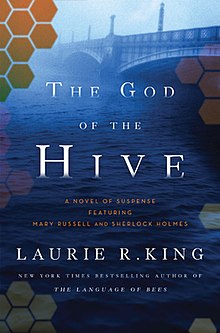
The God of the Hive

What I try to do with reviews at this Bookshelf blog is keep it simple and spoiler-free, and let you know whether I'd recommend you pick up a copy of what I just read. Seems to work okay. This time, a brief review of The God of the Hive (Bantam, 2010).


It's really not fair to be disappointed by a story because it doesn't fit into your preconceived fan notions and your narrative. The story is the author's narrative, not yours. Yours are only wishes. The author is under no obligation to grant them.

Back in the second of Laurie R. King's novels of Mary Russell and Sherlock Holmes, there is a fleeting reference to Holmes having a son, Damian. The matter is shoved under the rug. Now, among some Holmes fans - by no means a majority or a consensus - there's a belief that during the "missing years" after Reichenbach Falls, Holmes looked up Irene Adler and spent some time with her and they had a son. Among some of that subset of fans - by no means a majority or a consensus - there's a belief that Adler raised their son on her own, and that boy grew up to be Nero Wolfe. That is the greatest fan theory of them all. I love it to pieces.

Sadly, King belongs to the first camp but not the second. And I felt so certain that she was One Of Us. It was a writer named William S. Baring-Gould who concocted the "son of Sherlock" theory in 1962. King had already included this man's real-life grandfather, the Reverend Sabine Baring-Gould, as a character in the fourth of her series of novels, The Moor, and revealed that the reverend was Holmes' godfather. So it's not like she could have been unaware of this theory. She just had another direction for the son of Sherlock.

Before continuing, I should point out that one writer has, using a pseudonym for the still-copyrighted Wolfe, written two novels set during World War One in which Holmes and his son, "Auguste Lupa," work together. The writer is John Lescroart, and I enjoyed those books so darn much that I started reading his subsequent, much longer series of contemporary legal thrillers featuring a revolving series of featured protagonists. A lawyer named Dismas Hardy takes the lead role in most of these books, and I enjoy that universe so darn much that I'm forever in Baring-Gould's debt for coming up with the theory, because I'd probably never have made my way, via Lupa, to the wonderful world of Hardy, Abe Glitsky and Gina Roake without it.

And I should point out how selfishly disappointed I was in Robert Goldsborough's recent Archie Meets Nero Wolfe, a book which is solid and entertaining and doesn't do a darn thing wrong except miss out on the spectacular opportunity to introduce a Wolfe who had not established his routine yet. I really wanted to see a man on the cusp of becoming that set-in-stone icon, still putting his ready-for-caricature rules together.

So when Damian Adler showed up at Holmes and Russell's door at the beginning of 2009's Language of Bees, a book that I read in late June, I punched the air with excitement because - surely! - we were about to meet the proto-Wolfe. We don't. There's just no way that Damian could possibly be the same man.

The Language of Bees and 2010's God of the Hive are so closely joined that they might as well have had "part one" and "part two" inscribed on them. It's one very long epic, set over the course of several weeks that sees Damian swallowing his pride and asking his father for help in finding his missing wife. In short order, he also goes missing and his wife's body is discovered, and the police want a word or two with him, and with Holmes and Russell about what they know. The powerful cult leader at the center of things - sort of a pastiche of Alistair Crowley - looks set to be one of Holmes' greatest adversaries, particularly when "part one" ends in a remote corner of Scotland, with Holmes and the grievously wounded Damian looking for discreet medical attention, while Russell, trying to get Damian's small daughter - good heavens, our 24 year-old heroine is a step-grandmother! - back to London, realizes that their enemy was not killed as they believed, and is still alive...

God of the Hive then twists things even more deliciously, as it's revealed that the cult leader is himself a patsy for an even more powerful villain, a master manipulator who removes even the mighty Mycroft Holmes from the state of play. King then pulls a twist about Mycroft that's so remarkable that I broke apart completely, abandoning every rule that I hold dear, and thumbed through the back twenty pages of the book because - surely not! - I just could not believe her moxie in doing that. I'm not going to tell you what "that" is, but it's sort of like asking whether Molly Ivins can say that (can she?) after she'd already said it.. Nope, there it is. She did it. (Well, that would be telling.)

The whole book's a headspinner, with new characters dropped into the narrative like small atomic bombs, their loyalty questionable and their motives uncertain. The most bewildering is this lord of misrule type, who's a mad mix between Robin Goodfellow and Lord Sebastian Flyte, and how trustworthy this guy is, even after finishing the book, I can't say. What I can share is that even though parts of the story had me biting my lip in unhappiness over the direction things were going, I was completely and thoroughly unable to guess what would possibly be happening next, and who would be safe. This is the tenth book in the series. For any series to go on so long and still be so completely unpredictable is a really good thing indeed.

Now if somebody, somewhere, would kindly write me some dense, novel-length fanfic set in 1924 involving Russell, Holmes, and a son who's a decade away from becoming Nero Wolfe when he moves to Manhattan, and which is one-tenth as engaging and as weird as this, I'll pay decent money. Not a lot, but decent. I wish that I had the talent to write it myself.

Heh. If I did, I'd have to use pseudonyms for Wolfe and for Russell. Laws!

Monday, April 29, 2013

The Final Solution

What I try to do with reviews at this Bookshelf blog is keep it simple and spoiler-free, and let you know whether I'd recommend you pick up a copy of what I just read. Seems to work okay. This time, a brief review of The Final Solution (Harper, 2004).


Of course, we all know that Sherlock Holmes did not have a particularly long career. We are told that he retired early, to Sussex, and spent the many remaining days of a long life raising bees. Those decades have of course provided many writers with inspiration for many stories and pastiches, just as the missing years between Reichenbach Falls and "The Empty House" have done. I'm a great fan, for example, of Laurie R. King's stories, most of which are set between 1915 and the late 1920s, and recently began rereading those.

I honestly had no idea, when I began reading Michael Chabon at roughly the same time I began picking and choosing a few revisionist Holmes tales, that Chabon had written one as well. So I was exceptionally delighted to stumble into this oddball novella about an 89 year-old beekeeper - the old man is never named - who crosses paths with a mute nine year-old German boy in 1944. The boy's parrot is constantly repeating long series of numbers, leading some in the community to wonder whether these are not critical codes being chirped along, or perhaps the location to hidden Nazi treasure.

Soon, the parrot goes missing, and a local man is jailed for murder, and the local police ask the old man whether he can assist with their inquiries. With the game afoot once more, albeit moving somewhat more slowly than the man moved earlier in his life, the trail takes him back to the great city where he once worked, with several clues to follow, and hidden meanings to deduce.

A book this short - just 130 pages and hardly dense with text - is difficult to stay with long enough to embrace. However, I can't imagine anybody reading it and not finding it a completely charming little distraction. It is a clever and very well-crafted tribute to Arthur Conan Doyle, with a small, realistic, and interesting cast of characters, not least of whom is the parrot. Chabon's typically thick scene-setting and description is mostly tabled here in favor of quicker and lighter character sketches, which is what the light little plot needs. It's an absolutely perfect aperitif before diving into something like one of Carole Nelson Douglas's dense epics, and comes recommended with a smile.

Monday, April 8, 2013

All-Consuming Fire

What I try to do with reviews at this Bookshelf blog is keep it simple and spoiler-free, and let you know whether I'd recommend you pick up a copy of what I just read. Seems to work okay. This time, a brief review of All-Consuming Fire (Virgin, 1994).


Since I've been reading or rereading some revisionist Sherlock Holmes stories, it's only natural that I'd want to dust off what I remembered as one of my favorite Doctor Who stories from Virgin's seven-year line of novels. Andy Lane's All-Consuming Fire sees the Doctor teaming up with Holmes and Watson, or, rather, the "real" people whose adventures were published under the pseudonyms of Sherlock Holmes and John Watson. This concept is a recurring one in revisionist Holmes literature, and one that honestly doesn't stand up to very much scrutiny. However, this concept was nevertheless gleefully embraced by Who fandom, which is why some of us old-timers are a little aggravated with one aspect of the last couple of years of the TV series. We've lately been informed that the fictional Sherlock Holmes was actually based on Madame Vastra, a heavily veiled lizard woman who assisted police with their inquiries. I actually kind of liked Madame Vastra just fine until that insistence*. It messed with a perfectly good novel that had a much, much more sensible take on how the Doctor could team up with Holmes.

Well, I say "perfectly good," but it's actually very flawed in one respect: one of the Doctor's companions is utterly unlikeable. Having been away from the New Adventures series for so long, I had forgotten how unpleasant and downright awful Ace had become. The writers had played a pretty neat trick with the character, who had been depicted in the last two years of the TV series as an Earth girl in her late teens. After nine books, she left the Doctor in the far distant future, only to call for his help and rejoin the Time Lord three books, and three years, later. In the meantime, she'd joined the army (space marines, actually) and become much more jaded and surly. The writers of the books greatly enjoyed playing with the characters of the manipulative Doctor, his broken friend Ace, and the third part of the triangle, a fantastic and fun archaeologist named Bernice, who's one of Doctor Who's all-time best companions. The interplay between the three is almost always engaging and fascinating.

But Andy Lane, writer of this novel, makes the awful mistake of putting Ace and Watson together. This does not do Ace any favors, and it took me completely out of the story.

Lane does an incredible job capturing the feel of Holmes, and much of this book should be praised as one of the very best of all the countless Holmes pastiches. It is structured as a Holmes story into which the Doctor keeps interfering, rather than the other way around as Who readers might expect, and Lane nails the tropes and the characterization. He also proves that he's also very familiar with the tropes of the pastiches that have preceded him. So Lane becomes the latest in a long line of writers to speculate about a certain giant rat of Sumatra and the inner workings of the Diogenes Club - naturally, the third Doctor is a member, despite really being a much more clubbable sort of chap than their usual roster - and he follows William S. Baring-Gould's theories and provides Sherlock and Mycroft with an older brother. In fact, it's such an entertaining Holmes story that the more it blazes off into science fiction, the less I enjoyed it. It's not even simplistic alien invasion stuff, but body horrors and Lovecraftian old gods and sickening metamorphoses, not the sort of sci-fi that I like to read in the first place, and it feels like the whole novel, and not just members of the supporting cast, loses humanity as the book itself transforms from proper Victoriana into something hideous and modern.

Nowhere does this transformation hit home harder than in the Watson-Ace dynamic. I think that Lane made a bad miscalculation here. Watson is one of fiction's most beloved characters. To love Holmes fiction, even the stories written from alternative points of view or set, like Laurie King's often wonderful novels, after the conclusion of their partnership, is to love John Watson, for all his bad luck, quiet dignity, and loyalty. Now, I understand that he's the guest star and Ace is one of the heroes of the show, but to have Ace constantly belittle Watson and yell at him just drives home how horrible she's become. (And what a poor host, to be so disrespectful to a famous guest!) I've read all the New Adventures, some of them many times, and I thought that I was used to "New Ace" and all her unhappy, brittle points, but either I had forgotten how shrill she is in the years since I last read one of these books, or Lane drove her to extreme behavior in this one, or I've become much, much more of fan of Watson without realizing it. Ace doesn't enter the narrative for 200 of the book's 300 pages, meaning I spent a hundred pages waiting for her to get a comeuppance for being so nasty to Watson. If this is the modern world, give me Baker Street.

I know that I had read All-Consuming Fire at least twice before, and I enjoyed the London-set material so much that, during this reread, it was like reacquainting myself with a beloved old friend. I found myself very surprised to have so much more of the book left to read once the disturbingly alien elements appeared, suggesting that I've always found the events on the planet Ry'leh to be disappointing by comparison; I'd remembered the book as having much more happening in England and in India than in space. Maybe that's just the book that I would rather remember, because what happens in space isn't happy and is downright nasty to Holmes and Watson, and what happens on our planet is a blast and very respectful to those characters, firmly one of the best of all the pastiches until things get dark. Recommended for Holmes fans with very strong reservations.

*A second aggravation is that I'm very pleased that Vastra and Jenny are happy together, and, were they residing on contemporary Earth, I'd wish them a long and happy legal marriage. Since they're in 1880-something, however, I think that their public claims of a happy marriage are just this side of completely idiotic. And she's not Holmes, either. The fellow in this book [and the following year's Happy Endings] is Holmes, and Vastra is a Silurian in a veil. Steven Moffat really has done a thorough job in letting us all down.

Monday, March 11, 2013

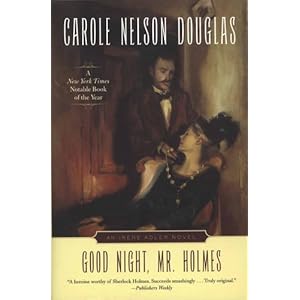
Good Night, Mister Holmes

What I try to do with reviews at this Bookshelf blog is keep it simple and spoiler-free, and let you know whether I'd recommend you pick up a copy of what I just read. Seems to work okay. This time, a brief review of Good Night, Mister Holmes (Tor, 1990).


I decided to sample a few other alternate Holmes novels while I am between series rereads, and Carole Nelson Douglas's run of eight books, published between 1990 and 2004, that feature Irene Adler as the protagonist, sounded promising. The first one is astonishingly busy, but it ends quite satisfactorily and has me looking forward to the others in the line.

The book covers the first several years of Penelope "Nell" Huxleigh's association with Adler, a rising star of the opera and a trusted, discreet agent who the rich, the powerful, and the literary-minded can call upon for delicate investigations. Adler and Huxleigh are shown to join forces at the same time that Holmes and Watson meet in A Study in Scarlet, and their adventures progress over a period of a few years, climaxing with the famous events from the classic Scandal in Bohemia, here shown from Adler's perspective.

The slow, deliberate pace of the book, along with the way it covers several years, took a little getting used to, but I enjoyed the whole, sprawling epic. It takes in cameos by the likes of Oscar Wilde, office politics in a barrister's chambers, cross-dressing, and a thrilling escape by train across Europe, setting the stage for one of the most well-remembered encounters of Sherlock Holmes' career. It left me looking forward to what Douglas had planned for her characters next. Recommended.

Monday, March 4, 2013

The House of Silk

What I try to do with reviews at this Bookshelf blog is keep it simple and spoiler-free, and let you know whether I'd recommend you pick up a copy of what I just read. Seems to work okay. This time, a brief review of The House of Silk (Orion, 2011).


I am a sucker for Sherlock Holmes stories. I am incredibly happy to try anybody's fiction set in 221B Baker Street and give it a few hours. Anthony Horowitz, best known as a writer of British TV drama - notably the series Foyle's War and Midsomer Murders - obtained Arthur Conan Doyle's estate's authorization and approval to write this novel. He didn't need it, of course, as the character is in the public domain, but it lends the story a whisper of authenticity.

Holmes fanfic typically begins with a cute series of explanations as to why this story has had to be suppressed until now. This time out, Watson did not even write the events down until quite late in his life, after Holmes had passed away, and provided explicit instructions that they were not to be published for decades. Of course. That's all part of The Game.

Anyway, Watson recounts an occasion where Holmes' use of his Baker Street Irregulars gets one of the kids killed. It's a much more convoluted and involved story than any that Doyle had ever penned, taking in ruined paintings in America, criminal gangs, mysterious and malicious strangers, and an orphanage for wayward boys before reaching one of the lowest points of Holmes' career: his arrest for murder under the influence of narcotics.

One little quirk that I have about reading detective fiction is that I do not try to speculate ahead, and yet sometimes there's no getting around it. I don't want to figure things out before the protagonists do, but I suspect that the great secret at the heart of The House of Silk will be readily apparent to jaded 21st-century eyes, even if the prim and correct Dr. Watson would never imagine such horrors. As such, I found myself impatient with the narrative, urging it to move on. Horowitz does a good job capturing Holmes, Watson, Lestrade, and Mycroft, and his construction is solid, but it would take a Victorian to be very surprised by what's going on in this book. Recommended with reservations.

Tuesday, December 22, 2009

Sherlock Holmes: The Missing Years

Here's how this works. I read a book or two and tell you about them and try not to get too long-winded, and maybe you'd like to think about reading them as well. This time, a review of Sherlock Holmes: The Missing Years (Bloomsbury, 2000).


Here is a book that I wish I could say that I enjoyed more than I did. Jamyang Norbu is a Tibetan-rights activist who has lived in exile for decades. I found this promising Holmes pastiche, published in England and America under this title and more recently available under its original name, The Mandala of Sherlock Holmes, misfiled at a local library and suspected my wife might enjoy it. We both quite liked Laurie King's The Game, and I'm a big fan of William S. Baring-Gould's speculation about what Sherlock was up to during his years underground following the incident at Reichenbach Falls.

Fellow Baring-Gould fans will be disappointed to read that Norbu doesn't allow Holmes to linger in Europe, and there's no mention at all of Irene Adler, because Norbu ships him off immediately for India with a packed itinerary in the company of Rudyard Kipling's fat Bengali spy Huree Chunder Mookerjee. Doyle was pretty clear that Holmes did spend some time in the region and perform some assistance with politically sensitive matters around the Forbidden City in Tibet, and I can certainly see how this would appeal to Norbu's own interests, but it truly is a shame that he elected to fill in practically every possible blank and account for darn near every minute of Holmes' time between "The Final Problem" and "The Empty House."

As far as stories go, taken on its own it's still a bit dry for my liking. It's interesting to see Holmes cut off completely from his resources and unable to use his name as a calling card, but I never felt that Norbu really captured his voice. This Holmes is too friendly, too cordial, too willing to relate his past triumphs, and not at all the same man who, in King's novels, really wished that Doyle fellow had kept his mouth shut. If you have read The Game, then I can recommend this as a curious counterpoint, but otherwise it was an unsatisfying distraction.

Wednesday, November 4, 2009

The Game

Here's how this works. I read a book or two and tell you about them and try not to get too long-winded, and maybe you'd like to think about reading them as well. This time, a review of The Game (Bantam, 2004).


Credit where it's due: with The Game, her seventh novel of Mary Russell and Sherlock Holmes, Laurie King succeeded in keeping me worried out of my skull that something really unpleasant was right around the corner for our heroes. The villain of the piece proves to be dangerously demented, and a combination of insanity and infinite resources really looks like it's enough to finally beat the invunerable Holmes.

Getting to the meat of this one takes a little patience, however. I was unsatisfied with O Jerusalem, even as reading the sixth novel, Justice Hall, proved why it was necessary for King to fill in the characters' backstory in that longwinded fashion, because of what felt like research overwhelming the narrative. It seemed like each nuance of the foreign culture, and every minute of the arduous travel, had to be detailed in minutiae. Here, as 1924 dawns and Russell and Holmes travel to India to search for the missing Kimball O'Hara (you'll remember him if you've read your Kipling), King again seems more interested in immersing readers in the culture than getting on with the story. I concede that she's playing by the rules; Holmes' powers as a master of disguise and an undercover operator rely on his ability to completely immerse himself into his new identities, after all, but it can become a little wearying.

It's probably more snobbery on my part than any fault of the fiction. It was always amusing when Doyle had Holmes vanish for weeks on end, only to turn up and startle Dr. Watson with his reappearance somehow. Something about the hoops that Mary has to jump through can't help but bother me. Sure, I suppose being uprooted and forced to learn foreign languages and etiquette at a moment's notice comes as part and parcel of being married to the world's greatest detective, and Mary knew exactly what she was getting into some years previously, and Holmes would never have allowed himself to fall in love with anybody not capable of doing the job.

Still, with one hair-raising adventure after another, and three novels spanning three continents, set across a period of less than five months, I understand Mary's exhaustion and sympathize wholeheartedly with her when she says that the next time her wretched brother-in-law needs some job doing, they should decline and relax for a year or two. Unfortunately, there's enough of a hint dropped towards the end that I'm pretty sure the summer of 1924 will see our heroes in Savannah, of all places, looking for a mysterious woman who was on the steamer to Aden with them. Poor Mary!

Thursday, September 24, 2009

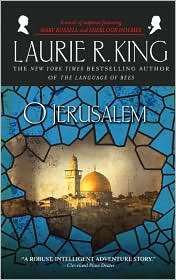
O Jerusalem

Here's how this works. I read a book or two and tell you about them and try not to get too long-winded, and maybe you'd like to think about reading them as well. This time, a review of O Jerusalem (Bantam, 1999).


This one was a bit of a challenge. After four novels in her series of revisionist Sherlock Holmes stories, Laurie King elected to use the fifth to plug an old plot hole in the first, throwing off and disappointing any reader who was hoping to see the characters grow and progress. Back in that first novel (reviewed here), Holmes and his protege Mary Russell are forced to flee England after their unseen foe proves, with a bomb attack, that she's one step ahead of them. The narrative then skips forward, noting that it was many months before they could return, and that Mycroft Holmes had found a job for them in British-occupied Palestine, among other travels.

So O Jerusalem is the story of that job, and it's a real slog to get through. I can understand why King wished to come back to it. The fourth book in her series, The Moor, vividly brings the location to life, so that it is as much a character in the story as any human, and King's lingering discussion of topography and history is as entrancing as the most satisfying backstory and character development. She clearly had developed the talent, over the course of her nineties work, to attempt the same here, with endless, detailed focus on the desert sands, the cities they visit, and the difficulties in Russell adapting to the Holy Land's culture.

Yet it doesn't work for me, not at all. You may chalk this up to personal disinterest in the region or my deficiencies as a prose reader if you like, but to be honest, the "leaving the country" material in The Beekeeper's Apprentice was easily the only skippable section of that novel for me, and in the short space of a few months between reading Apprentice and this, I had entirely forgotten that Holmes and Russell had left England at all. As a character piece, hiding Mary Russell under shoe polish and spectacles and posing as a quiet and unassuming man lost its luster almost instantly, and as an adventure story, the hundred-odd pages of running in circles, our heroes "tested" by their minders in the Holy Land before being trusted to meet the local spymaster who needs them to uncover and foil an assassination scheme, are agonizing. After a day's reading, I realized that I still had no idea what the plot of this novel was, and became frustrated and bored as King lingered on one set piece after another, looking for any kind of narrative thread to link them.

All of this compounds the basic problem going into the book in the first place. In each of the previous four novels in the series, King was able to surprise and blindside me with a new development of the characters and their relationship, and these "reveals," the understanding that what will come next, are part of the thrill of reading the stories in the first place. That's a testament to King's skill at making believable, engaging characters and more than just another dry Holmes pastiche. But we already know going in what will come next for Holmes and Russell going in to O Jerusalem: they'll go back to England and finish that more interesting adventure. Even to somebody who's begun this series, I can't recommend this book at all. I've certainly no interest in trying it again.

Monday, August 24, 2009

A Letter of Mary

Here's how this works. I read a book or two and tell you about them and try not to get too long-winded. This time, a review of A Letter of Mary (St. Martin's, 1997).


In the third novel in her series of Mary Russell and Sherlock Holmes novels, Laurie R. King sees the couple's home ransacked and vandalized shortly after they take possession of a first-century papyrus which may be a letter from Mary Magdalene confirming what Christian doctrine has denied: that she was one of Christ's disciples. This happens while they are in London to identify the body of the scholar who left them the document for safekeeping. It looks like somebody wants this damning evidence silenced.

I find it strange, the way King captures the voices of other people's characters, and projects them to her audience, better than the ones that she created herself. By her third novel, she's got an amazing rhythm down for Sherlock Holmes, and writes him as well or better than any other writer of pastiches such as this. Mycroft, too, is as comfortable to read as it is watching Charles Grey put in a guest appearance in the 1980-90s Granada TV series. In fact, my interest in her revisionist novels was sparked by learning that Lord Peter Wimsey would be putting in a small cameo at some point. He's in this book for about five pages and he's so absolutely perfect that I can't help but wish that it was King who had received the job of completing Dorothy Sayers' unfinished Thrones, Dominations manuscript.

But Mary Russell herself I still have problems with. I can't visualize the character, much as I am trying. Sherlock Holmes's wife is a woman in her late forties trapped in the body of a 23 year-old. She never reads as being completely genuine to me, and is very much a product of the modern age, and not a character who could conceivably have been created in the 1920s. Further, the plot itself is very much of its time. Though it predates The Da Vinci Code by six years, it's still tapping into a very modern notion of the Church suppressing potentially ruinous old documents. Well, Irving Wallace's The Word, a book forgotten by everybody but me (and I only know it because David Janssen was in the TV adaptation), possibly started the zeitgiest back in 1972, but you still can't imagine a book with a mindset anything like this actually being written in the twenties.

That said, the book, while sometimes difficult for me to embrace because of the pecuilarities of the main character, is still a pleasant read. It's a story full of red herrings and misdirections, where avenues of investigation led me to expect an absolutely certain conclusion, and yet I was pleased and tickled to learn how very wrong I was. I wouldn't call this a great book, but it was certainly an entertaining one, and the three mornings I devoted to it were certainly well-spent. I shall have to tackle the fourth in the series next month.

Friday, May 22, 2009

The Beekeeper's Apprentice

Here's how this works. I read a book or two and tell you about them and try not to get too long-winded. This time, a review of The Beekeeper's Apprentice (St. Martin's Press, 1994).


There's just never enough time, is there? I've been curious about Laurie R. King's stories of Sherlock Holmes' later life and his time as mentor to the young detective Mary Russell in the 1920s for simply ages, and I only this month cleared enough stuff from the reading pile to tackle the first of King's eight novels in the series. The Beekeeper's Apprentice has fifteen year-old Mary Russell run across the retired Holmes in Sussex. Holmes has retained the services of his old housekeeper, and she encourages the headstrong, incredibly intelligent Mary to visit again. Over time, Holmes takes Mary under his wing as his apprentice, and they work a couple of small local cases where she proves her abilities.

It's only after Mary goes to college that the stakes are raised considerably. When the daughter of an American politician is abducted, the parents insist that Holmes be called from retirement to track down the criminals, and Mary leaves the dormitory to join him on the trail. But their success finds them a new and dangerous enemy, who has been waiting for many years to make a move against Holmes...

Honestly, I enjoyed this even more than I thought I might. Sherlock Holmes pastiches are a dime a dozen (three years back, I discussed William Baring-Gould, pretty much the patron saint of fanfic), but I thought this was done with a light touch and an honest commitment to keeping true to Doyle's character while presenting him from another angle. The story is told as though Mary, much later in life, has taken up Dr. Watson's old job as Holmes's biographer and has written her own memoirs for later publication.

Russell tells us more about her own life and experiences than Watson ever did, and it is very fun to read about her days in college in 1918. With twinkling references both to the original canon (fifteen year-old Mary asking what will happen in the next installment of the then-serialized Valley of Fear) and fan speculation (Irene Adler, although not that giant rat), it's clear that Laurie King has done a great deal of research to make her novel appealing to either beginning readers or veterans. I had a great time reading it, and I look forward to starting her second novel later this summer.