Monday, May 24, 2010

Friday, May 21, 2010
Obliviously On He Sails and A Heckuva Job
Here's how this works. I read a book or two and tell you about them and try not to get too long-winded, and maybe you'd like to think about reading them as well. This time, a review of Obliviously On He Sails and A Heckuva Job (Random House, 2004 and 2006).

I've raved about Calvin Trillin in these pages before, but what readers of this blog might not know is that his writing, compiled in the omnibus Tummy Trilogy, inspired me to start a food blog with my wife. It's much more interesting than this silly old book review blog. You should bookmark it and tell all your friends.
I'd like more people to know about Trillin. He's much more than just a great food writer, he's one of the most consistently entertaining humorists of the last several decades. When I was last on St. Simons Island, I picked up two of his books of political verse, in which he skewers everything in and around the 2000 and 2004 elections with incredible insight and very playful wit. The pieces range from silly couplets to longer poems set to Gershwin tunes. Obliviously On He Sails (with marks not quite as good as Quayle's) looks at the first election, and A Heckuva Job the second. A third book, Deciding the Next Decider, was released in 2008.
Of course, the really delightful thing about reading these has doing a little research to learn that Trillin has appeared on The Daily Show a few times, giving me something new and fun to watch. I'm very happy with these collections, and love the way that Trillin can bounce around topics so playfully and so honestly. At one point, speculating on the possible existence of a terrorist called "Kahlid the Droll," he supposes that Richard Reid's failed shoe-bombing attempt was one colossal practical joke intended simply to force Americans to shuffle around airports with their shoes off. At the same time, he successfully predicted the 2009 underwear bomber, proving his hypothesis. Highly recommended.
I've raved about Calvin Trillin in these pages before, but what readers of this blog might not know is that his writing, compiled in the omnibus Tummy Trilogy, inspired me to start a food blog with my wife. It's much more interesting than this silly old book review blog. You should bookmark it and tell all your friends.
I'd like more people to know about Trillin. He's much more than just a great food writer, he's one of the most consistently entertaining humorists of the last several decades. When I was last on St. Simons Island, I picked up two of his books of political verse, in which he skewers everything in and around the 2000 and 2004 elections with incredible insight and very playful wit. The pieces range from silly couplets to longer poems set to Gershwin tunes. Obliviously On He Sails (with marks not quite as good as Quayle's) looks at the first election, and A Heckuva Job the second. A third book, Deciding the Next Decider, was released in 2008.
Of course, the really delightful thing about reading these has doing a little research to learn that Trillin has appeared on The Daily Show a few times, giving me something new and fun to watch. I'm very happy with these collections, and love the way that Trillin can bounce around topics so playfully and so honestly. At one point, speculating on the possible existence of a terrorist called "Kahlid the Droll," he supposes that Richard Reid's failed shoe-bombing attempt was one colossal practical joke intended simply to force Americans to shuffle around airports with their shoes off. At the same time, he successfully predicted the 2009 underwear bomber, proving his hypothesis. Highly recommended.
Wednesday, May 19, 2010
Requiem: Vampire Knight Volume Two
What I try to do with reviews at this Bookshelf blog is keep it simple and spoiler-free, and let you know whether I'd recommend you pick up a copy of what I just read. Seems to work okay. This time, a brief review of Requiem: Vampire Knight Volume Two (Heavy Metal, 2010)

Heavy Metal has released the second in their series of dirt-cheap, frill-free collections of Requiem: Vampire Knight for the American market. This completely insane series, created by Pat Mills and Oliver Ledroit for a French publisher, Nickel, is one of the most gleefully demented and brain-bludgeoningly bizarre series I've ever read, completely entertaining from start to finish, and very poorly served by the slapdash way that Heavy Metal has chosen to package it.
Requiem is the story of Heinrich and Rebecca, lovers who betrayed each other in World War Two and have met again in Hell for a second chance. Unfortunately, he's now a vampire and she's now a ghoul and Hell is a planet where time runs backwards and pirate queens in flying ships wage war on cybernetic werewolves and soldiers in Dracula's army carry weapons that fire bolts and go "TEPESS!" when they're used. About every fifth page, a new plate gets spun and somehow Mills makes this colossal, unwieldy and thunderously odd series work. The whole story is a great exercise in making readers say "You have got to be kidding" aloud as often as possible.
Requiem is published in France as an annual 48-page story, with nine of the planned dozen issues out so far. Heavy Metal has collected the first six in two volumes, the second of which came out earlier this year. These books were designed to get the job done as cheaply as possible. There are no wasted pages among the 144 between the covers; copyright information is on the inside front and everything else is comic. You're telling me they couldn't afford a single extra signature? Anything to space this out, give some creator credits, background information, even just basic front- and endpapers? It's not like anybody's ever going to mistake Requiem for high art, but that doesn't mean that Heavy Metal needs to release it in a package so amateurish and sloppy. Recommended for older readers despite itself, basically.
Heavy Metal has released the second in their series of dirt-cheap, frill-free collections of Requiem: Vampire Knight for the American market. This completely insane series, created by Pat Mills and Oliver Ledroit for a French publisher, Nickel, is one of the most gleefully demented and brain-bludgeoningly bizarre series I've ever read, completely entertaining from start to finish, and very poorly served by the slapdash way that Heavy Metal has chosen to package it.
Requiem is the story of Heinrich and Rebecca, lovers who betrayed each other in World War Two and have met again in Hell for a second chance. Unfortunately, he's now a vampire and she's now a ghoul and Hell is a planet where time runs backwards and pirate queens in flying ships wage war on cybernetic werewolves and soldiers in Dracula's army carry weapons that fire bolts and go "TEPESS!" when they're used. About every fifth page, a new plate gets spun and somehow Mills makes this colossal, unwieldy and thunderously odd series work. The whole story is a great exercise in making readers say "You have got to be kidding" aloud as often as possible.
Requiem is published in France as an annual 48-page story, with nine of the planned dozen issues out so far. Heavy Metal has collected the first six in two volumes, the second of which came out earlier this year. These books were designed to get the job done as cheaply as possible. There are no wasted pages among the 144 between the covers; copyright information is on the inside front and everything else is comic. You're telling me they couldn't afford a single extra signature? Anything to space this out, give some creator credits, background information, even just basic front- and endpapers? It's not like anybody's ever going to mistake Requiem for high art, but that doesn't mean that Heavy Metal needs to release it in a package so amateurish and sloppy. Recommended for older readers despite itself, basically.
Monday, May 17, 2010
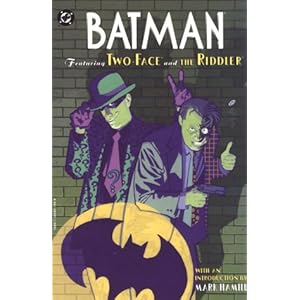
Batman Featuring Two-Face and the Riddler
What I try to do with reviews at this Bookshelf blog is keep it simple and spoiler-free, and let you know whether I'd recommend you pick up a copy of what I just read. Seems to work okay. This time, a brief review of Batman Featuring Two-Face and the Riddler (DC, 1995)
Here's an interesting case where not only is the book I've read just all over the map, my thoughts on it are equally scattered. This might just add up to an even more incoherent than usual entry.
Naturally, DC Comics would like to cash in on the film versions of their comic books, and so when Batman Forever was released in 1995, somebody compiled this incredibly slapdash 192-page book which collects some of the many stories that featured the film's two bad guys. Each villain gets the spotlight in three tales, and they share space with the Penguin in an interesting additional story called "Original Sins."
"Original Sins" is by far the most interesting thing in the book. It was initially published in the 1989 Secret Origins special edition and was co-written by Neil Gaiman, Alan Grant and Mark Verheiden. Gaiman contributed the frame story about a documentary film crew coming to Gotham to investigate the city's problem with oddball criminals, and the middle story, in which the Riddler explains his life of crime to them. Magically, Gaiman chose to include the Riddler of the 1960s TV series, rather than the comics, and presents a sad, aging man who misses his old colleagues like King Tut and Marsha, Queen of Diamonds, and laments the modern version of the Joker, who goes around killing people these days. This story, and Grant's clever look at the Penguin, are easily the best things in the collection, although the two Riddler episodes from his 1960s heyday are each amusing in their audacious, impossible way.
Was Two-Face always such a boring villain that no writer wanted to bother with him unless they were recounting his origin for the umpteenth time? This book includes his two-part first appearance from 1941 and an extra-long tale from 1990, each of which tells his origin. So does Verheiden's segment from "Original Sins." I suppose there is some mild archaeological curiosity in comparing the way that Bill Finger and Bob Kane told the story in '41 and the ways that Verheiden and Andrew Helfer did it more recently, but crowded into this slim volume, it's too repetitive, and makes Two-Face feel One-Note.
The 1960s Riddler episodes are available in the second and third volumes of DC's Showcase Presents line of Batman reprints, where they make a little more sense placed in the high-concept, bizarrely-told pop art world of that time. The Secret Origins Special should be available from many back issue dealers, although demand from Neil Gaiman's fans might make it a little pricy. As for this book itself, I found it at a publishers' overstock clearout store about a year after its release, and felt good paying just two bucks for it. I'd recommend it if you could find it for less than what dealers charge for the Secret Origins Special, but no more.
Here's an interesting case where not only is the book I've read just all over the map, my thoughts on it are equally scattered. This might just add up to an even more incoherent than usual entry.
Naturally, DC Comics would like to cash in on the film versions of their comic books, and so when Batman Forever was released in 1995, somebody compiled this incredibly slapdash 192-page book which collects some of the many stories that featured the film's two bad guys. Each villain gets the spotlight in three tales, and they share space with the Penguin in an interesting additional story called "Original Sins."
"Original Sins" is by far the most interesting thing in the book. It was initially published in the 1989 Secret Origins special edition and was co-written by Neil Gaiman, Alan Grant and Mark Verheiden. Gaiman contributed the frame story about a documentary film crew coming to Gotham to investigate the city's problem with oddball criminals, and the middle story, in which the Riddler explains his life of crime to them. Magically, Gaiman chose to include the Riddler of the 1960s TV series, rather than the comics, and presents a sad, aging man who misses his old colleagues like King Tut and Marsha, Queen of Diamonds, and laments the modern version of the Joker, who goes around killing people these days. This story, and Grant's clever look at the Penguin, are easily the best things in the collection, although the two Riddler episodes from his 1960s heyday are each amusing in their audacious, impossible way.
Was Two-Face always such a boring villain that no writer wanted to bother with him unless they were recounting his origin for the umpteenth time? This book includes his two-part first appearance from 1941 and an extra-long tale from 1990, each of which tells his origin. So does Verheiden's segment from "Original Sins." I suppose there is some mild archaeological curiosity in comparing the way that Bill Finger and Bob Kane told the story in '41 and the ways that Verheiden and Andrew Helfer did it more recently, but crowded into this slim volume, it's too repetitive, and makes Two-Face feel One-Note.
The 1960s Riddler episodes are available in the second and third volumes of DC's Showcase Presents line of Batman reprints, where they make a little more sense placed in the high-concept, bizarrely-told pop art world of that time. The Secret Origins Special should be available from many back issue dealers, although demand from Neil Gaiman's fans might make it a little pricy. As for this book itself, I found it at a publishers' overstock clearout store about a year after its release, and felt good paying just two bucks for it. I'd recommend it if you could find it for less than what dealers charge for the Secret Origins Special, but no more.
Friday, May 14, 2010
Literary Murder: A Critical Case
Here's how this works. I read a book or two and tell you about them and try not to get too long-winded, and maybe you'd like to think about reading them as well. This time, a review of Literary Murder: A Critical Case (HarperCollins, 1994).

Here's a decent example of a contemporary police procedural, one which screams out for a late '80s BBC adaptation. At a major university in Jerusalem, a doctoral student abruptly turns on his idol, the internationally acclaimed poet Shaul Tirosh, embarrassing him during a televised seminar. Before the weekend is out, both men are dead and Inspector Michael Ohayon must deal with a web of lies and hidden affairs, and with stubborn academic types refusing to assist him with his inquiries. If it sounds like something from the PD James playboook, you wouldn't be wrong; all you'd need to do is set it on an island somewhere and have Dalgliesh think about taking some time off and you'd be most of the way there.
This isn't actually a PD James novel, although it brings to mind the best of her work. Literary Murder: A Critical Case was the late Batya Gur's second novel to be published in the United States. I first read it more than ten years ago, in college, and was so surprised and thrilled by it that I bought her first American novel soon after. Unfortunately, I found that one to be impenetrably ponderous, so I shelved it and never got back to her.
Having finished several other authors during my recent revisiting of detective fiction, I dug out these two books again. Unfortunately, The Saturday Morning Murder: A Psychoanalytic Case is just as dense and dry as it was a decade ago. I figured that I had a lot on my mind in 2000 and didn't afford it the attention it warranted back then, but no, it really is a morass. Literary Murder, however, while still a considerable improvement, has not aged quite as well as I had hoped. I had a lot of trouble visualizing the action, which I'd like to think is down to both an unflattering translation and my complete lack of knowledge of what Jerusalem looks like, but I also realized in several cases that I had skipped right over small, important bits. It's a very good story, and Tirosh's captivating hold on people turns him into a terrific posthumous villain, but I wasn't left with very strong feelings about the book's hero, and just didn't follow it as closely as I'd hoped. Probably worth a read for fans of the genre, but recommended with reservations.
Here's a decent example of a contemporary police procedural, one which screams out for a late '80s BBC adaptation. At a major university in Jerusalem, a doctoral student abruptly turns on his idol, the internationally acclaimed poet Shaul Tirosh, embarrassing him during a televised seminar. Before the weekend is out, both men are dead and Inspector Michael Ohayon must deal with a web of lies and hidden affairs, and with stubborn academic types refusing to assist him with his inquiries. If it sounds like something from the PD James playboook, you wouldn't be wrong; all you'd need to do is set it on an island somewhere and have Dalgliesh think about taking some time off and you'd be most of the way there.
This isn't actually a PD James novel, although it brings to mind the best of her work. Literary Murder: A Critical Case was the late Batya Gur's second novel to be published in the United States. I first read it more than ten years ago, in college, and was so surprised and thrilled by it that I bought her first American novel soon after. Unfortunately, I found that one to be impenetrably ponderous, so I shelved it and never got back to her.
Having finished several other authors during my recent revisiting of detective fiction, I dug out these two books again. Unfortunately, The Saturday Morning Murder: A Psychoanalytic Case is just as dense and dry as it was a decade ago. I figured that I had a lot on my mind in 2000 and didn't afford it the attention it warranted back then, but no, it really is a morass. Literary Murder, however, while still a considerable improvement, has not aged quite as well as I had hoped. I had a lot of trouble visualizing the action, which I'd like to think is down to both an unflattering translation and my complete lack of knowledge of what Jerusalem looks like, but I also realized in several cases that I had skipped right over small, important bits. It's a very good story, and Tirosh's captivating hold on people turns him into a terrific posthumous villain, but I wasn't left with very strong feelings about the book's hero, and just didn't follow it as closely as I'd hoped. Probably worth a read for fans of the genre, but recommended with reservations.
Wednesday, May 12, 2010
YOW! A "John Stanley Library" Grab-Bag
What I try to do with reviews at this Bookshelf blog is keep it simple and spoiler-free, and let you know whether I'd recommend you pick up a copy of what I just read. Seems to work okay. This time, a brief review of YOW! A "John Stanley Library" Grab-Bag (Drawn & Quarterly, 2010)

I'll make a deal with you, Drawn & Quarterly. No matter how old and jaded I get with comics, even if I turn into a long-nailed cackling Hughes-ish weirdo buying nothing but 2000 AD, if you promise to publish a John Stanley sampler every year for Free Comic Book Day, then once a year, I will go to a comic store and pick it up. This year on FCBD, a road trip took precedence over all other things - especially since 2000 AD's publishers still won't participate in the darn event - but as soon as I heard there was a John Stanley book to be had, I found myself a comic shop in Birmingham just to get the goods.
John Stanley basically spent about a dozen years writing and occasionally drawing the most consistently entertaining kids' comics on the market, lunatic little tales of neighborhood adventures, bad dreams, oddball physics and children communicating with awesome sound effects. Last year, the publisher Drawn & Quarterly began an ambitious series of reprints, "The John Stanley Library," all designed by Seth and all featuring some thunderously fun funnybooks. They still resonate with children today; my kids are firm fans of Stanley's Melvin Monster and Thirteen "Going on Eighteen".
YOW! is a perfect little sampler of these great comics. It includes short stories featuring Melvin, Tubby, Judy Jr., Nancy and Choo-Choo Charlie. I'd never heard of this last character before, but he's a trip, a locomotive-obsessed oddball who gets on the bad side of a crocodile in the story here. I can't imagine anybody not liking this stuff. Admittedly, the Tubby story is awfully dated - you know as soon as the story gets that surreal, it's going to eventually end with Tubby falling out of bed - but the playful malevolence on display as the whole planet starts chasing Tubby down to shave his mustache really is funny as heck.
Unfortunately, YOW! was only available for one day as a freebie and will probably not be reprinted. It's possible that some shops still have some copies left over. If you've got kids in your house or if you personally were ever a kid yourself, ring every comic shop within driving distance and see if they've got one that they'll hold for you. Then ask to see their stock of John Stanley Library editions; if the shop's worth a hoot, they've got several just waiting to go home with you. Highly recommended.
I'll make a deal with you, Drawn & Quarterly. No matter how old and jaded I get with comics, even if I turn into a long-nailed cackling Hughes-ish weirdo buying nothing but 2000 AD, if you promise to publish a John Stanley sampler every year for Free Comic Book Day, then once a year, I will go to a comic store and pick it up. This year on FCBD, a road trip took precedence over all other things - especially since 2000 AD's publishers still won't participate in the darn event - but as soon as I heard there was a John Stanley book to be had, I found myself a comic shop in Birmingham just to get the goods.
John Stanley basically spent about a dozen years writing and occasionally drawing the most consistently entertaining kids' comics on the market, lunatic little tales of neighborhood adventures, bad dreams, oddball physics and children communicating with awesome sound effects. Last year, the publisher Drawn & Quarterly began an ambitious series of reprints, "The John Stanley Library," all designed by Seth and all featuring some thunderously fun funnybooks. They still resonate with children today; my kids are firm fans of Stanley's Melvin Monster and Thirteen "Going on Eighteen".
YOW! is a perfect little sampler of these great comics. It includes short stories featuring Melvin, Tubby, Judy Jr., Nancy and Choo-Choo Charlie. I'd never heard of this last character before, but he's a trip, a locomotive-obsessed oddball who gets on the bad side of a crocodile in the story here. I can't imagine anybody not liking this stuff. Admittedly, the Tubby story is awfully dated - you know as soon as the story gets that surreal, it's going to eventually end with Tubby falling out of bed - but the playful malevolence on display as the whole planet starts chasing Tubby down to shave his mustache really is funny as heck.
Unfortunately, YOW! was only available for one day as a freebie and will probably not be reprinted. It's possible that some shops still have some copies left over. If you've got kids in your house or if you personally were ever a kid yourself, ring every comic shop within driving distance and see if they've got one that they'll hold for you. Then ask to see their stock of John Stanley Library editions; if the shop's worth a hoot, they've got several just waiting to go home with you. Highly recommended.
Monday, May 10, 2010
The ABC Warriors: The Volgan War Volume Two
What I try to do with reviews at this Bookshelf blog is keep it simple and spoiler-free, and let you know whether I'd recommend you pick up a copy of what I just read. Seems to work okay. This time, a brief review of The ABC Warriors: The Volgan War Volume Two (Rebellion, 2010)

"The Volgan War," arguably Pat Mills' most ambitious series to feature his thirty-odd year-old ABC Warriors, finally wound to a conclusion earlier this year in its serialized form. The really nice hardcover editions are lingering a little bit behind, and the second of the four hardcover book versions was released a few months ago.
In it, the Warriors are on Mars, intending to leave the demented Mek-Quake in a rest home for a long convalescence while they recruit a mysterious flamethrower called Zippo to fill their ranks. While some of the robots, who've always squabbled, begin scheming even more than usual, secrets from their military past are revealed, showing it might be impossible for them to ever work together as a unit again after old betrayals are unveiled.
It's very hard to find any flaws with this collection. Mills and Clint Langley, possibly the definitive Warriors artist, really have created a wild, brainstorming wonder of a series, full of double-dealing and bizarre tech. There's an ongoing joke about Blackblood, the robot war criminal programmed for treachery, being unable to understand that the human euphemism "the general public" isn't actually a secret officer who's hunting him down, a rare example of a running gag that turns into an important plot point when we see what his literal mind did with the misinformation years previously. Fun, outlandish and occasionally intense, "The Volgan War" is a real treat, and highly recommended.
"The Volgan War," arguably Pat Mills' most ambitious series to feature his thirty-odd year-old ABC Warriors, finally wound to a conclusion earlier this year in its serialized form. The really nice hardcover editions are lingering a little bit behind, and the second of the four hardcover book versions was released a few months ago.
In it, the Warriors are on Mars, intending to leave the demented Mek-Quake in a rest home for a long convalescence while they recruit a mysterious flamethrower called Zippo to fill their ranks. While some of the robots, who've always squabbled, begin scheming even more than usual, secrets from their military past are revealed, showing it might be impossible for them to ever work together as a unit again after old betrayals are unveiled.
It's very hard to find any flaws with this collection. Mills and Clint Langley, possibly the definitive Warriors artist, really have created a wild, brainstorming wonder of a series, full of double-dealing and bizarre tech. There's an ongoing joke about Blackblood, the robot war criminal programmed for treachery, being unable to understand that the human euphemism "the general public" isn't actually a secret officer who's hunting him down, a rare example of a running gag that turns into an important plot point when we see what his literal mind did with the misinformation years previously. Fun, outlandish and occasionally intense, "The Volgan War" is a real treat, and highly recommended.
Subscribe to:
Posts (Atom)