Monday, August 16, 2010

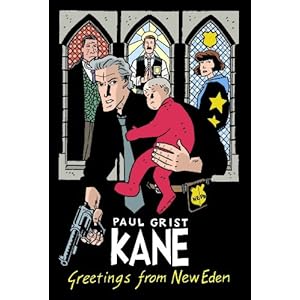
Kane: Greetings from New Eden

What I try to do with reviews at this Bookshelf blog is keep it simple and spoiler-free, and let you know whether I'd recommend you pick up a copy of what I just read. Seems to work okay. This time, a brief review of Kane: Greetings from New Eden (Image, 2004)


Paul Grist's police procedural Kane has been one of those books that I've told myself repeatedly to sample, but I never got around to trying it until this summer. The good folk at the suburban Titan Games & Comics marked a box of trades and graphic novels down to 75% off at one of their locations a couple of months ago, and so I stopped in and found this.

Kane is a loner detective in a big town called New Eden. Wikipedia tells me nothing that I couldn't glean from the issues here, that Kane has rejoined the force after a lengthy suspension and some unpleasantness with his former partner. He's a reckless, incredibly effective cop whom nobody with a badge wants to trust anymore. Conceptually, there's little of note here.

Honestly, Grist has done much, much better work since these chapters, which I believe were originally published in the late 1990s. I quite like his series Jack Staff, which is an homage to classic British adventure comics, and Kane features many of the same storytelling quirks, such as starting a new scene by way of a dramatic, portrait-and-caption introduction to the characters within it. Something about that bag of tricks just doesn't work as well for me here. Grist made the same mistake that many newly-published writer/artists stumble in their early work (guilty as charged, myself) and assumes that the reader can follow similarly-drawn characters into and out of scenes and flashbacks without using captions to guide the flow.

There are also far too many characters, honestly, for something with such a similar-looking cast presented in monochrome. Somebody like Gene Ha could certainly manage a Hill Street Blues-sized cast of cops in his Alan Moore collaboration Top 10, but working in color with radically different character designs. Here, with all the males looking almost exactly the same and the lone character with a distinctive wardrobe the only female, I found it unpleasantly difficult to follow. Four issues were reprinted in this book, and I genuinely couldn't tell you what happens in the second and the third, because I couldn't tell the difference between the mayor, the detectives or the guy who was sometimes wearing a bunny suit. Sadly, not recommended.

Monday, August 9, 2010

Slaine: Demon Killer

What I try to do with reviews at this Bookshelf blog is keep it simple and spoiler-free, and let you know whether I'd recommend you pick up a copy of what I just read. Seems to work okay. This time, a brief review of Slaine: Demon Killer (Rebellion, 2010)


With their fifth volume in the collected adventures of Slaine, Rebellion has entered the long-running strip's somewhat questionable period. There's usually something worth looking at in the series, and happily, "Demon Killer" and its assorted stories have aged much better than I remember them. It helps that Pat Mills' scripts were tackled by some tremendously good artists, but this is still the period where the rot began, and it's hard to approach them without knowing that subsequent episodes would be notably poorer.

The previous four volumes saw Slaine as a wandering hero, returning to his tribe in time to become its leader, and unite all of the Celtic tribes as their High King in opposition to an army of demons and beasts. The fourth book, "The Horned God," could well have been an excellent finale, but Mills found many more stories to tell and Slaine returned after about two years' break.

In "Demon Killer," a storyline painted by Glenn Fabry (42 pages) and by Dermot Power (54), Slaine reaches the end of his seven-year reign as High King and is ceremonially put to death, only to have the Earth's goddess Danu resurrect him for a mission in her land's future, defending Britain from Roman invaders. The story's peppered with very memorable moments, most stunningly its bleak tone towards the end when Slaine realizes he has underestimated the sort of atrocities that Romans would be willing to exact upon the native Britons.

The artwork is gorgeous, and the story in which Slaine and his wife Niamh are forced to find some compromise in their squabbling marriage by being tied to a tree is really funny. Best of all is a terrific scene in which Slaine first arrives in Roman-occupied Britain and is racking up a body count within sixty seconds.

All in all, it's quite a good package of twenty episodes, plus some pin-ups and a very neat bonus: a David Lloyd-illustrated role-playing game strip from the pages of Diceman. Sadly, the reprint of this game is missing a page, making it a little difficult to play, but I think of it as just a bonus and not essential. That's a good way to think of the book, really. It's good, but not outstanding, and the series' new time-traveling format really robbed Slaine of its charm. Recommended for completists, only.

Sunday, August 8, 2010

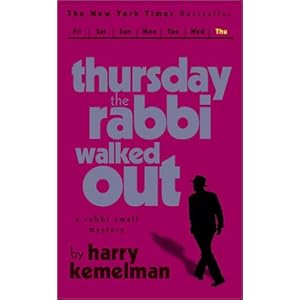
Thursday the Rabbi Walked Out

What I try to do with reviews at this Bookshelf blog is keep it simple and spoiler-free, and let you know whether I'd recommend you pick up a copy of what I just read. Seems to work okay. This time, a brief review of Thursday the Rabbi Walked Out (William Morrow & Co, 1978)


After seven books, I think that Kemelman could well have retired Rabbi David Small, and Thursday the Rabbi Walked Out has the feel of something working towards a conclusion. As it turned out, the author would write another four or five stories after this one, but the always entertaining Temple politics and arguments get pretty crazy this time out, and the question of whether David will still have a job at the end of the book - usually a foregone conclusion - is just as critical as who murdered the town miser, a grouchy anti-Semite who will be mourned by nobody.

I enjoyed this story as much as the first in the series, and despite a pile of hiding-in-plain-sight clues, had no idea who was behind the killing. I honestly don't know that a crime like this would fool an investigator from TV's CSI for a second, however. After I thought about it for a while, I found myself starting to question whether the faked evidence would have fooled the police even in a small, sleepy town in the mid-seventies. Either police methods have improved massively over the years, or the real cops in the seventies were content to let the decade's quirky detectives take all the glory in order to surprise real killers with the knowledge that actually, quirky TV detectives really aren't necessary when they have evidence teams who can see right through these carefully-orchestrated killings. It's the same way that there are at least three episodes of the original run of Columbo in which suspension of belief is similarly damaged by knowing that all the fun cat-and-mouse would have, in the real world, been busted by simple crime scene evidence.

Taken on its own terms, the story remains very fun, and I love the way that Kemelman is able to reflect the business of the Temple into the action, leaving Rabbi Small juggling so many different things. His inflexible position on matters related to Judaism sometimes seems a little baffling to me. I'm really uncertain why he refuses to perform Bar Mitzvah for an elderly man who was unable to have the ceremony at age thirteen. Saying that the ceremony is irrelevant, that the man is Bar Mitzvah regardless, makes sense, but is it that big a deal to him? Well, it's not like I've got any training in Talmudic reasoning. I'll take his word on it. Recommended.

Friday, August 6, 2010

Gone Pogo

What I try to do with reviews at this Bookshelf blog is keep it simple and spoiler-free, and let you know whether I'd recommend you pick up a copy of what I just read. Seems to work okay. This time, a brief review of Gone Pogo (Simon & Schuster, 1961)


Now that Fantagraphics has finally announced the release of the first in their series of Pogo collections - would you believe it's said to be out next month? - I think my fellow hobbyists are about to have an autumn full of tributes to Walt Kelly's old strip. I'm curious to read it from the beginning, and get to know the characters better. I imagine that in 1961, when this collection was published, they were a bit more well-known among the public. To be honest - and I know that sounding wishy-washy about Kelly doesn't get you much agreement - not knowing who the heck these characters are helped to make Gone Pogo a surprising chore to read.

The price of these classic editions varies pretty wildly. I've always wanted to read Pogo, but I've turned down $20 and $40 copies of this collection. Clicking the image above takes you to Stuart Ng Books, whom I recommend very highly, and they have two copies priced at $30 and $60. I found this copy in terrific shape for only $13 at Bookman Bookwoman in Nashville. I'm honestly, however, more impressed by the find and the uniqueness of the book than its contents.

On the one hand, it's a fascinating look at how comic strip collections used to be handled. Kelly apparently is quite notorious for the way he would juggle strips and rearrange panels when these books were compiled. A strip, for example, would often be four panels wide in newspapers, but only three in the book, with the fourth moved down to a second tier, followed by a spot illustration and then the first panel of the next four. I was really distracted by it. You know when you go to a show and spot somebody taping it, you're taken out of the moment and can't concentrate on the performance because you're curious how it will look on their bootleg? It was like that; the production was so curious that I found myself not reading the comic, but grouping panels and questioning the production. At one point, I came out of a trance and realized I had no idea what I had been reading for the last ten minutes.

Rereading it, I was oddly disappointed because I didn't know who any of the characters were. Most of them, I can't name. I'm sure that Kelly's legion of fans can tell you the cast in their sleep, just like my kids know everybody who made a one-panel cameo in Fox Trot. A huge number of characters make their way through this narrative, most amusingly a pair of bickering communist crows, but I didn't get to know any of them, and I'm pretty sure this bespectacled owl is never named in the book. Can you imagine reading an old Fawcett Crest Peanuts paperback from the decade and wondering what that bossy dark-haired girl is called? It's that weird.

In addition to the truncated and rearranged strips, there's plenty of additional material that makes this a very fun curiosity, and I can see how these books will remain in demand even once the complete archive becomes available. There's music and lyrics for a song called "Deck us All with Boston Charlie" and a long-form ten-page strip called "A Visit from St. Nicholas (to the Moon)" along with an illustrated text story called "Way Out in the Land of the Calabash." Each chapter - there are 21 - is preceded by its own little verse and the back cover's amusingly clever as well, using old-fashioned traveling showman-styled script to announce the book's content.

It's definitely a book that Kelly aficionados will enjoy more than newcomers. Honestly, I think that I will get more out of Fantagraphics' treatment of the property than Kelly's own efforts. I certainly wasn't expecting to have my enjoyment of the art obscured by the production, but I imagine that in 1961, this would have been a much-beloved gift for families, and that kids familiar with the characters would have left most copies of this book beat up and in tatters, much the way my kids' Fox Trot collections have been read to death. Reckon it was worth $13 to find a good condition survivor.

Tuesday, August 3, 2010

Showcase Presents: Dial H for Hero

What I try to do with reviews at this Bookshelf blog is keep it simple and spoiler-free, and let you know whether I'd recommend you pick up a copy of what I just read. Seems to work okay. This time, a brief review of Showcase Presents: Dial H for Hero (DC, 2010)


Here's a book that I was not intending to buy. The old funnybook budget's been a little tighter lately, plus I decided in May to quit spending money on books and music unless I knew full well that I was going to love and revisit them. (It's high time I got an occasional comp copy to review, don't you think?) So, since I had not read Dial H for Hero, I did not order this recent collection. Then I took a pile of old textbooks to Once & Again and found a copy of this for four bucks. This will be going back to Once & Again this week.

One of my favorite fun comic book websites is Dial B for Blog, a tribute to books from the 1950s through the 1970s that was in equal parts witty, well researched and lavishly illustrated. Its owner, "Robby Reed," wrapped up the blog after 500 fun entries, but it remains online for everybody to enjoy. You should check it out, pronto.

I mention this because inspiring that blog was the only good thing that Dial H for Hero ever did. This was an incredibly dopey comic that started in 1966 in the pages of DC's horror book House of Mystery, an example of DC rushing out more superhero books in the wake of Batman's TV success. It was written by Dave Wood and illustrated, competently but without enthusiasm, by Jim Mooney.

I've got a lot of patience for silly old comics, but this thing really is past me. Conceptually, it's an okay Silver Age concept. Some brainiac kid finds an ancient dial, translates it, and when he uses it, he transforms into one of several different spandex-clad superheroes. Each sixteen-page story usually finds room for three new heroes to foil the latest outlandish and implausible supervillain scheme. These are the sort of things where some baddie must spend millions of dollars buying submarines and giant robots and hiring a dozen black-clad hoodlums to rob the Littleville minor league ballpark of its gate receipts.

I could possibly enjoy the silly wish-fulfillment of its premise if it wasn't so incredibly stupid. Robby Reed himself is the first problem. Like TV's Joe 90, it's kind of difficult to root for some kid you'd rather bang against the floor for lunch money. He transforms into utterly retarded heroes, reaching, I think, a nadir with a toddler who runs around with a bottle that squirts shrinking juice. This is played straight. The heroes, each of whom pretends to be unique and not Robby's alter ego, are instantly treated with awe and respect by the police, who give them access to confidential files. Even the toddler. The high school boys of Littleville collect pin-ups of the battalion of do-gooders who show up in their town. Even the toddler. If you think about it, these pin-ups themselves are almost as improbable as the notion of high school boys in 1966 collecting pin-ups of anybody not named Deanna Lund or Donna Michelle. Oh, and Robby has a catchphrase which he finds a chance to shout at least seven times in each sixteen-page episode.

It's not just that it was hopelessly square and dated when it originally ran in 1966. Seriously, compare the simplistic plotlines and stilted fifties dialogue to what Lee and Kirby were doing at Marvel. (That's stilted sixties dialogue, man!) These are comics for very small, very unsophisticated children. If your six year-old has seen a single episode of that new Batman cartoon, he won't sit still for this. And as for Jim Mooney, well, I've seen some very good pages of his art over the years. Not one of them is present in this book, which is full of dull, uninspiring, bare-minimum designs and layouts, the sort of thing Curt Swan would have knocked off in his sleep. And I find Swan pretty dishwater dull myself.

I've mentioned before that DC has created a very welcome sub-line to their Showcase Presents series, giving shorter run series a new outing in 300-page books with a ten-buck price tag. I like the format, and I really, really liked that terrific Bat Lash collection that they chose to launch it last year, and I hate the possibility that airing complaints like this might impact potential sales, and see the sub-line shelved before we get to rare gems like Rose and the Thorn or Inferior 5. I guess DC must have a new Dial H for Hero series on the shelves or something to justify this book, because there's no other excuse for dusting this off when Sugar and Spike and The Monster Society of Evil are still in the vaults. Not at all recommended.
Monday, August 2, 2010

Bart Simpson # 54

What I try to do with reviews at this Bookshelf blog is keep it simple and spoiler-free, and let you know whether I'd recommend you pick up a copy of what I just read. Seems to work okay. This time, a brief review of Bart Simpson # 54 (Bongo, 2010)


Sad to say that we're coming to an end of the big stacks of Simpsons comics that have been teetering around this house for years; only medium-sized stacks await us in the future. I told my son to make some changes in the various subscriptions that I finance and to have his mother pick up some slack from stores in Louisville - she won't, of course - and so he has elected to scale back to just one monthly title from Bongo's line. The bimonthly Bart Simpson got the axe and so we picked up our last issue, for now, from Bizarro Wuxtry in Athens. Not that Louisville's lacking a good funnybook store - their Great Escape branch is terrific - but I don't think there's any way in hell we can get his mother to send money to Athens for Bart Simpson comics.

I think it's pretty bad timing on everybody's part. Not only has the Simpsons' publisher, Bongo, finally got a website up and running, but the Bart title has gotten stronger with each issue thanks to regular contributions from cartoonists and creators not normally seen on licensed properties. I was unfamiliar with Carol Lay and Peter Kuper despite extensive credits in comics, but they both contributed really funny stuff in Bart Simpson # 54. Kuper's story, in which a firecracker explosion leaves Bart deaf, mute, color blind and an easy target for the unscrupulous Mr. Burns, is a real scream.

I'm more familiar with Sergio Aragonés, of course, and he has his standard single page comic in each issue that's always worth seeing. Evan Dorkin, best known for Milk & Cheese and his never-published-frequently-enough Dork!, also has a few pages, and, oddly, the only thing that I didn't like about them is the lettering. Something had struck me as "off" about the pages, and when Dorkin mentioned on his blog last week that deadline doom had forced him to turn in a comic recently for somebody else to letter, that's when it clicked. This is a really funny little story, but the trademark Simpsons lettering, oddly, just doesn't do the mayhem justice.

I think Bongo's line is a no-brainer. Three bucks gets you some clever little comics packed with in-jokes and silliness suitable for everybody with a funny bone. Happily recommended.

Sunday, August 1, 2010

Friday the Rabbi Slept Late

What I try to do with reviews at this Bookshelf blog is keep it simple and spoiler-free, and let you know whether I'd recommend you pick up a copy of what I just read. Seems to work okay. This time, a brief review of Friday the Rabbi Slept Late (Fawcett, 1964)


I read the first of Harry Kemelman's series of novels about amateur sleuth Rabbi David Small after finishing four others in the series. I've really enjoyed reading them out of sequence, although I've had to force my system to allow me to do it that way. It's just not in my nature to read series out of order!

I really like the way that Kemelman started Friday the Rabbi Slept Late by establishing David as a character who simply isn't going to do what audiences will expect. He agrees to mediate a dispute about car damages between two members of his temple, and I would bet that almost every person reading this book would come to the same conclusion that I did as to who should pay for the repairs, but the character's fascinating use of logic and reasoning turns things completely on their heads. That's not the first time in this book that things don't go the way they're planned.

Interestingly, Barnard's Crossing's police chief Hugh Lanigan comes across as very much an equal character in this book, which is as much focused on him as the rabbi. They get to meet at cross purposes, as the rabbi is a suspect in a girl's death. I used to wonder whether NBC had screwed with the premise when they did their TV adaptation in the '70s and called it Lanigan's Rabbi, but they were really following the template of the original novel. While later books would use Lanigan as a supporting character, the first time out, the story's as much his as it is Small's.

I enjoy this series more with each one I read, and happily recommend them to anybody who likes detective fiction, on the understanding that they're probably more for the Columbo and Murder, She Wrote fans than any other school. Why the heck hasn't the USA Network started a new adaptation of these? There's no character they could welcome more than the rabbi!