Showing posts with label walter mosley. Show all posts

Friday, June 20, 2014

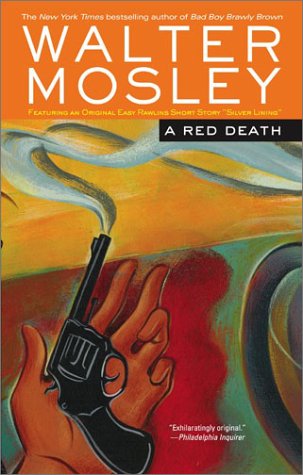
A Red Death

What I try to do with reviews at this Bookshelf blog is keep it simple and spoiler-free, and let you know whether I'd recommend you pick up a copy of what I just read. Seems to work okay. This time, a brief review of A Red Death (Thorndike, 1991).


Stepping back in time a bit, I've recently been rereading Walter Mosley's novels, and catching a few that I had missed previously. The second in the series is A Red Death, and it's set in 1953. Our hero, Easy Rawlins, has used the big payout from an earlier job to quietly buy a couple of apartment buildings off the books and avoid any scrutiny by keeping the ownership records very secret. He hires a manager and acts as that man's employee, spending his days doing janitor work in the buildings and just trying to stay off the radar and out of trouble.

Unfortunately for Easy, somebody leaks his ownership to the IRS, and a jerk of an agent wants to come down on him hard. Even more unfortunately, this puts him on the FBI's radar, as they could use a man on the ground to break up a union problem. Seems somebody's agitating labor at the aircraft plant where Easy used to work, somebody with possible communist leanings. The FBI agent suggests that he could make Easy's tax problems go away, but there's no guarantee he'll be rewarded for his off-the-book work. And even more unfortunately still, Easy's about to have troubles with his deeply violent friend Mouse, whose woman has come to town looking for Easy's company.

I've never read a book by Mosley that I didn't enjoy. I think that Easy is such a terrific character, and, while wincing, I love watching him always try to do the right thing but get shafted and stymied by the system, by people he trusts, by the city, and by the police. His troubles get worse when one of his tenants hangs herself and the cops seem, arbitrarily, to decide to treat it like a murder just to push Easy around - that's what you get for phoning in a body - and worse still when the trail of the leftist organizer takes Easy to a church, where more bodies get found. Happily recommended for anybody who enjoys hard-boiled detective fiction.

Monday, January 13, 2014

Little Green

What I try to do with reviews at this Bookshelf blog is keep it simple and spoiler-free, and let you know whether I'd recommend you pick up a copy of what I just read. Seems to work okay. This time, a brief review of Little Green (Doubleday, 2013).


It's not technically true that I had missed Easy Rawlins, because I had never really embraced the Los Angeles-based detective. I have read a few of Walter Mosley's novels that star the character, but never fell for them the way that I did some of the other writers in Mosley's school. I did myself a disservice; struggling through those last four or five turgid Lew Archer books on the strength of the earlier ones was a waste of time. I'd have done better to read more from a writer whose work was improving with each new book, instead of the other way around.

Like the police and various parties in Los Angeles in 1967, I had read, incorrectly, that Easy Rawlins was dead. Mosley ended the detective's previous adventure, published in 2007, with the character, despondent, plunging to his death in a car. Little Green, published in the spring of last year, is set two months later, during which time Easy has been slowly recuperating from a coma. His best friend, the violent and always-present Mouse, comes to him with a problem. An old family friend, eighteen year-old Evander - known as Little Green - has vanished. Entranced by the hippie scene on the Strip, he's met some free spirits and taken some bad acid and got into serious trouble.

When I last read a Rawlins story, the time was the late 1950s. This book is set in the aftermath of the Watts riots and the release of Surrealistic Pillow. There are flowers and acid and free love, and strange voodoo and crooked cops. It's a brilliant evocation of the time and place. I enjoyed it thoroughly, and think that I shall go read some passages again with Forever Changes playing on the hi-fi as I do, and then go back to pick up some of the many novels that I had, wrongly, skipped. Highly recommended.

Wednesday, November 2, 2011

Devil in a Blue Dress

What I try to do with reviews at this Bookshelf blog is keep it simple and spoiler-free, and let you know whether I'd recommend you pick up a copy of what I just read. Seems to work okay. This time, a brief review of Devil in a Blue Dress (Norton, 1990).


Publisher's Weekly, strangely, described Walter Mosley's debut novel as "jaunty." That is not at all the word I would use for Devil in a Blue Dress. Set in 1950, it is the first in a cycle of novels featuring Easy Rawlins, a veteran recently fired from his job at an airplane manufacturing plant. Needing money, he takes a commission to find a lady recently seen in the company of a gangster. If you know your Chandler, then trying to find people who don't want to be found, in the presence of people who don't want anybody to find them, invariably leaves violence and corpses as the story progresses.

Plotwise, there isn't anything new at all in this book. Even the sex scene, once a bruised and beaten Easy falls into the arms of his femme fatale, proceeds with a weary sense of inevitability. But what I had never seen before in earlier work in this genre is the strong characterization and sense of place. Mosley's ability to build a 1950 that audiences have rarely had chances to see - the poor black neighborhoods of postwar Los Angeles - is downright amazing. It's a world where the bigotry and secrecy are natural and uncompromising, and where nothing is really left buried.

Violence is just an expected ingredient in hard-boiled, or California-based, detective fiction, but the sheer brutality of this book is nevertheless eye-popping. DeWitt Albright, the man who hires Easy, is revealed early on to have a sadistic, cruel side that overpowers everything and leaves our hero very uncertain about continuing, but then we meet Mouse. Oh, man. Mouse is a violent former associate of Easy's who stays in Texas most of the time. Dropping him into the proceedings is like lobbing a grenade into a burning building. Yeah, the force of the explosion might blow out the nearest flames, but at one hell of a cost.

In the end, the book is most satisfying if the reader is watching how this events affect Easy. The heroes of Ross McDonald or Raymond Chandler novels are wired to handle these kinds of escalating messes of lies and emotion. Easy isn't. While the outcome of the plot is fairly obvious from about thirty pages in, the impact on his character is less certain. Readers will be confident that he'll make it out in one piece, but the cost might be a little higher, and a little more honest, than what earlier writers have doled out on their casts. Recommended.

Saturday, October 22, 2011

Always Outnumbered, Always Outgunned

What I try to do with reviews at this Bookshelf blog is keep it simple and spoiler-free, and let you know whether I'd recommend you pick up a copy of what I just read. Seems to work okay. This time, a brief review of Always Outnumbered, Always Outgunned (Norton, 1997).


I thought that I'd try a few things by Walter Mosley. I enjoyed his Black Betty some years ago and am looking forward to rereading it, and so I picked up a pair of his many other books. Always Outnumbered, Always Outgunned introduced a new character named Socrates Fortlow, who was played by Laurence Fishburne in a TV-movie adaptation of this set of short stories. Fortlow is a thoughtful but rage-filled ex-con who let his temper run away with him only once, at entirely the wrong time, and since his release, he's been eking out a tough existence in a two-room apartment in Watts.

While this is a collection of short stories, it's not a simple anthology. Each of these tales builds on the events of the previous story, and certainly reads as well as any deliberately-constructed novel. Fortlow is a fascinating character, and it's illuminating to see the directions that his wounded pride takes him. At one point, it gets him a needed job, but it also gets him in confrontations that really should have been avoided.

This was a very unpredictable and satisfying read, with moments where it gets really sad and touching. I think this goes a long way towards cementing Mosley's status as one of the most important authors of the last twenty years. Recommended.