Showing posts with label mike sekowsky. Show all posts

Monday, May 3, 2010

Showcase Presents: The Brave & The Bold - Batman Team-Ups Volume One

What I try to do with reviews at this Bookshelf blog is keep it simple and spoiler-free, and let you know whether I'd recommend you pick up a copy of what I just read. Seems to work okay. This time, a brief review of Showcase Presents: The Brave & The Bold - Batman Team-Ups Volume One (DC, 2007)


Well, this was a trial. DC has released three collections of the old team-up series The Brave & the Bold in their Showcase Presents format and I've read the first. This was a book that I enjoyed picking up from time to time throughout my youth, but the mid-to-late sixties material in this volume has dated terribly and was a slog to get through, despite some extremely good art which is worth a look.

The Brave & the Bold started life in the 1950s as an anthology book with various adventure stories, occasionally including superhero stories as those became more popular. Within a decade, it would usually feature a team-up between one of DC's popular marquee characters and one of their lesser-known properties. Batman was a frequent visitor to the book, and after the character's TV series became a hit on ABC, the comic was given over to him entirely, to con kids watching Adam West that they needed to read this as well.

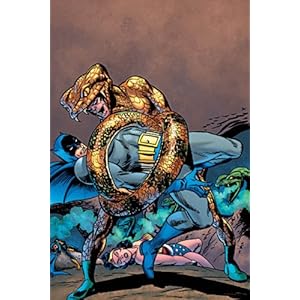
The book was written by Bob Haney without any regard to continuity, common sense, logic or anything you might hope to hold a story together. Many of the stories are agreeably weird and wild, but some are just plain dopey from the outset. One baffling example from 1967 shows Bruce Wayne teaming up with Sgt. Rock in wartorn France and meeting again in "the present," neither having visibly aged a day. Another teams the hero with the wacky Metamorpho to fight the popular TV villains Joker, Riddler and Penguin, and also deal with a strange chemical that turns the Dark Knight Detective into a giggling, bloated "Bat-Hulk." I don't think Haney watched that TV series very much. And then there's the story pictured on the cover, where Batgirl and Wonder Woman pretend to fall in love with Batman in an extremely convoluted scheme to convince the evil Copperhead that the hero's off his game, only it starts to backfire when the ladies really do fall for him. That one's worth reading just to experience the feeling of your eyebrows raising past your hairline.

The quality of the artwork varies greatly throughout. Most of the book's second half is drawn by Neal Adams, and it's just terrific. Adams was starting about a decade of exciting, dramatic work with wild panel layouts and a really unique presentation when he got this gig, and it's certainly worth looking at his early material. Unfortunately, the book's first half is nowhere near as visually engaging. Some of it is pretty good; I always like looking at Ross Andru, especially inked by Mike Esposito, and Carmine Infantino was always reliable in the sixties, but much of it is drawn by the likes of George Papp, Mike Sekowsky and Jack Abel, and is uniformly dreary and unimaginative, grounded in the corporation's stodgy 1950s house presentation.

The thing is, Bob Haney's highwire, high-concept scripts really demand an artist who will throw caution to the wind and come up with something completely unique. The Neal Adams material works to an interesting degree; the rest of the book looks like the reason people started the cry of "Make Mine Marvel!" Not without its charms, but not really recommended either.

Friday, April 17, 2009

Showcase Presents Justice League of America Volume Four

Here's how this works. I read a book or two and tell you about them and try not to get too long-winded. This time, a review of Showcase Presents Justice League of America volume four (DC, 2009).


When I was a kid, devouring whatever comics I could find, Justice League of America was my favorite book, and I've learned that those 1970s adventures hold up surprisingly well. However, getting to those heady days of the book's best run was occasionally quite a chore, as this run of Showcase Presents collections has shown. The title spent most of the sixties being as tedious as superhero funnybooks can get, with the usual team of Gardner Fox, Mike Sekowsky and Sid Greene turning out increasingly weird, convoluted, hard-to-follow plots starring a bunch of identikit circus strongmen. The stories were baffling and the art was boring. I found myself flipping through most of the third Showcase collection without really reading any of it.

Mercifully, the fourth volume in this series, covering the book's 1968-70 run, is when it finally gets good. It starts with the final few stories from this team, showing just how ridiculous and ugly this book had been. The first of these was covered in hilarious detail by J. Caleb Mozzocco over at his Every Day is Like Wednesday blog earlier this month. You should go check out that review to see what I'm talking about, then pop back here.

After a few of these nutball comics, Fox is replaced as writer by Denny O'Neil, who chose to emphasize character over plot, and this, finally, is the beginning of the JLA I fondly remember as a boy. Fox's League was a gang of clones and any panel's thought balloon could be attached to any character's head; O'Neil, who was writing Green Arrow's solo adventures at the time and turning him into the strident liberal loudmouth we all know and love, starts with the character's differences and lets their personality clashes fuel the drama.

The other huge, long overdue, change is with the art. Sekowsky is replaced as penciller by Dick Dillin. The change isn't instantly evident, because Sid Greene's inks still overpower what the penciller wants to do. Greene isn't a good match for Dillin - he uses two lines, heavy or light, when Dillin's art screams out for someone who can bring all the tricks he wants to life. However, Dillin's layouts are more interesting, and the characters no longer have that barrel-chested torso that Sekowsky used for the whole cast. When Greene is replaced by Joe Giella, the book finally looks as good as it should, with vibrant artwork that just sings off the page. A few years later, Frank McLaughlin would become Dillin's principal inker, and it was their work that thrilled me so much when I was a kid, but Giella's just about as good.

So in the 500 pages you get in this book, you'll see about 100 pages of the original team, about 200 of the transitional period, and about 200 very solid, very entertaining pages of superhero/sci-fi fun. I can't recommend this as strongly as I could the eventual next volume in the series, which will be essential, but if you enjoy superhero comics, this is certainly worth checking out.