Showing posts with label liane moriarty. Show all posts

Tuesday, October 22, 2013

The Husband's Secret

What I try to do with reviews at this Bookshelf blog is keep it simple and spoiler-free, and let you know whether I'd recommend you pick up a copy of what I just read. Seems to work okay. This time, a brief review of The Husband's Secret (Putnam, 2013).


Last month, I explained how I started to read a featured review in Entertainment Weekly, had a brainstorm, and decided to order the book without finishing the review, and picked up another of the author's titles while I waited. The author was Liane Moriarty, and while I have to say that I enjoyed her previous novel, What Alice Forgot, a little more, this year's The Husband's Secret was still quite entertaining and a much meaner read than I had been expecting.

To be fair, Moriarty does contrive a whole passel of coincidences to put all the players in this drama together in Sydney at the same time and then keep things moving. As such, the fairly obvious nature of the husband's secret - revealed in a letter written many years ago and hidden in the family attic - is pretty predictable from all of the clues and people around the characters. I found myself hoping that there would be a great twist in this, but instead the revelation hits the players like an iceberg, a little more than a third of the way through the book.

Things proceed with an entertaining, if curious inevitability from there, as though the central horror that brought so many of these people together - the unsolved murder of a teenager in the mid-1980s - had never been spoken of before all three splintered families and their children and grandchildren have been assembled in the attendance of a suburban Catholic school. While the character study is very entertaining, I fear that the book's climax, while at last containing a quite remarkable plot twist, really is contrived beyond belief. It requires the aging mother of the dead girl, now in her sixties, to just happen to stumble upon an old VHS tape with some footage of her daughter on the last week of her life, driving her decades-long belief in one man's guilt into what's, for her if not the police, indisputable proof. I don't doubt that this would have happened, but for it to happen within a couple of days of all this other thunderous drama really is pushing credibility.

The book is severely flawed, in other words, but it's almost completely redeemed by a daring, knife-twisting epilogue. I was already pleased by the stunning climactic plot twist and the downbeat aftermath of that, but reading the omniscient narration that caps the story and provides hints at what the characters never knew was almost gleefully mean-spirited. I do have some reservations about recommending it since it's certain to push the limits of your suspension of disbelief, but when it's good, it's criminally good.

Monday, September 16, 2013

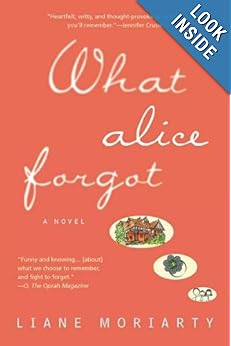
What Alice Forgot

What I try to do with reviews at this Bookshelf blog is keep it simple and spoiler-free, and let you know whether I'd recommend you pick up a copy of what I just read. Seems to work okay. This time, a brief review of What Alice Forgot (MacMillan, 2009).


I decided to try out some more contemporary fiction, and picked what you might think is an eccentric way to select some. I decided that, with each novel that got the big feature in each issue of Entertainment Weekly, I would join the library's queue for that book and also see whether any other novels by the same author might be available. So in the case of Australian author Liane Moriarty, at some point in late October I might get a new novel that I know little about, beyond briefly scanning a review long enough to conclude "yeah, sure," and that I am familiar with one earlier book by that writer, about which I knew nothing whatever.

I don't like spoilers at all, and don't read blurbs or reviews or even a hint of what I'll find if at all possible. With What Alice Forgot, I stumbled into a situation where it looked as though the protagonist of the piece was losing her memory of a happy vacation while suffering from a bad injury and, horrifically, learning that she must have lost her child, as there was no fetal heartbeat. Thrust into the same very unhappy water as Alice, it looked like she was losing her baby and her memories at the same time.

Ah, but what was really happening was even more frightening. The baby was just fine; in fact, she's ten years old now. The vacation memory, fading by the second, is just about the only thing from the last decade that she remembers at all. What Alice has forgotten is an entire ten years of her life, but what's more stunning is that what Alice has forgotten is that over those last ten years, she has become a horrible person.

There's a subplot about Alice's aunt that never really went anywhere, but otherwise, this was a really entertaining and unpredictable story. Some of Alice's lost past is so controversial among her family that they're loathe to tell her details, forcing both the reader and the hero to put her story back together again, and make mistakes - occasionally amusing ones - along the way. I found this a real pleasure to read, with breezy, clear prose, and happily recommend it.

(Check back on Thursday for a post about another novel I knew nothing of before I opened the cover!)