Showing posts with label food. Show all posts

Friday, April 8, 2016

The One True Barbecue

What I try to do with reviews at this Bookshelf blog is keep it simple and spoiler-free, and let you know whether I'd recommend you pick up a copy of what I just read. Seems to work okay. This time, a brief review of The One True Barbecue: Fire, Smoke, and the Pitmasters Who Cook the Whole Hog (Touchstone, 2016).


Some of you may know that my wife and I have been writing a travel and food blog called Marie, Let's Eat! regularly since 2010. It gets updated a whole lot more frequently than this one, anyway. We don't do "restaurant reviews" in it, we just share stories of our experiences eating in wonderful places, and one thing that I enjoy doing is looking around for other blog posts about the restaurant we've just featured, and maybe send a little traffic in the direction of some blog posts so that our readers may get additional information and see more photos about the place.

In 2014, I visited a really good, and really popular place in Shelby NC called Red Bridges Barbecue Lodge, and I think that's when I discovered a great blog called The Barbecue Bus, written by Rien Fertel and illustrated with some downright stunning photography by Denny Culbert. The pictures are such a sore point with me. I have been able to persuade myself that my writing is not awful, and in fact it's occasionally pretty good, but nothing makes me more envious than somebody with better photographic equipment, training, and talent than me. Culbert's photos for their story on Red Bridges led me to read all of the short-lived blog - it covers tours through North Carolina in 2011-2012 - and I found myself triply envious. I wish I could shoot as well as Culbert, I wish I could write as well as Fertel, and I wish somebody'd sponsor me to spend a month or ten on the road doing their jobs.

Fertel's particular passion is whole hog cooking, which is typically associated with eastern North Carolina. As I've come to learn, that doesn't mean "the eastern half of the state," it means the region east of I-95 and north of Fayetteville. It's farmland, chiefly, with a few small cities, a big USAF base, and lots of old one-horse towns. In most of the south, barbecue places will typically smoke pork shoulders, but in this region, the whole hog is used, smoked low and slow, and served with a lightly-seasoned vinegar dip.

It's not specifically limited to this area. Fertel's new book The One True Barbecue - part travelogue and part memoir, very much a first-person narrative - introduced me to some other places and regions where whole hog cooking can still be found, such as Scott's-Parker's Barbecue in Lexington TN. It discusses the curious contradiction of whole hog over wood in an outdoor pit slowly losing out to less expensive ways of cooking, while at the same time younger enthusiasts and entrepreneurs in cities like Asheville NC and Nolensville TN have revived the form and made it trendy.

I like it when a book makes me rethink a position. I had read Fertel's blog post about Grady's BBQ in the middle of nowhere - sort of around Dudley NC - along with Dan Levine's especially rhapsodic story at his blog BBQ Jew, and concluded that I simply must have come on an off day, because the meal that I had here in 2014 was pretty good, but nothing like these fellows described. Here, Fertel goes into even more detail about Grady's technique and history, and the sad reality that the business will not live beyond its owners, who are getting on in years. It breaks my heart that I didn't really love my meal here, since Fertel loves the place so much. I am very hopeful that I can go back one Friday this coming October. My fingers are crossed.

It's just an incredibly well-written book that talks honestly about history and family, poverty and economics, race and difficulty. Fertel spends a lot of time with pitmasters and packs in the detail. There are some great stories here. You will absolutely want to take a barbecue road trip yourself with this book at your side. Even if you can't get to a whole hog place, this book will make for absolutely fine reading at any table that serves pork with any kind of sauce.

He also, sensibly, doesn't give himself the opportunity to piss me off like Robb Walsh did by dismissing Georgia. Nobody in this state seems to cook whole hog, so there's no reason for his travelogue to take him here. Our loss. Highly, highly recommended.

(Clicking the link in the image will take you to Amazon, where you can purchase the book. A copy of this book was provided by the publisher for the purpose of review. If you'd like to see your books (typically comics or detective fiction) featured here, send me an email.)

Tuesday, September 8, 2015

Domestic Chic

What I try to do with reviews at this Bookshelf blog is keep it simple and spoiler-free, and let you know whether I'd recommend you pick up a copy of what I just read. Seems to work okay. This time, a brief review of Domestic Chic (Waldorf, 2015).


I have grown to really enjoy reading cookbooks. I go through them slowly and deliberately, lingering over the photography and the lists of ingredients, marking the ones that seem the most amazing and appealing with post-it notes, and hoping, occasionally with a slight bite of the lip, that Marie will play with what she found for a Sunday dinner.

I didn't get that opportunity this time. We were invited to look over an advance copy of Domestic Chic by Kristin Sollenne, a chef and nutritionist, and Marie claimed the book first. She really liked the breezy, fun, keep-it-simple attitude that Sollenne advocates, and the book vanished for several days. When I next saw it, Marie had it propped up in the kitchen one Sunday evening, prepping what turned out to be a delicious dinner of Chicken Piccata. Click that link and you can read all about it over at our food and travel blog, Marie, Let's Eat!. But wait! What about my post-it notes?!

Sollenne has worked with the New York City Restaurant Group since 2008, and currently oversees a chain called Bocca Di Bacco that specializes in southern Italian cuisine, which has three locations in that city. She's written a remarkably readable cookbook that we're certain to use for many years to come. It's broken down by seasons, with many full menus throughout to help planners arrange their meals in full, rather than pairing individual dishes from different parts of the book. That's not to say anybody's obliged to follow the menus that she's created, but it certainly makes it easier for readers who wish to.

The chicken dish that Marie prepared was really tasty, and I'm looking forward to whatever she creates next. I see that she's marked a page with Mixed Stuffed Peppers. We'll be on the road this Sunday. Maybe next?

A copy of this book was provided by the publicist for the purpose of review. If you'd like to see your books (typically comics or detective fiction) featured here, send me an email.

Tuesday, May 19, 2015

The Fortune Cookie Chronicles

What I try to do with reviews at this Bookshelf blog is keep it simple and spoiler-free, and let you know whether I'd recommend you pick up a copy of what I just read. Seems to work okay. This time, a (VERY) brief review of The Fortune Cookie Chronicles (Twelve, 2006).


Several months ago, I wrote about Chop Suey, USA by Yong Chen, and found it dry and barely-penetrable, in that cold, academic way. Chen referenced a book by the unusually-named Jennifer 8. Lee called The Fortune Cookie Chronicles in his text, and I'm happy to report that her book is so much friendlier, more fun and readable, and anybody who has an interest in the development of American Chinese food really is sure to enjoy this.

I kind of hit a wall here. I mean, I try to dig a little deeper than two paragraphs when I write about something here, but this kind of stumped me, how best to explain to you good people how I felt about this fun story.

Basically, I learned so much by reading this. I even learned that Atlanta is home to the only kosher Chinese restaurant for 400 miles. We'll check that out for our food blog one day. It's a really neat and interesting story, tackling everything from smuggling to the Greyhound routes for itinerant cooks to all those little clear packets of soy sauce to the development of fortune cookies. It's just a terrific little read and absolutely ideal for anybody interested in the history of food. I loved it to pieces and recommend it happily.

Tuesday, March 31, 2015

Pure Pork Awesomeness

What I try to do with reviews at this Bookshelf blog is keep it simple and spoiler-free, and let you know whether I'd recommend you pick up a copy of what I just read. Seems to work okay. This time, a brief review of Pure Pork Awesomeness: Totally Cookable Recipes from Around the World (Andrews McMeel, 2015).


Chef Kevin Gillespie's PR team asked me whether I'd like to have a look at his new cookbook, which is all about what you can do with pork. Twist my arm, why don't you?

Gillespie, whose restaurant Gunshow is one of the most celebrated and popular in Atlanta, grew up here in Georgia, and I was pleasantly surprised to read that he learned a thing or two about how different parts of the pig are used in cooking when, as a teenager, he started asking questions of the staff at Fresh Air BBQ near Jackson. They use hams there rather than shoulders, which most barbecue joints in this state will smoke. There's a place near Hoschton called John's that also uses hams, but not a whole lot of other restaurants do this.

This cookbook, a follow-up to his 2012 debut, Fire in My Belly, is full of side stories like that which make the experience of reading it so much more fun than most cookbooks. He starts with about twenty pages discussing sustainability, the history of hog breeding, and the important distinctions between pastured and commodity pork. He never talks down to the reader; he makes a strong case for spending the extra money to eat better because the results simply taste a lot better. His tone throughout is approachable and friendly and full of great anecdotes. There's a really funny story from a restaurant where Gillespie had worked previously, Woodfire Grill, in which an older customer chews him out for taking his popular pork belly dish off the menu, and that's one of several great ones. Decades from now, when Gillespie retires, he's going to write a great memoir.

But the main draw for this will be the recipes and how interesting and / or simple they appear to be. And also the photography by Angie Mosier. I read most of this book one evening last week in Memphis, and the only reason that I didn't have to stop looking at her drool-worthy pictures and go eat something was that I'd visited four barbecue restaurants that day and had a fairly full meal at each of them. This is some of the best food photography I've ever seen. Speaking with the authority of somebody who is responsible for some of the worst food photography available online, I was remarkably impressed by this.

But ANYWAY, the recipes. I love Gillespie's encouraging attitude and his inclusion of "worth knowing" tips to make food preparation even easier. Some of these sound terrific: his "really good" Cuban and ham sandwiches that could even be assembled by a bumbler like me, the pork minute steaks with potato pancakes and pumpkin butter that I hope we'll have for supper one evening just as soon as we buy a nice, heavy skillet for them, pork vindaloo, tacos al pastor... no, I wasn't hungry when I read the book, but, foolishly, I waited until now to write this story, and I'm not meeting a friend for lunch for another three hours and forty minutes.

On a final note, because my God, I have to stop thinking about food, I am particularly pleased by Gillespie's recipe for Brunswick stew, which does NOT include potatoes. I am so tired of restaurants sticking those cheap extenders in the stew, especially when they then turn around and charge you extra for it because it's a "premium" side. I think I need to start carrying a copy of this book around with me, and when some barbecue joint serves me a bowl of stew with potatoes, pull it out and firmly tell them, "Page 218." Probably tap on the cover with a heavy, authoritative finger, too. Recommended before a meal, but not too many hours before it.

A copy of this book was provided by the PR company for the purpose of review. If you'd like to see your books (typically comics or detective fiction) featured here, send me an email.

Friday, August 8, 2014

Chop Suey, USA

What I try to do with reviews at this Bookshelf blog is keep it simple and spoiler-free, and let you know whether I'd recommend you pick up a copy of what I just read. Seems to work okay. This time, a brief review of Chop Suey, USA (Columbia University Press, 2014).


You know you're reading a book for academic types when this happens: the author, Yong Chen, who's an associate professor of history at the University of California - Irvine, makes a point that "the development of American Chinese food followed the trajectory of America's evolution as an empire." He then spends the next eight pages defining what the heck he means by "empire." Oh, settle in, readers, because sweet and sour chicken might be comfort food for some of you, but this won't be comfort reading for anybody.

Chop Suey, USA is a dry but fact-stuffed analysis of the socioeconomic rise of inexpensive food made for the masses, cooked with compromises for American tastes and shortcuts for ease of service. Food in Chinese restaurants was, in the days before McDonald's, the least expensive dining-out option, letting people in the early 20th Century have a taste of affordable cooking outside their homes on a regular basis.

So this is a denser read than something that would come with a Food Network logo on the front cover. It required me to reactivate long dormant parts of my brain, the ones that, once upon a time, wrote 65 dense, dense pages about Ezra Pound's embrace of fascism in Italy, to tackle any more than about seven pages of economic theory, class, history, and sociology without falling asleep. Those of you who are used to the academic need to explain and footnote absolutely everything for fear of some peer asking a question they had not already answered in meticulous detail - that's why academic texts are so damn dry, because the writers are anticipating scrutiny that the rest of us, particularly bloggers, don't suffer in quite the same way - will probably find this an interesting little jaunt over the last 150 years.

On the other hand, those of you who are interested in the history of Chinese-American cuisine in a slightly more offhand and anecdotal way will find this, frankly, a longwinded bore. See, for me, Chinese-American food was historically a reasonable compromise to enjoy with friends or family who liked it more than me. I knew that it was not "traditional" or "authentic," but never really knew what was until about the last eighteen months, when I started digging into the menus of some Chinese-owned restaurants along Buford Highway in northeast Atlanta that do not really advertise to Americans, or cater to them with sweet and sour sauce, orange goop, or MSG. I make a distinction between what I term suburban Golden-This-Happy-That joints and the more authentic ones, and I wondered whether that's really fair. This book leads me to think that I'm correct. Chapter 7 goes into this in great detail. Interestingly, chop suey itself has gradually fallen out of favor - I honestly don't think that I've ever had it - and kung pao chicken or shrimp is more frequently seen as the most popular Chinese-American takeout dish. Neither dish is generally known inside China.

Don't get me wrong - this is a good book and an enlightening one. The conclusion and the afterword, "Why Study Food?," are fascinating essays on their own, but I found myself craving a lighter touch, more anecdotes, and more studies of modern subcultures where authentic Chinese cooking may be available for locals to find, instead of pages and pages of old economic theories. Recommended, mildly, with a cup of coffee by your side.

Tuesday, October 8, 2013

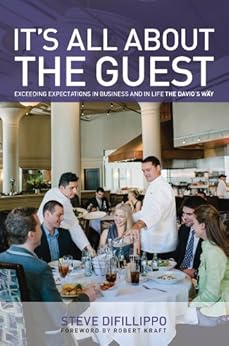
It's All About the Guest

What I try to do with reviews at this Bookshelf blog is keep it simple and spoiler-free, and let you know whether I'd recommend you pick up a copy of what I just read. Seems to work okay. This time, a brief review of It's All About the Guest (Lyons, 2013).

There's a restaurant here in Atlanta called The Vortex which is every bit as well-known for its amazing burgers as it is for its hilarious book of rules. This is a restaurant that flatly does not believe that the customer is always right, that this is their house and they'll do things their own way, and won't suffer fools at all. You, the customer, are perfectly able to be propelled through the same door that you entered. The owners have a less well-known sister restaurant, Bone Garden Cantina, where their similar rules are repeated on the menu. My parents took me there for a birthday once, and while my late father laughed all the way through the list, my mother was horrified by it. "Well, let me ask you this, Mom," I said. "Were we planning to camp at this table long after we'd paid the check, and stiff the server with a crummy tip?" She conceded that we certainly weren't, but it was just the very idea of a business owner putting in print what common etiquette has long suggested that got her aggravated.

I wonder what Steve DiFillippo of Davio's Northern Italian Steakhouse would make of The Vortex and Bone Garden Cantina's policy about the customer not necessarily being right. He's built a very successful chain of high-end restaurants and a packaged food line around the policy that both his customers and his employees should never be referred to as anything other than "guests." Davio's is a restaurant where the guest comes first, period. For him, it's a policy that has been working extremely well.

Davio's is one of those rare businesses that traces its history only as far back as the present ownership. In my other blog, Marie, Let's Eat!, which I co-write with my wife, we have a special fondness for very old restaurants. Ideally, these are passed down to family members, but often sold several times. Dub and Darlene Walters, the present owners of Twin Oaks Drive-In BBQ in Brunswick, Georgia, have only had the place a few years, but happily carry on a seventy-year tradition. DiFillippo bought Davio's in Boston, which was a popular place with staffing troubles which everybody knew had peaked, in the 1980s, and anything that happened before then was consigned to the file cabinet. The Davio's story effectively starts with his purchase of it, and the last couple of entertaining decades are covered in his new memoir, It's All About the Guest, newly released this month.

I'm not a high-maintenance guest, myself. I like to order food the way it's offered without special requests, and I like to have attentive service from people who know the company they're working for and can answer my questions. We lack the funds to be regular diners at Davio's - those advertisements on the sides of your screen when you read blogs? They're there for a reason, folks - but our limited experiences here have shown us that this is a restaurant that has got it right. Their Atlanta location is in a pretty soulless shopping mall one floor underneath an amusement park for kiddies, but the food is unbelievably good, the service just about the best around, and their general manager almost certainly the finest in the business. It's a terrific restaurant, and so I have been naturally curious to read DiFillippo's gloves-off account of how he's made it that way.

One thing that I appreciate is his honesty. DiFillippo has made some mistakes along the way, and put his trust where he shouldn't have, and suffered some losses. But they've been worth it because he has a really good team and a really good product, and his hands-on approach has clearly worked very well for him. His memoir is written in a breezy, fun style full of great anecdotes. Some of these will be familiar to people who've read his occasional columns at The Huffington Post. (Happily, the great one about the server who kept recommending veal parmesan, which has never been on any Davio's menu, is included.) And while very few of us have had the fortune or opportunity to run a business so large and so well-known that we find ourselves driving last-minute deliveries out to NFL stars like Tom Brady, anybody in the customer service industry can learn a lot from DiFillippo's suggestions and rules for running a business right and treating your guests with value and respect.

Honestly, we eat out a lot, and at a lot more different places than most people. Bad service, in our considerable experience (more than 900 different restaurants in four years) is really uncommon, so much so that it's memorable when you get it. Davio's strives for the other side, to have an experience so good that it stands out. The stories of this book might honestly not apply at every single restaurant - I can't imagine either The Vortex or another Atlanta institution, Ann's Snack Bar, having much use for it - but unless you're in that very small subset of businesses that find pleasure and profit in the infamy afforded by attitude, this is a book that you need to read. It's very fun and very enlightening, and just as soon as we've tried one or two of the Davio's recipes within, I'm going to lend it around my civilian identity workplace for my co-workers to read.

An advance copy of this book was provided by the publisher for the purpose of review. If you'd like to see your books (typically comics or detective fiction) featured here, send me an email.

Tuesday, July 9, 2013

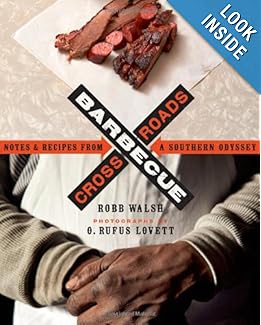
Barbecue Crossroads

What I try to do with reviews at this Bookshelf blog is keep it simple and spoiler-free, and let you know whether I'd recommend you pick up a copy of what I just read. Seems to work okay. This time, a brief review of Barbecue Crossroads (University of Texas Press, 2013).


There's a bit in this book where Robb Walsh, a Texas-based food writer who took several weeks driving across the southeast in the company of an amazing photographer, O. Rufus Lovett, eating barbecue and talking to chefs and pitmasters and the owners of very old restaurants, describes the sensation of being so aggravated with a clueless book that he threw it across multiple hotel rooms in several cities. Heh. Know the feeling.

140-odd pages into Barbecue Crossroads and I don't know when I've ever enjoyed a book about my hobby so much. Then I got to the chapter about Georgia barbecue. Now, y'all forgive me. It is difficult, in the printed word, to affect a pose of artificial outrage without seeming honestly aggrieved. I read the five pages - five - that Walsh deigned to bestow upon Georgia barbecue and was reminded of Arthur Dent looking up his home planet in the first edition of The Hitchhiker's Guide to the Galaxy and finding that its editors had granted it a single word: harmless. These five pages break down thusly: three pages about the very good Fresh Air Barbecue, which is between Jackson and Flovilla, half a page making the owner of Purvis Barbecue in Louisville look like a dingbat, and a page and a half singing the praises of parched peanuts. Sprinkled within them, a general dismissal of whatever other unnamed shacks he tried, and of Brunswick stew, which, done right, is simply the finest side dish that smoked pork can hope to have on offer, although he does kind of wish that he could have found a place in Georgia that still makes Brunswick stew with squirrel.

Now, you'll forgive my mixing genuine disagreement that our state was so slighted with wholly artificial outrage, but seriously? My regular Bookshelf readers might not know about it, but my wife and I write a food blog called Marie, Let's Eat!, and, if I do say so myself, we have done a fairly decent job covering barbecue within our immediate travel radius. We lack the funds to spend weeks on the road like Walsh and Lovett and envy their journey, but we do pretty well, and have, in the last three-plus years, visited and written about more than 220 barbecue restaurants, most of which are in Georgia. Even as Walsh claimed to have paced the floors of the house near Lake Lanier where they stayed, frustrated that he could not find a meal he enjoyed, my telephone did not ring. It feels, for all the world, like Walsh allowed his biases to keep him where he expected to find great stories (in Texas, Memphis, and North Carolina), and ushered him through the areas where he expected little to nothing. Speaking as someone who loves to learn and aspires to become ever better in the business of sharing the lives and the careers of people in the world of cooking and serving food, and also as someone who loves to champion the underrated wonder of the barbecue in this great state, this was 95% genuine and honest disappointment that Walsh done us so wrong, and 5% flippant fury that the jackass failed to reach out to somebody in this community's hobbyists and amateurs - if not us, then three or four others I could recommend - and break some bread with 'em before he gave up and took I-85 out of town.

And these five pages stink up the rest of the book so much for me that it's doubly disagreeable, because it's otherwise one hell of a read. There's just a hole in the middle of the book. He done us wrong, so wrong that it wounds the project almost fatally.

And it was doing so well. I acknowledge and greatly appreciate Walsh bringing up some very important points that, as a hobbyist and writer, I need to remember as I gallivant off on my little amateur expeditions. I've long been attempting to acknowledge my ethnocentrist bias, for example. There are little things, but serious things, that we can do as we write our reports and our chapters to not come across as privileged and smug. Just by reading the work of so many other hobbyists, I've become aware that there are language cues that we should all practice in our writing - excising the word "ethnic" in describing dishes or restaurants is a good start - but I was not prepared for the really fascinating chapter in which the dynamic duo visit the impoverished areas of the Mississippi and Arkansas deltas and click away at the poor folk. Walsh takes this opportunity to give a remarkable shotgun blast at Jane and Michael Stern of Roadfood.com .

I got as far as this section before I left on my most recent "circumnavigation," a two-day eating tour that I hope to take every eight months or so, during which I try to briefly visit 13-15 businesses, at least half of which have not been covered by other hobbyists or writers. (You can read about this most recent one starting here.) The section, in which Walsh and Lovett visit Craig's Barbecue in DeValls Bluff, Arkansas and find the locals not really interested in communicating with these fancy-pants food tourists, was very much on my mind, a reminder that I need to get to know the people whose stories I'm sharing. The Sterns, who visited this same establishment in 2004 on assignment for Gourmet, wrote it up with all the sensitivity of big-city toffs sharing slideshows of the carny geeks.

At the end of the first day of that tour, I spent about fifteen minutes just talking with two employees of Brooks Barbeque in Muscle Shoals, Alabama. When I got home and resumed the book, I saw that Walsh had also been by. (He also confirmed the name of the current owner as Marvin. The ladies there briefly debated whether his name was Marvin or Melvin, before concluding that it didn't really matter.) Anyway, even though I didn't know, then, that Walsh had visited, I reminded myself that I'm a guest, and a privileged one who uses advertising dollars from a website to fund my trips, and repay my readers with a Twitter check-in from a smartphone letting them know where I am. If I am a guest in somebody's place of business, I should always be respectful, and when I write about my visit, whether I'm visiting a low-income area of Memphis or a Chinese-owned kabob place in Doraville that serves ox penis on a stick, I need to not be that tour bus operator showin' off the "poor" and the "ethnic" to an audience of reasonably upscale suburbanites with a large entertainment budget. Walsh's experiences on the Delta are the strongest reminder of my responsibilities that I have read so far.

The other part of the book that I found tremendously important details the changing realities of the restaurant trade, and how many restaurant owners, cutting costs, have moved away from outdoor pits and into indoor burners, using electricity and gas and maybe just a chip or two of wood to do the job. I have done a very poor job getting these details for our work. I've done all right once in a while. I'm quite happy with the few minutes that I spent with Phil Beaubian at Hickory Pig in Gainesville, Georgia learning about his awesome outdoor pit, where he smokes "with hickory and oxygen," emphasizing the particular route that the heat takes up a U-bend to smoke his pork, and there have been many other instances of enjoying the details and the fine print about how my food was prepared. But I've been hasty and I've been in a hurry before, and I've left places with scattered words and notes and didn't really learn anything. I must try harder.

I've rambled enough. I'm in Walsh's debt for reminding me about elements where I can always improve. Were it not for the black hole in the book's center, I'd call it remarkable and insist that everybody in this hobby needs to read it and learn and work at doing a little better. But honestly, and haughtily, Walsh is also in this hobby and, where Georgia is concerned, he needs to do a little better, too. Very strongly recommended for all us food bloggers, but recommended with an eyebrow raised and maybe a lip silently bit.

Tuesday, February 19, 2013

The Truck Food Cookbook

What I try to do with reviews at this Bookshelf blog is keep it simple and spoiler-free, and let you know whether I'd recommend you pick up a copy of what I just read. Seems to work okay. This time, a brief review of The Truck Food Cookbook (Workman, 2012).

This is not a book that I would have wanted to read had anybody else written it. I really like John T. Edge's style a lot - his Southern Belly is absolutely essential reading for anybody in the southeast who shares our interest in travel and food - and envy his ability to go all around the nation meeting people and discovering new recipes. However, my favorite thing to do when reading books about restaurants, whether in buildings or on wheels, is to savor the possibilities of visiting them. And since food trucks are still blinking in the sunlight in Georgia, that's not so easy for us to do with our small travel budget.

The city of Atlanta cannot stand food trucks. It has spent years coming up with new regulations, bureaucracy, and red tape to prevent their emergence. Last year was the first time we were really able to enjoy them, when a gravel lot was opened up alongside I-75 at Howell Mill. So, over the course of last year, more than two dozen trucks started their engines, especially as some of the suburbs, like Smyrna and Alpharetta, invited owner/operators to come join them at set times on the calendar. There were at least two stupid and mammoth occasions when City Hall made attempts to stop these infernal hippies and beatniks from committing the crime of selling food and having fun, but you can start to hear the regulators grumbling that they done lost this fight. And after they'd had such success running all the hot dog carts outta town, too!

Meanwhile, of course, Portland, Los Angeles, Madison, New York, and other cities figured this out a decade or more back, and welcomed these entrepreneurs. The startup costs for a food truck are about 10% of the cost of a brick-and-mortar restaurant, so that encourages big dreamers without a lot of capital to get cooking and try their ideas out on the public. So this book is a celebration of food truck culture, full of stories and anecdotes and silliness and love. The bulk of it is a cookbook, with the stories appearing as sidebars throughout the pages.

It didn't take me long to shrug and accept that I wouldn't get the chance to visit many, or any, of these places, and just treated the book as a loving tribute to and a record of a growing and popular subculture. It was just huge fun to read, and it leaves me anticipating the spring, when we'll get to revisit some of our local favorites like Roux'd and the Blaxican and W.O.W. and the Mac and Cheese again. Mmmmm. Recommended.

Wednesday, September 8, 2010

Southern Belly: The Ultimate Food Lover's Companion to the South

What I try to do with reviews at this Bookshelf blog is keep it simple and spoiler-free, and let you know whether I'd recommend you pick up a copy of what I just read. Seems to work okay. This time, a brief review of Southern Belly: The Ultimate Food Lover's Companion to the South (revised edition, Algonquin, 2007)


Well, I finally finished this book after more than a year, but I assure you that I have not let it sit untouched over all that time. This was a wedding gift from our friends CB and Elizabeth, and it proved immediately useful; we took our epic honeymoon road trip six weeks after we got married and made it a point to stop into one of the restaurants spotlighted here, Southern Kitchen in the town of New Market, Virginia, on the way back.

John Edge's delightful book is, I'm certain, going to continue to prove very useful for years to come. It's one part guidebook to fiercely independent and unique restaurants across the south and one part social history, with little sections spotlighting everything from Brunswick stew to Krystal to Duke's mayonnaise.

There's a lot of room for quibbling in a book like this, which is part of the fun. For every inclusion that I approve ("Wintzell's in Mobile, Alabama! Damn right!"), there are omissions that are baffling. A book like this can't be comprehensive, but nor could it conceivably pretend to be. It's the story of some places across a great region, and as fun and sparklingly-written as it is, it can only be bettered by the many revised editions that readers craft themselves. I wonder when we can visit all these communities in coastal North Carolina, Marie? Terrific fun and highly recommended.