Monday, March 30, 2009

The Muppet Show Comic Book # 1

Here's how this works. I read a book or two and tell you about them and try not to get too long-winded. This time, a review of The Muppet Show Comic Book # 1 (Boom, 2009).


I love it when a title meets your expectations. I really like both the Muppets and Roger Langridge's excellent work, so this was a property made in heaven for me. This isn't some jerryrigged fairytale or adaptation bent to fit the Muppets, but rather a brand-new episode of the 1970s Muppet Show, just told in a comic book rather than on TV.

Langridge uses the format wonderfully, with goofy transitions from scene to scene and appropriate backstage chaos surrounding the main story while the onstage action (including "Pigs in Space," a visit to the Swedish Chef's kitchen and a report from the planet Koosbane) somehow manages to be pulled off without anybody dying.

If I had any complaints, it would be that it felt a little short to me, and that the evening's special guest stars - to reveal them in a review would spoil a good joke - got really short-changed. Then I figured that there were two musical numbers by the guests which the comic didn't have the rights to "broadcast," sort of like "You've Got a Friend in Me" on the season one DVDs, and felt better about it.

Langridge packs each page with gags and puns and silliness. His characterization is dead-on and you won't be able to read the Swedish chef's dialogue out loud with a straight face. My favorite part was, as usual, Statler and Waldorf. While Langridge would never come right out and say it and spoil the mystique, I think we're pretty sure the reason why they keep coming to the darn theatre is because they really just love giving that bear a hard time. Recommended for Langridge fans, Muppet fans and families.

Thursday, March 26, 2009

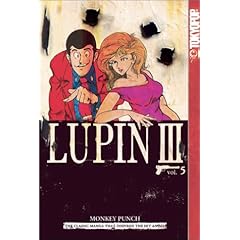
Lupin III volume five

Here's how this works. I read a book or two and tell you about them and try not to get too long-winded. This time, a review of Lupin III volume five (Tokyopop, 2003).


I can certainly understand why Monkey Punch's international super-crook Lupin III has been a successful media empire in Japan for the last forty years, with its annual cartoon TV movie and quarterly comic book release. The stories are very fun and loopy, some of those movies are terrific, and one of them, Castle of Cagliostro, belongs on anybody's list of all-time ten best animated films.

What I don't understand is why TMS and Toho ever decided to make these comics into the TV series that would become so successful, because these comics are terrible. When Tokyopop first released these in 2003, I decided I didn't like the artwork and passed on them. But as time has taught me to enjoy Punch's long, blotchy lines of ink - reminiscent, in its odd way, of Ronald Searle or Hank Ketcham - I reconsidered and picked up an inexpensive copy of volume five from a local shop's clearance table.

I couldn't follow it. Punch's storytelling is so loose and weird, and his characters move with body language and postures so similar, that I genuinely could not tell what was happening on the page or who the characters were, or where the stories were taking place. It's certainly different from anything I was expecting, and many things I've seen from its period (roughly 1968-69), but the in-at-the-deep-end pace and the nebulous conclusions to the stories made me unhappy because I couldn't follow them. My son, who urged me to buy the book, gave up after about three episodes, similarly baffled and bored. There was one episode about Lupin being forced at gunpoint into a strange woman's bed which was mildly amusing, but there were seven or eight head-scratching pages of confusion and disjointed action sequences before a plot that I could follow got started.

I'm assured that Punch's second series of Lupin III comics, which ran from 1977-1981 and are available under the English title World's Most Wanted, are considerably better and tell longer stories. Hopefully they're more coherent, and I might give those a try one day. The original batch, however, I don't recommend.

Monday, March 23, 2009

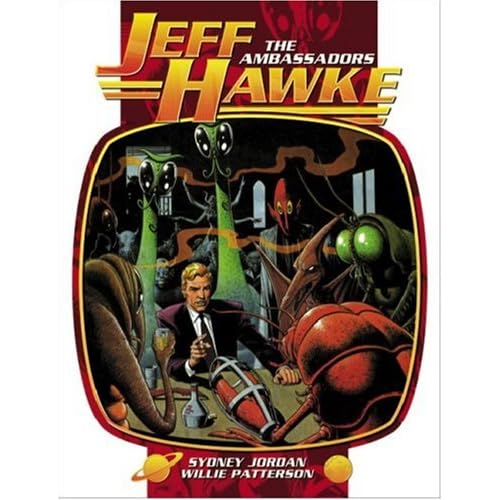
Jeff Hawke: The Ambassadors

Here's how this works. I read a book or two and tell you about them and try not to get too long-winded. This time, a review of Jeff Hawke: The Ambassadors (volume two) (Titan, 2008).


In the mid-1980s, when Titan was originally doing its lines of black-spined, 64-to-80 page collections of British comics, they released a pair of Jeff Hawke editions, each reprinting three serials. Hawke's original home was a comic strip in the Daily Express which ran for two decades. Titan didn't start from the beginning, but about six years into the run, when Willie Patterson took over writing chores from the strip's creator and artist Sydney Jordan. The two books featured cover artwork by Brian Bolland and were quite popular, but they never released a third volume.

Twenty years later, and with their other collected editions proving very successful, Titan went back to the well and has now upgraded those old paperbacks considerably as a pair of nice hardcover editions. The first book, which I reviewed briefly a year ago, reprinted the first four of the six serials which Titan had done in the 1980s. This book features the remaining two, along with a further three storylines not previously reprinted, and they include introductory pages and a complete "stripography" of all the character's storylines.

Honestly, I enjoyed the unpredictable and witty stories so much more than just about any other science fiction material available today. Hawke is a thoughtful diplomat, working with bemused curiosity at the latest strange "non-invasion" of Earth by some unusual aliens. The title story deals with some oddball ambassadors who are flabbergasted to learn that birds are not the dominant species on our planet, while another wonderful one features some tiny alien students wreaking havoc after they boost a scientist's intelligence and conceptual understanding of physics, only to have him retreat to a levitated Winnebago and try to blackmail the British government with a heat ray.

Patterson and Jordan's solutions to the very unusual challenges are reasoned and rational, with very little violence or wild action, leading to very entertaining stories with unexpected resolutions. Jordan's artwork is gorgeously detailed, with a believable and consistent design for the far-flung future of the 1990s.

I don't believe that Titan has announced plans for any further Jeff Hawke collections yet, but I hope they do. These are very intelligent, whimsical stories, and highly recommended for fans of British literary science fiction. If you've got Clarke, Kneale and Wyndham on your shelves already, you'll probably want Patterson and Jordan. More please, Titan!

Thursday, March 19, 2009

Mega-City Undercover


In other news, I ordered one of the recentish 2000 AD trade collections which Diamond should have sent to my shop in the spring of 2008. They didn't, and a reorder also fumbled, claiming that it was no longer available, so I finally broke down and ordered Mega-City Undercover from Amazon UK. It's a very good book, and I'm glad I finally own it, but it must be said that this is a peculiar little collection by Rebellion's standards. It's effectively the first volume of Rob Williams' Low Life, a Dreddworld series about a pair of undercover judges which began in 2004's prog 1387. However, the book actually begins with the five episodes of Lenny Zero, a similar series by Andy Diggle and Jock which first appeared in the Megazine in 2000-2002, and which was prematurely curtailed when the creators signed exclusive contracts with DC Comics.

Despite the nice attraction of having all of Lenny Zero's appearances in one place, it is certainly Low Life which is the selling point of the book. This has been one of the more successful of the recent semiregular series. At the time I'm writing this, the eighth Low Life story, "Creation," is currently running in the prog. The first six of them, totalling 29 episodes, appear in this book.

One thing that makes Low Life so interesting is that it's a "dual-lead" strip. Some of the stories focus on the passionate, liberal Judge Aimee Nixon, and others on the very deep-cover, hopelessly insane Dirty Frank, who somehow manages to work as an effective judge despite having lost his mind some years previously. Usually, the Nixon stories tend to take a more serious approach, while Dirty Frank's are played with a much lighter tone. The characters were created by Rob Williams and Henry Flint, who drew the first 13 episodes in the book. The remaining episodes were drawn by Simon Coleby and first appeared in 2005-07.

Since I'm just now finishing the year 2000 in my reread and would prefer to read these stories in their original context when I reach that period in a few months' time, I only gave the Mega-City Undercover book a brief scan to confirm the quality and contents. The reproduction is fantastic and it includes introductory pages by Diggle and Williams as well as a nice new cover by Jock. After an initial moment of eyebrow-furrowing over Rebellion's choice to use an umbrella approach to collect the stories, I decided I actually prefer this format to issuing a Low Life-only book. Certainly with only one new story a year, it will be some time before we ever see a second collection, but who knows, perhaps Diggle and Jock will return to Lenny Zero before too much longer and future tales of that ne'er-do-well can also be included.

(Excerpted from Thrillpowered Thursday, March 19 2009.)

Tuesday, March 17, 2009

Yotsuba&!, volume one

Here's how this works. I read a book or two and tell you about them and try not to get too long-winded. This time, a review of Yotsuba&! volume one (ADV Manga, 2005).


Yotsuba is a four year-old, green-haired ball of hyperkinetic energy. She and her dad have moved to a small town from parts unspecified, and here she's confounded by all the perplexing things in modern culture which her neighbors take for granted. Doorbells and air conditioners blow Yotsuba's mind, and even a swingset is completely alien to her. The neighbor girls may be baffled by the new little girl next door, but they're certain she can't be too much trouble... can she?

Yotsuba&! - the strange name comes from each episode's title, such as "Yotsuba & Moving" - is a giddily goofball family comedy which I bought after hearing a dozen strong recommendations. I gave it to my kids with only a single glimpse inside, and they've been roaring with laughter ever since. They've finished the next two volumes and are impatiently waiting for me to pick up more. It really is funny stuff; when Yotsuba smacks herself in the face with the swing, I laughed like a drain.

The Hipster Daughter is already insisting on some hair color and an appropriate shirt so she can cosplay as Yotsuba at this year's AWA. At ten, she's a little old for the part, but if Marie and I put our minds to it and decide to have a little girl, I'm thinking that kid's hair's gonna be green. Yes. (Then we'll keep it that way and she can either cosplay as Locke the Superman or Andromeda from Saint Seiya when she's a teen.)

ADV Manga released the first five collections of Yotsuba&! from 2005-2007 before suspending the series. Yen Press has since picked up the rights, and they'll be releasing two more this year and an eighth in 2010. Wholeheartedly recommended for anybody with kids; everybody in the house will get a good chuckle from it.

Monday, March 16, 2009

Captain America and the Falcon: Madbomb

Here's how this works. I read a book or two and tell you about them and try not to get too long-winded. This time, a review of Captain America and the Falcon: Madbomb (Marvel, 2004).


Written correctly, there's no superhero more fun than Captain America, who basically has the power to beat the heck out of everybody. His co-creator Jack Kirby understood this better than just about any other writer or artist, and when he returned to Marvel in 1975, following a five-year stint at DC, the company put him back to work on the book. At the time, the comic was struggling for an audience, despite some well-remembered work by Steve Englehart, and the character was sharing his title with a partner, the high-flying Harlem-based hero the Falcon, who brought some period relevancy to the narrative with some very unsubtle dialogue about race relations in the early seventies.

"Unsubtle" is a pretty accurate word for this stuff; bricks to the head have been delivered with more subtlety than Kirby's Crazy Cap Comix. This book reprints the first eight issues of his run, a lengthy story about an underground army of mercenaries led by (get this) 18th Century Tory loyalists, who are planning to detonate a bomb on America's bicentennial that will drive everybody in the country into a gibbering, violent lunatic. It's exactly what anybody would want in a Kirby Captain America comic: giant, bizarre machinery, garishly-costumed villains sneering at everybody, and the hero jumping into a mob of enemy henchmen and punching the daylights out of about nine at a time while choking another goon between his ankles and dodging a hail of bullets. If this book doesn't make you want to draw, then I don't know what to tell you.

Structurally, it is certainly a dated book, and the story feels awkward read in one sitting. Kirby did a great job making every issue understandable for any reader who'd never picked it up before, but in collected form, the characters' constant restating and re-explaining their positions does feel a little long-winded. This is perhaps not the best introduction to Kirby for somebody wanting to see what all the fuss is about, but for those who love him already, it's a terrific read.

(All of Kirby's material from the period is available in three collections. Each, eyebrow-raisingly, is pricier than the previous book, but I will probably be picking up the second, Bicentennial Battles, pretty soon.)

Thursday, March 12, 2009

Pluto volume one

Here's how this works. I read a book or two and tell you about them and try not to get too long-winded. This time, a review of Pluto volume one (Viz, 2009).


Well, here's a book that's so darn good, there's not a hat size to fit it. In this spectacular SF crime story by Naoki Urusawa, a Europol detective named Gesicht looks into the connection between the murder, in Dusseldorf, of a man campaigning to preserve the laws giving robots equal treatment under worldwide law, and the destruction of the beloved Mont Blanc, a powerful mechanoid who worked for the Swiss forestry service.

It's an expansion of a classic Astro Boy serial by Osamu Tezuka from the mid-1950s called "The Greatest Robot on Earth," only Urusawa, best known to American readers for his slow-burning thriller Monster, expands the narrative and shits the focus to other characters. It results in something incredibly compelling and very beautiful.

Pluto has run in monthly chunks in Japan's Big Comic Original since 2003, and apparently just concluded. From what I understand, Viz plans to follow the Japanese publishing model and collect this story in seven digests, the first five of which are planned for this year. I am completely sold and am getting the lot; Urusawa invokes dread and fear like nobody's business, and I'll be biting my lip until volume two shows up. Highly recommended.